

Psychometric Properties of the Climate Change Worry Scale
Open accessThe DOI matches its Crossref record; 79 of the 81 references it cites were found in a registry or an index.
Abstract
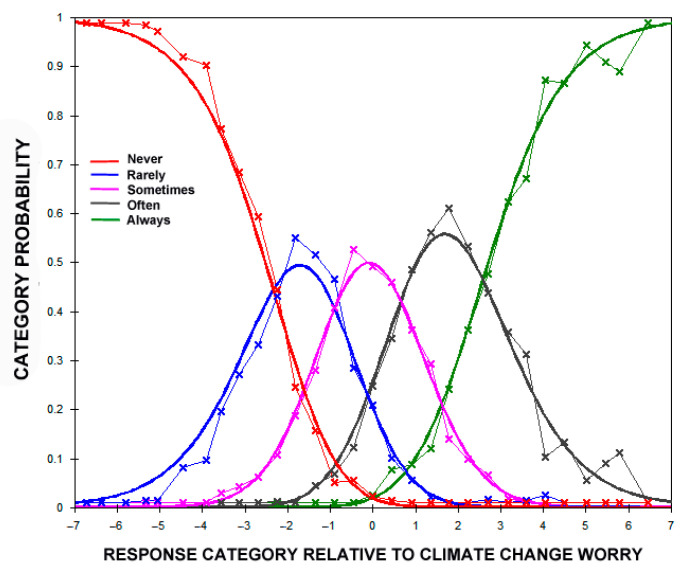
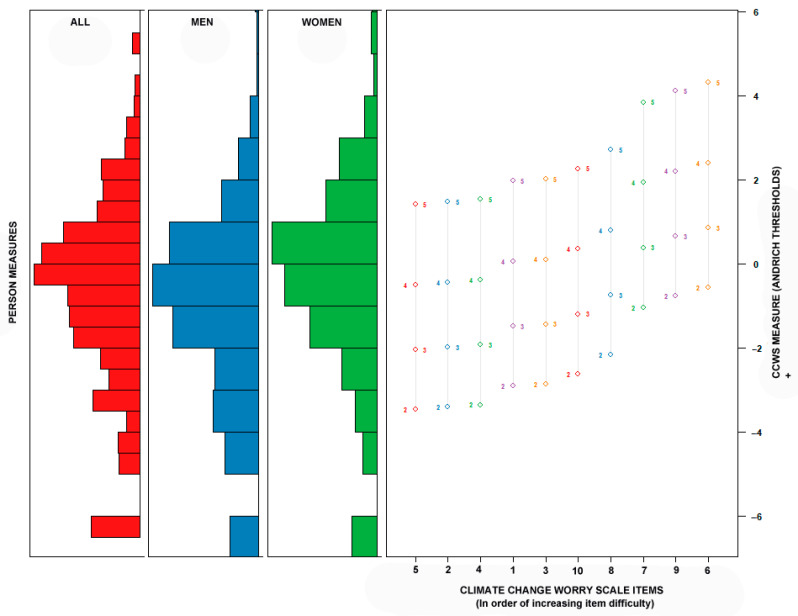
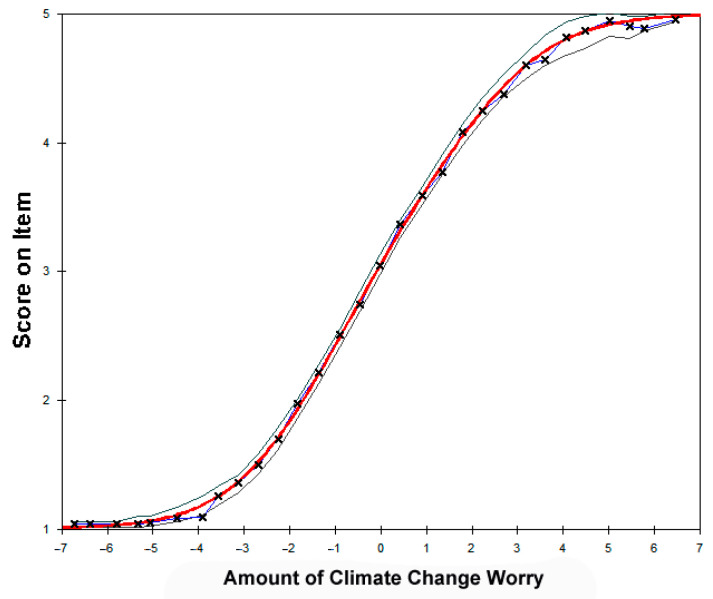
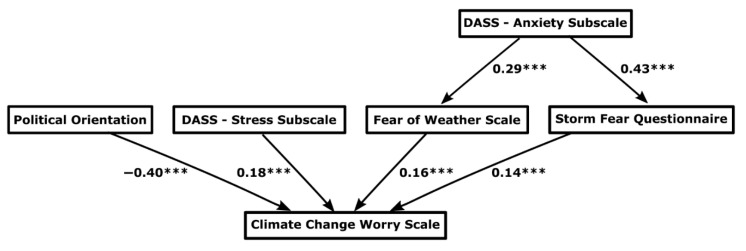
Climate change worry involves primarily verbal-linguistic thoughts about the changes that may occur in the climate system and the possible effects of these changes. Such worry is one of several possible psychological responses (e.g., fear, anxiety, depression, and trauma) to climate change. Within this article, the psychometric development of the ten-item Climate Change Worry Scale (CCWS) is detailed in three studies. The scale was developed to assess proximal worry about climate change rather than social or global impacts. Study 1 provided evidence that the CCWS items were internally consistent, constituted a single factor, and that the facture structure of the items was invariant for men and women. The results from Study 1 also indicated a good fit with a Rasch model of the items. Study 2 affirmed the internal consistency of the CCWS items and indicated that peoples’ responses to the measure were temporally stable over a two-week test–retest interval (r = 0.91). Study 3 provided support for the convergent and divergent validity of the CCWS through its pattern of correlations with several established clinical and weather-related measures. The limitations of the studies and the possible uses of the CCWS were discussed. The current work represents a starting point.
Overview
The claims and statistics of this paper haven’t been checked yet.
Free: it reads the open-access text and checks the first 5 claims that cite a source we can check. Create a free account to check every claim.
Integrity signals
Registry
Cites
Statistics
Figures
Verification
Claims the paper makes
The claims and statistics of this paper haven’t been checked yet.
Free: it reads the open-access text and checks the first 5 claims that cite a source we can check. Create a free account to check every claim.
Claims other papers make about this one
Each is checked against this paper’s own text: does it say what the citing paper says it does?
The source backs part of the claim, not all of it — or backs it for a different population, condition or comparison.
In the citing paper
“A further two studies showed eco-anxiety was not significant after adjustment for covariates [53, 63].”
From The relationship between climate change and mental health: a systematic review of the association between eco-anxiety, psychological distress, and symptoms of major affective disorders (2024) · cites this paper as [63]
Experimental — accuracy not yet measuredThe source backs part of the claim, not all of it — or backs it for a different population, condition or comparison.
In the citing paper
“Nine studies, all utilising the DASS-21, reported significant small-to-moderate (r = .22 to 0.46) positive correlations between eco-anxiety with stress symptoms [38, 42, 48, 50, 56, 62–65].”
From The relationship between climate change and mental health: a systematic review of the association between eco-anxiety, psychological distress, and symptoms of major affective disorders (2024) · cites this paper as [63]
Experimental — accuracy not yet measuredThe source backs part of the claim, not all of it — or backs it for a different population, condition or comparison.
In the citing paper
“Two studies found small but significant (r = .17 to 0.30) positive relationships [63, 66], although these were no longer significant after adjustment.”
From The relationship between climate change and mental health: a systematic review of the association between eco-anxiety, psychological distress, and symptoms of major affective disorders (2024) · cites this paper as [63]
Experimental — accuracy not yet measuredThe source backs part of the claim, not all of it — or backs it for a different population, condition or comparison.
In the citing paper
“Notably, one study found that, when controlling for other mental health outcomes, stress was the only assessed mental health outcome that remained significantly associated with eco-anxiety [63].”
From The relationship between climate change and mental health: a systematic review of the association between eco-anxiety, psychological distress, and symptoms of major affective disorders (2024) · cites this paper as [63]
Experimental — accuracy not yet measuredThe cited source says what the claim attributes to it.
In the citing paper
“Seven studies found small-to-moderate positive associations [38, 42, 45, 58, 63, 65, 66], whereas other studies showed no or minimal significance in adjusted analyses [19, 53, 63, 66], and one study found a negative association [52].”
3 more claims about this paper
Create a free account to see every claim other papers make about this one.
Self-check
Percentages, sums and reported differences re-computed from the paper’s own numbers.
The self-check needs the paper’s full text.
Citations
Cites
Coefficient Alpha and the Internal Structure of Tests
Cronbach, L. J. (1951) · Psychometrika · doi:10.1007/bf02310555 · Cited by 43,931
lavaan : An R Package for Structural Equation Modeling
Rosseel, Y. (2012) · Journal of Statistical Software · doi:10.18637/jss.v048.i02 · Cited by 27,955
Lovibond, P. F., & Lovibond, S. H. (1995) · Behaviour Research and Therapy · doi:10.1016/0005-7967(94)00075-u · Cited by 14,523 · cited 19×
“The DASS instruction set asks people to respond to the items using the timeframe of “over the past week” and a four-point rating scale that ranges from 0 (“Did not apply to me at all”) to 3 (“Applied to me very much or most of the time”).”
BackgroundMethodInfluentialSensitivity of Goodness of Fit Indexes to Lack of Measurement Invariance
Chen, F. F. (2007) · Structural Equation Modeling: A Multidisciplinary Journal · doi:10.1080/10705510701301834 · Cited by 12,217
(2014) · Cambridge University Press eBooks · doi:10.1017/cbo9781107415379 · Cited by 11,249
Construal-level theory of psychological distance.
Trope, Y., & Liberman, N. (2010) · Psychological Review · doi:10.1037/a0018963 · Cited by 6,618 · cited 1×
“Because climate change may be unrealized for some people, the assessment of climate change fear may be less informative at this point, but certainly should be considered for the future [95,96].”
BackgroundDevelopment and validation of the Penn State Worry Questionnaire
Meyer, T. J., Miller, M. L., Metzger, R. L., & Borkovec, T. D. (1990) · Behaviour Research and Therapy · doi:10.1016/0005-7967(90)90135-6 · Cited by 5,099 · cited 6×
“I notice that I have been worrying about climate change [43].”
BackgroundMethodResultInfluentialMeasures of multivariate skewness and kurtosis with applications
MARDIA, K. V. (1970) · Biometrika · doi:10.1093/biomet/57.3.519 · Cited by 4,792
Putnick, D. L., & Bornstein, M. H. (2016) · Developmental Review · doi:10.1016/j.dr.2016.06.004 · Cited by 4,369
Use Omega Rather than Cronbach’s Alpha for Estimating Reliability. But…
Hayes, A. F., & Coutts, J. J. (2020) · Communication Methods and Measures · doi:10.1080/19312458.2020.1718629 · Cited by 2,675 · cited 1×
“Because McDonald’s omega (ω) provides a more conservative estimate of internal consistency, the author also calculated this statistic as well [83,84].”
Background
Research works printed but not linked: 7
- Clayton S.D. Manning C.D. Psychology and Climate Change: Human Perceptions, Impacts, and Responses Academic Press London, UK 2018
- Albrecht G.A. Solastalgia and the new mourning Mourning Nature Consulo A. Landman K. McGill-Queens University Press Montreal, QC, CA 2017 292 315
- Roser-Renouf C. Nisbet M.C. The measurement of key behavioral science constructs in climate change research Int. J Sustain. 2008 3 37 95
- Barlow D. Anxiety and Its Disorders: The Nature and Treatment of Anxiety and Panic 2nd ed. Guilford Press New York, NY, USA 2002
- Tallis F. Davey G. Capuzzo N. The phenomenology of non-pathological worry: A preliminary investigation Worrying: Perspectives on Theory, Assessment and Treatment Davey G. Tallis F. John Wiley & Sons, Ltd. Chichester, UK 1994 61 89
- Allen M.J. Yen W.M. Introduction to Measurement Theory Waveland Press Prospect Heights, IL, USA 1979
- DeVellis R.F. Scale Development: Theory and Applications 4th ed. Sage Publications Los Angeles, CA, USA 2017
Cited by
Items 101–200 of 285
Hanss, D., Ogunbode, C. A., Doran, R., Renkel, J. E., Müller, H., Albzour, M., Ardi, R., Ayanian, A. H., Bayad, A., van den Broek, K. L., et al. (2025) · Journal of Environmental Psychology · doi:10.1016/j.jenvp.2025.102695 · Cited by 9
Assessing eco-anxiety across the lifespan: A systematic review of current global scales
Samarawickrama, S. K., Richmond, S., Freeman, N. C., & Kirk, H. (2025) · The Journal of Climate Change and Health · doi:10.1016/j.joclim.2025.100595 · Cited by 11
Systematic Review of the Links between Eco-Distress and Mental Health
Gebhardt, N., Westermann, F., Kleinböhl, L., Friederich, H., & Nikendei, C. (2025) · EcoHealth · doi:10.1007/s10393-025-01769-z · Cited by 8
“For example, the Climate Change Worry Scale shows good psychometric properties, but the confidence intervals around the pooled correlation coefficients are larger than for most other eco-distress questionnaires included in the review.”
InfluentialİKLİM DEĞİŞİKLİĞİ ENDİŞESİNİ ETKİLEYEN FAKTÖRLER: MERSİN İLİNE YÖNELİK BİR ARAŞTIRMA
Korkmaz, M., & Şahin, H. (2023) · TURKISH JOURNAL OF FOREST SCIENCE · doi:10.32328/turkjforsci.1333268 · Cited by 8
Grand, J. (2023) · Frontiers in Climate · doi:10.3389/fclim.2023.1264495 · Cited by 7
“In relation to climate change activism, the youth has captured most of the attention of researchers in recent years (Davies et al., 2019; de Moor et al., 2020, 2021; Pickard et al., 2020; Halstead et al., 2021; Pickard, 2021).”
Does Climate Change Worry Decrease during Armed Conflicts?
Hamama‐Raz, Y., & Shinan‐Altman, S. (2024) · Climate · doi:10.3390/cli12100162 · Cited by 7
Çetin, A. K., Şen, G., & Aksaray, B. (2024) · British Food Journal · doi:10.1108/bfj-06-2024-0577 · Cited by 8
Balaskas, S. (2024) · Psychology International · doi:10.3390/psycholint6040060 · Cited by 10
“…research on the factors that influence climate anxiety, and psychological and behavioral Sołtys, Izdebski, Mudło-Głagolska, Golonka, Demski, and Rosi´nska [52] have reported some mediating effects, other studies [18,27,53,54] have reported partial behavioral re-sults despite high anxiety levels.”
InfluentialEco-anxiety: An adaptive behavior or a mental disorder? Results of a psychometric study
Micoulaud‐Franchi, J., Coelho, J., Geoffroy, P. A., Vecchierini, M., Poirot, I., Royant‐Parola, S., Hartley, S., Cugy, D., Gronfier, C., Gauld, C., et al. (2024) · L Encéphale · doi:10.1016/j.encep.2023.08.009 · Cited by 9
Nezlek, J. B., & Cypryańska, M. (2024) · Anxiety Stress & Coping · doi:10.1080/10615806.2024.2332628 · Cited by 11
“When referring to studies by Searle and Gow (2010), Stewart (2021), and Clayton and Karazsia (2020), McBride et al. (p. 101713) noted that prior research has established that climate change anxiety encompasses distress and impedes typical functioning; this finding is internally valid as “climate…”
Definitions and Conceptualizations of Climate Distress: An International Perspective
Pihkala, P. (2024) · Cambridge University Press eBooks · doi:10.1017/9781009252904.003 · Cited by 11
Adamus, M., & Grežo, M. (2024) · Comparative Migration Studies · doi:10.1186/s40878-024-00405-z · Cited by 8
“A 10-item Climate change worry scale (Stewart, 2021) was adapted/modified to ask about feelings of worry with regard to the Ukraine war (e.g. “ Thoughts about Ukrainian war cause me to have worries about what the future may hold ”).”
MethodDevelopment and validation of the climate change-related reproductive concerns scale (CCRCS)
Innocenti, M., Santarelli, G., Comerci, C., Carluccio, N. D., Anzaghi, E., & Cadeddu, C. (2024) · The Journal of Climate Change and Health · doi:10.1016/j.joclim.2024.100351 · Cited by 7
“The scale items showed high internal consistency (Stewart, 2021), as well as good test-retest reliability ( r = 0.91).”
InfluentialOwczarek, M., Redican, E., Shevlin, M. E., & Nolan, E. (2025) · Current Psychology · doi:10.1007/s12144-025-07519-2 · Cited by 26
Rice, K., Usher, K. J., Schutte, N. S., Austin, E. K., Patrick, R., Fatema, S. R., Kabir, H., Rock, A. J., Jones, R., & Davies, R. L. (2025) · Frontiers in Climate · doi:10.3389/fclim.2025.1560820 · Cited by 10
“The measures that do exist are mostly limited to the assessment of one emotion in isolation, such as eco-anxiety (e.g., Clayton and Karazsia, 2020) or climate change worry (Stewart, 2021).”
Sarıköse, S., Şengül, T., & Güney, S. (2025) · International Nursing Review · doi:10.1111/inr.70120 · Cited by 6
Using evaluation data to inform climate education practice
Howard‐Jones, P. A., Warren‐Lee, N., & Aldred, C. (2023) · Applied Environmental Education & Communication · doi:10.1080/1533015x.2023.2268107 · Cited by 7
“Similarly, for the sake of validity, we chose to retain all ten statements (with small modifications) of the Climate Change Worry Scale (Stewart, 2021).”
MethodBeckord, J., Krakowczyk, J. B., Gebhardt, N., Geiser, L. S., Kamler, K., Nikendei, C., Skoda, E.-M., Teufel, M., & Bäuerle, A. (2024) · The Journal of Climate Change and Health · doi:10.1016/j.joclim.2024.100356 · Cited by 10
Perfectionism and Cognitive and Emotional Reactions to Climate Change and Psychological Distress
Pereira, A. T., Cabaços, C., Marques, C., Araújo, A. I., & Macedo, A. (2024) · Sustainability · doi:10.3390/su16219221 · Cited by 8
ESRİNGÜ, A., & Toy, S. (2022) · Kent Akademisi · doi:10.35674/kent.1041157 · Cited by 8
Hadfield, K., Sulowska, M., Rasolomalala, N., Solomon, S. G., Ramaroson, S., & Mareschal, I. (2025) · The Journal of Climate Change and Health · doi:10.1016/j.joclim.2025.100438 · Cited by 12
“…( a = 0.53, [25]) to assess depressive symptoms, the 7-item GAD-7 ( a = 0.56, [26]) to assess anxiety symptoms, the 10-item Climate Change Worry Scale ( a =0.81, [27]) to assess concern about climate change, and the 8-item Food Insecurity Experience Scale (FIES) to assess food insecurity [28].”
InfluentialPsychometric properties of the Arabic version of the Eco guilt and Eco grief scales
Awad, E., Malaeb, D. N., Sakr, F., Dabbous, M., Iskandar, K., Khatib, S. E., Obeïd, S., Hallit, S. R., & Fekih‐Romdhane, F. (2025) · Scientific Reports · doi:10.1038/s41598-025-90765-y · Cited by 12
Toward a unified understanding of climate anxiety: Examining measures of climate and eco-anxiety
Hempel, L. M., Geiger, M., & Betsch, C. (2025) · PLoS ONE · doi:10.1371/journal.pone.0339562 · Cited by 6
“…review by Jarrett and colleagues [16] identified several other measures with similar item content or construct names, such as the Climate Change Worry Scale [CCWS; 17], the Environmental Worry Questionnaire [EWQ; 18], or the Climate Change Distress and Impairment Scale [CC-DIS;19], among others.”
From anxiety to hope: Do climate change-related emotions influence actual environmental behaviour?
Schwarz, M. I., Rosenauer, V., Vlasak, T., & Barth, A. (2026) · Journal of Environmental Psychology · doi:10.1016/j.jenvp.2026.102939 · Cited by 10
The role of eco-anxiety in the presentation of bulimia nervosa: a case report
Runfola, C. D., & Safer, D. L. (2024) · Journal of Eating Disorders · doi:10.1186/s40337-024-01118-5 · Cited by 7
“Readers are referred to Baudon & Jachens [27], Xue et al. [32], and Wilkinson & Wray [33] for additional recommendations stemming from the qualitative and preliminary work on general interventions for eco-anxiety”
BackgroundMethodWorry about Climate Change of Outdoor Recreation Participants: A Case Study in Türkiye
Aslan, R., Köçer, M. S., & Mızrak, S. (2023) · Weather Climate and Society · doi:10.1175/wcas-d-23-0039.1 · Cited by 5
Regnoli, G. M., Tiano, G., & Rosa, B. D. (2025) · Sustainability · doi:10.3390/su17062622 · Cited by 6
Ramadan, R., Randell, A., Lavoie, S., Gao, C. X., Manrique, P. C., Anderson, R., & Zbukvic, I. (2021) · medRxiv · doi:10.1101/2021.09.27.21264151 · Cited by 5
Söder, A., Herr, R. M., Görig, T., & Diehl, K. (2025) · Climate · doi:10.3390/cli13020027 · Cited by 7
“Climate change worry was more prevalent in females than in males and was associated with self-ratings of being politically liberal [8,9,16].”
InfluentialPredictors and correlates of self-reported climate anxiety in the United States
Kricorian, K., Kricorian, C., & Turner, K. (2025) · PLOS Climate · doi:10.1371/journal.pclm.0000534 · Cited by 24
Shao, L., & Yu, G. (2025) · Journal of Environmental Psychology · doi:10.1016/j.jenvp.2025.102751 · Cited by 6
Innocenti, M., Benucci, S. B., Dockerty, G., Micco, G. D., Lombardi, G. S., Perilli, A., Congedo, G., Russo, M. D., Bruno, S., & Fioravanti, G. (2025) · Frontiers in Psychology · doi:10.3389/fpsyg.2025.1601891 · Cited by 7
“The Italian version (Innocenti et al., 2022) of the 10-item Climate Change Worry Scale (CCWS; Stewart, 2021) was used to measure self-perceived worry about climate change.”
Climate Change Anxiety and Youth: Mental Health Implications
Ossipova, I., Henry, M. C., & Temmen, C. D. (2026) · Journal of Child and Adolescent Counseling · doi:10.1080/23727810.2026.2615589 · Cited by 4
“However, the CCWS was validated in adult student samples (ages 18–51) and has not been reported to be formally normed for use with children or adolescents (Stewart, 2021).”
Shinan‐Altman, S., & Hamama‐Raz, Y. (2025) · PLoS ONE · doi:10.1371/journal.pone.0325836 · Cited by 5
“Moderate worry can motivate positive actions and support for climate-related policies, whereas excessive worry may cause feelings of powerlessness or resignation [12,14–16].”
Ortaokul Öğrencilerine Yönelik İklim ve İklim Değişikliği Başarı Testinin Geliştirilmesi
Arslan, K., & Arı, A. G. (2023) · Türkiye Eğitim Dergisi · doi:10.54979/turkegitimdergisi.1380932 · Cited by 5
Tobias, R. M., Brügger, A., & Monge, F. S. (2024) · Climate · doi:10.3390/cli12100164 · Cited by 5
Psychometric properties of the French version of the climate change worry scale
Shepherd, S., Raynal, P., & Guedj, M. (2024) · The Journal of Climate Change and Health · doi:10.1016/j.joclim.2024.100361 · Cited by 6
“The CCWS is a self-report questionnaire assessing personal worry about climate change rather than social or global impacts [11].”
InfluentialSümen, A., Kublay, Y., & Adıbelli, D. (2024) · Public Health Nursing · doi:10.1111/phn.13493 · Cited by 5
“The climate crisis discussions, which reveal with data that potential disasters due to global climate change are approaching day by day, have led to the breakdown of positive belief in the future and shaken the basic sense of trust in individuals (Stewart 2021).”
Donati, M. A., Santisi, S., Romano, L., Panno, A., & Primi, C. (2025) · Journal of Environmental Psychology · doi:10.1016/j.jenvp.2025.102562 · Cited by 5
SÜTÇÜ, S., & DEMİREL, A. C. (2023) · Korkut Ata Türkiyat Araştırmaları Dergisi · doi:10.51531/korkutataturkiyat.1324759 · Cited by 5
Predictive effect of climate change worry on depression in pregnant women
Kartal, B., & Güncü, S. (2025) · Current Psychology · doi:10.1007/s12144-025-08154-7 · Cited by 5
“In Turkey, the average annual temperature is projected to increase by 2.5°−4 °C in its possible effects in the future may lead to psychological reactions such as fear, stress, trauma, depression and anxiety (Stewart, 2021).”
InfluentialShliakhovchuk, E., Martin, M., Chover, M., & Danchuk, V. (2025) · Simulation & Gaming · doi:10.1177/10468781251362482 · Cited by 7
“The “ Climate Change Worries Scale ” included four statements selected from the Climate Change Worry Scale (CCWS) to assess respondents ’ psychological responses, such as fear and anxiety related to climate change (Stewart, 2021).”
Zhang, B., Darnell, R., & Hossain, N. (2025) · Environmental Communication · doi:10.1080/17524032.2025.2556190 · Cited by 3
“We adapted the climate change worry scale (Stewart, 2021) to measure health-related worries associated with climate change.”
InfluentialTecuta, L., Gardini, V., & Tomba, E. (2025) · Journal of Eating Disorders · doi:10.1186/s40337-025-01477-7 · Cited by 5
“The scale has demonstrated a one-factor structure that was invariant across gender, and good internal consistency (Cronbach’s α = 0.95) and test–retest reliability ( r =.91) in the original study [50].”
InfluentialMatijasevich, A., Xavier, M. O., Tovo‐Rodrigues, L., Ribeiro, A. I., Henriques, A., Pastor‐Valero, M., & Santos, I. S. (2025) · Journal of Environmental Psychology · doi:10.1016/j.jenvp.2025.102792 · Cited by 4
Introduction: Eco-Anxiety, Climate Change, and the Coronavirus
Pihkala, P. (2022) · Oxford University Press eBooks · doi:10.1093/oso/9780197622674.003.0001 · Cited by 3
Wagner, L., & Witthöft, M. (2024) · Zeitschrift für Klinische Psychologie und Psychotherapie · doi:10.1026/1616-3443/a000754 · Cited by 3
Próchniak, P., Kawicka-Wamberski, S., & Wilanowska, E. (2024) · Sustainability · doi:10.3390/su162411222 · Cited by 4
Abd–El–Aal, W. M. M., & Evans, N. S. (2025) · Journal of Science Teacher Education · doi:10.1080/1046560x.2024.2442839 · Cited by 4
Gould, R. K., Moreau, K., Fisher, B., González-Jiménez, D., & Vatovec, C. M. (2025) · PLoS ONE · doi:10.1371/journal.pone.0322464 · Cited by 2
“To measure climate anxiety, we used a four-item scale that measured climate anxiety (with response options on a 1–7 Likert scale) [24]; we created a climate change anxiety index by taking the average score.”
Climate Change Worry and Environmental Sensitivity Among Nursing Students
Tosun, A. S., Yüceer, Ü. Ü., Demirdağ, B., Gündoğdu, N. A., & Lök, N. (2025) · Public Health Nursing · doi:10.1111/phn.13580 · Cited by 2
“However, it is reported that excessive worry can hinder climate change adaptation and lead to negative emotions such as tension and anxiety, resulting in a reduced level of problem-solving ability (Stewart 2021).”
Yılmaz, G., Kanat, M., Torpuş, K., & Usta, G. (2025) · Sociological Spectrum · doi:10.1080/02732173.2025.2519340 · Cited by 4
“Climate change worry is defined as verbal or linguistic thought processes regarding the effects of possible changes in the climate system has become a concept that has been frequently used with the phenomenon of climate change (Stewart 2021).”
Endişeden Eyleme: İklim Endişesi ve Sürdürülebilir Tüketim Arasındaki İlişki
Türe, K., Erdoğan, Ö., & Kuday, A. D. (2025) · Gümüşhane Üniversitesi Sağlık Bilimleri Dergisi · doi:10.37989/gumussagbil.1608062 · Cited by 2
The Emergence of Ecological Consciousness: A Transformative Journey
Corvello, M. M., Benomar, C., & Maggi, S. (2025) · Youth · doi:10.3390/youth5030076 · Cited by 7
Ingrassia, M., Khachatryan, N., Rollo, S., Arakelyan, E., Mikayelyan, T., & Benedetto, L. (2025) · European Journal of Investigation in Health Psychology and Education · doi:10.3390/ejihpe15120244 · Cited by 2
“…Future Time Perspective Scale [FTP; Carstensen & Lang, 1996; Lang & Carstensen, 2002]), worry for climate change ( Climate Change Worry Scale [CCWS; Stewart, 2021]) and war ( War Experience Worry Scale [WEWS; Rollo et al., 2023]), lastly view of the context ( Views of Context [Ciavolino et al.,…”
InfluentialPaymard, P., Ellis, G., & Briers, G. (2025) · Journal of Agricultural Education · doi:10.5032/jae.v66i4.3244 · Cited by 3
Özdemir, C., Şahan, S., & Baykan, N. (2026) · Journal of Public Health · doi:10.1007/s10389-025-02635-6 · Cited by 2
Sü, S., Yavuz, M. F., & Dalbudak, O. (2026) · Nurse Education Today · doi:10.1016/j.nedt.2026.107020 · Cited by 2
Han, T., Gu, J., Han, Y. H., & He, Z. (2026) · Sustainability · doi:10.3390/su18031559 · Cited by 2
“Environmental worry was adapted from Stewart’s Climate Change Worry Scale (CCWS) [71], by rewording climate change–specific items to refer to broader environmental issues (e.g., “I often worry about how environmental problems will affect my future”; “When I think about environmental issues, I find…”
Disentangling the association between climate emotions and mental health outcomes
Deneault, A., Lorteau, S., Neville, R. D., & Stern, J. A. (2026) · Journal of Affective Disorders · doi:10.1016/j.jad.2026.121697 · Cited by 4
Ekrem, E. C., Akar, A., & Akar, A. (2026) · Revista Latino-Americana de Enfermagem · doi:10.1590/1518-8345.7793.4837 · Cited by 2
Pedretti, B., & Lavazza, A. (2026) · Environmental Challenges · doi:10.1016/j.envc.2026.101506 · Cited by 2
Rana, S. S. J. B., Morris, P. G., Brett, C. E., Pacheco, E.-M., Demetriou, K., & Tunç, H. (2026) · Applied Psychology Health and Well-Being · doi:10.1111/aphw.70157 · Cited by 8
“The climate-change worry scale operationalized climate-change worry based on ‘ proximal and personal worry about climate change ’ (Stewart, 2021 Pg. 4).”
Açıkgöz, Ö., & Soylar, P. (2026) · International Journal of Environmental Research and Public Health · doi:10.3390/ijerph23050685 · Cited by 2
“The Cronbach’s alpha coefficient was reported as 0.98 in the Turkish validation study and 0.95 in the present study [25,26].”
InfluentialPetrescu‐Mag, R. M., Petrescu, D. C., Rastegari, H., Ivan, A., & Petrescu-Mag, I. V. (2026) · PLoS ONE · doi:10.1371/journal.pone.0348574 · Cited by 2
“We implemented the 10-item climate change worry scale developed by Stewart et al. [114] to investigate climate change worry.”
Негативные эмоции и поддержка климатической политики в России
Valko, D., & Мальцева, А. С. (2023) · Психология Журнал Высшей школы экономики · doi:10.17323/1813-8918-2023-4-643-665 · Cited by 3
The Psychometric Properties of the Environmental Worry Index
Oguntayo, R., Gutiérrez-Vega, M., & Villar, Ó. A. E. D. (2024) · Mental Health Global Challenges Journal · doi:10.56508/mhgcj.v7i1.181 · Cited by 4
“More so, some existing assessments of environmental worry are typically available in English, German, Polish, and French (Clayton et al., 2020; Larionow et al., 2022; Mouguiama-Daouda et al., 2022; Rethage et al., 2008; Stewart, 2021).”
BackgroundClimate Change Worry and Purchase Behavior Towards Biodegradable Plastic Bags: The New Approach
Le, N., & Bui, T. T. (2025) · International Journal of Sustainable Development and Planning · doi:10.18280/ijsdp.200116 · Cited by 2
Reliability generalization meta-analysis of the Climate Change Worry Scale
Gezer, M., Yıldırım, Y., & İlhan, M. (2025) · Frontiers in Psychology · doi:10.3389/fpsyg.2025.1590126 · Cited by 2
“…climate change on mental health by focusing on the concept of anxiety (a psychological state that can lead to restlessness and sleep disturbances), while Stewart (2021) focused on worry (verbal-linguistic thoughts about potential alterations in the climate system and their possible consequences).”
InfluentialBalaskas, S., & Komis, K. (2025) · Psychology International · doi:10.3390/psycholint7020055 · Cited by 3
“Activism also involves riskier, more time-consuming, or more political involvement and therefore may be more under the control of social–political identity, perceived behavioral efficacy, or normative influence than dispositional qualities as such (Becht et al., 2024; Stewart, 2021).”
InfluentialKüresel Isınma Bilimine Yönelik Tutum ve Eyleme Geçme Envanteri: Geçerlik ve Güvenirlik Çalışması
Küçükaydın, M. A., & Ayaz, E. (2022) · Cukurova University Faculty of Education Journal · doi:10.14812/cuefd.1038801 · Cited by 2
Bolton, M. J. (2023) · PsyArXiv (OSF Preprints) · doi:10.31234/osf.io/qhb3s · Cited by 3
Magdalena, A., & Matúš, G. (2023) · MUNI ECON Working Papers · doi:10.5817/wp_muni_econ_2023-01 · Cited by 2
Do Meteorological Variations and Climate Changes Affect Hyperemesis Gravidarum?
Akgün, N., Misirligil, S., Yeğin, G. F., Keskin, H. L., & Yavuz, A. F. (2022) · Zeitschrift für Geburtshilfe und Neonatologie · doi:10.1055/a-1808-1800 · Cited by 1
مسحل, ر. ع. ا. م. (2023) · مجلة قطاع الدراسات الإنسانیة · doi:10.21608/jsh.2023.304920 · Cited by 1
Effects of Climate Changes on Anxiety and Quality of Life in Pregnant Women
Altınayak, S. Ö., & Söylemez, T. (2025) · Balıkesır Health Sciences Journal · doi:10.53424/balikesirsbd.1630265 · Cited by 2
The impact of social crises on nursing students’ mental health: a cross-sectional study
Saçıkara, Z., Koçoğlu, D., & Dengiz, K. S. (2025) · BMC Nursing · doi:10.1186/s12912-025-03706-5 · Cited by 4
“The Climate Change Worry Scale (CCWS) was developed by Stewart [37] and adapted to Turkish by Özbay and Alcı [35].”
Turkish adaptation of the Eating-Related Eco-Concern questionnaire: validity and reliability study
Bozan, G. S., & Çapar, A. G. (2025) · British Journal Of Nutrition · doi:10.1017/s0007114525104200 · Cited by 3
“The mean age of the participants in the original EREC questionnaire and its Italian adaptation was 37 years (16,19) , while in the Arabic adaptation, the mean age was 28 years (18) .”
Navigating environmental stress: Climate change impacts on adults' mental health in the Middle East
Fadhel, F. H., & Seyabi, S. A. A. (2025) · Geopsychiatry · doi:10.1016/j.geopsy.2025.100031 · Cited by 2
Eco-anxiety and ocean stewardship: evidence from a U.S. National Survey
O’Halloran, C. (2025) · Frontiers in Psychology · doi:10.3389/fpsyg.2025.1680637 · Cited by 1
“To address the limitations of this exploratory study, future research would benefit from the use of validated measurements, such as the Hogg Eco-Anxiety Scale (Hogg et al., 2021) or climate worry scales (Stewart, 2021).”
Ferrajão, P. C., Torres, N., & Martins, A. Q. (2025) · SAGE Open · doi:10.1177/21582440251388161 · Cited by 5
“Some studies have found that eco-anxiety was positively and weakly to moderately correlated with symptoms of anxiety, depression, and general psychological distress (Feather & Williams, 2022; Helm et al., 2018; Hogg et al., 2021; Schwartz et al., 2023; Stanley et al., 2021; Stewart, 2021).”
J., H. N. K., & Chithra, G. K. (2025) · Frontiers in Education · doi:10.3389/feduc.2025.1657999 · Cited by 5
Bechtoldt, M. N., Keller, C., Schunk, D., & Zipperle, I. (2025) · Journal of Environmental Economics and Management · doi:10.1016/j.jeem.2025.103273 · Cited by 2
Cabaços, C., Macedo, A., Baptista, M., & Pereira, A. T. (2026) · Sustainability · doi:10.3390/su18031501 · Cited by 2
Factors associated with climate change worry in older adults: a multidimensional health perspective
Önal, B., Kocaman, A. A., & Önal, Ş. N. (2026) · BMC Geriatrics · doi:10.1186/s12877-026-07394-x · Cited by 1
“It was used to assess participants’ levels of worry related to climate change [23].”
Konieczny, K., Karasiewicz, K., Rachubińska, K., Wietrzyński, K., Mazza, M., & Mak, M. (2026) · Journal of Clinical Medicine · doi:10.3390/jcm15082853 · Cited by 2
“The CCWS is a 10-item measure designed to assess recurrent worry related to climate change [29].”
Cahyaningrum, N., Jaro’ah, S., & Santosa, R. P. (2026) · Indigenous Jurnal Ilmiah Psikologi · doi:10.23917/indigenous.v11i1.15444 · Cited by 2
Lee, E. H., Ogunbode, C. A., Aquino, S. D., Bhullar, N., Albzour, M., Ardi, R., Ayanian, A. H., Bayad, A., Martínez‐Buelvas, L., Chegeni, R., et al. (2026) · Journal of Environmental Studies and Sciences · doi:10.1007/s13412-026-01120-0 · Cited by 1
Saalwirth, C. (2026) · Applied Psychology Health and Well-Being · doi:10.1111/aphw.70183 · Cited by 3
“The Climate Change Worry Scale (CCWS; Stewart, 2021) was used to measure eco-worry.”
InfluentialGuapacha-Montoya, M., & Agudelo‐Hernández, F. (2026) · International Journal of Environmental Research and Public Health · doi:10.3390/ijerph23070884 · Cited by 1
“When a territory is perceived as disposable, environmental experience becomes a moral and political experience as well [21].”
Tokatlıoğlu, T. Ş., İŞBAY, B., & Çataldaş, S. K. (2026) · Nursing Open · doi:10.1002/nop2.70692 · Cited by 1
“The scale, originally titled the ‘Psychometric Properties of the Climate Change Worry Scale’, was developed by Stewart (2021), and its Turkish adaptation was conducted by Özbay and Alcı (2021).”
Topal, M. H., Başpınar, A., & Güntürkün, M. (2024) · TRC JOURNAL OF HUMANITARIAN ACTION · doi:10.55280/trcjha.2024.3.1.0099 · Cited by 6
The role of the media in escalating social tension in the USA
Анатольевна, К. О., & Novosyolova, M. V. (2022) · SHS Web of Conferences · doi:10.1051/shsconf/202213400171 · Cited by 1
Haas, L., Haddock, R. L., & Fullerton, J. (2023) · The California State University journal of sustainability and climate change · doi:10.55671/2771-5582.1015 · Cited by 1
Assessment of Climate Change Anxiety in High School Youths of Kwale County, Kenya
Mutua, P. M., Kauti, M. K., Mwangangi, L., & Nzilani, M. S. (2023) · African Journal of Climate Change and Resource Sustainability · doi:10.37284/ajccrs.2.1.1610 · Cited by 4
Ecer, K., Ülker, S. V., & Sayar, G. H. (2023) · Sustainability and Climate Change · doi:10.1089/scc.2023.0089 · Cited by 1
Development of a generic scale to measure psychotherapy specific treatment satisfaction scale
Oladele, O. T., Adejumo, A. O., Oguntayo, R., Olaseni, A. O., & Agberotimi, S. F. (2024) · Current Psychology · doi:10.1007/s12144-024-05779-y · Cited by 1
“EFA is also recommended for determining product quality especially when a scale is newly developed (Stewart, 2021; Oguntayo et al., 2023).”
Conceptual Foundations of Climate Distress in Young People
Haase, E., & Hudson, K. (2024) · Cambridge University Press eBooks · doi:10.1017/9781009252904.001 · Cited by 1
Examining the perception and attitudes of farmers towards climate change: An application in Türkiye
Fidanoğlu, A., Değirmenci, B., & Güzel, A. (2024) · Environmental Research and Technology · doi:10.35208/ert.1512649 · Cited by 1
Rohn, N., Barke, A., & Forkmann, T. (2025) · Verhaltenstherapie · doi:10.1159/000541505 · Cited by 1
“…und gesteigerten Symptomen der generellen Angststörung, Depression und Stress gefunden [Searle und Gow, 2010; Clayton und Karazsia, 2020; Baudon und Jachens, 2021; Hogg et al., 2021; Innocenti et al., 2021; Stewart, 2021; Wullenkord et al., 2021; Schwartz et al., 2022; Whitmarsh et al., 2022].”
Metadata
- Authors
- Stewart, A. E.
- Affiliations
- University of Georgia (US)
- Corresponding author
- Stewart, Alan E.
- ORCID
- Stewart, Alan E.
- Venue
- International Journal of Environmental Research and Public Health
- Publisher
- MDPI AG
- Published
- 2021-01-09
- Volume
- 18
- Issue
- 2
- Pages
- 494
- ISSN
- 1660-4601 (ISSN-L)
- PMC
- PMC7826965
- OpenAlex
- W3118579120
- Semantic Scholar
- 0ca9e67524c20e8c40d115ebb8c1d3338f5081e7
- Cited by
- 286
- References
- 81
- Citations by year
- 2026: 71 · 2025: 67 · 2024: 68 · 2023: 47 · 2022: 21 · 2021: 11
- FWCI
- 50.91
- Type
- journal article
- Language
- en
- Open access
- gold
- doi.org
- Licence
- Locations
- International Journal of Environmental Research and Public Health (publishedVersion, cc-by)
- Europe PMC (PubMed Central) (publishedVersion, other-oa)
- PubMed Central (publishedVersion, cc-by)
- PubMed (publishedVersion)
- RePEc: Research Papers in Economics (submittedVersion)
- DOAJ (DOAJ: Directory of Open Access Journals) (submittedVersion)
- Topics
- Social Sciences › Sociology and Political Science › Climate Change Communication and Perception
- Social Sciences › Psychology › Experimental and Cognitive Psychology › Anxiety, Depression, Psychometrics, Treatment, Cognitive Processes
- Social Sciences › Decision Sciences › Management Science and Operations Research › Psychometric Methodologies and Testing
- Keywords
- climate change concern, psychometric properties, scale development, Rasch model, test-retest reliability, convergent and discriminant validity, gender invariance, climate anxiety
- MeSH terms
- Anxiety, Anxiety Disorders, Female, Humans, Male, Psychometrics, Surveys and Questionnaires, Reproducibility of Results, Climate Change
About these checks
Registry, retraction, Cites and statistics results are computed, not judged, with one exception: a printed reference that no index lists is read once by a model before it counts as a citation error. Claims are extracted by a model and kept only when their quote appears verbatim in the text; each cited source is then checked, with a model’s help, for whether it says what the claim relies on. Those verdicts can be wrong — read the claim’s quote and the cited source before relying on one.
Statistics and arithmetic are recomputed, not judged.
Confidence bands are shown only for fields calibrated on our annotated test set. None is calibrated yet, so no band is shown.
What counts as a claim ›How we measure confidence ›How we check this ›
Are you an author, or do you see a problem with this page? Request a review
Data sources
Bibliographic data: Semantic Scholar, OpenAlex, Crossref.
Contains information from the Semantic Scholar Academic Graph Datasets, made available under the ODC Attribution License (ODC-BY 1.0).
Semantic Scholar’s data is described in: Kinney, R., et al. (2023). The Semantic Scholar Open Data Platform. arXiv:2301.10140.
