

Mechanisms of Moral Disengagement in the Transition from Cybergossip to Cyberaggression: A Longitudinal Study
The DOI matches its Crossref record; 48 of the 48 references it cites were found in a registry or an index.
Abstract
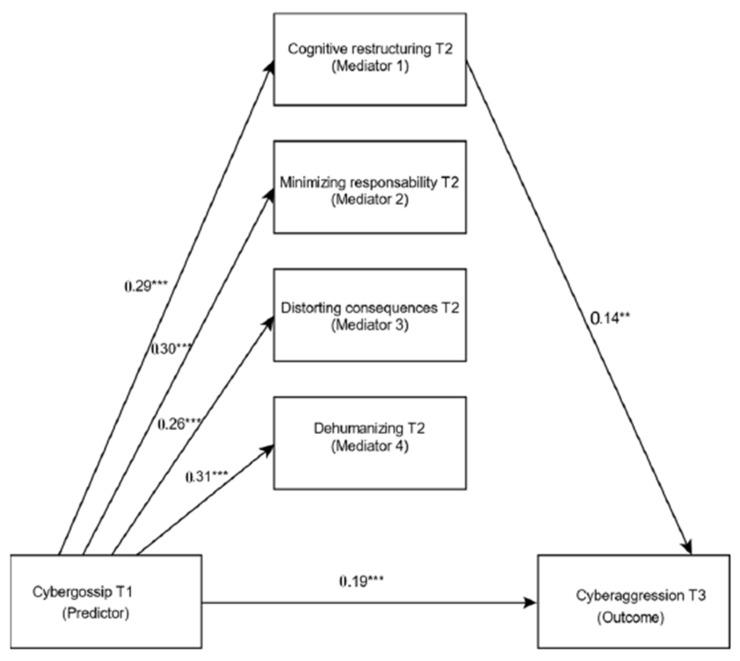
The internet is an area where young people establish relationships and develop socially, emotionally and morally, but it also gives rise to certain forms of online behaviour, such as cybergossip, which are associated with cyberaggression and other risky behaviour. The aims of this study were to verify whether a longitudinal association exists between cybergossip and cyberaggression, and to discover which mechanisms of moral disengagement may mediate this relationship. The final sample consisted of 1392 students (50% girls; Mage = 13.47; SD = 0.77), who were surveyed in a three-wave longitudinal study at six-month intervals. The results obtained confirmed a direct, positive relationship between cybergossip, subsequent cyberaggression and the mediation exerted by cognitive restructuring in this transition. We discuss the importance of recognizing and detecting the fine distinction between online gossip and cyberaggression with the intention of doing harm, and focus on the justifications used by young people to normalize online bullying. To sum up, there is a clear need to encourage ethical, responsible behaviour in online interactions in order to achieve well-balanced, more sustainable relationships in classrooms.
Overview
The claims and statistics of this paper haven’t been checked yet.
Free: it reads the open-access text and checks the first 5 claims that cite a source we can check. Create a free account to check every claim.
Integrity signals
Registry
Cites
Statistics
Figures
Verification
Claims the paper makes
The claims and statistics of this paper haven’t been checked yet.
Free: it reads the open-access text and checks the first 5 claims that cite a source we can check. Create a free account to check every claim.
Claims other papers make about this one
Each is checked against this paper’s own text: does it say what the citing paper says it does?
In the citing paper
“targeting moral disengagement represents a key element, as it is a precursor to harmful online conduct (Runions & Bak, 2015;Falla et al., 2021).”
From Countering dis/misinformation sharing by hindering moral disengagement in adolescence: the role of prosocial conversational modeling (2026) · cites this paper as Falla et al., 2021
Self-check
Percentages, sums and reported differences re-computed from the paper’s own numbers.
The self-check needs the paper’s full text.
Citations
Cites
Required sample size to detect the mediated effect
Fritz, M. S., & MacKinnon, D. P. (2007) · Psychological Science · doi:10.1111/j.1467-9280.2007.01882.x · Cited by 4,810
Kowalski, R. M., Giumetti, G. W., Schroeder, A. N., & Lattanner, M. R. (2014) · Psychological Bulletin · doi:10.1037/a0035618 · Cited by 3,266 · cited 2×
“The immorality of aggressive online behaviour, shown in different meta-analyses [20,21], made us predict that the mechanisms of moral disengagement, in particular cognitive reconstruction, dehumanization and the distorting of harmful consequences for the victim, would have a mediating effect, as previously observed in…”
BackgroundResultDowdall, G. W., Singleton, R., Straits, B. C., Straits, M. N., & McAllister, R. J. (1989) · Teaching Sociology · doi:10.2307/1317936 · Cited by 2,821
Mechanisms of moral disengagement in the exercise of moral agency
Bandura, A., Barbaranelli, C., Caprara, G. V., & Pastorelli, C. (1996) · Journal of Personality and Social Psychology · doi:10.1037/0022-3514.71.2.364 · Cited by 2,680 · cited 1×
“MD is a set of cognitive strategies and trains of thought which allows individuals to self-justify their own antisocial and immoral behaviour when they violate ethical conventions and standards, and remove any emotional and moral reservations they may have about breaking these standards [22].”
BackgroundSelective Moral Disengagement in the Exercise of Moral Agency
Bandura, A. (2002) · Journal of Moral Education · doi:10.1080/0305724022014322 · Cited by 1,948 · cited 1×
“in four: cognitive restructuring, minimizing responsibility, distorting consequences and dehumanizing victims [23].”
BackgroundThe association between adolescent well-being and digital technology use
Orben, A., & Przybylski, A. K. (2019) · Nature Human Behaviour · doi:10.1038/s41562-018-0506-1 · Cited by 1,500 · cited 1×
“In fact, online behaviour and communication, if not marred by other problems, has a huge potential to widen the social horizons of both boys and girls [2].”
BackgroundPornari, C. D., & Wood, J. (2010) · Aggressive Behavior · doi:10.1002/ab.20336 · Cited by 538
A developmental approach to cyberbullying: Prevalence and protective factors
Kowalski, R. M., Limber, S. P., & McCord, A. (2019) · Aggression and Violent Behavior · doi:10.1016/j.avb.2018.02.009 · Cited by 497 · cited 3×
“Young people take advantage of the possibilities offered by Information and Communication Technologies (ICT) to engage in behaviour such as intimidation, harassment, mockery, attacks on social prestige and, in general, aggressive behaviour towards their peers, which weakens the self-esteem and confidence of the victim…”
BackgroundAlexandrov, A., Lilly, B., & Babakus, E. (2013) · Journal of the Academy of Marketing Science · doi:10.1007/s11747-012-0323-4 · Cited by 448
Chen, L., Ho, S. S., & Lwin, M. O. (2017) · New Media & Society · doi:10.1177/1461444816634037 · Cited by 440 · cited 4×
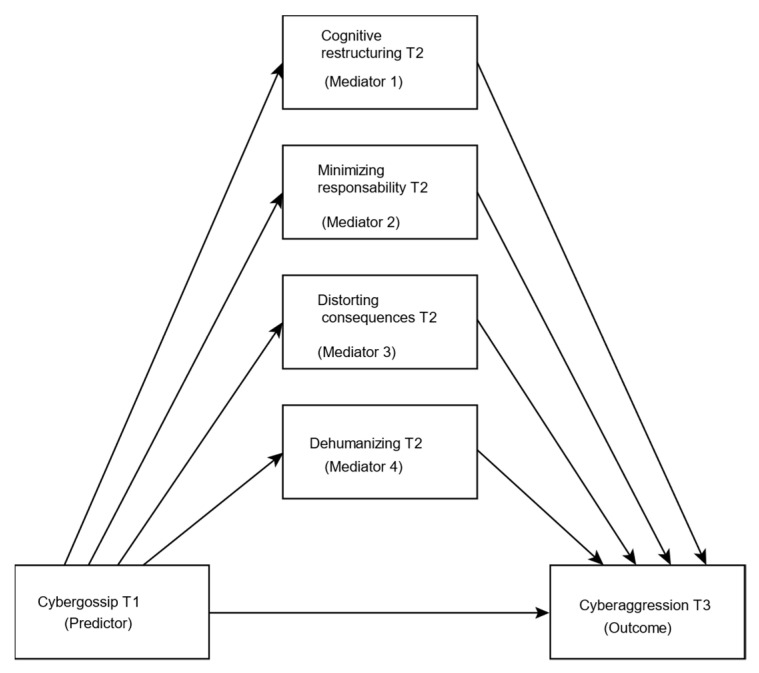
“Based on studies about the mediation role of moral disengagement strategies [21,30], it was hypothesized that cognitive restructuring, distortion of consequences and dehumanization (T2) will be the mechanisms that mediate the relationship between cybergossip (T1) and cyberaggression (T3).”
BackgroundResultInfluential
Research works printed but not linked: 3
- Orue I. Calvete E. Psychopathic Traits and Moral Disengagement Interact to Predict Bullying and Cyberbullying among Adolescents J. Interpers. Violence 2019 34 2313 2332 10.1177/0886260516660302 27436091 · DOI
- Caprara G.V. Barbaranelli C. Vicino S. Bandura A. La misura del disimpegno morale in età evolutiva Età Evol. 1996 51 18 29
- MacKinnon D.P. Introduction to Statistical Mediation Analysis Taylor & Francis Group Milton Park, UK 2008 978-080-586-4298
Cited by
Paciello, M., Corbelli, G., Sportelli, C., Cicirelli, P. G., & D’Errico, F. (2026) · Humanities and Social Sciences Communications · doi:10.1057/s41599-026-08382-7 · Cited by 1
Metadata
- Authors
- Falla, D., Ortega-Ruiz, R., & Romera, E. M.
- Affiliations
- Department of Psychology, Universidad de Córdoba, 14014 Córdoba, Spain
- Venue
- International Journal of Environmental Research and Public Health
- Publisher
- MDPI AG
- Published
- 2021-01-23
- Volume
- 18
- Issue
- 3
- Pages
- 1000
- ISSN
- 1660-4601
- PMC
- PMC7908605
- Cited by
- 30
- References
- 48
- Language
- en
- Funders
- The Government of Spain, I + D + i, Ministry of Science and Innovation (PSI2016-74871-R)
About these checks
Registry, retraction, Cites and statistics results are computed, not judged, with one exception: a printed reference that no index lists is read once by a model before it counts as a citation error. Claims are extracted by a model and kept only when their quote appears verbatim in the text; each cited source is then checked, with a model’s help, for whether it says what the claim relies on. Those verdicts can be wrong — read the claim’s quote and the cited source before relying on one.
Statistics and arithmetic are recomputed, not judged.
Confidence bands are shown only for fields calibrated on our annotated test set. None is calibrated yet, so no band is shown.
What counts as a claim ›How we measure confidence ›How we check this ›
Are you an author, or do you see a problem with this page? Request a review
Data sources
Bibliographic data: Semantic Scholar, OpenAlex, Crossref.
Contains information from the Semantic Scholar Academic Graph Datasets, made available under the ODC Attribution License (ODC-BY 1.0).
Semantic Scholar’s data is described in: Kinney, R., et al. (2023). The Semantic Scholar Open Data Platform. arXiv:2301.10140.
