

Effects of Gamification on Behavioral Change in Education: A Meta-Analysis
Open accessThe DOI matches its Crossref record; 66 of the 66 references it cites were found in a registry or an index; none of the 28 sources its claims cite is checked for support yet.
Abstract
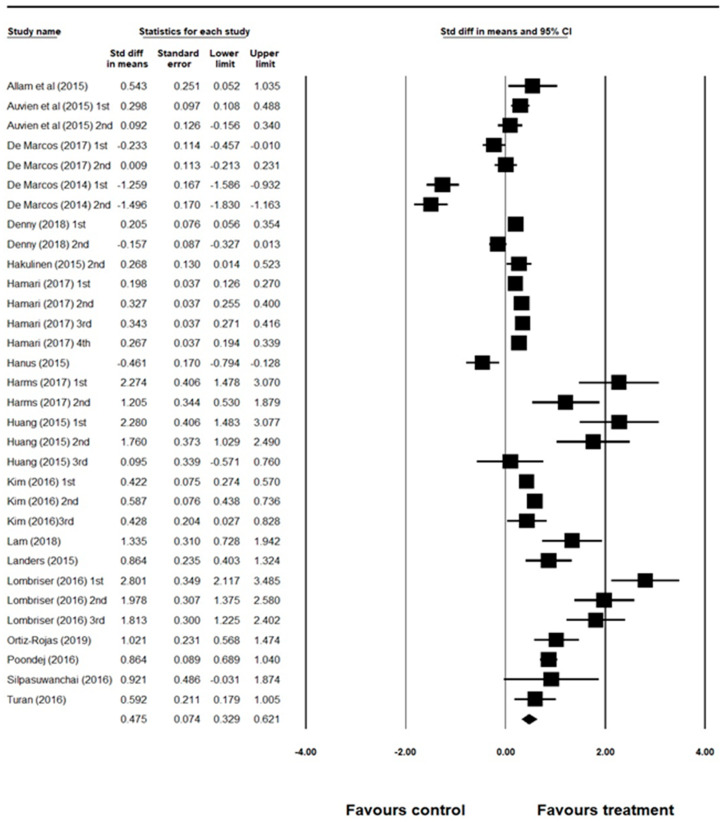
Background: Gamified reward systems, such as providing digital badges earned for specific accomplishments, are related to student engagement in educational settings. The purpose of this study was to conduct a meta-analytic review to quantify the effects of gamified interventions on student behavioral change. Methods: A meta-analysis was performed using the following databases: The Academic Search Complete, Communication & Mass Media Complete, Education Source, ERIC, Library Information Science & Technology Abstracts, and PsycINFO. Inclusion in the review required: (a) peer-reviewed conducted between 2010 and 2019, (b) experimental controlled design, (c) gamification elements, and (d) educational setting. Results: Using a random-effects model, a statistically significant (Cohen’s d (ES) = 0.48, 95% CI = 0.33, 0.62) gamification effect was evidenced by moderate and positive grand effects sizes (ES). Gamification effects were higher with adults in higher education (ES = 0.95) than K-12 students (ES = 0.92). Brief interventions delivered in days or less than 1 week were significantly more effective (ES = 1.57) than interventions lasting up to 20 weeks (ES = 0.30). Interventions incorporating gamification elements across years (ES = −0.20) was adversely associated with behavioral change. Conclusions: Findings suggest that short-term over longer-term gamified interventions might be a promising way to initiate changes in learner’s behaviors and improve learning outcome.
Overview
CoChat Summary
TL;DR
This meta-analysis of 18 studies (32 effect sizes) found a moderate positive overall effect of gamification on learner behavioral change (Cohen’s d = 0.48, 95% CI 0.33–0.62). Effects were moderated by age and intervention length, with adults and brief interventions showing larger effects and multi-year interventions showing an adverse association.
Key findings
- Overall gamification effect was statistically significant and moderate: ES = 0.48, 95% CI = 0.33, 0.62, based on 32 effect sizes from 18 studies.
- Age moderated effects: adults ES = 0.95 (95% CI = 0.70, 1.12), K-12 ES = 0.92 (95% CI = 0.29, 1.55), college students ES = 0.15 (95% CI = −0.04, 0.35); Q between = 26.27, df = 2, p < 0.01.
- Intervention length moderated effects: less than 1 h ES = 1.57 (95% CI = 1.25, 1.90), 2–16 weeks ES = 0.39 (95% CI = 0.21, 0.57), 1–2 years ES = −0.20 (95% CI = 0.40, 0.77 as reported); Q statistic significant.
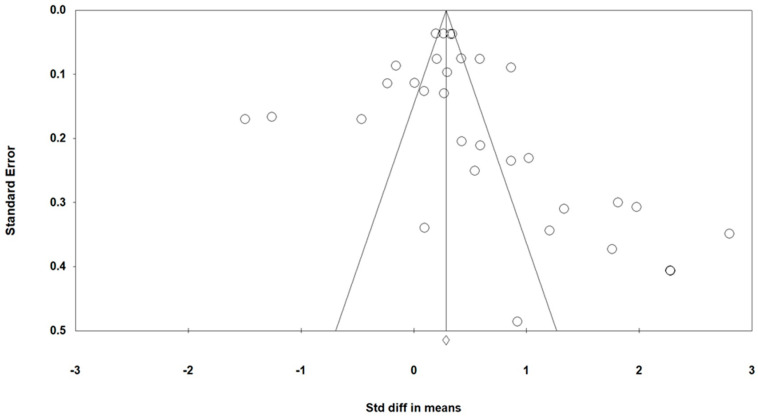
- Measurement type did not significantly differ, but participation level ES = 0.60 (95% CI = 0.40, 0.77) was higher than test score ES = 0.30 (95% CI = 0.03, 0.18 as reported). Publication bias was minimized (Egger’s intercept = 1.46, p = 0.22).
Methods
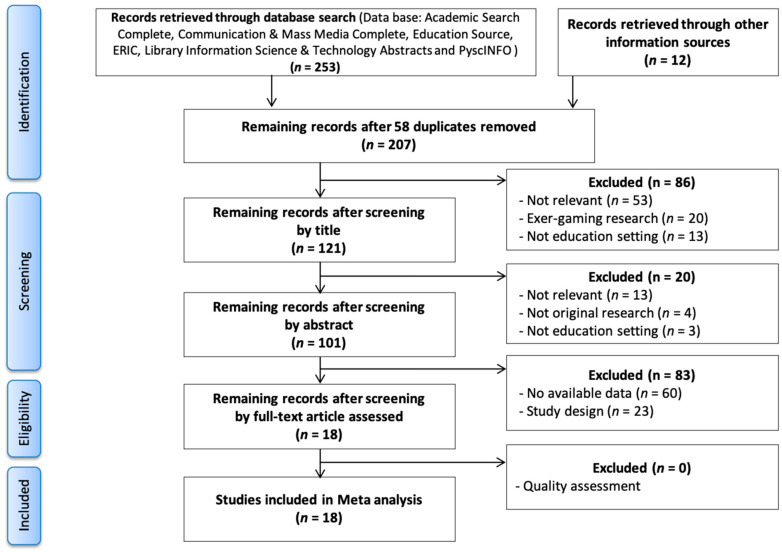
- PRISMA-guided meta-analysis; searched Academic Search Complete, Communication & Mass Media Complete, Education Source, ERIC, Library Information Science & Technology Abstracts, and PsycINFO for peer-reviewed English articles published 2010–2019; inclusion required experimental controlled design, gamification elements, and educational setting; game-based learning/serious games excluded.
- From 253 records plus 12 from reference lists, 18 studies provided sufficient data and were included, yielding 32 effect sizes; two reviewers coded studies, and methodological quality was fair (Downs and Black mean ± SD = 17.11 ± 1.37, range 15–20, maximum 28).
- Random-effects model used mean group differences between gamification and control for test score and participation level; moderator analyses used Cochran’s Q; publication bias assessed via funnel plot and Egger’s test; analyses conducted in Comprehensive Meta-Analysis version 2.
Limitations
- Stated: all included studies were quasi-experimental rather than randomized controlled trials, limiting causal conclusions; gamification elements varied across studies (e.g., badges/leaderboards combined with progress bars or points), and future research should use objective measurable treatments such as online badges and leaderboards only.
- Stated: methodological quality was fair; generalizability should be interpreted cautiously; additional concurrent experimental research could not be included; contextual/developmental factors were beyond scope; more data are needed to support reliability of timing/duration assertions.
- Evident: only 18 studies and 32 effect sizes were included, with small age subgroup counts (2 K-12, 10 college, 6 adult studies), limiting precision of moderator estimates; some reported confidence intervals appear inconsistent (e.g., 1–2 years ES = −0.20 with 95% CI = 0.40, 0.77; test score ES = 0.30 with 95% CI = 0.03, 0.18).
Model-written summary. Check it against the paper before relying on it.
Integrity signals
Registry
Cites
Statistics
Figures
Verification
Claims the paper makes
0 Valid · 0 Not valid · 27 Not checked · 45 Own results and interpretations
A result the paper reports from its own data — it cites no other source for it, so there is none to check. The quote shows it is in the paper.
In the paper
“Brief interventions delivered in days or less than 1 week were significantly more effective (ES = 1.57) than interventions lasting up to 20 weeks (ES = 0.30).”
§ Effects of Gamification on Behavioral Change in Education: A Meta-Analysis > Abstract
plainstates a cause- Asserted: passes — The authors put it forward as true.
- Checkable: passes — It can be checked against evidence.
- Load-bearing: passes — The paper’s conclusions depend on it.
- Based: passes — The paper gives a reason why it holds.
A result the paper reports from its own data — it cites no other source for it, so there is none to check. The quote shows it is in the paper.
In the paper
“The results of moderator analysis indicate that the Q statistic for the age (K-12, college students, and adults) and intervention length (less than 1 h, 2–16 weeks, and 1–2 years) were statistically significant.”
§ Effects of Gamification on Behavioral Change in Education: A Meta-Analysis > 3. Results > 3.2. Moderator Analysis
hedged- Asserted: passes — The authors put it forward as true.
- Checkable: passes — It can be checked against evidence.
- Load-bearing: passes — The paper’s conclusions depend on it.
- Based: passes — The paper gives a reason why it holds.
A result the paper reports from its own data — it cites no other source for it, so there is none to check. The quote shows it is in the paper.
In the paper
“Using a random-effects model, a statistically significant (Cohen’s d (ES) = 0.48, 95% CI = 0.33, 0.62) gamification effect was evidenced by moderate and positive grand effects sizes (ES).”
- Also stated in: § 3.1. Overall ES · plain
“The results from ES calculations indicated that the treatment (gamification) effect was statistically significant (Cohen’s d (ES) = 0.48, 95% CI = 0.33, 0.62), moderate, and positive mean ES, using a random-effects model.”
- Also stated in: § 4. Discussion · plain
“The results show that the gamification strategy has a moderate, positive effect on engagement behaviors and test scores.”
§ Effects of Gamification on Behavioral Change in Education: A Meta-Analysis > Abstract
plainstates a cause- Asserted: passes — The authors put it forward as true.
- Checkable: passes — It can be checked against evidence.
- Load-bearing: passes — The paper’s conclusions depend on it.
- Based: passes — The paper gives a reason why it holds.
- Also stated in: § 3.1. Overall ES · plain
A result the paper reports from its own data — it cites no other source for it, so there is none to check. The quote shows it is in the paper.
In the paper
“The Q statistic for the intervention length also indicated that less than 1-h intervention (ES = 1.57, 95% CI = 1.25, 1.90) appeared to be more effective than 2–16 weeks (ES = 0.39, 95% CI = 0.21, 0.57) and 1–2 years (ES = −0.20, 95% CI = 0.40, 0.77) intervention groups in behavioral change.”
§ Effects of Gamification on Behavioral Change in Education: A Meta-Analysis > 3. Results > 3.2. Moderator Analysis
hedgedstates an association- Asserted: passes — The authors put it forward as true.
- Checkable: passes — It can be checked against evidence.
- Load-bearing: unclear — It is unclear whether the paper’s conclusions depend on it.
- Based: passes — The paper gives a reason why it holds.
A result the paper reports from its own data — it cites no other source for it, so there is none to check. The quote shows it is in the paper.
In the paper
“The results indicated that gamification impacts are similar across all types of outcome measurements.”
§ Effects of Gamification on Behavioral Change in Education: A Meta-Analysis > 4. Discussion > 4.5. Implications for Gamified Educational Learning
hedged- Asserted: passes — The authors put it forward as true.
- Checkable: passes — It can be checked against evidence.
- Load-bearing: passes — The paper’s conclusions depend on it.
- Based: passes — The paper gives a reason why it holds.
35 more claims
Create a free account to see all 72 claims and to verify the 27 references still open.
- It may state two separate claims as one. 18
- The quote only partly states this claim. 1
- Probably not a substantial claim. 21
Self-check
Percentages, sums and reported differences re-computed from the paper’s own numbers.
Each contradiction between two passages listed here was confirmed by an independent check.
Rated major: it would touch a result — a value a result rests on, reported and recomputed p-values on opposite sides of the significance level, two passages that conflict with no sign which is right, or a cited work retracted before this paper was published.
In the paper
§ Effects of Gamification on Behavioral Change in Education: A Meta-Analysis > Abstract
“ES = −0.20”
§ Effects of Gamification on Behavioral Change in Education: A Meta-Analysis > 3. Results > 3.2. Moderator Analysis
“95% CI = 0.40, 0.77”
Rated major: it would touch a result — a value a result rests on, reported and recomputed p-values on opposite sides of the significance level, two passages that conflict with no sign which is right, or a cited work retracted before this paper was published.
In the paper
§ Effects of Gamification on Behavioral Change in Education: A Meta-Analysis > 4. Discussion > 4.3. Behavioral Change and Learning Outcome
“test score (ES = 0.30”
§ Effects of Gamification on Behavioral Change in Education: A Meta-Analysis > 4. Discussion > 4.3. Behavioral Change and Learning Outcome
“95% CI = 0.03, 0.18”
Rated minor: it would not touch a result — a value no result rests on, a p-value that stays on the same side of the significance level, or a conflict that is clerical, resolved elsewhere in the paper, or outside its own findings.
In the paper
§ Effects of Gamification on Behavioral Change in Education: A Meta-Analysis > 3. Results
“A total of 253 publications from 5 databases and 12 potentially relevant studies from the reference lists of the included articles were considered for further review.”
§ Effects of Gamification on Behavioral Change in Education: A Meta-Analysis > 2. Materials and Methods > 2.1. Procedure
“The search engines of Academic Search Complete, Communication & Mass Media Complete, Education Source, ERIC, Library Information Science & Technology Abstracts, and PsycINFO were used to identify relevant studies published between 2010 and 2019.”
Rated minor: it would not touch a result — a value no result rests on, a p-value that stays on the same side of the significance level, or a conflict that is clerical, resolved elsewhere in the paper, or outside its own findings.
In the paper
§ Effects of Gamification on Behavioral Change in Education: A Meta-Analysis > 3. Results
“No studies had quality scores outside two standard deviations of the mean.”
§ Effects of Gamification on Behavioral Change in Education: A Meta-Analysis > 3. Results
“mean ± standard deviation (SD) 17.11 ± 1.37, ranging from 15 to 20”
Citations
Cites
Preferred Reporting Items for Systematic Reviews and Meta-Analyses: the PRISMA statement
Moher, D., Liberati, A., Tetzlaff, J., Altman, D. G., & for the PRISMA Group (2009) · BMJ · doi:10.1136/bmj.b2535 · Cited by 83,823
Statistical power analysis for the behavioral sciences
(1990) · Computers, Environment and Urban Systems · doi:10.1016/0198-9715(90)90050-4 · Cited by 65,269
Bias in meta-analysis detected by a simple, graphical test
Egger, M., Smith, G. D., Schneider, M., & Minder, C. (1997) · BMJ · doi:10.1136/bmj.315.7109.629 · Cited by 56,722 · cited 2×
“When publication bias has occurred, sections of the funnel may be missing, or the plot ay become very asymmetrical [49].”
BackgroundUser Acceptance of Information Technology: Toward A Unified View1
Venkatesh, V., Morris, M. G., Davis, G. B., & Davis, F. D. (2003) · MIS Quarterly · doi:10.2307/30036540 · Cited by 45,035 · cited 1×
“This result was contrary to previous research that the influences of age in technology adoption and usage have designated that younger technology users value the technology’s usefulness more than older [52].”
ResultPreferred reporting items for systematic reviews and meta-analyses: the PRISMA Statement.
(2009) · PubMed Central · Cited by 44,859
Preferred reporting items for systematic reviews and meta-analyses: The PRISMA statement
Moher, D., Liberati, A., Tetzlaff, J., Altman, D. G., & the PRISMA Group* (2009) · Annals of Internal Medicine · doi:10.7326/0003-4819-151-4-200908180-00135 · Cited by 37,554
The "what" and "why" of goal pursuits: Human needs and the self-determination of behavior
Deci, E. L., & Ryan, R. M. (2000) · Psychological Inquiry · doi:10.1207/s15327965pli1104_01 · Cited by 34,210 · cited 1×
“SDT is grounded in three essential human psychological needs: competence, autonomy, and relatedness [12].”
BackgroundStatistical Methods for Meta-Analysis
Wasserman, S., Hedges, L. V., & Olkin, I. (1988) · Journal of Educational Statistics · doi:10.2307/1164953 · Cited by 10,326
From game design elements to gamefulness: defining "gamification"
Deterding, S., Dixon, D., Khaled, R., & Nacke, L. (2011) · Proceedings of the 15th International Academic MindTrek Conference: Envisioning Future Media Environments · doi:10.1145/2181037.2181040 · Cited by 8,402 · cited 1×
“These studies led researchers to theorize that gamification could also be used in education as a tool to increase students’ engagement and to drive them toward desirable learning behaviors [18].”
BackgroundDowns, S. H., & Black, N. (1998) · Journal of Epidemiology and Community Health · doi:10.1136/jech.52.6.377 · Cited by 8,252 · cited 2×
“During the screening step, two reviewers inspected the full text of included studies and independently coded the research methodological to assess its rigor using the Downs and Black checklist [25].”
Method
Cited by
Items 201–300 of 332
Math Basics Pro With 5Is Learning Path Integration in Mastering Algebra Prerequisites
Catacutan, S. J. M., & Cajandig, A. J. S. (2025) · International journal of research and scientific innovation · doi:10.51244/ijrsi.2025.12040025 · Cited by 1
Gamified Interactive Multimedia Experiences in the Organizational Context: A Systematic Review
Solano, A. F., Peláez, C. A., Romero, H., Loaiza, J., Bravo, J., Cortés, N., & Beltrán, P. (2025) · Communications in computer and information science · doi:10.1007/978-3-031-91328-0_14 · Cited by 1
Indriani, Sumardjo, Amanah, S., & Fahmida, U. (2026) · BIO Web of Conferences · doi:10.1051/bioconf/202623404023 · Cited by 1
Bando, U. D. M. A., Afia, S., Yusuf, A. J., & Anwar, Q. A. (2026) · Cokroaminoto Journal of Primary Education · doi:10.30605/cjpe.9.2.2026.8426 · Cited by 1
Astuti, R. P., Riyadi, R., & Triyani, S. (2026) · Social Humanities and Educational Studies (SHEs) Conference Series · doi:10.20961/shes.v9i1.117900 · Cited by 1
Intervensi Edukasi Reproduksi untuk Cegah Infeksi Menular Seksual pada Remaja Melalui Sekolah
Ellistasari, E. Y., Mawardi, P., & Primisawitri, P. P. (2026) · Jurnal Inovasi dan Pengabdian Masyarakat Indonesia · doi:10.26714/jipmi.v5i2.1066 · Cited by 1
Lavigne, M. (2022) · Médiations et médiatisations · doi:10.52358/mm.vi11.279 · Cited by 1
Gamification - Expected and Unexpected Effects
Bankov, B., Parusheva, S. S., & Kasabova, G. (2023) · Izvestia Journal of the Union of Scientists - Varna Economic Sciences Series · doi:10.56065/ijusv-ess/2023.12.1.143 · Cited by 1
Karimian, Z., Mosallanezhad, L., Fakhrzad, N., & Fakhrzad, M. (2023) · doi:10.32592/rmegums.15.3.51 · Cited by 1
Considering Culture in Redefining Educational Experiences through Gamification
Neculăesei, A.-N., & MANOLESCU, I.-T. (2024) · MANAGEMENT INTERCULTURAL · doi:10.70147/m523745 · Cited by 1
Metodologias ativas no ensino superior: aplicação em epidemiologia nutricional
Marchioni, D. M. L., Brito, C. A. F., & da Costa, N. M. L. (2025) · Universidade de São Paulo. Faculdade de Saúde Pública eBooks · doi:10.11606/9786588304174 · Cited by 1
GAMIFICATION AS ONE OF THE WAYS TO DEVELOP SOFT SKILLS OF HIGH SCHOOL STUDENTS
Mukhametkairov, A. E., Ayapbergenova, G. S., & Куатовна, А. С. (2025) · BULLETIN OF THE NATIONAL ACADEMY OF SCIENCES OF THE REPUBLIC OF KAZAKHSTAN ( THE BULLETIN) · doi:10.32014/2025.2518-1467.923 · Cited by 1
Carmen Salinas, B. K. (2023) · LA Referencia (Red Federada de Repositorios Institucionales de Publicaciones Científicas) · Cited by 1
Syöpägenetiikan perusteiden pelillistäminen sekä pelin vaikutuksen arvioiminen oppimiseen
Helminen, J. (2024) · UTUPub (University of Turku) · Cited by 1
Analysis of Counseling Approaches in Addressing Students’ Learning Problems in Indonesia
Saputra, N. M. A., Indreswari, H., Fauzan, L., Wahyuni, F., Alamsyah, M. N., Rafli, M., & Arip, M. A. S. M. (2026) · Al Musyrif Jurnal Bimbingan dan Konseling Islam · doi:10.38073/almusyrif.v9i1.4642
Levelling Up Language Learning: Strategic Game Integration for Engaging and Effective Instruction
Madondo, F., & Mahoso, T. (2026) · IGI Global eBooks · doi:10.4018/979-8-3373-4322-8.ch009
Wen-Ling, C. H. E. N., Winitchayothin, S., CHENG, C.-H., Tonapa, S. I., Chou, F., & Zimmerman, P.-A. (2026) · Journal of Nursing Research · doi:10.1097/jnr.0000000000000772
Rosa, G., Seibert, V. A., Bastos, R. R., Santos, H., Lucca, G., Yamin, A., Reiser, R., & Cruz, A. P. (2023) · doi:10.5753/weit.2023.26591
Theoretical Principles Underpinning Game-Based and Immersive Learning
Ghosh, O., & Kumar, B. (2025) · IGI Global eBooks · doi:10.4018/979-8-3373-4465-2.ch001
Theoretical Frameworks for Implementing Game-Based Learning in Language Development and Acquisition
Ghosh, O., & Kumar, B. (2026) · IGI Global eBooks · doi:10.4018/979-8-3373-4322-8.ch010
Genç, F. E. (2025) · Eğitimde Kuram ve Uygulama · doi:10.17244/eku.1746458
Almazan, K. J., Buscato, D. R., Luben, J. A., Capuyan, T. N., Pintor, K. E., Egno, G. K., Porras, A. J., Baliad, L., Gabuat, H., Leopardas, Z., et al. (2026) · Psychology and Education A Multidisciplinary Journal · doi:10.70838/pemj.600209
Innovating Curriculum Design with AI and Gamification: A Roadmap for Society 5.0
Mertayasa, I. K., & Saputra, P. W. (2025) · Advances in computational intelligence and robotics book series · doi:10.4018/979-8-3373-1062-6.ch010
Christoforakos, L., Mastrino, C., & Diefenbach, S. (2026) · i-com · doi:10.1515/icom-2026-0051
Prototype of Gamification Teaching Materials to Foster AI Literacy for Children
Sakakura, T., 西田, 義., Sakamoto, S., & Kitagawa, T. (2025) · IEEE International Conference on Engineering Education (ICEED) · doi:10.1109/iceed66794.2025.11400000
Future Directions and Innovations in Digital Educational Escape Room Games
(2025) · IGI Global eBooks · doi:10.4018/979-8-3693-4219-0.ch008
Maternal Perspectives on Gamified Oral Health Interventions for Children
Rajeh, M. T., & Nassar, A. A. (2025) · International Journal of Paediatric Dentistry · doi:10.1111/ipd.70057
Tse, M. Y. M., He, J., Kwok, T. T. O., & Ho, S. (2026) · JMIR Research Protocols · doi:10.2196/80542
Revealing the Information Delivery of Diabetes Prevention in K-12: A Systematic Literature Review
Izza, J. N., Suwono, H., Habiddin, H., Susanto, H., & Putranda, R. A. R. (2025) · Salud Ciencia y Tecnología · doi:10.56294/saludcyt20251727
An Adaptable Gamification Design in Online Education Based on the D6 Gamification Model
Özmen, E., & Kan, A. Ü. (2024) · Educational Academic Research · doi:10.33418/education.1466294
Palomino, P. T., Rodrigues, L., Portela, C. D. S., Porto, G. L., Toda, A. M., Bittencourt, I. I., Isotani, S., & Cordeiro, T. (2025) · Communications in computer and information science · doi:10.1007/978-3-031-99261-2_18
Designing an Intelligent Multimedia Vending Interface for Ethical-Choice Interaction
Pang, W. Y. J., & Wan, Y. C. (2026) · IEEE International Conference on Multimedia Information Processing and Retrieval (MIPR) · doi:10.1109/mipr70517.2026.00095
Lenk-Ostendorf, B., Thaller, A., Brudermann, T., & Krusche, S. (2026) · Environmental Research Communications · doi:10.1088/2515-7620/ae7fdd
Shahul Hameed, S. (2026) · Journal of Valartamil · doi:10.37134/jvt.vol7.1.8.2026
The Influence Of Gamification In Investment Apps On Risky Financial Behaviour Among YouthPreprint
Lokeshwari, D. V. (2025) · SSRN Electronic Journal · doi:10.2139/ssrn.5278312
Téllez, E. S. M., & Mendoza, W. P. (2025) · DIALÉCTICA · doi:10.56219/dialctica.v2i25.4010
Díaz-López, M. M., Gómez, L. A., Ordoñez, P. D., & Bustos, R. (2026) · Computers · doi:10.3390/computers15100664
How to engage young adults in healthy eating ? : Increasing their empowerment through gamification
Khodaverdi, H. (2024) · theses.fr (ABES) · doi:10.70675/a36ebeabzc08dz46c9zbe59z37fa59e0c65c
Quality Science Education: Role of Digital Technologies in the Developing World
Misra, R., Rahul, Nishu, & Mathur, V. (2026) · Springer eBooks · doi:10.1007/978-981-95-7785-9_9
Applying a Gamification Technique for Learning Sustainable Finance
Gómez, N. E. G., Carles, P. G., de la Cruz, E. M., Cañete, A. R. M., Aguilar, I. P.-S., & Sánchez, R. S. (2024) · Springer eBooks · doi:10.1007/978-3-031-72549-4_24
Jedel, I., & Palmquist, A. (2026) · CHI Conference on Human Factors in Computing Systems · doi:10.1145/3772318.3791046
Students’ evaluation of motivational design tradeoffs in higher educational gamification
Jedel, I. (2026) · Interactive Learning Environments · doi:10.1080/10494820.2026.2667456
A Deep Neural Network-Based Adaptive Gamification Approach for Virtual Learning
Lin, Y., Chen, J., Chen, F., & Wu, W. (2026) · IEEE Transactions on Learning Technologies · doi:10.1109/tlt.2026.3700399
Tarteer, S., Tlili, A., Salha, S. H., Denden, M., & Λαμπρόπουλος, Γ. (2026) · Interactive Learning Environments · doi:10.1080/10494820.2026.2674786
Suntasig, N. L. C., & Bósquez-Barcenes, V. A. (2026) · ASCE MAGAZINE · doi:10.70577/asce.v5i1.700
Analysis of the Influence of Gamification on Students’ Interest in Cultural Learning
Uljannah, L., & Arifin, Y. (2025) · IEEE Information Technology International Seminar (ITIS) · doi:10.1109/itis67966.2025.11309052
Habets, W., Xu, L., Dendale, P., & Coninx, K. (2025) · Lecture notes of the Institute for Computer Sciences, Social Informatics and Telecommunications Engineering · doi:10.1007/978-3-031-85575-7_3
Effect of Gamification on the Attitudes of the Students toward Mathematics and Academic Performance
Lazarte, J., & Apohen, S. L. (2025) · Psychology and Education A Multidisciplinary Journal · doi:10.70838/pemj.330205
Exploring the Effectiveness of Gamification in Food Safety Training: A Systematic Review
Mekanna, A. N., & Bou‐Mitri, C. (2026) · Journal of Food Science · doi:10.1111/1750-3841.71442
Arslan, B. Ç. (2025) · Özgür Yayınları eBooks · doi:10.58830/ozgur.pub781.c3265
Villarreal, L. I. Z., & Jácome-Gómez, J. R. (2026) · Erevna Research Reports · doi:10.70171/vmz0b906
An Innovative Approach to Addressing Compassion Fatigue: A Feasibility Study of a Serious Game
Esbjørn, B. H., Moltke-Aaen, F., Schwanz, K. A., & Paiva-Salisbury, M. L. (2025) · Simulation & Gaming · doi:10.1177/10468781251350934
The Effectiveness of Online Learning Platforms in Healthcare Education: A Meta-Analysis
Panda, A. K., & Parashar, M. (2022) · Health Leadership and Quality of Life · doi:10.56294/hl2022116
Özkaya, M. N., & Baykal, G. E. (2026) · ACM International Conference on Interaction Design and Children (IDC) · doi:10.1145/3773077.3812164
Romero, G. E. P. (2026) · Polo del Conocimiento · doi:10.23857/pc.v11i3.11296
Carrillo, B. G. (2026) · Ibero Ciencias - Revista Científica y Académica · doi:10.63371/ic.v5.n3.a1626
Gamification in Virtual Learning Environments
Gancevska, B. (2025) · International Journal of Research Publication and Reviews · doi:10.55248/gengpi.06.1125.3820
Examining the role of personality traits and perceived need satisfaction in gamified learning
Gao, F., Liu, J., Rogers, K. C., Li, L., & Liu, R. (2026) · Knowledge Management & E-Learning An International Journal · doi:10.34105/j.kmel.2026.18.011
Laronze, F. (2024) · theses.fr (ABES) · doi:10.70675/45be5714zfbb4z4a3fzb428zca74e5948891
The Impact of Kahoot Gamification on IT Project Management Learning in Libyan Higher Education
Ghawail, E. A., & Ghawail, E. A. A. (2026) · Wadi Alshatti University Journal of Pure and Applied Sciences · doi:10.63318/waujpasv4i2_35
The role of gamification in teaching English
Djoldasova, G. B. (2025) · AIP conference proceedings · doi:10.1063/5.0306149
Valverde-Berrocoso, J. (2022) · RELATEC Revista Latinoamericana de Tecnología Educativa
Steimle, K. (2025) · Qucosa (Saxon State and University Library Dresden)
Munikasari, L. E., Fatirul, A. N., & Prayogo, P. (2026) · Jurnal Pendidikan dan Pembelajaran Indonesia (JPPI) · doi:10.53299/jppi.v6i3.4465
Gamification: An Approach in Developing Social Skills of Kindergarten Learners
Argueza, L. A. (2026) · International Journal of Sustainability and Advanced Integrated Research · doi:10.65339/ijsair.v2.i3.711
Satrio, Y. D., Daroin, A. D., Narmaditya, B. S., Qurrata, V. A., Sahid, S., & Adhisty, M. (2026) · JURNAL EKONOMI PENDIDIKAN DAN KEWIRAUSAHAAN · doi:10.26740/jepk.v14n2.p325-346
Zapata-Aguirre, D. G., Reinozo-Panamá, D. F., Utreras-Zapata, M. D. R., & Torres-Cumbajin, D. R. (2026) · Cognopolis Revista de educación y pedagogía · doi:10.62574/jbp86q31
(2024) · Theseus (Ammattikorkeakoulujen)
Applying Gamification to Undergraduate Accounting Education: A Mixed-Methods Study
Scanlan, T., & Scanlan, S. (2026) · IAFOR Journal of Education · doi:10.22492/ije.14.2.04
From Task Management to Self-Actualization: Enhancing Behavioral Intention in Digital Goal-Setting
Anvari, S. S., Gourashettar, R., & Wehbe, R. R. (2026) · International Journal of Human-Computer Interaction · doi:10.1080/10447318.2026.2721897
Game Feel como elemento complementario en procesos de gamificación de prototipos educativos
Micheas, R. S. (2026) · Cuadernos del Centro de Estudios de Diseño y Comunicación · doi:10.18682/cdc.vi318.13861
Rahim, M., & Mohammed, L. A. (2026) · International Journal of Education in Mathematics Science and Technology · doi:10.46328/ijemst.5784
GAMIFICATION-BASED TECHNIQUE AND MOTIVATION OF LEARNERS IN ENGLISH: AN EXPERIMENTAL STUDY
Sumido, A. G., & Gumanoy, A. M. (2025) · Globus Journal of Progressive Education · doi:10.46360/globus.edu.220251020
The use of digital gamification to improve money management
(2023) · UpSpace Institutional Repository (University of Pretoria) · doi:10.25403/upresearchdata.25211573
Gamification for sustainability and data analytics: the use case Enmo
Rotering, H. J. (2022) · Portuguese National Funding Agency for Science, Research and Technology (RCAAP Project by FCT)
Development of an interdisciplinary educational resource to foster active and motivated learning
Muñoz, F. J. S., Baena‐Morales, S., & Valero, A. F. (2026) · Transformar
Da spazi marginali a spazi di solidarietà. Epistemologie per una cultura dell’incontro
Pescarmona, I. (2025) · Institutional Research Information System University of Turin (University of Turin)
Development of ARCS Model–Based Gamification Indicators with a Multilevel Interpretability Framework
Nababan, P. N., Ruhiat, Y., & Hendrayana, A. (2026) · AL-ISHLAH Jurnal Pendidikan
Exploring students’ attitude and motivation toward GRAMBOT: a gamified language learning tool
Saufi, N. A., Ambi, S. H., Nazamud-Din, A., & MAHMUD, N. F. F. (2025) · UiTM Institutional Repositories (Universiti Teknologi MARA) · doi:10.24191/cplt.v13i3.6718
Spannungsfeld der digitalen Kompetenz
(2024) · MedienPädagogik Zeitschrift für Theorie und Praxis der Medienbildung · doi:10.21240/mpaed/58.x
Koshekov, K., Sakhov, A., Levchenko, N., & Koshekov, A. (2026) · RADIOELECTRONIC AND COMPUTER SYSTEMS · doi:10.32620/reks.2026.1.17
матеріали британсько-української конференції (Лондон, 16 жовт. 2025 р.)
(2025) · Electronic Archive of the National University "Odessa Law Academy" (Scientific Library of the Odessa Law Academy) · doi:10.32837/11300.31737
Castañeda, J. C. D., Rodríguez, A. N., & Romance, R. (2026) · Scientific Repository of Open Access of Portugal (RCAAP)
OPINIÃO DOS ESTUDANTES SOBRE GAMIFICAÇÃO NO PROCESSO DE ENSINO-APRENDIZAGEM DA ENDODONTIA
Júnior, P. M. R. D. M., Travassos, R. M. C., Maia, S. M. A. S., de Menezes, M. R. A., Valones, M. A. A., Martins, W. W. A., Santos, P. G. S. T. D., de Souza, G. F. M., & Silva, L. B. (2025) · LUMEN ET VIRTUS · doi:10.56238/levv16n49-075
OPINIÃO DOS ESTUDANTES SOBRE GAMIFICAÇÃO NO PROCESSO DE ENSINO-APRENDIZAGEM DA ENDODONTIA
Júnior, P. M. R. D. M., Travassos, R. M. C., Maia, S. M. A. S., de Menezes, M. R. A., Valones, M. A. A., Martins, W. W. A., Santos, P. G. S. T. D., Souza, G. F. M. D., & Silva, L. B. (2025) · Aracê. · doi:10.56238/arev7n6-306
Halim, A., Asiyah, R., Andyastanti, T. M., Susanti, A., Robbani, I. F., Althafsyah, N., Nurdiar, S., Mahdi, M. Y., Nugroho, O. E. A., Salsabila, A. N., et al. (2026) · Jurnal SOLMA · doi:10.22236/solma.v15i1.21139
Μακρής, Δ.-Κ. Γ., & Μακρής, Δ.-Κ. Γ. (2024) · University of Thessaly Institutional Repository (University of Thessaly)
Sismi, M., Martha, A., & Aisyah, S. (2026) · Journal of Education Research · doi:10.37985/jer.v7i4.4329
(2024) · Theseus (Ammattikorkeakoulujen)
Bae, I., Xiao, F., Chen, X., Han, E., Sarno, D. M., Stewart, C., Nikolich, A., Lyu, S., DiFranzo, D. J., & Bazarova, N. (2026) · Computers in Human Behavior · doi:10.1016/j.chb.2026.109266
Playing with Mobilities and Urban Observations. Mobile Games, Flânerie, and Social Education
Conti, G., Salvador, M., Montanari, F., & Dusi, N. M. (2023) · IRIS UNIMORE (University of Modena and Reggio Emilia)
A Case Study of Preschool Children’s Behavioural Changes in the Application of Gamification Element
Nasir, S. F. S. M., & Noor, H. M. (2025) · Kupas Seni · doi:10.37134/kupasseni.vol13.sp.4.2025
Theoretical Creation of a Supply Chain Serious Game
Kragulj, L. (2025) · University of Maribor digital library (University of Maribor)
Natalia, D., Pramujiono, A., & Hartono, H. (2026) · Edu Cendikia Jurnal Ilmiah Kependidikan · doi:10.47709/educendikia.v6i02.9287
Demeester, A., & Pelaccia, T. (2024) · Pédagogie médicale · doi:10.1051/pmed/2024015
Significance and Strategy Analysis of Gamified Curriculum in Early Childhood Education
Gao, X. (2024) · Research and Advances in Education · doi:10.56397/rae.2024.08.05
Developing students motive achievement through Torrance concept in conjunction with gamification
Duanyai, P., & Nuangchalerm, P. (2024) · Journal of Advanced Sciences and Mathematics Education · doi:10.58524/jasme.v4i2.381
Jafri, F., Joseph, S. N. R., Robert, C., & Abdullah, A. M. R. A. (2025) · International Journal of Modern Languages And Applied Linguistics · doi:10.24191/ijmal.v9i2.4604
The Impact of Kahoot on Enhancing Grammar Accuracy, Quantitative Approach Study
Ahmed, M., & Amoudi, K. A. (2025) · Journal of English Language Teaching and Applied Linguistics · doi:10.32996/jeltal.2025.7.8.2
An Octalysis Framework Audit for Analyzing Gamification in Quizizz
Lukman, P. D., & Oktavia, T. (2025) · International Conference on Information Management and Technology (ICIMTech) · doi:10.1109/icimtech67074.2025.11265019
Metadata
- Authors
- Kim, J., & Castelli, D. M.
- Affiliations
- Physical Education Teacher Education, Department of Curriculum and Instruction, The University of Texas at Austin, Austin, TX 78712, USA
- The University of Texas at Austin (US)
- Corresponding author
- Castelli, Darla M.
- ORCID
- Castelli, Darla M.
- Venue
- International Journal of Environmental Research and Public Health
- Publisher
- MDPI AG
- Published
- 2021-03-29
- Volume
- 18
- Issue
- 7
- Pages
- 3550
- ISSN
- 1660-4601 (ISSN-L)
- PMC
- PMC8037535
- OpenAlex
- W3143984123
- Cited by
- 332
- References
- 66
- Citations by year
- 2026: 81 · 2025: 101 · 2024: 68 · 2023: 43 · 2022: 33 · 2021: 6
- FWCI
- 5.17
- Type
- journal article
- Language
- en
- Open access
- gold
- doi.org
- Licence
- Locations
- International Journal of Environmental Research and Public Health (publishedVersion, cc-by)
- PubMed Central (publishedVersion, cc-by)
- PubMed (publishedVersion)
- RePEc: Research Papers in Economics (acceptedVersion)
- Topics
- Social Sciences › Psychology › Developmental and Educational Psychology › Educational Games and Gamification
- Physical Sciences › Computer Science › Computer Science Applications › Online Learning and Analytics
- Social Sciences › Sociology and Political Science › Digital Games and Media
- Keywords
- gamification, behavior change, digital badges, student engagement, higher education, K-12 students, intervention duration, game elements, learning outcomes
- MeSH terms
- Adult, Humans, Learning, Reward, Students
About these checks
Registry, retraction, Cites and statistics results are computed, not judged, with one exception: a printed reference that no index lists is read once by a model before it counts as a citation error. Claims are extracted by a model and kept only when their quote appears verbatim in the text; each cited source is then checked, with a model’s help, for whether it says what the claim relies on. Those verdicts can be wrong — read the claim’s quote and the cited source before relying on one.
A language model drew the claims from the paper on 2026-11-23, under version 3 of the claim definition (model deepseek-v4.1-flash, prompt extract-v3).
A second model labelled each claim on 2026-11-23 (model jev-1.13-20260917, definition revision gold-guideline-v0.2).
Statistics and arithmetic are recomputed, not judged.
Confidence bands are shown only for fields calibrated on our annotated test set. None is calibrated yet, so no band is shown.
What counts as a claim ›How we measure confidence ›How we check this ›
Are you an author, or do you see a problem with this page? Request a review
Data sources
Bibliographic data: Semantic Scholar, OpenAlex, Crossref.
Contains information from the Semantic Scholar Academic Graph Datasets, made available under the ODC Attribution License (ODC-BY 1.0).
Semantic Scholar’s data is described in: Kinney, R., et al. (2023). The Semantic Scholar Open Data Platform. arXiv:2301.10140.
