

Effects of Gamification on Behavioral Change in Education: A Meta-Analysis
Open accessThe DOI matches its Crossref record; 66 of the 66 references it cites were found in a registry or an index; none of the 28 sources its claims cite is checked for support yet.
Abstract
Background: Gamified reward systems, such as providing digital badges earned for specific accomplishments, are related to student engagement in educational settings. The purpose of this study was to conduct a meta-analytic review to quantify the effects of gamified interventions on student behavioral change. Methods: A meta-analysis was performed using the following databases: The Academic Search Complete, Communication & Mass Media Complete, Education Source, ERIC, Library Information Science & Technology Abstracts, and PsycINFO. Inclusion in the review required: (a) peer-reviewed conducted between 2010 and 2019, (b) experimental controlled design, (c) gamification elements, and (d) educational setting. Results: Using a random-effects model, a statistically significant (Cohen’s d (ES) = 0.48, 95% CI = 0.33, 0.62) gamification effect was evidenced by moderate and positive grand effects sizes (ES). Gamification effects were higher with adults in higher education (ES = 0.95) than K-12 students (ES = 0.92). Brief interventions delivered in days or less than 1 week were significantly more effective (ES = 1.57) than interventions lasting up to 20 weeks (ES = 0.30). Interventions incorporating gamification elements across years (ES = −0.20) was adversely associated with behavioral change. Conclusions: Findings suggest that short-term over longer-term gamified interventions might be a promising way to initiate changes in learner’s behaviors and improve learning outcome.
Overview
CoChat Summary
TL;DR
This meta-analysis of 18 studies (32 effect sizes) found a moderate positive overall effect of gamification on learner behavioral change (Cohen’s d = 0.48, 95% CI 0.33–0.62). Effects were moderated by age and intervention length, with adults and brief interventions showing larger effects and multi-year interventions showing an adverse association.
Key findings
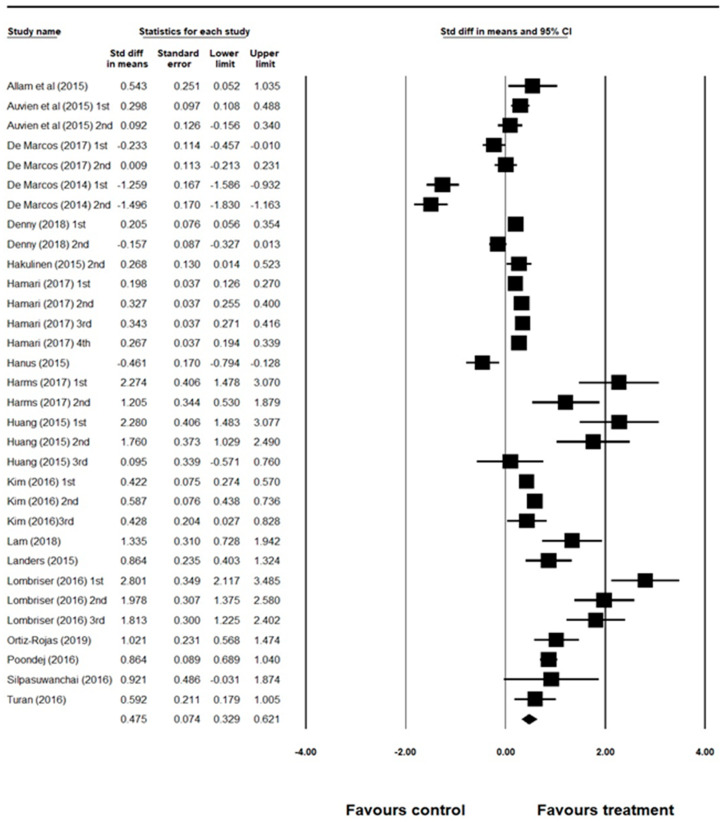
- Overall gamification effect was statistically significant and moderate: ES = 0.48, 95% CI = 0.33, 0.62, based on 32 effect sizes from 18 studies.
- Age moderated effects: adults ES = 0.95 (95% CI = 0.70, 1.12), K-12 ES = 0.92 (95% CI = 0.29, 1.55), college students ES = 0.15 (95% CI = −0.04, 0.35); Q between = 26.27, df = 2, p < 0.01.
- Intervention length moderated effects: less than 1 h ES = 1.57 (95% CI = 1.25, 1.90), 2–16 weeks ES = 0.39 (95% CI = 0.21, 0.57), 1–2 years ES = −0.20 (95% CI = 0.40, 0.77 as reported); Q statistic significant.
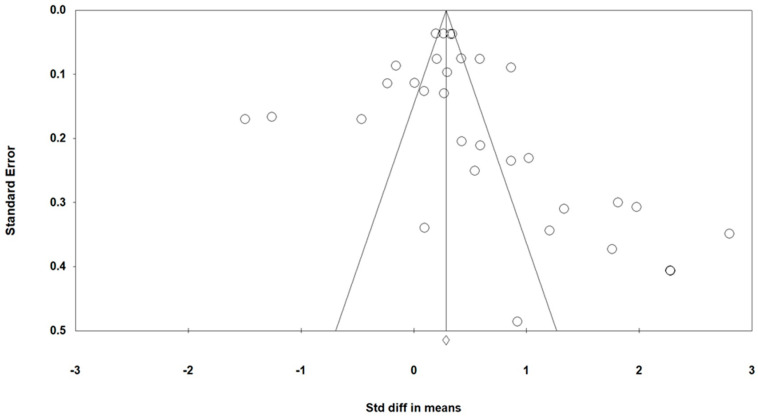
- Measurement type did not significantly differ, but participation level ES = 0.60 (95% CI = 0.40, 0.77) was higher than test score ES = 0.30 (95% CI = 0.03, 0.18 as reported). Publication bias was minimized (Egger’s intercept = 1.46, p = 0.22).
Methods
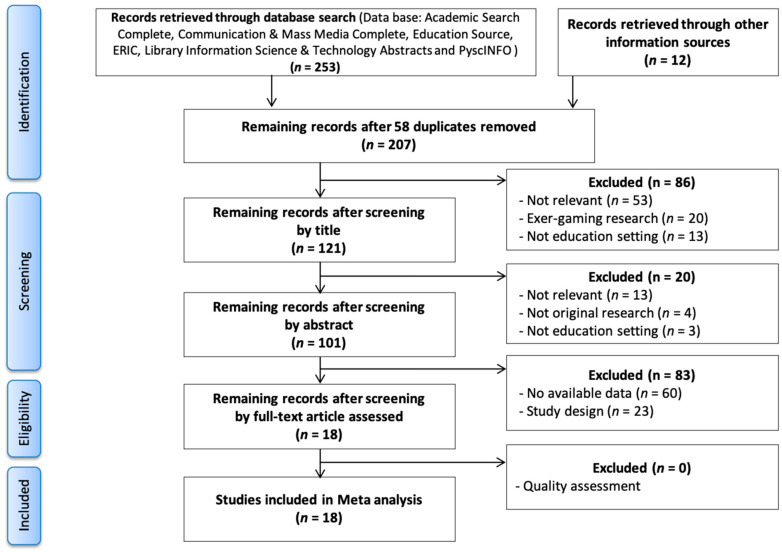
- PRISMA-guided meta-analysis; searched Academic Search Complete, Communication & Mass Media Complete, Education Source, ERIC, Library Information Science & Technology Abstracts, and PsycINFO for peer-reviewed English articles published 2010–2019; inclusion required experimental controlled design, gamification elements, and educational setting; game-based learning/serious games excluded.
- From 253 records plus 12 from reference lists, 18 studies provided sufficient data and were included, yielding 32 effect sizes; two reviewers coded studies, and methodological quality was fair (Downs and Black mean ± SD = 17.11 ± 1.37, range 15–20, maximum 28).
- Random-effects model used mean group differences between gamification and control for test score and participation level; moderator analyses used Cochran’s Q; publication bias assessed via funnel plot and Egger’s test; analyses conducted in Comprehensive Meta-Analysis version 2.
Limitations
- Stated: all included studies were quasi-experimental rather than randomized controlled trials, limiting causal conclusions; gamification elements varied across studies (e.g., badges/leaderboards combined with progress bars or points), and future research should use objective measurable treatments such as online badges and leaderboards only.
- Stated: methodological quality was fair; generalizability should be interpreted cautiously; additional concurrent experimental research could not be included; contextual/developmental factors were beyond scope; more data are needed to support reliability of timing/duration assertions.
- Evident: only 18 studies and 32 effect sizes were included, with small age subgroup counts (2 K-12, 10 college, 6 adult studies), limiting precision of moderator estimates; some reported confidence intervals appear inconsistent (e.g., 1–2 years ES = −0.20 with 95% CI = 0.40, 0.77; test score ES = 0.30 with 95% CI = 0.03, 0.18).
Model-written summary. Check it against the paper before relying on it.
Integrity signals
Registry
Cites
Statistics
Figures
Verification
Claims the paper makes
0 Valid · 0 Not valid · 27 Not checked · 45 Own results and interpretations
A result the paper reports from its own data — it cites no other source for it, so there is none to check. The quote shows it is in the paper.
In the paper
“Brief interventions delivered in days or less than 1 week were significantly more effective (ES = 1.57) than interventions lasting up to 20 weeks (ES = 0.30).”
§ Effects of Gamification on Behavioral Change in Education: A Meta-Analysis > Abstract
plainstates a cause- Asserted: passes — The authors put it forward as true.
- Checkable: passes — It can be checked against evidence.
- Load-bearing: passes — The paper’s conclusions depend on it.
- Based: passes — The paper gives a reason why it holds.
A result the paper reports from its own data — it cites no other source for it, so there is none to check. The quote shows it is in the paper.
In the paper
“The results of moderator analysis indicate that the Q statistic for the age (K-12, college students, and adults) and intervention length (less than 1 h, 2–16 weeks, and 1–2 years) were statistically significant.”
§ Effects of Gamification on Behavioral Change in Education: A Meta-Analysis > 3. Results > 3.2. Moderator Analysis
hedged- Asserted: passes — The authors put it forward as true.
- Checkable: passes — It can be checked against evidence.
- Load-bearing: passes — The paper’s conclusions depend on it.
- Based: passes — The paper gives a reason why it holds.
A result the paper reports from its own data — it cites no other source for it, so there is none to check. The quote shows it is in the paper.
In the paper
“Using a random-effects model, a statistically significant (Cohen’s d (ES) = 0.48, 95% CI = 0.33, 0.62) gamification effect was evidenced by moderate and positive grand effects sizes (ES).”
- Also stated in: § 3.1. Overall ES · plain
“The results from ES calculations indicated that the treatment (gamification) effect was statistically significant (Cohen’s d (ES) = 0.48, 95% CI = 0.33, 0.62), moderate, and positive mean ES, using a random-effects model.”
- Also stated in: § 4. Discussion · plain
“The results show that the gamification strategy has a moderate, positive effect on engagement behaviors and test scores.”
§ Effects of Gamification on Behavioral Change in Education: A Meta-Analysis > Abstract
plainstates a cause- Asserted: passes — The authors put it forward as true.
- Checkable: passes — It can be checked against evidence.
- Load-bearing: passes — The paper’s conclusions depend on it.
- Based: passes — The paper gives a reason why it holds.
- Also stated in: § 3.1. Overall ES · plain
A result the paper reports from its own data — it cites no other source for it, so there is none to check. The quote shows it is in the paper.
In the paper
“The Q statistic for the intervention length also indicated that less than 1-h intervention (ES = 1.57, 95% CI = 1.25, 1.90) appeared to be more effective than 2–16 weeks (ES = 0.39, 95% CI = 0.21, 0.57) and 1–2 years (ES = −0.20, 95% CI = 0.40, 0.77) intervention groups in behavioral change.”
§ Effects of Gamification on Behavioral Change in Education: A Meta-Analysis > 3. Results > 3.2. Moderator Analysis
hedgedstates an association- Asserted: passes — The authors put it forward as true.
- Checkable: passes — It can be checked against evidence.
- Load-bearing: unclear — It is unclear whether the paper’s conclusions depend on it.
- Based: passes — The paper gives a reason why it holds.
A result the paper reports from its own data — it cites no other source for it, so there is none to check. The quote shows it is in the paper.
In the paper
“The results indicated that gamification impacts are similar across all types of outcome measurements.”
§ Effects of Gamification on Behavioral Change in Education: A Meta-Analysis > 4. Discussion > 4.5. Implications for Gamified Educational Learning
hedged- Asserted: passes — The authors put it forward as true.
- Checkable: passes — It can be checked against evidence.
- Load-bearing: passes — The paper’s conclusions depend on it.
- Based: passes — The paper gives a reason why it holds.
35 more claims
Create a free account to see all 72 claims and to verify the 27 references still open.
- It may state two separate claims as one. 18
- The quote only partly states this claim. 1
- Probably not a substantial claim. 21
Self-check
Percentages, sums and reported differences re-computed from the paper’s own numbers.
Each contradiction between two passages listed here was confirmed by an independent check.
Rated major: it would touch a result — a value a result rests on, reported and recomputed p-values on opposite sides of the significance level, two passages that conflict with no sign which is right, or a cited work retracted before this paper was published.
In the paper
§ Effects of Gamification on Behavioral Change in Education: A Meta-Analysis > Abstract
“ES = −0.20”
§ Effects of Gamification on Behavioral Change in Education: A Meta-Analysis > 3. Results > 3.2. Moderator Analysis
“95% CI = 0.40, 0.77”
Rated major: it would touch a result — a value a result rests on, reported and recomputed p-values on opposite sides of the significance level, two passages that conflict with no sign which is right, or a cited work retracted before this paper was published.
In the paper
§ Effects of Gamification on Behavioral Change in Education: A Meta-Analysis > 4. Discussion > 4.3. Behavioral Change and Learning Outcome
“test score (ES = 0.30”
§ Effects of Gamification on Behavioral Change in Education: A Meta-Analysis > 4. Discussion > 4.3. Behavioral Change and Learning Outcome
“95% CI = 0.03, 0.18”
Rated minor: it would not touch a result — a value no result rests on, a p-value that stays on the same side of the significance level, or a conflict that is clerical, resolved elsewhere in the paper, or outside its own findings.
In the paper
§ Effects of Gamification on Behavioral Change in Education: A Meta-Analysis > 3. Results
“A total of 253 publications from 5 databases and 12 potentially relevant studies from the reference lists of the included articles were considered for further review.”
§ Effects of Gamification on Behavioral Change in Education: A Meta-Analysis > 2. Materials and Methods > 2.1. Procedure
“The search engines of Academic Search Complete, Communication & Mass Media Complete, Education Source, ERIC, Library Information Science & Technology Abstracts, and PsycINFO were used to identify relevant studies published between 2010 and 2019.”
Rated minor: it would not touch a result — a value no result rests on, a p-value that stays on the same side of the significance level, or a conflict that is clerical, resolved elsewhere in the paper, or outside its own findings.
In the paper
§ Effects of Gamification on Behavioral Change in Education: A Meta-Analysis > 3. Results
“No studies had quality scores outside two standard deviations of the mean.”
§ Effects of Gamification on Behavioral Change in Education: A Meta-Analysis > 3. Results
“mean ± standard deviation (SD) 17.11 ± 1.37, ranging from 15 to 20”
Citations
Cites
Preferred Reporting Items for Systematic Reviews and Meta-Analyses: the PRISMA statement
Moher, D., Liberati, A., Tetzlaff, J., Altman, D. G., & for the PRISMA Group (2009) · BMJ · doi:10.1136/bmj.b2535 · Cited by 83,823
Statistical power analysis for the behavioral sciences
(1990) · Computers, Environment and Urban Systems · doi:10.1016/0198-9715(90)90050-4 · Cited by 65,269
Bias in meta-analysis detected by a simple, graphical test
Egger, M., Smith, G. D., Schneider, M., & Minder, C. (1997) · BMJ · doi:10.1136/bmj.315.7109.629 · Cited by 56,722 · cited 2×
“When publication bias has occurred, sections of the funnel may be missing, or the plot ay become very asymmetrical [49].”
BackgroundUser Acceptance of Information Technology: Toward A Unified View1
Venkatesh, V., Morris, M. G., Davis, G. B., & Davis, F. D. (2003) · MIS Quarterly · doi:10.2307/30036540 · Cited by 45,035 · cited 1×
“This result was contrary to previous research that the influences of age in technology adoption and usage have designated that younger technology users value the technology’s usefulness more than older [52].”
ResultPreferred reporting items for systematic reviews and meta-analyses: the PRISMA Statement.
(2009) · PubMed Central · Cited by 44,859
Preferred reporting items for systematic reviews and meta-analyses: The PRISMA statement
Moher, D., Liberati, A., Tetzlaff, J., Altman, D. G., & the PRISMA Group* (2009) · Annals of Internal Medicine · doi:10.7326/0003-4819-151-4-200908180-00135 · Cited by 37,554
The "what" and "why" of goal pursuits: Human needs and the self-determination of behavior
Deci, E. L., & Ryan, R. M. (2000) · Psychological Inquiry · doi:10.1207/s15327965pli1104_01 · Cited by 34,210 · cited 1×
“SDT is grounded in three essential human psychological needs: competence, autonomy, and relatedness [12].”
BackgroundStatistical Methods for Meta-Analysis
Wasserman, S., Hedges, L. V., & Olkin, I. (1988) · Journal of Educational Statistics · doi:10.2307/1164953 · Cited by 10,326
From game design elements to gamefulness: defining "gamification"
Deterding, S., Dixon, D., Khaled, R., & Nacke, L. (2011) · Proceedings of the 15th International Academic MindTrek Conference: Envisioning Future Media Environments · doi:10.1145/2181037.2181040 · Cited by 8,402 · cited 1×
“These studies led researchers to theorize that gamification could also be used in education as a tool to increase students’ engagement and to drive them toward desirable learning behaviors [18].”
BackgroundDowns, S. H., & Black, N. (1998) · Journal of Epidemiology and Community Health · doi:10.1136/jech.52.6.377 · Cited by 8,252 · cited 2×
“During the screening step, two reviewers inspected the full text of included studies and independently coded the research methodological to assess its rigor using the Downs and Black checklist [25].”
MethodDeci, E. L., Koestner, R., & Ryan, R. M. (1999) · Psychological Bulletin · doi:10.1037/0033-2909.125.6.627 · Cited by 7,176 · cited 1×
“Self-Determination Theory (SDT) is a motivation process with three emotional states of intrinsic motivation, extrinsic motivation, and amotivation [11].”
BackgroundDoes Gamification Work? -- A Literature Review of Empirical Studies on Gamification
Hamari, J., Koivisto, J., & Sarsa, H. (2014) · 2014 47th Hawaii International Conference on System Sciences · doi:10.1109/hicss.2014.377 · Cited by 5,201 · cited 1×
“For this review, gamification was operationalized as any gamelike element applied in a non-game context like a learning environment [20].”
MethodA motivational approach to self: integration in personality.
Deci, E. L., & Ryan, R. M. (1990) · PubMed · Cited by 4,259
Specious reward: A behavioral theory of impulsiveness and impulse control.
Ainslie, G. (1975) · Psychological Bulletin · doi:10.1037/h0076860 · Cited by 2,708 · cited 1×
“People often prefer short-term rewards rather than long-term rewards in modern life [55], and this cognitive inclination is called hyperbolic discounting [56].”
BackgroundThe gamification of learning: a meta-analysis
Sailer, M., & Homner, L. (2020) · Educational Psychology Review · doi:10.1007/s10648-019-09498-w · Cited by 2,594 · cited 2×
“Consequently, this is viewed as one of the leading researches [16,17] to quantify and qualify gamification effects in educational settings using meta-analysis.”
BackgroundNiemiec, C. P., & Ryan, R. M. (2009) · Theory and Research in Education · doi:10.1177/1477878509104318 · Cited by 2,542
Statistical Methods for Meta-Analysis
(1985) · Elsevier eBooks · doi:10.1016/c2009-0-03396-0 · Cited by 2,521
Gamification by Design: Implementing Game Mechanics in Web and Mobile Apps
Zichermann, G., & Cunningham, C. J. L. (2011) · Cited by 2,378
Gamifying learning experiences: Practical implications and outcomes
Domínguez, A., Saenz-de-Navarrete, J., de-Marcos, L., Fernández-Sanz, L., Pagés, C., & Martínez-Herráiz, J.-J. (2013) · Computers & Education · doi:10.1016/j.compedu.2012.12.020 · Cited by 2,007 · cited 1×
“Commercially, gamification has been successfully integrated into platforms, especially social ones, to create targeted relationships between the software application and the users to drive viral behaviors that increase popularity [8].”
BackgroundHanus, M. D., & Fox, J. (2015) · Computers & Education · doi:10.1016/j.compedu.2014.08.019 · Cited by 1,918 · cited 1×
“Hanus & Fox (2015) [34] 71 71 CS Weeks PL Badges, leaderboard Communication”
BackgroundAGE DIFFERENCES IN TECHNOLOGY ADOPTION DECISIONS: IMPLICATIONS FOR A CHANGING WORK FORCE
MORRIS, M. G., & VENKATESH, V. (2000) · Personnel Psychology · doi:10.1111/j.1744-6570.2000.tb00206.x · Cited by 1,723 · cited 1×
“The more inferior effect of social influence on the younger generation, maybe because they have been exposed to a gamified strategy at a younger age [51].”
BackgroundFacebook and academic performance
Kirschner, P. A., & Karpinski, A. C. (2010) · Computers in Human Behavior · doi:10.1016/j.chb.2010.03.024 · Cited by 1,578
Investigating the determinants and age and gender differences in the acceptance of mobile learning
Wang, Y., Wu, M., & Wang, H. (2009) · British Journal of Educational Technology · doi:10.1111/j.1467-8535.2007.00809.x · Cited by 1,218 · cited 1×
“Wang and colleagues [50] found that older users are more easily influenced by social modeling than younger adults.”
BackgroundDefining gamification: a service marketing perspective
Huotari, K., & Hamari, J. (2012) · Proceeding of the 16th International Academic MindTrek Conference · doi:10.1145/2393132.2393137 · Cited by 1,150 · cited 1×
“The potential benefits of gamified learning may address public issues such as the lack of student motivation due to the limited interaction with teachers and students [19].”
BackgroundLiaw, S.-S. (2008) · Computers & Education · doi:10.1016/j.compedu.2007.09.005 · Cited by 1,116 · cited 2×
“The action of earning badges can thus drive the acquisition of knowledge and skill [10].”
BackgroundA test of self‐determination theory in school physical education
Standage, M., Duda, J. L., & Ntoumanis, N. (2005) · British Journal of Educational Psychology · doi:10.1348/000709904x22359 · Cited by 1,059 · cited 1×
“People often prefer short-term rewards rather than long-term rewards in modern life [55], and this cognitive inclination is called hyperbolic discounting [56].”
BackgroundGamification and student motivation
Buckley, P., & Doyle, E. (2016) · Interactive Learning Environments · doi:10.1080/10494820.2014.964263 · Cited by 879 · cited 2×
“These meta-analysis findings are significant because gamification is an emerging and growing issue in education [58].”
BackgroundDemographic differences in perceived benefits from gamification
Koivisto, J., & Hamari, J. (2014) · Computers in Human Behavior · doi:10.1016/j.chb.2014.03.007 · Cited by 841 · cited 1×
“It is based on the same idea that gamified or gameful motivational tools are most beneficial to younger ages [62].”
BackgroundA RECIPE for Meaningful Gamification
Nicholson, S. (2015) · Gamification in Education and Business · doi:10.1007/978-3-319-10208-5_1 · Cited by 722 · cited 1×
“This finding provides a practical implementation that learners possibly have more motivation for learning or participation in intensive, short-term scenarios than in extended education settings [57].”
BackgroundDo badges increase user activity? A field experiment on the effects of gamification
Hamari, J. (2017) · Computers in Human Behavior · doi:10.1016/j.chb.2015.03.036 · Cited by 675 · cited 1×
“Hamari (2017) [33] 1579 1401 Adult Years PL”
An empirical study comparing gamification and social networking on e-learning
de-Marcos, L., Domínguez, A., Saenz-de-Navarrete, J., & Pagés, C. (2014) · Computers & Education · doi:10.1016/j.compedu.2014.01.012 · Cited by 626 · cited 1×
“(2014) [30] 106 72 CS Years Test score Badges, leaderboard, points, progress bar Computer science 112 72 CS Years PL”
BackgroundThe Lens of Intrinsic Skill Atoms: A Method for Gameful Design
Deterding, S. (2015) · Human–Computer Interaction · doi:10.1080/07370024.2014.993471 · Cited by 525 · cited 1×
“Because gamification includes online badges, ownership, and leaderboard [15], it can be a factor covers competence, autonomy, and relatedness to fulfill intrinsic motivation.”
BackgroundAge-related macular degeneration and low-vision rehabilitation: a systematic review
Hooper, P., Jutai, J. W., Strong, G., & Russell-Minda, E. (2008) · Canadian Journal of Ophthalmology · doi:10.3129/i08-001 · Cited by 491 · cited 1×
“) Cochran’s Q test is a nonparametric statistical test that assesses whether the treatments have the same effects among groups [48] The results of moderator analysis indicate that the Q statistic for the age (K-12, college student , and adults) and intervention length (less than 1 h, 2–16 weeks, and 1–2 years) were st…”
BackgroundAre badges useful in education?: it depends upon the type of badge and expertise of learner
Abramovich, S., Schunn, C., & Higashi, R. M. (2013) · Educational Technology Research and Development · doi:10.1007/s11423-013-9289-2 · Cited by 485 · cited 1×
“Gamification is thought of as both a game element and as the process of creating gameful experiences to increase motivation to sustain desired behaviors [21].”
BackgroundGamification of task performance with leaderboards: A goal setting experiment
Landers, R. N., Bauer, K. N., & Callan, R. C. (2017) · Computers in Human Behavior · doi:10.1016/j.chb.2015.08.008 · Cited by 474 · cited 1×
“(2015) [39] 33 49 Adult Hours Test score Leaderboard, points, Brainstorming”
Background“Working out for likes”: An empirical study on social influence in exercise gamification
Hamari, J., & Koivisto, J. (2015) · Computers in Human Behavior · doi:10.1016/j.chb.2015.04.018 · Cited by 473 · cited 1×
“The novelty of the gamified elements is likely driving the effects [54].”
BackgroundStudent Motivation and Self-Regulated Learning in the College Classroom
Pintrich, P. R., & Zusho, A. (2002) · Higher Education: Handbook of Theory and Research · doi:10.1007/978-94-010-0245-5_2 · Cited by 387 · cited 1×
“Motivation is a mental process that brings about and maintains goal-oriented actions [1].”
BackgroundSteering user behavior with badges
Anderson, A., Huttenlocher, D., Kleinberg, J., & Leskovec, J. (2013) · Proceedings of the 22nd international conference on World Wide Web · doi:10.1145/2488388.2488398 · Cited by 357 · cited 1×
“For adults, airlines award elite status for meeting threshold amounts of travel [6].”
BackgroundThe impact of gamification in educational settings on student learning outcomes: a meta-analysis
Huang, R., Ritzhaupt, A. D., Sommer, M., Zhu, J., Stephen, A., Valle, N., Hampton, J., & Li, J. (2020) · Educational Technology Research and Development · doi:10.1007/s11423-020-09807-z · Cited by 340 · cited 2×
“Consequently, this is viewed as one of the leading researches [16,17] to quantify and qualify gamification effects in educational settings using meta-analysis.”
BackgroundUnderstanding age differences in PDA acceptance and performance
Arning, K., & Ziefle, M. (2007) · Computers in Human Behavior · doi:10.1016/j.chb.2006.06.005 · Cited by 332 · cited 1×
“Older participants are attracted to the gamified elements because they emphasize ease of achieving goals by reflecting progress [53].”
BackgroundAllam, A., Kostova, Z., Nakamoto, K., & Schulz, P. J. (2015) · Journal of Medical Internet Research · doi:10.2196/jmir.3510 · Cited by 274 · cited 1×
“(2015) [28] 28 40 Adult Weeks Test score Badges, leaderboard, points Medical education”
BackgroundEmpirical Study on the Effect of Achievement Badges in TRAKLA2 Online Learning Environment
Hakulinen, L., Auvinen, T., & Korhonen, A. (2013) · 2013 Learning and Teaching in Computing and Engineering · doi:10.1109/latice.2013.34 · Cited by 225 · cited 2×
“The pursuit of badges is an emotional investment that symbolizes the magnitude of a challenge [5].”
BackgroundHakulinen, L., Auvinen, T., & Korhonen, A. (2015) · International Journal of Emerging Technologies in Learning (iJET) · doi:10.3991/ijet.v10i1.4221 · Cited by 201
Gamification and Education: Achievements, Cognitive Loads, and Views of Students
Turan, Z., Avinc, Z., Kara, K., & Goktas, Y. (2016) · International Journal of Emerging Technologies in Learning (iJET) · doi:10.3991/ijet.v11i07.5455 · Cited by 189 · cited 1×
“(2016) [44] 46 48 K-12 Weeks Test score Badges, leaderboard, points Technology software”
Background(2013) · RMIT Research Repository (RMIT University Library) · Cited by 171
Auvinen, T., Hakulinen, L., & Malmi, L. (2015) · IEEE Transactions on Learning Technologies · doi:10.1109/tlt.2015.2441718 · Cited by 168 · cited 2×
“Expanded access to the Internet has changed the way we learn [3].”
BackgroundImproving argumentative writing: Effects of a blended learning approach and gamification
Lam, Y. W., Hew, K. F., & Chiu, K. F. (2018) · Language Learning & Technology · doi:10.64152/10125/44583 · Cited by 165 · cited 1×
“(2018) [38] 22 30 K-12 Weeks PL Leaderboard, points, ESL writing”
Gamification through leaderboards: An empirical study in engineering education
Ortiz‐Rojas, M., Chiluiza, K., & Valcke, M. (2019) · Computer Applications in Engineering Education · doi:10.1002/cae.12116 · Cited by 142 · cited 1×
“(2019) [41] 55 34 Adult Hours Test score Leaderboard Computer programing”
BackgroundThe Gameful World: Approaches, Issues, Applications
(2015) · The MIT Press eBooks · doi:10.7551/mitpress/9788.001.0001 · Cited by 139
The development of gamified learning activities to increase student engagement in learning
Poondej, C., & Lerdpornkulrat, T. (2016) · Australian educational computing · Cited by 139
Empirical Support for a Causal Relationship Between Gamification and Learning Outcomes
Denny, P., McDonald, F., Empson, R., Kelly, P., & Petersen, A. (2018) · Proceedings of the 2018 CHI Conference on Human Factors in Computing Systems · doi:10.1145/3173574.3173885 · Cited by 135 · cited 1×
“(2018) [31] 702 702 CS Weeks Test score Badges, points Online education 521 180 CS Weeks Test score”
BackgroundHuang, B., & Hew, K. (2015) · International Conference on Computers in Education · Cited by 127
The Gameful World: Approaches, Issues, Applications
Walz, S. P., & Deterding, S. (2014) · Cited by 115
Effects of Weight-Bearing Exercise on Bone Health in Girls: A Meta-Analysis
Ishikawa, S., Kim, Y., Kang, M., & Morgan, D. W. (2013) · Sports Medicine · doi:10.1007/s40279-013-0060-y · Cited by 74 · cited 2×
“The modified Downs and Black checklist permitted the reviewers to determine the quality of the research across different methodologies and approaches [26,27].”
BackgroundGamified Requirements Engineering: Model and Experimentation
Lombriser, P., Dalpiaz, F., Lucassen, G., & Brinkkemper, S. (2016) · Lecture Notes in Computer Science · doi:10.1007/978-3-319-30282-9_12 · Cited by 73
Towards the social gamification of e-learning: a practical experiment
de‐Marcos, L., García‐Cabot, A., & García‐López, E. (2017) · International journal of engineering education · Cited by 68
Developing a Comprehensive Engagement Framework of Gamification for Reflective Learning
Silpasuwanchai, C., Ma, X., Shigemasu, H., & Ren, X. (2016) · Proceedings of the 2016 ACM Conference on Designing Interactive Systems · doi:10.1145/2901790.2901836 · Cited by 68 · cited 1×
“(2016) [43] 19 6 CS Hours PL Badges, leaderboard, points Memory”
BackgroundBeemer, L. R., Ajibewa, T. A., DellaVecchia, G., & Hasson, R. E. (2019) · International Journal of Environmental Research and Public Health · doi:10.3390/ijerph16214082 · Cited by 57 · cited 2×
“Contrary to previous findings suggesting that gamified interventions of 20 weeks offering badges to children who participated in physical activity breaks in the classroom significantly increased children participation [7], the summary of research, in comparison to college students and older adults, did not produce the…”
BackgroundResultGamification of Online Surveys: Design Process, Case Study, and Evaluation
Harms, J., Biegler, S., Wimmer, C., Kappel, K., & Grechenig, T. (2015) · Lecture notes in computer science · doi:10.1007/978-3-319-22701-6_16 · Cited by 56 · cited 1×
“(2017) [35] 21 19 Adult Hours PL Badges, avatar, progress bar Physical activity 21 19 Adult Hours Test score”
BackgroundThe effects of Gamification on engineering lab activities
Kim, E., Rothrock, L., & Freivalds, A. (2016) · IEEE Frontiers in Education Conference (FIE) · doi:10.1109/fie.2016.7757442 · Cited by 34
Meta-Analysis and the Myth of Generalizability
Tett, R. P., Hundley, N. A., & Christiansen, N. D. (2017) · Industrial and Organizational Psychology · doi:10.1017/iop.2017.26 · Cited by 28 · cited 1×
“However, a fundamental question driving every meta-analytic research is generalizability [61].”
BackgroundKim, K., Ok, G., Jeon, S., Kang, M., & Lee, S. (2016) · Journal of Sports Sciences · doi:10.1080/02640414.2016.1166389 · Cited by 27
At-Risk Students in After-school Programs: Outcomes and Recommendations
Davies, S. C., & Peltz, L. J. (2012) · Principal leadership · Cited by 23
Student perceptions of the impact of online discussion forum participation on learning outcomes
Jahnke, J. (2010) · Journal of Learning Design · doi:10.5204/jld.v3i2.48 · Cited by 11 · cited 1×
“, learning time) using gamification strategy, impacting learning outcomes [60].”
MethodKim, K. R., Ok, G., Jeon, S., Kang, M., & Lee, S. (2015) · Medicine & Science in Sports & Exercise · doi:10.1249/01.mss.0000480431.31576.0f · Cited by 3
(2011) · Academic exchange quarterly
Cited by
Li, M., Ma, S., & Shi, Y. (2023) · Frontiers in Psychology · doi:10.3389/fpsyg.2023.1253549 · Cited by 439
“Another possible explanation concerns the greater familiarity of higher education users with technology and digital tools (Kim and Castelli, 2021), which makes them more receptive to gamified learning activities that incorporate these resources.”
BackgroundInfluentialZeng, J., Sun, D., Looi, C., & Fan, A. C. W. (2024) · British Journal of Educational Technology · doi:10.1111/bjet.13471 · Cited by 391
Λαμπρόπουλος, Γ., & Sidiropoulos, A. (2024) · Education Sciences · doi:10.3390/educsci14040367 · Cited by 346
Cascella, M., Cascella, A., Monaco, F., & Shariff, M. N. (2023) · Journal of Anesthesia Analgesia and Critical Care · doi:10.1186/s44158-023-00118-2 · Cited by 148
Using gamification to support learning in K‐12 education: A systematic literature review
Dehghanzadeh, H., Farrokhnia, M., Dehghanzadeh, H., Taghipour, K., & Noroozi, O. (2024) · British Journal of Educational Technology · doi:10.1111/bjet.13335 · Cited by 130
Metadata
- Authors
- Kim, J., & Castelli, D. M.
- Affiliations
- Physical Education Teacher Education, Department of Curriculum and Instruction, The University of Texas at Austin, Austin, TX 78712, USA
- The University of Texas at Austin (US)
- Corresponding author
- Castelli, Darla M.
- ORCID
- Castelli, Darla M.
- Venue
- International Journal of Environmental Research and Public Health
- Publisher
- MDPI AG
- Published
- 2021-03-29
- Volume
- 18
- Issue
- 7
- Pages
- 3550
- ISSN
- 1660-4601 (ISSN-L)
- PMC
- PMC8037535
- OpenAlex
- W3143984123
- Cited by
- 332
- References
- 66
- Citations by year
- 2026: 81 · 2025: 101 · 2024: 68 · 2023: 43 · 2022: 33 · 2021: 6
- FWCI
- 5.17
- Type
- journal article
- Language
- en
- Open access
- gold
- doi.org
- Licence
- Locations
- International Journal of Environmental Research and Public Health (publishedVersion, cc-by)
- PubMed Central (publishedVersion, cc-by)
- PubMed (publishedVersion)
- RePEc: Research Papers in Economics (acceptedVersion)
- Topics
- Social Sciences › Psychology › Developmental and Educational Psychology › Educational Games and Gamification
- Physical Sciences › Computer Science › Computer Science Applications › Online Learning and Analytics
- Social Sciences › Sociology and Political Science › Digital Games and Media
- Keywords
- gamification, behavior change, digital badges, student engagement, higher education, K-12 students, intervention duration, game elements, learning outcomes
- MeSH terms
- Adult, Humans, Learning, Reward, Students
About these checks
Registry, retraction, Cites and statistics results are computed, not judged, with one exception: a printed reference that no index lists is read once by a model before it counts as a citation error. Claims are extracted by a model and kept only when their quote appears verbatim in the text; each cited source is then checked, with a model’s help, for whether it says what the claim relies on. Those verdicts can be wrong — read the claim’s quote and the cited source before relying on one.
A language model drew the claims from the paper on 2026-11-23, under version 3 of the claim definition (model deepseek-v4.1-flash, prompt extract-v3).
A second model labelled each claim on 2026-11-23 (model jev-1.13-20260917, definition revision gold-guideline-v0.2).
Statistics and arithmetic are recomputed, not judged.
Confidence bands are shown only for fields calibrated on our annotated test set. None is calibrated yet, so no band is shown.
What counts as a claim ›How we measure confidence ›How we check this ›
Are you an author, or do you see a problem with this page? Request a review
Data sources
Bibliographic data: Semantic Scholar, OpenAlex, Crossref.
Contains information from the Semantic Scholar Academic Graph Datasets, made available under the ODC Attribution License (ODC-BY 1.0).
Semantic Scholar’s data is described in: Kinney, R., et al. (2023). The Semantic Scholar Open Data Platform. arXiv:2301.10140.
