

Effects of Gamification on Behavioral Change in Education: A Meta-Analysis
Open accessThe DOI matches its Crossref record; 66 of the 66 references it cites were found in a registry or an index; none of the 28 sources its claims cite is checked for support yet.
Abstract
Background: Gamified reward systems, such as providing digital badges earned for specific accomplishments, are related to student engagement in educational settings. The purpose of this study was to conduct a meta-analytic review to quantify the effects of gamified interventions on student behavioral change. Methods: A meta-analysis was performed using the following databases: The Academic Search Complete, Communication & Mass Media Complete, Education Source, ERIC, Library Information Science & Technology Abstracts, and PsycINFO. Inclusion in the review required: (a) peer-reviewed conducted between 2010 and 2019, (b) experimental controlled design, (c) gamification elements, and (d) educational setting. Results: Using a random-effects model, a statistically significant (Cohen’s d (ES) = 0.48, 95% CI = 0.33, 0.62) gamification effect was evidenced by moderate and positive grand effects sizes (ES). Gamification effects were higher with adults in higher education (ES = 0.95) than K-12 students (ES = 0.92). Brief interventions delivered in days or less than 1 week were significantly more effective (ES = 1.57) than interventions lasting up to 20 weeks (ES = 0.30). Interventions incorporating gamification elements across years (ES = −0.20) was adversely associated with behavioral change. Conclusions: Findings suggest that short-term over longer-term gamified interventions might be a promising way to initiate changes in learner’s behaviors and improve learning outcome.
Overview
CoChat Summary
TL;DR
This meta-analysis of 18 studies (32 effect sizes) found a moderate positive overall effect of gamification on learner behavioral change (Cohen’s d = 0.48, 95% CI 0.33–0.62). Effects were moderated by age and intervention length, with adults and brief interventions showing larger effects and multi-year interventions showing an adverse association.
Key findings
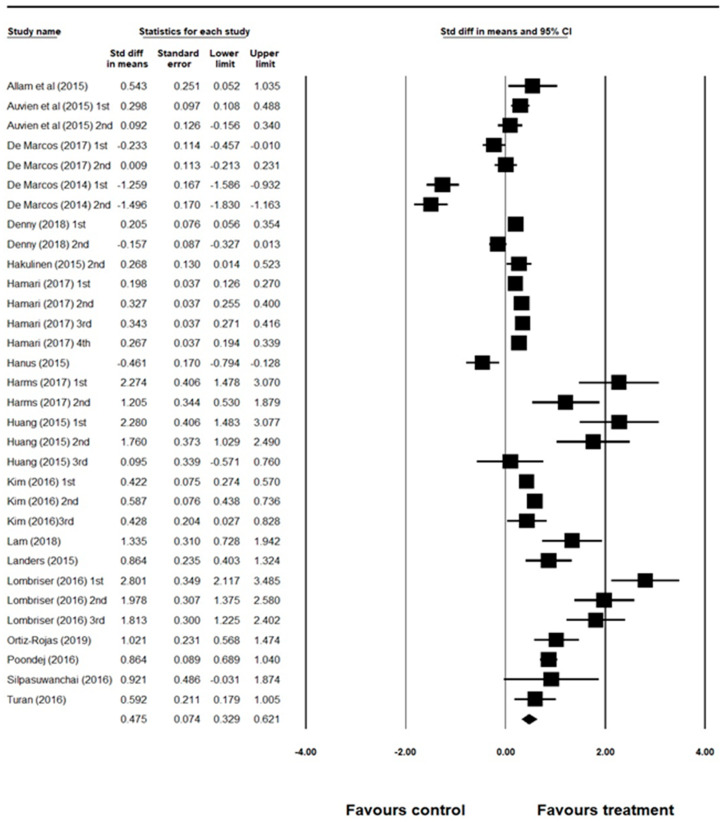
- Overall gamification effect was statistically significant and moderate: ES = 0.48, 95% CI = 0.33, 0.62, based on 32 effect sizes from 18 studies.
- Age moderated effects: adults ES = 0.95 (95% CI = 0.70, 1.12), K-12 ES = 0.92 (95% CI = 0.29, 1.55), college students ES = 0.15 (95% CI = −0.04, 0.35); Q between = 26.27, df = 2, p < 0.01.
- Intervention length moderated effects: less than 1 h ES = 1.57 (95% CI = 1.25, 1.90), 2–16 weeks ES = 0.39 (95% CI = 0.21, 0.57), 1–2 years ES = −0.20 (95% CI = 0.40, 0.77 as reported); Q statistic significant.
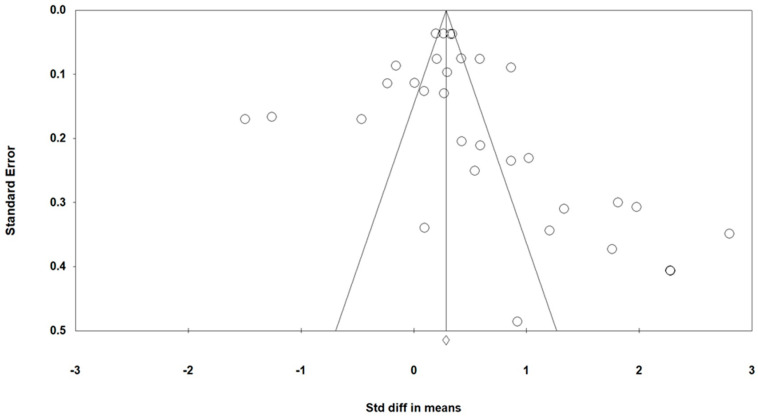
- Measurement type did not significantly differ, but participation level ES = 0.60 (95% CI = 0.40, 0.77) was higher than test score ES = 0.30 (95% CI = 0.03, 0.18 as reported). Publication bias was minimized (Egger’s intercept = 1.46, p = 0.22).
Methods
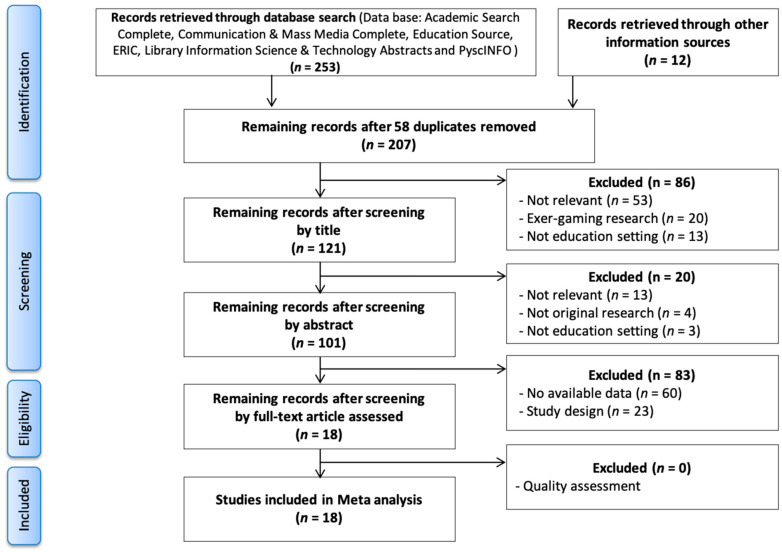
- PRISMA-guided meta-analysis; searched Academic Search Complete, Communication & Mass Media Complete, Education Source, ERIC, Library Information Science & Technology Abstracts, and PsycINFO for peer-reviewed English articles published 2010–2019; inclusion required experimental controlled design, gamification elements, and educational setting; game-based learning/serious games excluded.
- From 253 records plus 12 from reference lists, 18 studies provided sufficient data and were included, yielding 32 effect sizes; two reviewers coded studies, and methodological quality was fair (Downs and Black mean ± SD = 17.11 ± 1.37, range 15–20, maximum 28).
- Random-effects model used mean group differences between gamification and control for test score and participation level; moderator analyses used Cochran’s Q; publication bias assessed via funnel plot and Egger’s test; analyses conducted in Comprehensive Meta-Analysis version 2.
Limitations
- Stated: all included studies were quasi-experimental rather than randomized controlled trials, limiting causal conclusions; gamification elements varied across studies (e.g., badges/leaderboards combined with progress bars or points), and future research should use objective measurable treatments such as online badges and leaderboards only.
- Stated: methodological quality was fair; generalizability should be interpreted cautiously; additional concurrent experimental research could not be included; contextual/developmental factors were beyond scope; more data are needed to support reliability of timing/duration assertions.
- Evident: only 18 studies and 32 effect sizes were included, with small age subgroup counts (2 K-12, 10 college, 6 adult studies), limiting precision of moderator estimates; some reported confidence intervals appear inconsistent (e.g., 1–2 years ES = −0.20 with 95% CI = 0.40, 0.77; test score ES = 0.30 with 95% CI = 0.03, 0.18).
Model-written summary. Check it against the paper before relying on it.
Integrity signals
Registry
Cites
Statistics
Figures
Verification
Claims the paper makes
0 Valid · 0 Not valid · 27 Not checked · 45 Own results and interpretations
A result the paper reports from its own data — it cites no other source for it, so there is none to check. The quote shows it is in the paper.
In the paper
“Brief interventions delivered in days or less than 1 week were significantly more effective (ES = 1.57) than interventions lasting up to 20 weeks (ES = 0.30).”
§ Effects of Gamification on Behavioral Change in Education: A Meta-Analysis > Abstract
plainstates a cause- Asserted: passes — The authors put it forward as true.
- Checkable: passes — It can be checked against evidence.
- Load-bearing: passes — The paper’s conclusions depend on it.
- Based: passes — The paper gives a reason why it holds.
A result the paper reports from its own data — it cites no other source for it, so there is none to check. The quote shows it is in the paper.
In the paper
“The results of moderator analysis indicate that the Q statistic for the age (K-12, college students, and adults) and intervention length (less than 1 h, 2–16 weeks, and 1–2 years) were statistically significant.”
§ Effects of Gamification on Behavioral Change in Education: A Meta-Analysis > 3. Results > 3.2. Moderator Analysis
hedged- Asserted: passes — The authors put it forward as true.
- Checkable: passes — It can be checked against evidence.
- Load-bearing: passes — The paper’s conclusions depend on it.
- Based: passes — The paper gives a reason why it holds.
A result the paper reports from its own data — it cites no other source for it, so there is none to check. The quote shows it is in the paper.
In the paper
“Using a random-effects model, a statistically significant (Cohen’s d (ES) = 0.48, 95% CI = 0.33, 0.62) gamification effect was evidenced by moderate and positive grand effects sizes (ES).”
- Also stated in: § 3.1. Overall ES · plain
“The results from ES calculations indicated that the treatment (gamification) effect was statistically significant (Cohen’s d (ES) = 0.48, 95% CI = 0.33, 0.62), moderate, and positive mean ES, using a random-effects model.”
- Also stated in: § 4. Discussion · plain
“The results show that the gamification strategy has a moderate, positive effect on engagement behaviors and test scores.”
§ Effects of Gamification on Behavioral Change in Education: A Meta-Analysis > Abstract
plainstates a cause- Asserted: passes — The authors put it forward as true.
- Checkable: passes — It can be checked against evidence.
- Load-bearing: passes — The paper’s conclusions depend on it.
- Based: passes — The paper gives a reason why it holds.
- Also stated in: § 3.1. Overall ES · plain
A result the paper reports from its own data — it cites no other source for it, so there is none to check. The quote shows it is in the paper.
In the paper
“The Q statistic for the intervention length also indicated that less than 1-h intervention (ES = 1.57, 95% CI = 1.25, 1.90) appeared to be more effective than 2–16 weeks (ES = 0.39, 95% CI = 0.21, 0.57) and 1–2 years (ES = −0.20, 95% CI = 0.40, 0.77) intervention groups in behavioral change.”
§ Effects of Gamification on Behavioral Change in Education: A Meta-Analysis > 3. Results > 3.2. Moderator Analysis
hedgedstates an association- Asserted: passes — The authors put it forward as true.
- Checkable: passes — It can be checked against evidence.
- Load-bearing: unclear — It is unclear whether the paper’s conclusions depend on it.
- Based: passes — The paper gives a reason why it holds.
A result the paper reports from its own data — it cites no other source for it, so there is none to check. The quote shows it is in the paper.
In the paper
“The results indicated that gamification impacts are similar across all types of outcome measurements.”
§ Effects of Gamification on Behavioral Change in Education: A Meta-Analysis > 4. Discussion > 4.5. Implications for Gamified Educational Learning
hedged- Asserted: passes — The authors put it forward as true.
- Checkable: passes — It can be checked against evidence.
- Load-bearing: passes — The paper’s conclusions depend on it.
- Based: passes — The paper gives a reason why it holds.
35 more claims
Create a free account to see all 72 claims and to verify the 27 references still open.
- It may state two separate claims as one. 18
- The quote only partly states this claim. 1
- Probably not a substantial claim. 21
Self-check
Percentages, sums and reported differences re-computed from the paper’s own numbers.
Each contradiction between two passages listed here was confirmed by an independent check.
Rated major: it would touch a result — a value a result rests on, reported and recomputed p-values on opposite sides of the significance level, two passages that conflict with no sign which is right, or a cited work retracted before this paper was published.
In the paper
§ Effects of Gamification on Behavioral Change in Education: A Meta-Analysis > Abstract
“ES = −0.20”
§ Effects of Gamification on Behavioral Change in Education: A Meta-Analysis > 3. Results > 3.2. Moderator Analysis
“95% CI = 0.40, 0.77”
Rated major: it would touch a result — a value a result rests on, reported and recomputed p-values on opposite sides of the significance level, two passages that conflict with no sign which is right, or a cited work retracted before this paper was published.
In the paper
§ Effects of Gamification on Behavioral Change in Education: A Meta-Analysis > 4. Discussion > 4.3. Behavioral Change and Learning Outcome
“test score (ES = 0.30”
§ Effects of Gamification on Behavioral Change in Education: A Meta-Analysis > 4. Discussion > 4.3. Behavioral Change and Learning Outcome
“95% CI = 0.03, 0.18”
Rated minor: it would not touch a result — a value no result rests on, a p-value that stays on the same side of the significance level, or a conflict that is clerical, resolved elsewhere in the paper, or outside its own findings.
In the paper
§ Effects of Gamification on Behavioral Change in Education: A Meta-Analysis > 3. Results
“A total of 253 publications from 5 databases and 12 potentially relevant studies from the reference lists of the included articles were considered for further review.”
§ Effects of Gamification on Behavioral Change in Education: A Meta-Analysis > 2. Materials and Methods > 2.1. Procedure
“The search engines of Academic Search Complete, Communication & Mass Media Complete, Education Source, ERIC, Library Information Science & Technology Abstracts, and PsycINFO were used to identify relevant studies published between 2010 and 2019.”
Rated minor: it would not touch a result — a value no result rests on, a p-value that stays on the same side of the significance level, or a conflict that is clerical, resolved elsewhere in the paper, or outside its own findings.
In the paper
§ Effects of Gamification on Behavioral Change in Education: A Meta-Analysis > 3. Results
“No studies had quality scores outside two standard deviations of the mean.”
§ Effects of Gamification on Behavioral Change in Education: A Meta-Analysis > 3. Results
“mean ± standard deviation (SD) 17.11 ± 1.37, ranging from 15 to 20”
Citations
Cites
Preferred Reporting Items for Systematic Reviews and Meta-Analyses: the PRISMA statement
Moher, D., Liberati, A., Tetzlaff, J., Altman, D. G., & for the PRISMA Group (2009) · BMJ · doi:10.1136/bmj.b2535 · Cited by 83,823
Statistical power analysis for the behavioral sciences
(1990) · Computers, Environment and Urban Systems · doi:10.1016/0198-9715(90)90050-4 · Cited by 65,269
Bias in meta-analysis detected by a simple, graphical test
Egger, M., Smith, G. D., Schneider, M., & Minder, C. (1997) · BMJ · doi:10.1136/bmj.315.7109.629 · Cited by 56,722 · cited 2×
“When publication bias has occurred, sections of the funnel may be missing, or the plot ay become very asymmetrical [49].”
BackgroundUser Acceptance of Information Technology: Toward A Unified View1
Venkatesh, V., Morris, M. G., Davis, G. B., & Davis, F. D. (2003) · MIS Quarterly · doi:10.2307/30036540 · Cited by 45,035 · cited 1×
“This result was contrary to previous research that the influences of age in technology adoption and usage have designated that younger technology users value the technology’s usefulness more than older [52].”
ResultPreferred reporting items for systematic reviews and meta-analyses: the PRISMA Statement.
(2009) · PubMed Central · Cited by 44,859
Preferred reporting items for systematic reviews and meta-analyses: The PRISMA statement
Moher, D., Liberati, A., Tetzlaff, J., Altman, D. G., & the PRISMA Group* (2009) · Annals of Internal Medicine · doi:10.7326/0003-4819-151-4-200908180-00135 · Cited by 37,554
The "what" and "why" of goal pursuits: Human needs and the self-determination of behavior
Deci, E. L., & Ryan, R. M. (2000) · Psychological Inquiry · doi:10.1207/s15327965pli1104_01 · Cited by 34,210 · cited 1×
“SDT is grounded in three essential human psychological needs: competence, autonomy, and relatedness [12].”
BackgroundStatistical Methods for Meta-Analysis
Wasserman, S., Hedges, L. V., & Olkin, I. (1988) · Journal of Educational Statistics · doi:10.2307/1164953 · Cited by 10,326
From game design elements to gamefulness: defining "gamification"
Deterding, S., Dixon, D., Khaled, R., & Nacke, L. (2011) · Proceedings of the 15th International Academic MindTrek Conference: Envisioning Future Media Environments · doi:10.1145/2181037.2181040 · Cited by 8,402 · cited 1×
“These studies led researchers to theorize that gamification could also be used in education as a tool to increase students’ engagement and to drive them toward desirable learning behaviors [18].”
BackgroundDowns, S. H., & Black, N. (1998) · Journal of Epidemiology and Community Health · doi:10.1136/jech.52.6.377 · Cited by 8,252 · cited 2×
“During the screening step, two reviewers inspected the full text of included studies and independently coded the research methodological to assess its rigor using the Downs and Black checklist [25].”
Method
Cited by
Items 101–200 of 332
Cohesive Online Education Model Using Emergent Technologies to Improve Accessibility and Impact
Swanepoel, J. A. (2024) · Education Sciences · doi:10.3390/educsci14050522 · Cited by 8
Emerging Paradigms in Non-Profit Governance: A Comprehensive Analysis of Disruptive Innovations
Santos, J. (2024) · Advances in logistics, operations, and management science book series · doi:10.4018/979-8-3693-3723-3.ch001 · Cited by 7
Effects of reward strategies in gamified learning on academic performance: A systematic review
Bai, S., Liu, Y., Hew, K. F., Sailer, M., & Xiao, Y. (2026) · Educational Research Review · doi:10.1016/j.edurev.2026.100766 · Cited by 7
Sangroya, D., & Kabra, G. (2023) · AIP conference proceedings · doi:10.1063/5.0181951 · Cited by 7
The construction and validation of a Questionnaire of Gamification Skills in Teachers (QGST)
Reyes, W., Sosa, J. E. P., & Hernández-Dzib, R. (2022) · Interaction design & architecture(s)/ID&A Interaction design & architecture(s) · doi:10.55612/s-5002-053-001 · Cited by 7
Structured briefing: Towards meaningful learning experiences with simulation games
Freese, M., & Lukosch, H. K. (2025) · Computers & Education · doi:10.1016/j.compedu.2025.105461 · Cited by 7
Evaluation of the quality of oral hygiene mobile apps for children using the mobile app rating scale
Meriç, E. (2024) · International Journal of Medical Informatics · doi:10.1016/j.ijmedinf.2024.105612 · Cited by 7
Usability of Mathematics Gamification among Pre-Diploma Students
Zainuddin, P. F. A. (2023) · International Journal of Academic Research in Progressive Education and Development · doi:10.6007/ijarped/v12-i4/19547 · Cited by 7
Shojaei, F., Shojaei, F., Desai, A. P., Long, E., Mehta, J., Fowler, N. R., Holden, R. J., Orman, E. S., & Boustani, M. A. (2024) · JMIR Formative Research · doi:10.2196/57390 · Cited by 7
Martínez, A. G., & Agustí, M. F. (2022) · Innoeduca International Journal of Technology and Educational Innovation · doi:10.24310/innoeduca.2022.v8i1.10299 · Cited by 7
Should I Play or Should I Go? Identifying Challenges for Gamification
Cermak-Sassenrath, D. (2022) · Advances in business strategy and competitive advantage book series · doi:10.4018/978-1-7998-9223-6.ch002 · Cited by 6
Kim, J., Lindqvist, A. K., & Castelli, D. M. (2024) · Journal of American College Health · doi:10.1080/07448481.2024.2325929 · Cited by 6
Self-citationImprovement of soft skills in preschool teachers through gamification
Zhakupova, A., Yerkebaeva, S. Z., Zhumasheva, T., Myshbayeva, G., Zhandildina, R., & Mukhanbetzhanova, A. (2022) · Cypriot Journal of Educational Sciences · doi:10.18844/cjes.v17i9.8128 · Cited by 6
Cyber harassment of children with special reference to digital games
Baltezarević, V., Baltezarević, R., & Baltezarević, I. (2023) · Temida · doi:10.2298/tem2302261b · Cited by 6
Gamification in Higher Education: Analysis of Your Strengths and Weaknesses
Arufe-Giráldez, V., Navarro-Patón, R., & Sanmiguel-Rodríguez, A. (2022) · Advances in game-based learning book series · doi:10.4018/978-1-6684-4287-6.ch004 · Cited by 6
Shernay, N., Issakov, Y., Ussenov, N., Aubakirova, G. B., Bakirbayeva, P., Артыкбаевна, К. Д., Assen, N., Nizamatdinova, Z., Gajić, T., & Lóránt, D. D. (2026) · Frontiers in Education · doi:10.3389/feduc.2026.1722540 · Cited by 6
Use of Badges as Achievements to Enhance Online Learning
Raj, B. V. S., & Divya, C. (2023) · Archives of Medicine and Health Sciences · doi:10.4103/amhs.amhs_114_23 · Cited by 6
Transformations in Digital Linguistics: How Social Media Shapes Vocabulary and Grammar
Ovsiienko, L. (2025) · Journal of Information Systems Engineering & Management · doi:10.52783/jisem.v10i16s.2676 · Cited by 6
Leveraging Existing Trained AI Models for Enhanced Interview Preparation
Gupta, S. (2025) · Journal of Computer Science and Technology Studies · doi:10.32996/jcsts.2025.7.7.52 · Cited by 5
Beyond Points and Badges: Deepening Engagement in MOOCs through Gamification
Wahyudi, M. N. A., Budiyanto, C. W., Widiastuti, I., & Pambudi, N. A. (2025) · International Journal of Interactive Mobile Technologies (iJIM) · doi:10.3991/ijim.v19i01.51705 · Cited by 5
Quality Enhancement in Higher Education: Insights from Strategic Plan Implementation
Azhar, M., Subaedah, S., & Asykur, M. (2024) · AL-TANZIM JURNAL MANAJEMEN PENDIDIKAN ISLAM · doi:10.33650/al-tanzim.v8i2.6612 · Cited by 5
Walk in Their Shoes to Navigate Your Own Path: Learning About Procrastination Through A Serious Game
Zhang, R., Gan, J., Gao, S., Chen, S., Wu, X., Chen, D., Tian, Y., Wang, Q., & An, P. (2025) · CHI Conference on Human Factors in Computing Systems · doi:10.1145/3706598.3715271 · Cited by 5
Tsagaris, Á., & Chatzikyrkou, M. (2026) · European Journal of Educational Research · doi:10.12973/eu-jer.15.2.465 · Cited by 5
Orsoni, M. (2024) · AMS Dottorato Institutional Doctoral Theses Repository (University of Bologna) · doi:10.48676/unibo/amsdottorato/11482 · Cited by 5
Perancangan Gamifikasi Pada Proses Implementasi ERP Menggunakan Metode Accelerate SAP
Dewangga, K., Emanuel, A. W. R., & Widhiyanti, K. (2022) · Teknika · doi:10.34148/teknika.v11i3.552 · Cited by 5
Rahim, M., & Mohammed, L. A. (2025) · Journal of Asian Development Studies · doi:10.62345/jads.2025.14.1.148 · Cited by 5
Exploring Gamification Approaches in Grammar Learning
Inton, L. N. L. M. (2024) · FLIP Foreign Language Instruction Probe · doi:10.54213/flip.v3i1.398 · Cited by 5
Conesa, I. M. G. (2024) · Advances in educational technologies and instructional design book series · doi:10.4018/979-8-3693-2169-0.ch008 · Cited by 5
Transmedia and Digital Addiction
Semolini, F. F., da Silva, L. S., Vitta, A. S. L., Freires, É. M., & Andrade, A. L. M. (2025) · Springer eBooks · doi:10.1007/978-3-031-87986-9_11 · Cited by 4
GAMIFICATION AS A LEARNING RESOURCE FOR DENTISTRY STUDENTS – EXPERIENCE REPORT
Schimunda, N. D. F., Silva, F. J. D. S., Fregoneze, A. P., Petraukas, A., Doetzer, A. D., Spada, P. P., Torres, M. F. P., & Brancher, J. A. (2023) · Revista Contemporânea · doi:10.56083/rcv3n12-253 · Cited by 4
Characteristics of gamification as a method of adult education
Mironova, O. I., Ruonala, L. A., & researcher, I. (2023) · Педагогика и психология образования · doi:10.31862/2500-297x-2023-2-76-89 · Cited by 4
Lo, C.-H. (2026) · BMC Psychology · doi:10.1186/s40359-026-05046-8 · Cited by 4
Ma, T., Zheng, B., Wang, W., & Liu, H. (2025) · Technological Forecasting and Social Change · doi:10.1016/j.techfore.2025.124464 · Cited by 4
E-Learning as a Global Vessel Towards Inclusive and Quality Education
Renacido, J. M. D., & Biray, E. T. (2024) · Advances in educational technologies and instructional design book series · doi:10.4018/979-8-3693-8242-4.ch008 · Cited by 4
Conexiones en las nuevas metodologías educativas del Lore como recurso educativo
Sánchez-Cabrero, R. (2024) · Educación y Humanismo · doi:10.17081/eduhum.26.46.6668 · Cited by 4
Knowledge on the Move: Studies on Mobile Social Education
Roy, A. N., Tankut Gülhan, S., Bazuń, D., & Kwiatkowski, M. (2023) · CLOK (University of Central Lancashire) · Cited by 4
Mayanti, E. D., & Putra, A. K. (2024) · Jurnal Ekonomi Bisnis dan Pendidikan · doi:10.17977/um066v3i92023p3 · Cited by 4
Rulona, E. M. P., Colcol, G. S., & Baluyos, G. R. (2025) · International Journal of Research and Innovation in Social Science · doi:10.47772/ijriss.2025.908000618 · Cited by 4
STS and Participatory Edtech (Re-)Design
Hartong, S., & Decuypere, M. (2026) · Springer eBooks · doi:10.1007/978-981-92-1483-9_28 · Cited by 3
Gamification of an Automated Internet Intervention to Enhance Engagement and Adherence
Curland, R. A., Muñoz, R. F., & Leykin, Y. (2025) · Journal of Technology in Behavioral Science · doi:10.1007/s41347-025-00528-9 · Cited by 3
Jia, C., Hew, K. F., Xiao, Y., & He, J. (2024) · Interactive Learning Environments · doi:10.1080/10494820.2024.2372640 · Cited by 3
Impact of Gamified Learning on First-Time Learners in Thai Higher Education: A Mixed-Methods Study
Waluyo, B., & Kusuma, I. P. I. (2025) · English Teaching & Learning · doi:10.1007/s42321-025-00200-8 · Cited by 3
Using Gamification Techniques to Enhance Learning in Primary School
Koutsikou, A., & Αντωνόπουλος, Ν. (2024) · Advances in educational technologies and instructional design book series · doi:10.4018/979-8-3693-9806-7.ch008 · Cited by 3
Gamification: An Emerging Educational Technology for Student Learning
Banerjee, S., Banerjee, R., Gulati, C., & Chauhan, A. S. (2024) · International Conference on Recent Trends in Microelectronics, Automation, Computing and Communications Systems (ICMACC) · doi:10.1109/icmacc62921.2024.10894409 · Cited by 3
Ghosh, O., & Kumar, B. (2025) · IGI Global eBooks · doi:10.4018/979-8-3373-1235-4.ch001 · Cited by 3
Barth, R. (2024) · MedienPädagogik Zeitschrift für Theorie und Praxis der Medienbildung · doi:10.21240/mpaed/58/2024.07.01.x · Cited by 3
Nascimento, J., Santos, J. J., & Bittencourt, I. I. (2024) · International Journal of Artificial Intelligence in Education · doi:10.1007/s40593-024-00432-y · Cited by 3
Hong, Y., & Liu, W. (2023) · OALib · doi:10.4236/oalib.1110759 · Cited by 3
Digital Gamification And Physical Activity Of Students
Antonopoulos, N. (2024) · IOSR Journal of Sports and Physical Education · doi:10.9790/6737-1106014659 · Cited by 3
Kartal, M. Y., & Köksal, D. (2025) · Çanakkale Onsekiz Mart University Institutional Repository · doi:10.5281/zenodo.15210489 · Cited by 3
Wijayanti, W., & Subekti, F. E. (2026) · Journal of Advanced Sciences and Mathematics Education · doi:10.58524/jasme.v6i2.1178 · Cited by 3
Togambayev, R., Pirmanov, I., Koshekov, K., Левченко, Н. М., Koshekov, A., Tanovitskiy, Y., & Курбанов, Я. М. (2025) · RADIOELECTRONIC AND COMPUTER SYSTEMS · doi:10.32620/reks.2025.2.01 · Cited by 3
Jing, Z., Yongjie, L., Li, S., Ruiqi, M., Zhang, X., & Zheng, X. (2024) · International Symposium on Educational Technology · doi:10.1109/iset61814.2024.00093 · Cited by 3
Addressing Student Tardiness Through a Strategic Reward System: A Study Among Grade 12 Students
Montederamos, C. E. A. (2024) · Randwick International of Education and Linguistics Science Journal · doi:10.47175/rielsj.v5i4.1092 · Cited by 3
Gamification as a method supporting the adaptation of first-year students to the university life
Jędrzejczak, M. (2024) · Beyond Philology An International Journal of Linguistics Literary Studies and English Language Teaching · doi:10.26881/bp.2024.2.01 · Cited by 3
Hermoza, M. S., Morales, K. L. H., & Segovia, M. S. (2024) · Emergentes - Revista Científica · doi:10.60112/erc.v4.i2.156 · Cited by 3
Tang, K., Chen, K.-W., Gopi, S., Xie, L., Quinlan, M., & Cho, Y. (2026) · Designing Interactive Systems Conference · doi:10.1145/3800645.3812916 · Cited by 2
Adewojo, A. A. (2025) · Business Information Review · doi:10.1177/02663821251364072 · Cited by 2
Effects of gamification mechanisms on the behaviour of bank customers using credit cards
Gautam, P. (2022) · doi:10.34074/thes.5710 · Cited by 2
Bulut, Ö. Ü., & Gölbaşı, Z. (2023) · Journal of General Health Sciences (JGEHES) Necmettin Erbakan University · doi:10.51123/jgehes.2023.87 · Cited by 2
Melchor, P. J. M., & Parcutilo, J. O. (2025) · American Journal of Educational Research · doi:10.12691/education-13-4-1 · Cited by 2
Manual para la elaboración de laboratorios virtuales autorregulados
Manzanares, M. C. S., Sánchez, R. M., Val, E. M., Txopitea, M., & Sánchez, G. M. (2024) · Universidad de Burgos eBooks · doi:10.36443/9788418465871 · Cited by 2
Formes et sens de l’innovation éducative gamifiée Une étude de cas : la plateforme Pix
Lavigne, M. (2023) · Technologie et innovation · doi:10.21494/iste.op.2023.0972 · Cited by 2
Implementation of STEAM Gamification in Science Learning: A Systematic Literature Review
Wijayanti, A., ., W., Ridlo, S., & Parmin, P. (2025) · Journal of Posthumanism · doi:10.63332/joph.v5i7.2846 · Cited by 2
Khan, H., & Safdar, G. (2025) · THE PROGRESS A Journal of Multidisciplinary Studies · doi:10.71016/tp/16g7qy47 · Cited by 2
Review of Gamification Approach in Legal Studies
Khairunnizam, M. H. B., Mohd, N. I., & Ariffin, H. L. T. (2025) · International Journal of Research and Innovation in Social Science · doi:10.47772/ijriss.2025.903sedu0372 · Cited by 2
Points, Levels, and Streaks in Primary EFL: Effects on Vocabulary Growth and Engagement
Murphy, A. P. D. (2025) · Journal of Data Analysis and Critical Management · doi:10.64235/w0xjdy03 · Cited by 2
Arifuddin, A., Rayasari, F., Anggraini, D., & Jumaiyah, W. (2026) · Lentera Perawat · doi:10.52235/lp.v7i1.695 · Cited by 2
Kalimuthu, H. (2025) · International Journal on Research and Development - A Management Review · doi:10.65521/ijrdmr.v14i1.1852 · Cited by 2
Sosialisasi Bahaya JUDOL (Judi Online) Dalam Perspektif Ekonomi di SMKN 2 Sungailiat-Bangka
Sihombing, S., Sahputri, R. A. M., Njoman, M. G., & Rini, L. E. (2025) · Jurnal Pengabdian kepada Masyarakat Politeknik Negeri Batam · doi:10.30871/abdimaspolibatam.v7i1.9540 · Cited by 2
Lomonosova, A. V., Chuchaeva, K. Y., & Kupatenko, Y. G. (2023) · Infectious diseases News Opinions Training · doi:10.33029/2305-3496-2023-12-4-100-107 · Cited by 2
The Combination of Gamification Teaching and Technology
Zhang, Z. (2024) · Communications in Humanities Research · doi:10.54254/2753-7064/63/20242592 · Cited by 2
Kanadlı, S., & Tokmak, H. S. (2026) · Review of Education · doi:10.1002/rev3.70223 · Cited by 1
Immersive Experiences in Virtual Science Labs: A Systematic Review and the VIRTAS Framework
Saidi, A. E. M., Junaini, S. N., & Mustafa, W. A. (2025) · doi:10.1109/iceei68459.2025.11330708 · Cited by 1
Zia, T., Khan, M., & Hossain, M. B. (2025) · Human Behavior and Emerging Technologies · doi:10.1155/hbe2/9026903 · Cited by 1
Najamuddin, A. A., Umrati, & Juliani, J. (2024) · ETDC Indonesian Journal of Research and Educational Review · doi:10.51574/ijrer.v3i3.2691 · Cited by 1
Li, J., Zhu, H., Xiang, Y., & Huang, L. (2026) · Behavioral Sciences · doi:10.3390/bs16060979 · Cited by 1
Stamp collecting game improves internship performance and experience in medical education
Han, M., Wei, S., Yu, L., Yuan, T., & Zhang, Y. (2025) · BMC Medical Education · doi:10.1186/s12909-025-07764-w · Cited by 1
Enhancing First-Year Mathematics Achievement Through a Complex Gamified Learning System
Muzsnay, A., Szörényi, S., Stirling, A. D., Szabó, C. L., & Szeibert, J. (2026) · Education Sciences · doi:10.3390/educsci16010159 · Cited by 1
Aguirre, C. I. V., Escobar, L. M. C., Huera, V. B. B., Lloacana, M. Y. S., & Caló, V. L. L. (2026) · Perspectiva XXI · doi:10.70577/awxphx11 · Cited by 1
Using Gamification to Teach Cybersecurity in a Social Science Course: An Experience Paper
Graham, R. S., & Williams, M. (2025) · Journal of Cybersecurity Education Research and Practice · doi:10.62915/2472-2707.1207 · Cited by 1
Introduction Gamification in the Emerging Metaverse
Venkatachari, K. (2025) · IGI Global eBooks · doi:10.4018/979-8-3693-8886-0.ch001 · Cited by 1
Zuo, T., & Wei, Q. (2026) · International Journal of Technology and Design Education · doi:10.1007/s10798-026-10090-x · Cited by 1
Bulut, Ö. Ü., & Gölbaşı, Z. (2026) · Health Education Research · doi:10.1093/her/cyag014 · Cited by 1
Nascimento, J., Santos, J., Challco, G. C., & Bittencourt, I. I. (2024) · Journal of the Brazilian Computer Society · doi:10.5753/jbcs.2024.3600 · Cited by 1
The Spread and Impact of Game Innovations: A Systematic Review of Academic and Applied Domains
Steinkuehler, C. A., & Squire, K. D. (2026) · Games Research and Practice · doi:10.1145/3785325 · Cited by 1
Brumar, R., Nicola, S., & Ciocârlie, H. (2025) · Multimodal Technologies and Interaction · doi:10.3390/mti9110111 · Cited by 1
سويفي, غ., & همام, ن. ع. (2022) · Dirāsāt fi Al-Ṭufūlaẗ wa Al-Tarbiyyaẗ /Dirāsāt fi Al-Ṭufūlaẗ wa Al-Tarbiyyaẗ · doi:10.21608/dftt.2022.140264.1118 · Cited by 1
Analysis of MDE Based Gamification Framework for Cognitive Evaluation
Islam, M. M., Biswas, S., Ahmed, M. S., Rahman, M. J., Hasan, A. R., Amin, A., & Mukta, S. H. (2024) · International Conference on Computer Theory and Applications (ICCTA) · doi:10.1109/iccta64612.2024.10974770 · Cited by 1
Exploring the Impact of Gamified Learning on Student Motivation in Computer Science EducationPreprint
Alabdullah, B. I., Khenissi, M. A., & Almjally, A. (2024) · Research Square · doi:10.21203/rs.3.rs-4528949/v1 · Cited by 1
Manual para la elaboración de laboratorios virtuales autorregulados
Manzanares, M. C. S., Sánchez, R. M., Val, E. M., Txopitea, M., & Sánchez, G. M. (2024) · Universidad de Burgos eBooks · doi:10.36443/9788418465888 · Cited by 1
Torres, R. M. (2026) · Pantao (International Journal of the Humanities and Social Sciences) · doi:10.69651/pijhss05031293 · Cited by 1
Khokha, A. (2025) · International Journal of Social Science Research and Review · doi:10.47814/ijssrr.v8i7.2812 · Cited by 1
Wilkerson, T.-L., Meyers, K., Subramaniam, S., Hearns, R., Stevenson, L. D., & Ball, S. L. (2024) · Journal of Patient Experience · doi:10.1177/23743735241256463 · Cited by 1
Gamification as a Learning Strategy in the Training of B1 English Learners
Cevallos-Almeida, A.-L., & Martínez, M. Á. Q. (2023) · Lecture notes in educational technology · doi:10.1007/978-981-99-7353-8_5 · Cited by 1
Dóra, K., & Balázs, F. J. (2023) · SZTE Publicatio Repozitórium (University of Szeged) · Cited by 1
Hug, J., & Wollert, J. F. (2025) · European Conference on Games Based Learning · doi:10.34190/ecgbl.19.1.3885 · Cited by 1
Ghader Azad, H. (2025) · PolyPublie (École Polytechnique de Montréal) · Cited by 1
Josua, D. P., Sutisna, A., Suseno, M., & Arthur, R. (2025) · International Journal of Innovative Science and Research Technology (IJISRT) · doi:10.38124/ijisrt/25nov1212 · Cited by 1
Zamri, N. A. F., Bakar, A. A., & Saidin, S. (2025) · International Journal of Research and Innovation in Social Science · doi:10.47772/ijriss.2025.9010401 · Cited by 1
Metadata
- Authors
- Kim, J., & Castelli, D. M.
- Affiliations
- Physical Education Teacher Education, Department of Curriculum and Instruction, The University of Texas at Austin, Austin, TX 78712, USA
- The University of Texas at Austin (US)
- Corresponding author
- Castelli, Darla M.
- ORCID
- Castelli, Darla M.
- Venue
- International Journal of Environmental Research and Public Health
- Publisher
- MDPI AG
- Published
- 2021-03-29
- Volume
- 18
- Issue
- 7
- Pages
- 3550
- ISSN
- 1660-4601 (ISSN-L)
- PMC
- PMC8037535
- OpenAlex
- W3143984123
- Cited by
- 332
- References
- 66
- Citations by year
- 2026: 81 · 2025: 101 · 2024: 68 · 2023: 43 · 2022: 33 · 2021: 6
- FWCI
- 5.17
- Type
- journal article
- Language
- en
- Open access
- gold
- doi.org
- Licence
- Locations
- International Journal of Environmental Research and Public Health (publishedVersion, cc-by)
- PubMed Central (publishedVersion, cc-by)
- PubMed (publishedVersion)
- RePEc: Research Papers in Economics (acceptedVersion)
- Topics
- Social Sciences › Psychology › Developmental and Educational Psychology › Educational Games and Gamification
- Physical Sciences › Computer Science › Computer Science Applications › Online Learning and Analytics
- Social Sciences › Sociology and Political Science › Digital Games and Media
- Keywords
- gamification, behavior change, digital badges, student engagement, higher education, K-12 students, intervention duration, game elements, learning outcomes
- MeSH terms
- Adult, Humans, Learning, Reward, Students
About these checks
Registry, retraction, Cites and statistics results are computed, not judged, with one exception: a printed reference that no index lists is read once by a model before it counts as a citation error. Claims are extracted by a model and kept only when their quote appears verbatim in the text; each cited source is then checked, with a model’s help, for whether it says what the claim relies on. Those verdicts can be wrong — read the claim’s quote and the cited source before relying on one.
A language model drew the claims from the paper on 2026-11-23, under version 3 of the claim definition (model deepseek-v4.1-flash, prompt extract-v3).
A second model labelled each claim on 2026-11-23 (model jev-1.13-20260917, definition revision gold-guideline-v0.2).
Statistics and arithmetic are recomputed, not judged.
Confidence bands are shown only for fields calibrated on our annotated test set. None is calibrated yet, so no band is shown.
What counts as a claim ›How we measure confidence ›How we check this ›
Are you an author, or do you see a problem with this page? Request a review
Data sources
Bibliographic data: Semantic Scholar, OpenAlex, Crossref.
Contains information from the Semantic Scholar Academic Graph Datasets, made available under the ODC Attribution License (ODC-BY 1.0).
Semantic Scholar’s data is described in: Kinney, R., et al. (2023). The Semantic Scholar Open Data Platform. arXiv:2301.10140.
