

Changes in Adolescents' Psychosocial Functioning and Well-Being as a Consequence of Long-Term COVID-19 Restrictions
Open accessThe DOI matches its Crossref record; 57 of the 57 references it cites were found in a registry or an index.
Abstract
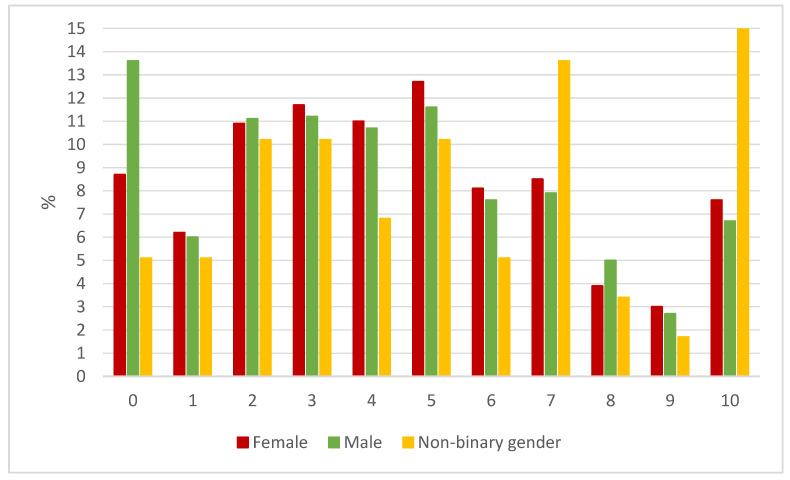
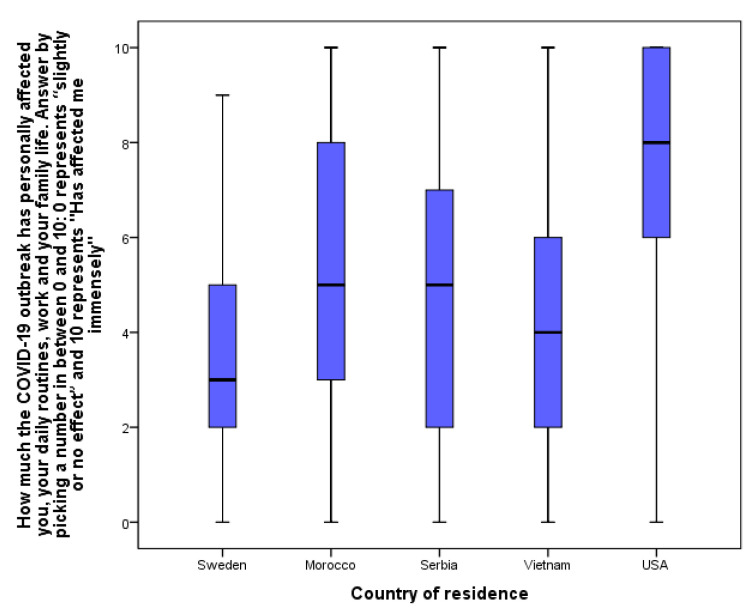
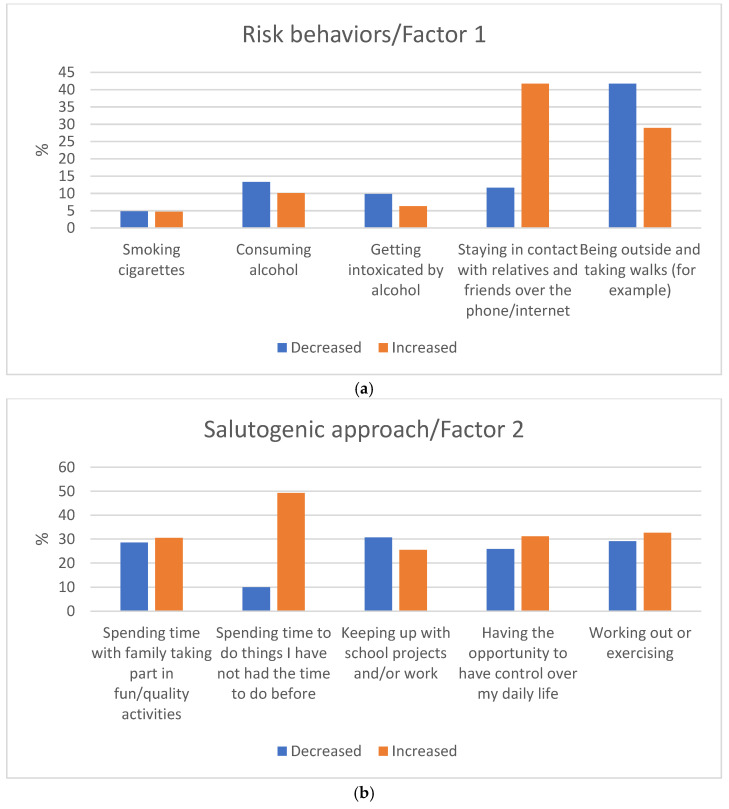
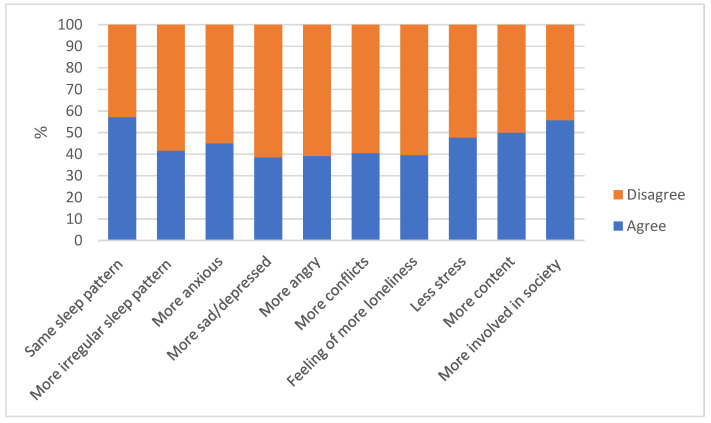
This work studied self-reports from adolescents on how the COVID-19 pandemic has changed their behaviors, relationships, mood, and victimization. Data collection was conducted between September 2020 and February 2021 in five countries (Sweden, the USA, Serbia, Morocco, and Vietnam). In total, 5114 high school students (aged 15 to 19 years, 61.8% females) responded to our electronic survey. A substantial proportion of students reported decreased time being outside (41.7%), meeting friends in real life (59.4%), and school performance (30.7%), while reporting increased time to do things they did not have time for before (49.3%) and using social media to stay connected (44.9%). One third of the adolescents increased exercise and felt that they have more control over their life. Only a small proportion of adolescents reported substance use, norm-breaking behaviors, or victimization. The overall COVID-19 impact on adolescent life was gender-specific: we found a stronger negative impact on female students. The results indicated that the majority of adolescents could adapt to the dramatic changes in their environment. However, healthcare institutions, municipalities, schools, and social services could benefit from the findings of this study in their work to meet the needs of those young people who signaled worsened psychosocial functioning, increased stress, and victimization.
Overview
The claims and statistics of this paper haven’t been checked yet.
Free: it reads the open-access text and checks the first 5 claims that cite a source we can check. Create a free account to check every claim.
Integrity signals
Registry
Cites
Statistics
Figures
Verification
Claims the paper makes
The claims and statistics of this paper haven’t been checked yet.
Free: it reads the open-access text and checks the first 5 claims that cite a source we can check. Create a free account to check every claim.
Claims other papers make about this one
Each is checked against this paper’s own text: does it say what the citing paper says it does?
The cited source says what the claim attributes to it.
In the citing paper
“a study on 5114 high school students from five countries (16) showed that more than 40% increased their social media time to stay connected with others since they could not meet in person.”
From Digital Media Use and Adolescents' Mental Health During the Covid-19 Pandemic: A Systematic Review and Meta-Analysis (2022) · cites this paper as [16]
Self-check
Percentages, sums and reported differences re-computed from the paper’s own numbers.
The self-check needs the paper’s full text.
Citations
Cites
The weirdest people in the world?
Henrich, J., Heine, S. J., & Norenzayan, A. (2010) · Behavioral and Brain Sciences · doi:10.1017/s0140525x0999152x · Cited by 12,641
WEIRD languages have misled us, too
Majid, A., & Levinson, S. C. (2010) · Behavioral and Brain Sciences · doi:10.1017/s0140525x1000018x · Cited by 4,076
Burden and consequences of child maltreatment in high-income countries
Gilbert, R., Widom, C. S., Browne, K., Fergusson, D., Webb, E., & Janson, S. (2009) · The Lancet · doi:10.1016/s0140-6736(08)61706-7 · Cited by 3,876
Why do many psychiatric disorders emerge during adolescence?
Paus, T., Keshavan, M., & Giedd, J. N. (2008) · Nature Reviews Neuroscience · doi:10.1038/nrn2513 · Cited by 3,123
Loades, M. E., Chatburn, E., Higson-Sweeney, N., Reynolds, S., Shafran, R., Brigden, A., Linney, C., McManus, M. N., Borwick, C., & Crawley, E. (2020) · Journal of the American Academy of Child & Adolescent Psychiatry · doi:10.1016/j.jaac.2020.05.009 · Cited by 2,906
Systematic review of COVID‐19 in children shows milder cases and a better prognosis than adults
Ludvigsson, J. F. (2020) · Acta Paediatrica · doi:10.1111/apa.15270 · Cited by 2,301 · cited 1×
“Children and adolescents were not considered at high risk for COVID-19 infection, and it was recognized that they had a milder disease course and a better prognosis than adults [1].”
BackgroundMitigate the effects of home confinement on children during the COVID-19 outbreak
Wang, G., Zhang, Y., Zhao, J., Zhang, J., & Jiang, F. (2020) · The Lancet · doi:10.1016/s0140-6736(20)30547-x · Cited by 2,148 · cited 1×
“Studies at the beginning of the pandemic warned that school closures and home confinement could lead to decreased physical activity and worsen psychological wellbeing in children and adolescents [35], and others reported such changes in a small study population (N = 125 university students in Canada) [36].”
BackgroundChronic stress, drug use, and vulnerability to addiction
Sinha, R. (2008) · Annals of the New York Academy of Sciences · doi:10.1196/annals.1441.030 · Cited by 1,904
Ten-Year Research Update Review: Child Sexual Abuse
PUTNAM, F. W. (2003) · Journal of the American Academy of Child & Adolescent Psychiatry · doi:10.1097/00004583-200303000-00006 · Cited by 1,488
Adolescent psychiatric disorders during the COVID-19 pandemic and lockdown
Guessoum, S. B., Lachal, J., Radjack, R., Carretier, E., Minassian, S., Benoit, L., & Moro, M. R. (2020) · Psychiatry Research · doi:10.1016/j.psychres.2020.113264 · Cited by 1,025 · cited 1×
“Another prediction that was not supported by our results is the expectation that adolescents would increase their substance use as a coping strategy during extremely stressful or traumatic environmental changes in their lives [7,18].”
Research works printed but not linked: 2
- Crocetti E. Meeus W.H.J. Ritchie R.A. Meca A. Schwartz S.J. Adolescent identity: Is this the key to unraveling associations between family relationships and problem behaviors? Parenting and Teen Drug Use Scheier L.M. Hansen W.B. Scheier L.M. Hansen W.B. Oxford University Press New York, NY, USA 2014 92 109
- Volkow N.D. America’s addiction to opioids: Heroin and prescription drug abuse Proceedings of the Senate Caucus on International Narcotics Control Washington, DC, USA 14 May 2014
Cited by
Marciano, L., Ostroumova, M., Schulz, P. J., & Camerini, A.-L. (2022) · Frontiers in Public Health · doi:10.3389/fpubh.2021.793868 · Cited by 420
“In line with this increment, a study on 5114 high school students from five countries (16) showed that more than 40% increased their social media time to stay connected with others since they could not meet in person.”
ResultSubstance Use Among Youth During the COVID-19 Pandemic: a Systematic Review
Layman, H. M., Thorisdottir, I. E., Halldorsdottir, T., Sigfusdottir, I. D., Allegrante, J. P., & Kristjansson, A. L. (2022) · Current Psychiatry Reports · doi:10.1007/s11920-022-01338-z · Cited by 176
Ge, M., Hu, F., Jia, Y., Tang, W. H., Zhang, W., Zhao, D., Shen, W., & Chen, H. (2023) · Psychological Reports · doi:10.1177/00332941231180119 · Cited by 84
“A study of 5114 high school students revealed that more than 40% increased the amount of time they spent staying connected to others on social media because they couldn ’ t meet in person (Kerekes et al., 2021).”
Hamilton, J. L., Dreier, M. J., & Boyd, S. I. (2023) · Current Opinion in Psychology · doi:10.1016/j.copsyc.2023.101633 · Cited by 78
Lappalainen, P., Lappalainen, R., Keinonen, K., Kaipainen, K., Puolakanaho, A., Muotka, J., & Kiuru, N. (2023) · Journal of Contextual Behavioral Science · doi:10.1016/j.jcbs.2022.12.001 · Cited by 41
Jusienė, R., Breidokienė, R., Sabaliauskas, S., Miežienė, B., & Emeljanovas, A. (2022) · International Journal of Environmental Research and Public Health · doi:10.3390/ijerph19063360 · Cited by 53
“sedentarily and less physical activity [2,11,17,19,26,31,32].”
BackgroundResultShukla, S., Ezebuihe, J. A., & Steinert, J. (2023) · BMC Public Health · doi:10.1186/s12889-023-15054-7 · Cited by 63
“[44] examined how the COVID-19 pandemic changed relationships, emotional wellbeing, and violence victimisation of adolescents (15–19 years, sample size: 3120 girls) in Sweden, the United States, Serbia, Morocco, and Vietnam, drawing on self-reported electronic survey data.”
BackgroundWindarwati, H. D., Lestari, R., Supianto, A. A., Wicaksono, S. A., Ati, N. A. L., Kusumawati, M. W., Humayya, A., & Ekawati, D. (2022) · Journal of Child and Adolescent Psychiatric Nursing · doi:10.1111/jcap.12370 · Cited by 45
Mzadi, A. E., Zouini, B., Kerekes, N., & Senhaji, M. (2022) · Frontiers in Psychiatry · doi:10.3389/fpsyt.2021.752539 · Cited by 40
Self-citationEarly Adolescents' Experiences During the COVID-19 Pandemic and Changes in Their Well-Being
Gadermann, A., Thomson, K., Gill, R., Schonert-Reichl, K. A., Gagné, M. H., Guhn, M., Warren, M. T., & Oberle, E. (2022) · Frontiers in Public Health · doi:10.3389/fpubh.2022.823303 · Cited by 53
“In other research, students have furthermore identified potential positive impacts of the pandemic, including more time for activities they previously were too busy to pursue, increased exercise, and increased control over one’s life (36).”
BackgroundPfefferbaum, B. J., & Horn, R. L. V. (2022) · Current Psychiatry Reports · doi:10.1007/s11920-022-01366-9 · Cited by 44
Magis‐Weinberg, L., Vargas, M. A., Carrizales, A., Trinh, C. T., Lopez, D. E. M., Hussong, A. M., & Lansford, J. E. (2024) · Journal of Research on Adolescence · doi:10.1111/jora.12931 · Cited by 42
Tambelli, R., Cimino, S., Marzilli, E., Ballarotto, G., & Cerniglia, L. (2021) · International Journal of Environmental Research and Public Health · doi:10.3390/ijerph182010649 · Cited by 33
“, the switch to distance education, social distancing, the increase in closure of playgrounds and recreational spaces) may have made these evolutionary steps even more difficult [12,23,24].”
BackgroundGarrett, S. L., Burnell, K., Armstrong‐Carter, E., Prinstein, M. J., & Telzer, E. H. (2023) · Journal of Research on Adolescence · doi:10.1111/jora.12871 · Cited by 28
“Furthermore, these findings align with other cross-sectional and self-report work indicating that the impact of COVID-19 in adolescents' lives was gender-specific and that girls experienced more negative impacts of the pandemic (Kerekes et al., 2021).”
BackgroundResultThe COVID-19 Pandemic and Adolescents’ Psychological Distress: A Multinational Cross-Sectional Study
Hằng, N. T. M., Nguyen, H. V., Zouini, B., Senhaji, M., Bador, K., Meszaros, Z. S., Stevanović, D., & Kerekes, N. (2022) · International Journal of Environmental Research and Public Health · doi:10.3390/ijerph19148261 · Cited by 29
“A detailed description of this comprehensive study can be found in [52].”
BackgroundSelf-citationShoshani, A., & Kor, A. (2023) · European Child & Adolescent Psychiatry · doi:10.1007/s00787-023-02269-7 · Cited by 29
“A study involving 5,114 adolescents from five countries showed that over 40% increased their social media consumption to maintain social relations in the absence of in-person interactions [20].”
Gender non-binary adolescents’ somatic and mental health throughout 2020
Johansson, C., Kullgren, C., Bador, K., & Kerekes, N. (2022) · Frontiers in Psychology · doi:10.3389/fpsyg.2022.993568 · Cited by 21
Self-citationEmerging adults’ digital technology engagement and mental health during the COVID-19 pandemic
Chase, G. E., Brown, M. T., & Jensen, M. R. (2022) · Frontiers in Psychology · doi:10.3389/fpsyg.2022.1023514 · Cited by 20
“…more importance within the past 2–3 years of the COVID-19 pandemic (Richtel, 2021; Shrier, 2021), during which we have seen spikes in both frequency of digital technology engagement (Cielo et al., 2021; Kerekes et al., 2021) and psychological distress (Chen et al., 2021; Czeisler et al., 2021).”
BackgroundShoshani, A., Kor, A., & Bar, S. (2024) · European Child & Adolescent Psychiatry · doi:10.1007/s00787-024-02454-2 · Cited by 25
“A multi-country study involving 5,114 adolescents found that over 40% increased their social media use to preserve their social ties when face-to-face interactions were not permitted [48].”
Swedish High School Students’ Drug and Alcohol Use Habits throughout 2020
Sfendla, A., Bador, K., Paganelli, M., & Kerekes, N. (2022) · International Journal of Environmental Research and Public Health · doi:10.3390/ijerph192416928 · Cited by 17
“However, the studies investigating adolescents have indicated that the COVID-19 pandemic is a potential trigger of risk factors that may increase the vulnerability of the adolescent population [24,25], especially those adolescents who are already substance users [22].”
BackgroundMethodInfluentialSelf-citationShoshani, A., Kor, A., Farbstein‐Yavin, S., & Gvion, Y. (2024) · Journal of Adolescence · doi:10.1002/jad.12295 · Cited by 23
Nutley, S. B., Burén, J., & Thorell, L. B. (2023) · International Journal of Environmental Research and Public Health · doi:10.3390/ijerph20166583 · Cited by 15
Sundler, A. J., Bergnéhr, D., Haffejee, S., Iqbal, H., Orellana, M. F., del Solar, A. V., Ángeles, S. L., Faircloth, C., Liu, L., Mwanda, A., et al. (2023) · International Journal of Qualitative Studies on Health and Well-Being · doi:10.1080/17482631.2023.2251236 · Cited by 14
“Researchers have highlighted challenges to children’s well-being and social relationships (Katz et al., 2021; Kerekes et al., 2021; Kusumaningrum et al., 2022; Orgilés et al., 2020; Petrowski et al., 2021).”
InfluentialTeenagers and Adolescents with Hemophilia–Need for a Specific Approach
Königs, C., Motwani, J., Jiménez‐Yuste, V., & Blatný, J. (2024) · Journal of Clinical Medicine · doi:10.3390/jcm13175121 · Cited by 11
“For adolescents, COVID-19 led to a decrease in time spent meeting friends face to face, but an increase in communication via digital means [70].”
BackgroundAdolescent Cyberbullying and Cyber Victimization: Longitudinal Study Before and During COVID-19
Schulz, P. J., Boldi, M., & van Ackere, A. (2025) · Journal of Medical Internet Research · doi:10.2196/70508 · Cited by 23
Wang, M., Scanlon, C. L., Toro, J. D., & Qin, X. (2023) · Development and Psychopathology · doi:10.1017/s0954579423001049 · Cited by 18
“It was likely the case that youth turned to virtual spaces to remain connected to their peers, a premise that has been supported by several pandemic-era studies (Drouin et al., 2020; Kerekes et al., 2021; Munasinghe et al., 2020).”
Pillai, R., Patel, I., & Balkrishnan, R. (2023) · Global Health Journal · doi:10.1016/j.glohj.2023.04.004 · Cited by 14
Wales, M., Hoff, E. V., Mårtensson, F., & Englund, J. (2024) · Landscape and Urban Planning · doi:10.1016/j.landurbplan.2024.105023 · Cited by 14
Källmén, H., & Hallgren, M. Å. (2024) · Scandinavian Journal of Public Health · doi:10.1177/14034948231219832 · Cited by 10
“A secondary aim was to examine gender differences [8].”
BackgroundResultInfluentialMelguizo-Ibáñez, E., Ubago-Jiménez, J. L., González-Valero, G., Bădicu, G., Al-Mhanna, S. B., & Puertas-Molero, P. (2023) · Children · doi:10.3390/children10071211 · Cited by 10
“Specifically, this stage of development is characterized by many physical, conceptual, and emotional changes in an individual [1].”
BackgroundSchool Nurses’ Perceptions About Student's Wellbeing During the Covid-19 Pandemic in Sweden
Martinsson, E., Garmy, P., & Einberg, E. (2022) · The Journal of School Nursing · doi:10.1177/10598405221112443 · Cited by 14
“Kerekes et al. (2021) highlights a gender gap for which girls felt worse, but the researchers also pointed out that many managed the adjustments to the new situation well.”
BackgroundLundqvist, S., & Kerekes, N. (2023) · The European Journal of Psychiatry · doi:10.1016/j.ejpsy.2023.100228 · Cited by 6
“33 For the present study, we focused solely on data from Sweden, as it is well-known that mostly due to cultural differences among raters, ADHD diagnosis often lack cross-cultural stability, 34 which could present a signi fi cant limitation if a multinational study population were used for the…”
BackgroundMethodSelf-citationBeing and Becoming among Young People Revealed through the Experience of COVID-19
Andersen, A. H., Viftrup, D. T., & Bank, M. (2022) · Religions · doi:10.3390/rel14010047 · Cited by 5
“Selvom nogle unge har oplevet positive konsekvenser så som øget taknemmelighed og empati (Beames et al., 2021; Kerekes et al., 2021), ses negative konsekvenser for unges mentale helbred i reviews af studier fra forskellige lande og kontinenter (Meherali et al., 2021; Nearchou et al., 2020).”
BackgroundFehkührer, S., Humer, E. C., Kaltschik, S., Pieh, C., Probst, T., Diestler, G., & Jesser, A. (2023) · Healthcare · doi:10.3390/healthcare11162242 · Cited by 7
“This suggests that female respondents generally felt more burdened by the pandemic measures, which is consistent with other studies [83] and may indicate that female adolescents rely more on face-to-face contact than male adolescents [84].”
ResultStevanović, D., Damjanović, R., Jović, V., Bador, K., Hằng, N. T. M., Senhaji, M., Kuch-Cecconi, R., Meszaros, Z. S., & Kerekes, N. (2022) · Psychiatry Research · doi:10.1016/j.psychres.2022.114504 · Cited by 4
“The LHA was already available in Swedish (Soderstrom et al., 2004); it was translated by the study personnel from English to Moroccan Arabic (Zouini et al., 2019), Vietnamese, and Serbian for the MeSHe project.”
Self-citationStevanović, D., Ćirović, N., Cortese, S., Knez, R., & Kerekes, N. (2024) · European Child & Adolescent Psychiatry · doi:10.1007/s00787-024-02488-6 · Cited by 4
“Data were used from an existing database of 1120 Serbian adolescents (735, 65.8% females), aged 14–18 years, who participated in the Mental and Somatic Health without Borders project (MeSHe) [9 ].”
InfluentialSelf-citationPhysical activity and mental health of children and adolescents in prolonged COVID-19 pandemic
Okuyama, J., & Seto, S. (2021) · Stress Science Research · doi:10.5058/stresskagakukenkyu.2021002 · Cited by 4
Investigating Patterns of Digital Socialisation During Leisure Through Multimodal Social Research
Symeonaki, M., Hyggen, C., Parsanoglou, D., Mifsud, L., & Stamou, G. B. (2024) · Springer eBooks · doi:10.1007/978-3-031-46929-9_5 · Cited by 9
Johansson, C., Ahlström, B. H., Barac, M., Berglund, T., Bador, K., & Kerekes, N. (2024) · International Journal of Environmental Research and Public Health · doi:10.3390/ijerph21050604 · Cited by 8
“Interestingly, our findings indicate that this increased family time had a more noticeable impact on adolescent women, leading to an increased frequency of arguments and conflicts.”
BackgroundMethodResultInfluentialSelf-citationKoike, C., Nestor, B. A., Baumer, A. M., & Kossowsky, J. (2025) · Frontiers in Psychology · doi:10.3389/fpsyg.2025.1512416 · Cited by 4
Stout, C. D., Ybarra, M. L., Mitchell, K. J., & Nelson, K. M. (2024) · Journal of Adolescence · doi:10.1002/jad.12303 · Cited by 2
Johansson, C., Bador, K., Kmety, K., Johansson, E., Olsson‐Tall, M., Råstam, M., & Kerekes, N. (2024) · Child Abuse & Neglect · doi:10.1016/j.chiabu.2024.107089 · Cited by 5
“Changes in the frequency of victimization were assessed using four items that were selected from the Swedish Crime Survey (Ring, 2013), these items have previously been employed in epidemiological studies (Kapetanovic et al., 2021; Kerekes, Bador, et al., 2021).”
Self-citationMurillo, S., Philipsheck, A. P., Dementyev, F., Bello-Soto, B., Bhatt, E., Wilson, H., Madison, K., Schuck, L., Wiafe, S., Brown, C. L., et al. (2025) · Frontiers in Sports and Active Living · doi:10.3389/fspor.2025.1646805 · Cited by 4
Derzsi-Horváth, M., Bánfai-Csonka, H., Masa, A., Bánfai, B., Kívés, Z., Szabó, A., & Deutsch, K. (2024) · Kontakt · doi:10.32725/kont.2024.006 · Cited by 5
Somatic and mental health of and the COVID-19 pandemic’s impact on adolescents diagnosed with asthma
Emilsson, M., Bador, K., Johansson, C., & Kerekes, N. (2025) · npj Primary Care Respiratory Medicine · doi:10.1038/s41533-025-00444-8 · Cited by 1
“A full description of the study protocol and procedures is available in Kerekes et al. 19 .”
Self-citationPetkovski, M., Rosen, C., Lehmann, N. L., Baune, L., Steinrücke, J., & Rodríguez, A. D. (2025) · Acta Psychologica · doi:10.1016/j.actpsy.2025.105577 · Cited by 7
Pakpour, A. H., Eriksson, M., Ahorsu, D. K., Broström, A., Bengtsson, S., Jakobsson, M., & Huus, K. (2025) · BMC Psychology · doi:10.1186/s40359-025-03737-2 · Cited by 1
“This suggests that stressful events such as COVID-19 can significantly influence other mental health conditions, especially when individuals use maladaptive coping strategies [28, 38, 39].”
Andersen, A. H., Viftrup, D. T., & Bank, M. (2023) · Tidsskrift for Forskning i Sygdom og Samfund · doi:10.7146/tfss.v20i38.130260 · Cited by 1
Brickley, K. G., Jiang, J., & O'Shea, M. (2022) · Systems and Information Engineering Design Symposium · doi:10.1109/sieds55548.2022.9799432
Cyberbullying During the COVID-19 Pandemic Among Children and Adolescents
Kokkinos, C. M., & Antoniadou, N. (2022) · Springer eBooks · doi:10.1007/978-3-030-98711-4_68-1
Sexual Satisfaction of Hospital Medical Staff During the COVID-19 Pandemic
Sheykhangafshe, F. B. (2022) · Armaghane Danesh · doi:10.52547/armaghanj.27.2.282
Silvers, E. R., & Erlich, K. J. (2023) · Advances in Family Practice Nursing · doi:10.1016/j.yfpn.2022.11.003 · Cited by 2
Cyberbullying During the COVID-19 Pandemic Among Children and Adolescents
Kokkinos, C. M., & Antoniadou, N. (2023) · Springer eBooks · doi:10.1007/978-3-031-31547-3_68
Unga mäns psykiska ohälsa i Norden
Randell, E. (2023) · TemaNord · doi:10.6027/temanord2023-543 · Cited by 1
Young men’s mental ill-health in the Nordics
Randell, E. (2023) · TemaNord · doi:10.6027/temanord2023-549 · Cited by 1
ADOLESCENTES Y CONFINAMIENTO ¿CÓMO CAMBIARON LAS RELACIONES ENTRE PARES?:
Santamarina, P. C., Berenzon, S., Forteza, C. F. G., Monreal, M. D. L. L. A., & Núñez, M. D. C. M. (2024) · Revista de Psicología de la Universidad Autónoma del Estado de México · doi:10.36677/rpsicologia.v13i36.23104
Andersen, A. H., Sørensen, V. H., & Schumann, A. (2025) · Nordic Psychology · doi:10.1080/19012276.2025.2486199
“…consequences such as increased empathy and gratitude (Beames et al., 2021), and one third of the adolescents in a survey across fi ve countries, including Sweden, reported an increase in physical activity exercises and a feeling of having more control over their lives (Kerekes et al., 2021).”
Olivella-Cirici, M., Vilagut, G., Sánchez, E., Serral, G., Cortés-Albaladejo, M., Cejas, P. M., Pasarín, M., Alonso, J., & Pérez, G. (2025) · Journal of Public Health · doi:10.1007/s10389-025-02573-3 · Cited by 1
Underage Drinking During COVID-19 Pandemic: A Systematic Review and Meta-Analysis
Cerrai, S., Romelli, M., Lugo, A., Ferrante, B., Odone, A., Smits, L. J. M., Molinaro, S., & Gallus, S. (2026) · International Journal of Mental Health and Addiction · doi:10.1007/s11469-026-01727-y
Metadata
- Authors
- Kerekes, N., Bador, K., Sfendla, A., Belaatar, M., Mzadi, A., Jovic, V., Damjanovic, R., Erlandsson, M., Nguyen, H., Nguyen, N., Ulberg, S., Kuch-Cecconi, R., Szombathyne Meszaros, Z., Stevanovic, D., Senhaji, M., Hedman Ahlström, B., & Zouini, B.
- Affiliations
- University West (SE)
- AGERA KBT AB, 41138 Gothenburg, Sweden
- Abdelmalek Essaâdi University (MA)
- Department of Psychiatry, Clinic for Neurology and Psychiatry for Children and Youth, 11000 Belgrade, Serbia
- Department of Social Sciences, Faculty of Education in Sombor, University of Novi Sad, 25000 Sombor, Serbia
- Department of Clinical Psychology, Faculty of Psychology, University of Social Sciences and Humanities, VNU, Hanoi 100000, Vietnam
- Hanoi National University of Education (VN)
- SUNY Upstate Medical University (US)
- Department of Psychiatry and Behavioral Sciences, SUNY Upstate Medical University, Syracuse, NY 13210, USA
- Department of Health Sciences, University West, 46186 Trollhättan, Sweden
- Corresponding author
- Kerekes, Nóra
- ORCID
- Venue
- International Journal of Environmental Research and Public Health
- Publisher
- MDPI AG
- Published
- 2021-08-19
- Volume
- 18
- Issue
- 16
- Pages
- 8755
- ISSN
- 1660-4601 (ISSN-L)
- PMC
- PMC8392883
- OpenAlex
- W3193619993
- Cited by
- 59
- References
- 57
- Citations by year
- 2026: 1 · 2025: 8 · 2024: 13 · 2023: 17 · 2022: 18 · 2021: 2
- FWCI
- 8.52
- Type
- journal article
- Language
- en
- Open access
- gold
- doi.org
- Licence
- Locations
- International Journal of Environmental Research and Public Health (publishedVersion, cc-by)
- PubMed Central (publishedVersion, cc-by)
- PubMed (publishedVersion)
- Diva portal (Dalarna University Library) (submittedVersion, other-oa)
- RePEc: Research Papers in Economics (submittedVersion)
- DOAJ (DOAJ: Directory of Open Access Journals) (submittedVersion)
- Funders
- State University of New York
- State University of New York Upstate Medical University
- Topics
- Social Sciences › Psychology › Clinical Psychology › COVID-19 and Mental Health
- Social Sciences › Sociology and Political Science › Impact of Technology on Adolescents
- Social Sciences › Sociology and Political Science › Social impacts of COVID-19
- Keywords
- COVID-19 pandemic, adolescents, psychosocial functioning, well-being, lockdown measures, interpersonal relationships, social media use, physical activity, substance use, victimization, gender differences, academic performance, stress, pandemic adaptation
- MeSH terms
- Psychosocial Functioning, COVID-19, SARS-CoV-2, Adolescent, Female, Humans, Male, Crime Victims, Pandemics
About these checks
Registry, retraction, Cites and statistics results are computed, not judged, with one exception: a printed reference that no index lists is read once by a model before it counts as a citation error. Claims are extracted by a model and kept only when their quote appears verbatim in the text; each cited source is then checked, with a model’s help, for whether it says what the claim relies on. Those verdicts can be wrong — read the claim’s quote and the cited source before relying on one.
Statistics and arithmetic are recomputed, not judged.
Confidence bands are shown only for fields calibrated on our annotated test set. None is calibrated yet, so no band is shown.
What counts as a claim ›How we measure confidence ›How we check this ›
Are you an author, or do you see a problem with this page? Request a review
Data sources
Bibliographic data: Semantic Scholar, OpenAlex, Crossref.
Contains information from the Semantic Scholar Academic Graph Datasets, made available under the ODC Attribution License (ODC-BY 1.0).
Semantic Scholar’s data is described in: Kinney, R., et al. (2023). The Semantic Scholar Open Data Platform. arXiv:2301.10140.
