

Pain Neuroscience Education Combined with Therapeutic Exercises Provides Added Benefit in the Treatment of Chronic Neck Pain
Open accessThe DOI matches its Crossref record; 49 of the 49 references it cites were found in a registry or an index.
Abstract
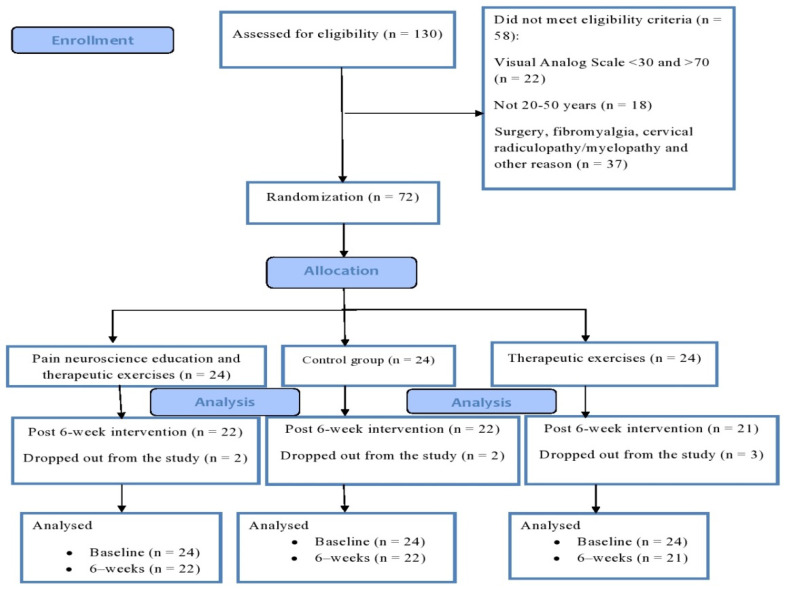
Background: Chronic neck pain is common in the adult general population. Although the etiology of chronic neck pain is under debate, it is clear that chronic neck pain is multifactorial, with both physical and psychosocial contributors. Objective: To determine whether adding pain neuroscience education (PNE) to therapeutic exercises improved their pain–disability index, pain catastrophizing, fear–avoidance beliefs, and pain self-efficacy in subjects with chronic nonspecific neck pain. Methods: This study was a three-arm randomized control trial. Seventy-two patients with chronic nonspecific neck pain were allocated to three groups: therapeutic exercises alone (n = 24), combined (therapeutic exercises + PNE; (n = 24), and a control group (n = 24). Each program took place three times a week, lasting for six weeks. The disability index, pain catastrophizing, fear–avoidance beliefs, and pain self-efficacy measured by the Neck Pain and Disability Scale (NPAD), Pain Catastrophizing Scale (PCS), Fear–Avoidance Beliefs Questionnaire (FABQ), and Pain Self-Efficacy Questionnaire (PSEQ), respectively. Participants were assessed before and after the six-week intervention, and there was no further follow-up. Results: For the outcomes NPAD, PSC, and FABQ, combined intervention demonstrated more significant improvements than therapeutic exercises alone (p ≤ 0.05), whereas no differences were observed between the two intervention groups for PSEQ (p = 0.99). In addition, significant differences were favoring experimental groups versus control for all outcomes (p ≤ 0.001). Conclusion: Therapeutic exercises combined with pain neuroscience education reduced the pain–disability index, pain catastrophizing, and fear–avoidance beliefs more than therapeutic exercises alone in patients with chronic neck pain. For pain self-efficacy, there was no statistically significant difference between the two intervention groups; however, the combined group had a more significant effect than therapeutic exercises alone. Further studies with longer periods and follow-up are required.
Overview
The claims and statistics of this paper haven’t been checked yet.
Free: it reads the open-access text and checks the first 5 claims that cite a source we can check. Create a free account to check every claim.
Integrity signals
Registry
Cites
Statistics
Figures
Verification
Claims the paper makes
The claims and statistics of this paper haven’t been checked yet.
Free: it reads the open-access text and checks the first 5 claims that cite a source we can check. Create a free account to check every claim.
Claims other papers make about this one
Each is checked against this paper’s own text: does it say what the citing paper says it does?
The source backs part of the claim, not all of it — or backs it for a different population, condition or comparison.
In the citing paper
“The combination of exercise therapy and health education has a strong effect on the pain variable compared to exercise therapy alone or health education alone [31,32,33,34,35,36,37,38,39,40,43].”
From Prevention of non-specific back pain through exercise and education: A systematic review and meta-analysis (2024) · cites this paper as [36]
Experimental — accuracy not yet measuredThe source backs part of the claim, not all of it — or backs it for a different population, condition or comparison.
In the citing paper
“The disability variable also showed a strong effect in the meta-analysis [28,29,30,31,32,33,36,37,39,40,41,43].”
From Prevention of non-specific back pain through exercise and education: A systematic review and meta-analysis (2024) · cites this paper as [36]
Experimental — accuracy not yet measuredThe source backs part of the claim, not all of it — or backs it for a different population, condition or comparison.
In the citing paper
“A strong effect was also observed in kinesiophobia, with an improvement of SMD more than one point [28,29,30,31,33,35,36,41].”
From Prevention of non-specific back pain through exercise and education: A systematic review and meta-analysis (2024) · cites this paper as [36]
Experimental — accuracy not yet measured
Self-check
Percentages, sums and reported differences re-computed from the paper’s own numbers.
The self-check needs the paper’s full text.
Citations
Cites
1 retracted
Monticone, M., Ambrosini, E., Rocca, B., Cazzaniga, D., Liquori, V., Pedrocchi, A., & Vernon, H. (2017) · Clinical Rehabilitation · doi:10.1177/0269215516651979 · Cited by 45 · cited 1×
“However, multimodal biopsychosocial therapy has been recommended for patients with CNP to modify abnormal notions and behaviors, enhance disability levels, and improve the use of self-control skills [13].”
BackgroundRetractedThe Pain Catastrophizing Scale: Development and validation.
Sullivan, M. J. L., Bishop, S. R., & Pivik, J. (1995) · Psychological Assessment · doi:10.1037//1040-3590.7.4.524 · Cited by 8,227
Waddell, G., Newton, M., Henderson, I., Somerville, D., & Main, C. J. (1993) · Pain · doi:10.1016/0304-3959(93)90127-b · Cited by 3,167
Theoretical perspectives on the relation between catastrophizing and pain
Sullivan, M. J. L., Thorn, B., Haythornthwaite, J. A., Keefe, F., Martin, M., Bradley, L. A., & Lefebvre, J. C. (2001) · The Clinical Journal of Pain · doi:10.1097/00002508-200103000-00008 · Cited by 2,472 · cited 1×
“Studies have stated that fear and avoidance of movement are the best variables to predict chronic musculoskeletal pain over 6 months [10,11].”
BackgroundACSM's guidelines for exercise testing and prescription
Kenney, W. L., Humphrey, R. H., Bryant, C. X., & Mahler, D. A. (1995) · Williams & Wilkins eBooks · Cited by 1,475
Louw, A., Zimney, K., Puentedura, E. J., & Diener, I. (2016) · Physiotherapy Theory and Practice · doi:10.1080/09593985.2016.1194646 · Cited by 720 · cited 3×
“One treatment strategy aimed at helping ease pain, and often the associated suffering and disability, is patient education [21].”
BackgroundLouw, A., Diener, I., Butler, D. S., & Puentedura, E. J. (2011) · Archives of Physical Medicine and Rehabilitation · doi:10.1016/j.apmr.2011.07.198 · Cited by 687 · cited 2×
“Furthermore, there is evidence that a pain neuroscience education can have a positive effect on pain intensity, disability level, fear of movement, and physical efficiency, especially if compound with therapeutic exercises [15,16].”
BackgroundNeck Pain in the General Population
Bovim, G., Schrader, H., & Sand, T. (1994) · Spine · doi:10.1097/00007632-199406000-00001 · Cited by 671 · cited 1×
“In the current trial, neck pain was specified as CNP without a specific identifiable etiology, but was provoked by neck postures, neck motion, or palpation of the cervical musculature [23].”
BackgroundExercises for mechanical neck disorders
Gross, A., Kay, T. M., Paquin, J.-P., Blanchette, S., Lalonde, P., Christie, T., Dupont, G., Graham, N., Burnie, S. J., Gelley, G., et al. (2015) · Cochrane Database of Systematic Reviews · doi:10.1002/14651858.cd004250.pub5 · Cited by 613
A Randomized Controlled Trial of Intensive Neurophysiology Education in Chronic Low Back Pain
Moseley, G. L., Nicholas, M. K., & Hodges, P. W. (2004) · The Clinical Journal of Pain · doi:10.1097/00002508-200409000-00007 · Cited by 537 · cited 1×
“One of the essential aims of pain neuroscience education intervention is to alter patients’ beliefs and cognitions regarding their pain experience [50].”
Background
Cited by
Lin, L., Lin, T., Chang, K. C., Wu, W., & Özçakar, L. (2023) · European Journal of Pain · doi:10.1002/ejp.2182 · Cited by 70
“Regarding pain intensity measurement, two studies used an NRS (Andias et al., 2022; Khosrokiani et al., 2022), four used a VAS (Andias et al., 2018; Matias et al., 2019; Mukhtar et al., 2022; Valiente-Castrillo et al., 2021), and one used an NPAD (Javdaneh et al., 2021) as the outcome measurement for pain intensity.”
BackgroundMethodInfluentialSalazar‐Méndez, J., Núñez‐Cortés, R., Suso‐Martí, L., Ribeiro, I. L., Garrido-Castillo, M., Gacitúa, J., Méndez-Rebolledo, G., Cruz‐Montecinos, C., López‐Bueno, R., & Calatayud, J. (2023) · Neuroscience & Biobehavioral Reviews · doi:10.1016/j.neubiorev.2023.105328 · Cited by 48
Núñez‐Cortés, R., Salazar‐Méndez, J., Calatayud, J., Malfliet, A., Lluch, E., Méndez-Rebolledo, G., Guzmán-Muñoz, E., López‐Bueno, R., & Suso‐Martí, L. (2023) · Pain · doi:10.1097/j.pain.0000000000003126 · Cited by 46
Mueller, J., Weinig, J., Niederer, D., Tenberg, S., & Mueller, S. (2023) · Journal of Orthopaedic and Sports Physical Therapy · doi:10.2519/jospt.2023.11820 · Cited by 45
Raizah, A., Reddy, R. S., Alshahrani, M. S., Gautam, A. P., Alkhamis, B. A., Kakaraparthi, V. N., Ahmad, I., Kandakurti, P. K., & ALMohiza, M. A. (2023) · Journal of Clinical Medicine · doi:10.3390/jcm12093140 · Cited by 29
“The etiology of CNP is multifactorial, and the most underlying factors are idiopathic [4].”
BackgroundHuang, J., Xu, Y., Xuan, R., Baker, J. S., & Gu, Y. (2022) · Frontiers in Psychology · doi:10.3389/fpsyg.2022.886015 · Cited by 26
Salazar‐Méndez, J., Cuyúl-Vásquez, I., Ponce‐Fuentes, F., Guzmán-Muñoz, E., Núñez‐Cortés, R., Huysmans, E., Lluch‐Girbés, E., Viscay‐Sanhueza, N., & Fuentes, J. (2024) · Patient Education and Counseling · doi:10.1016/j.pec.2024.108201 · Cited by 22
Peñalver, A. C., Lírio-Romero, C., Ferreira, E. A. L., Hernández-Iglesias, S., García-Valdivieso, I., Pérez-Pozuelo, J. M., & Gómez‐Cantarino, S. (2024) · Children · doi:10.3390/children11121420 · Cited by 33
Head-Mounted Display for Clinical Evaluation of Neck Movement Validation with Meta Quest 2
Trinidad‐Fernández, M., Bossavit, B., Salgado, J., Abbate-Chica, S., Fernández, A. J., & Vargas, A. I. C. (2023) · Sensors · doi:10.3390/s23063077 · Cited by 22
“patient education, physical exercise, and manual therapy [4,5].”
BackgroundRehabilitation to Improve Outcomes after Cervical Spine Surgery: Narrative Review
Sakaguchi, T., Heydar, A. M., Tanaka, M., Uotani, K., Omori, T., Kodama, Y., Takamatsu, K., Yasuda, Y., Sugyo, A., Takeda, M., et al. (2024) · Journal of Clinical Medicine · doi:10.3390/jcm13185363 · Cited by 29
“Patient education and self-management [28,29] Educate patients about their neck pain and how to reduce pain and suffering.”
BackgroundYoga and pain: A mind-body complex system
Chopra, D., Stern, E., Bushell, W. C., & Castle, R. (2023) · Frontiers in Pain Research · doi:10.3389/fpain.2023.1075866 · Cited by 22
Ponce‐Fuentes, F., Cuyúl-Vásquez, I., Medina, L., & Fuentes, J. (2022) · Physiotherapy Theory and Practice · doi:10.1080/09593985.2022.2061394 · Cited by 15
Tatikola, S. P., Natarajan, V., Amaravadi, S. K., Desai, V. K., Asirvatham, A. R., & Nagaraja, R. (2024) · Journal of Bodywork and Movement Therapies · doi:10.1016/j.jbmt.2024.11.016 · Cited by 18
Saadat, M., Salamat, S., Mostafaee, N., Soleimani, F., Rouintan, Z., & Amin, M. (2023) · European Spine Journal · doi:10.1007/s00586-023-07835-w · Cited by 13
“In recent years, different types of interventions are employed to manage fear avoidance beliefs among people with chronic spinal pain including therapies that combine management of the psychological factors into multidisciplinary rehabilitations such as pain neuroscience education (PNE) have been recommended for peopl…”
BackgroundCho, W. S., Park, C. B., & Kim, B.-G. (2023) · Journal of Bodywork and Movement Therapies · doi:10.1016/j.jbmt.2023.07.010 · Cited by 16
Effectiveness of Self-Care Education for Chronic Neck Pain: A Systematic Review and Meta-Analysis
Valenza-Peña, G., Núñez, J. M., Ciuró, A. H., Navas‐Otero, A., López‐López, L., Valenza, M. C., & Martos, I. C. (2023) · Healthcare · doi:10.3390/healthcare11243161 · Cited by 17
Xie, Y., Coombes, B. K., Thomas, L. C., & Johnston, V. (2022) · Physical Therapy · doi:10.1093/ptj/pzac050 · Cited by 12
“On an individual level, pain neuroscience education 42 and behavioral counseling 43 may be critical, especially where central sensitization or pain beliefs interfere with their efforts to achieve more vigorous physical activity.”
Fernández-Gualda, M. Á., Ariza‐Vega, P., Lozano‐Lozano, M., Cantarero‐Villanueva, I., Martín‐Martín, L., Castro‐Martín, E., Arroyo‐Morales, M., Martín, I. T., López-Garzón, M., Postigo-Martín, P., et al. (2023) · PLoS ONE · doi:10.1371/journal.pone.0290096 · Cited by 14
Hernandez-Lucas, P., Leirós-Rodríguez, R., Lopez-Barreiro, J., & García-Soidán, J. L. (2024) · Journal of Back and Musculoskeletal Rehabilitation · doi:10.3233/bmr-230252 · Cited by 10
Oirschot, G. V., Pomphrey, A., Dunne, C., Murphy, K., Blood, K., & Doherty, C. (2024) · JMIR Rehabilitation and Assistive Technologies · doi:10.2196/48154 · Cited by 11
Terradas‐Monllor, M., Beltrán-Alacreu, H., Ochandorena‐Acha, M., García-Oltra, E., Aliaga-Orduña, F., & Hernández‐Hermoso, J. A. (2025) · Journal of Clinical Medicine · doi:10.3390/jcm14010268 · Cited by 11
“These findings are consistent across different pain conditions, indicating that pain catastrophizing is a modifiable risk factor [34–36].”
Musculoskeletal Disorders in Primary School Teachers
Ramírez-García, C. O., Lluguay-Quispillo, D. J., Inga-Lafebre, J. D., Cuenca-Lozano, M. F., Ojeda-Zambrano, R. M., & Cárdenas-Baque, C. C. (2023) · Sustainability · doi:10.3390/su152316222 · Cited by 21
Cho, Y., Jung, Y. L., Im, A., Hong, S. J., & Kim, K. (2025) · Pain Management Nursing · doi:10.1016/j.pmn.2024.12.010 · Cited by 9
Miki, T., Kondo, Y., Kurakata, H., Takebayashi, T., & Samukawa, M. (2023) · PM&R · doi:10.1002/pmrj.13002 · Cited by 13
Barbosa, J. C., da Luz, B. V., da Silva, B. F. P., Marques, A. P., Saragiotto, B. T., Comachio, J., & Magalhães, M. O. (2025) · Musculoskeletal Care · doi:10.1002/msc.70119 · Cited by 14
Polo-Ferrero, L., Canchal-Crespo, D., Sáez-Gutiérrez, S., Dávila-Marcos, A., Puente-González, A. S., & Sánchez, R. M. (2023) · Healthcare · doi:10.3390/healthcare12010020 · Cited by 5
“In addition, this joint treatment has already been shown to have very positive effects in chronic neck pain [53,54].”
BackgroundFernandes, T., Vila-Chã, C. J. F., Polo-Ferrero, L., Martín‐Vallejo, J., Puente-González, A. S., & Sánchez, R. M. (2025) · Journal of Clinical Medicine · doi:10.3390/jcm14051581 · Cited by 5
“Additional interventions, such as pain neuroscience education, dry needling, shock waves, and multimodal biopsychosocial approaches, have also been recommended to reduce disability [60–64].”
Clinical Applications and Potential Mechanism of Cold Acclimation Therapy
Wang, Y., Wang, Y., Han, D., Sun, W., Qiao, Y., Wang, C., Zhang, X., & Xu, J.-L. (2025) · Journal of Multidisciplinary Healthcare · doi:10.2147/jmdh.s525146 · Cited by 5
“16 Additionally, cryotherapy has demonstrated therapeutic potential in managing chronic lower back pain, especially when combined with other therapeutic modalities.”
Pérez, L., García, R. M. C., Mayo-Íscar, A., Barrero-Santiago, L., de la Nava, J., & Montero-Cuadrado, F. (2025) · Scientific Reports · doi:10.1038/s41598-025-02765-7 · Cited by 4
James, B., Mashola, M. K., & Mothabeng, J. (2022) · South African Journal of Physiotherapy · doi:10.4102/sajp.v78i1.1767 · Cited by 4
“2019), pain neuroscience education (Javdaneh et al. 2021), TENS (Bi et al.”
BackgroundJavdaneh, N., Shams, A., Shojaedin, S. S., Rydzik, Ł., Ambroży, T., & Chwała, W. (2022) · Acta of Bioengineering and Biomechanics · doi:10.37190/abb-02187-2023-03 · Cited by 4
“Multimodal physiotherapy interventions may be more beneficial in improving pain and disability compared with unimodal physio-therapy [16], [33].”
Self-citationEffect of Exercise on Chronic Tension-Type Headache and Chronic Migraine: A Systematic Review
Río, C. J. P.-D., Monti-Ballano, S., Lucha-López, M. O., Hidalgo-García, C., & Tricás-Moreno, J. M. (2025) · Healthcare · doi:10.3390/healthcare13131612 · Cited by 8
“For example, Schiller et al. (2021) [41], Sung Hak Cho et al. (2021) [42], and Javdaneh et al. (2021) [50] observed better outcomes when exercise was integrated with other therapeutic approaches [41,42,50].”
Gray, E., Erickson, M., Bindler, R. J., Eti, D. U., & Wilson, M. (2023) · Pain Management Nursing · doi:10.1016/j.pmn.2023.04.002 · Cited by 7
Effectiveness of pain neuroscience education among adults with chronic neck pain. Systematic review
Palahí-Calsina, I., Jubany, J., Sordo, L., Lorente, S., Espelt, A., & Borao, O. (2024) · European Journal of Physiotherapy · doi:10.1080/21679169.2024.2365694 · Cited by 4
“The two studies [31,36] reporting fear and avoidance beliefs data showed significative differences in favour of PNE groups at 4, 6, and 16 weeks.”
InfluentialThe Role of Mindfulness Therapy in the Treatment of Chronic Pain
Biao, D., Umoh, K., Qiguang, C., Xiaole, W., Ting, F., Yuqian, Y., Jinchao, Z., & Fushui, L. (2024) · Current Pain and Headache Reports · doi:10.1007/s11916-024-01284-w · Cited by 8
Williams, T.-L., Nilsson-Wikmar, L. B., Phillips, J., & Joseph, C. (2024) · Disability and Rehabilitation · doi:10.1080/09638288.2024.2399228 · Cited by 4
Pain Neuroscience Education in management of non-traumatic neck pain: a scoping review
Opara, M., & Kozinc, Ž. (2023) · European Journal of Physiotherapy · doi:10.1080/21679169.2023.2287490 · Cited by 4
“In adult CNP patients, all studies show better improvements in PNE plus exercise group for disability outcome [36,39].”
InfluentialDemirel, M., Kaygısız, B. B., Kılıç, S., & Cavlak, U. (2023) · Türk fizyoterapi ve rehabilitasyon dergisi · doi:10.21653/tjpr.1145896 · Cited by 2
Zhang, Y., & Yang, C. (2024) · Medicine · doi:10.1097/md.0000000000040760 · Cited by 2
Williams, T.-L., Nilsson-Wikmar, L. B., & Joseph, C. (2025) · Global Advances in Integrative Medicine and Health · doi:10.1177/27536130251349456 · Cited by 2
Pain Neuroscience Education to Reduce Catastrophizing: A Parallel Randomized Trial in Youth Athletes
Sastre‐Munar, A., Jiménez, A. P., & Romero‐Franco, N. (2025) · Applied Sciences · doi:10.3390/app15179701 · Cited by 4
Sidiropoulos, G., Arvanitidis, M., Falla, D., Kanellopoulos, A., Τσεκούρα, Μ., Στριμπάκος, Ν., & Dimitriadis, Z. (2025) · Musculoskeletal Science and Practice · doi:10.1016/j.msksp.2025.103428 · Cited by 3
Ortíz-Mallasén, V., Llagostera‐Reverter, I., Pejó, L. A., Masiá-Ramos, M., Arriero-Sánchez, F., Mondéjar-Martín, M. R., Cuadrado-Baca, C., Micó-López, M. J., Valero‐Chillerón, M. J., & Cervera-Gasch, Á. (2026) · Healthcare · doi:10.3390/healthcare14040456 · Cited by 2
“These findings suggest that the magnitude of change in catastrophizing may depend on factors such as intervention intensity, duration, and the integration of educational components with exercise [21,50].”
Ghasemi, E., Naji, S. S., Najafi, M. R., Ghasemi, M., & Karimi, A. (2023) · Middle East Journal of Rehabilitation and Health Studies · doi:10.5812/mejrh-136156 · Cited by 2
“These findings are consistent with previous studies on patients with chronic back pain (7, 8, 14, 29), chronic fatigue (10), fibromyalgia (11), lumbar radiculopathy (15), and chronic neck pain (17).”
BackgroundResultInfluentialHenriksen, E., Young, J. T., Power, C., & Chan, C. (2025) · Pain Practice · doi:10.1111/papr.70018 · Cited by 2
“56 This, in conjunction with improved communication, may lead to increased patient satisfaction and better pain management outcomes, as highlighted in previous research.”
Suárez, F. E. Á., Garcia, P. A. G., & Sánchez-Vera, M. A. (2023) · Revista de la Sociedad Española del Dolor · doi:10.20986/resed.2022.3994/2022 · Cited by 8
Blanco-Fernández, F.-B., Forner-Álvarez, C., Vidal‐Quevedo, C., Cuenca‐Martínez, F., & Grande‐Alonso, M. (2025) · Exploration of Neuroprotective Therapy · doi:10.37349/ent.2025.1004102 · Cited by 1
Mehmetoğlu, G., & Yüksel, İ. (2025) · Healthcare · doi:10.3390/healthcare13121388 · Cited by 5
Bae, S.-U., Jung, J.-H., & Moon, D.-C. (2025) · Healthcare · doi:10.3390/healthcare13141734 · Cited by 1
“The self-exercise program incorporated elements of sensorimotor retraining and graded loading training, aiming to enable the patient to maintain the therapeutic effects in daily living (Figure 2D,E) [14].”
Doan, T. K. H., Sofija, E., Ho-Thi, T.-H., Phan, N. N., Le, H. N., Nguyen, L. N. C., & Phung, H. N. (2026) · Nursing Reports · doi:10.3390/nursrep16020044 · Cited by 1
Acikalin, E., & Uysal, S. A. (2026) · BMC Musculoskeletal Disorders · doi:10.1186/s12891-026-10182-8 · Cited by 1
Cabanillas‐Barea, S., Carrasco‐Uribarren, A., Medrano-de-la-Fuente, R., Jiménez‐del‐Barrio, S., Pardos-Aguilella, P., Pérez‐Guillén, S., & Ceballos‐Laita, L. (2022) · Healthcare · doi:10.3390/healthcare10122398 · Cited by 3
“It has been observed that pain education can provide benefits for the treatment of CP [21]; if there are differences between groups, the treatment and education provided can be emphasized, based on the differences found.”
BackgroundИгоревич, Г. М., Akif, H. N. A., & Григорьевич, З. М. (2024) · Consilium Medicum · doi:10.26442/20751753.2023.11.202485 · Cited by 1
Giler, S. X. C., Montalván, M. S. M., Alvarado, E. M. M., & Hidalgo, B. R. A. (2023) · RECIMUNDO · doi:10.26820/recimundo/7.(4).oct.2023.272-286
O efeito da auriculoterapia no quadro álgico e funcionalidade de pacientes com dor cervical crônica
de Faria, L. F., Cury, H. S., Duarte, G. C., Ferrone, M. V. B., Rosa, L. G., Gomes, G. G. C., Fioco, E. M., Verri, É. D., & Fabrin, S. (2024) · Revista Científica Multidisciplinar Núcleo do Conhecimento · doi:10.32749/nucleodoconhecimento.com.br/saude/auriculoterapia-no-quadro-algico
Agırtmış, M., Mustafaoğlu, R., & Özdemir, S. (2024) · Haliç Üniversitesi Sağlık Bilimleri Dergisi · doi:10.48124/husagbilder.1471304
Wolfram, S., & Bauer, R. (2024) · Springer eBooks · doi:10.1007/978-3-662-69586-9_5
Dolor y catastrofismo en el síndrome del túnel del carpo
Blanco, O. D. P., & García, E. G. (2024) · Fisioterapia · doi:10.1016/j.ft.2024.10.001
Wolfram, S., & Bauer, R. (2025) · Springer eBooks · doi:10.1007/978-3-662-70774-6_5
Perelló, L., Riera, N., Riera, C., Márquez, A. M., Tomé, A. L., Río-Martínez, L., & Aguado, A. (2025) · Medicina de Familia SEMERGEN · doi:10.1016/j.semerg.2025.102475
Qazi, A., & Castano-Betancourt, M. C. (2025) · Pain and Rehabilitation · doi:10.59210/q0wbrm27
Şahin, M., Yılmaz, R., & Şahin, N. (2025) · Ege Tıp Bilimleri Dergisi · doi:10.33713/egetbd.1621867
“(23,30).”
Shen, X., Dong, Y., Xiong, X., & Xue, Y. (2025) · Journal of Back and Musculoskeletal Rehabilitation · doi:10.1177/10538127251385792 · Cited by 2
Aportaciones de las II Jornadas de Psicología y Dolor (SEMDOR). De la teoría a la práctica.
DIONISIO, M. A., Suso‐Ribera, C., Cano‐García, F. J., Montoya, M. G., CARRASCO, B. L., PEREZ, A. M., Marques, F., GONZÁLEZ, A. M., Alonso, L. A. M., Nieto, R., et al. (2025) · Multidisciplinary Pain Journal · doi:10.20986/mpj.2025.1109/2025
Pun, J., Franklin, J., Browne, S., Mankelow, J., Mardon, A. K., Watson, J., Leake, H. B., & Ryan, C. G. (2025) · Musculoskeletal Science and Practice · doi:10.1016/j.msksp.2025.103466
The Impact of a One-Time Group Pain Management Educational Session in Primary Care
Howell, A. A., Rider, J. V., & Edgeworth, R. (2026) · Occupational Therapy In Health Care · doi:10.1080/07380577.2025.2609718
Gonzalez, M., Ruiz, J., Torres, L., & Ruiz, E. (2026) · Bulletin of pioneering researches of medical and clinical science · doi:10.51847/pi5xsitcyd
Güven, Z., Arsava, E. Y., Işıkay, A. İ., Akyay, A., Karabulut, E., & Uysal, S. A. (2026) · Medicina · doi:10.3390/medicina62050956
“The total score that can be obtained from the scale is between 0 and 52 points, with a higher score indicating more severe catastrophizing [52].”
Cui, Q., Zhao, H., Qin, P., Lingyan, L., Zhang, X., & Peifen, M. (2026) · Hong Kong Physiotherapy Journal · doi:10.1142/s1013702526500125
Andrejeva, J., & Povilaitytė-Leliugienė, E. (2026) · Acta Balneologica · doi:10.36740/abal202604102
Reguera-Arzúa, R., Mollinedo-Cardalda, I., Monge‐Pereira, E., de Oliveira, I. M., Aboal-Quintás, S. J., & Vázquez, O. C. (2026) · Healthcare · doi:10.3390/healthcare14213663
Metadata
- Authors
- Javdaneh, N., Saeterbakken, A. H., Shams, A., & Barati, A. H.
- Affiliations
- Kharazmi University (IR)
- Department of Sport, Food and Natural Sciences, Faculty of Teacher Education, Culture and Sport, Western Norway University of Applied Sciences, 6851 Sogndal, Norway
- Islamic Azad University Boroujerd Branch (IR)
- Shahid Beheshti University (IR)
- Venue
- International Journal of Environmental Research and Public Health
- Publisher
- MDPI AG
- Published
- 2021-08-22
- Volume
- 18
- Issue
- 16
- Pages
- 8848
- ISSN
- 1660-4601 (ISSN-L)
- PMC
- PMC8394804
- OpenAlex
- W3196044420
- Cited by
- 71
- References
- 49
- Citations by year
- 2026: 9 · 2025: 21 · 2024: 15 · 2023: 20 · 2022: 6
- FWCI
- 5.98
- Type
- journal article
- Language
- en
- Open access
- gold
- doi.org
- Licence
- Locations
- International Journal of Environmental Research and Public Health (publishedVersion, cc-by)
- PubMed Central (publishedVersion, cc-by)
- PubMed (publishedVersion)
- RePEc: Research Papers in Economics (submittedVersion)
- DOAJ (DOAJ: Directory of Open Access Journals) (submittedVersion)
- NORA - Norwegian Open Research Archives (submittedVersion, cc-by)
- Topics
- Health Sciences › Health Professions › Physical Therapy, Sports Therapy and Rehabilitation › Musculoskeletal pain and rehabilitation
- Health Sciences › Medicine › Anesthesiology and Pain Medicine › Pain Management and Treatment
- Health Sciences › Health Professions › Physical Therapy, Sports Therapy and Rehabilitation › Myofascial pain diagnosis and treatment
- Keywords
- chronic neck pain, non-specific neck pain, pain neuroscience education, exercise therapy, pain catastrophizing, fear-avoidance beliefs, pain self-efficacy, pain-related disability, Neck Pain and Disability Scale, Pain Catastrophizing Scale, Fear-Avoidance Beliefs Questionnaire, Pain Self-Efficacy Questionnaire
- MeSH terms
- Adult, Exercise Therapy, Humans, Pain Measurement, Neck Pain, Catastrophization, Chronic Pain
About these checks
Registry, retraction, Cites and statistics results are computed, not judged, with one exception: a printed reference that no index lists is read once by a model before it counts as a citation error. Claims are extracted by a model and kept only when their quote appears verbatim in the text; each cited source is then checked, with a model’s help, for whether it says what the claim relies on. Those verdicts can be wrong — read the claim’s quote and the cited source before relying on one.
Statistics and arithmetic are recomputed, not judged.
Confidence bands are shown only for fields calibrated on our annotated test set. None is calibrated yet, so no band is shown.
What counts as a claim ›How we measure confidence ›How we check this ›
Are you an author, or do you see a problem with this page? Request a review
Data sources
Bibliographic data: Semantic Scholar, OpenAlex, Crossref.
Contains information from the Semantic Scholar Academic Graph Datasets, made available under the ODC Attribution License (ODC-BY 1.0).
Semantic Scholar’s data is described in: Kinney, R., et al. (2023). The Semantic Scholar Open Data Platform. arXiv:2301.10140.
