

Enhancement of Mechanical and Thermal Properties of Polycaprolactone/Chitosan Blend by Calcium Carbonate Nanoparticles
Open accessThe DOI matches its Crossref record; 40 of the 41 references it cites were found in a registry or an index; none of the 35 sources its claims cite is checked for support yet.
Abstract
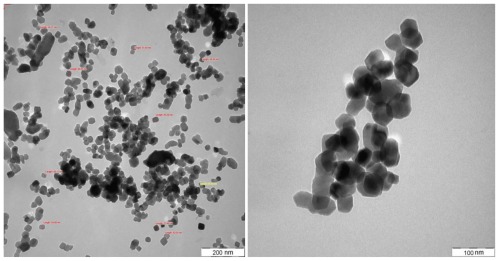
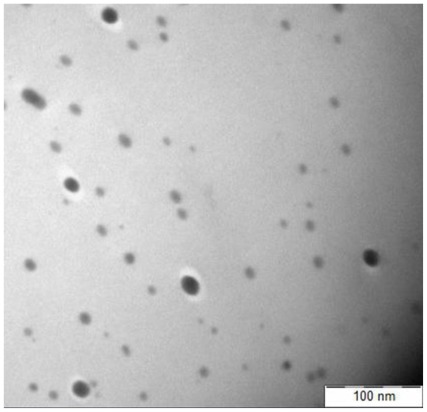
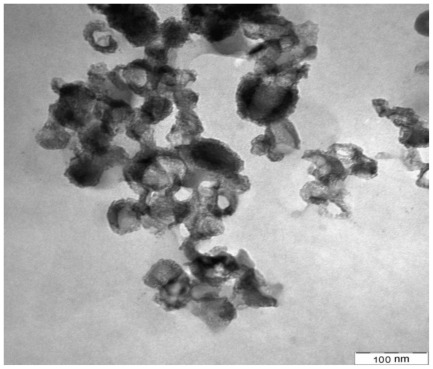
This study investigates the effects of calcium carbonate (CaCO3) nanoparticles on the mechanical and thermal properties and surface morphology of polycaprolactone (PCL)/chitosan nanocomposites. The nanocomposites of PCL/chitosan/CaCO3 were prepared using a melt blending technique. Transmission electron microscopy (TEM) results indicate the average size of nanoparticles to be approximately 62 nm. Tensile measurement results show an increase in the tensile modulus with CaCO3 nanoparticle loading. Tensile strength and elongation at break show gradual improvement with the addition of up to 1 wt% of nano-sized CaCO3. Decreasing performance of these properties is observed for loading of more than 1 wt% of nano-sized CaCO3. The thermal stability was best enhanced at 1 wt% of CaCO3 nanoparticle loading. The fractured surface morphology of the PCL/chitosan blend becomes more stretched and homogeneous in PCL/chitosan/CaCO3 nanocomposite. TEM micrograph displays good dispersion of CaCO3 at lower nanoparticle loading within the matrix.
Overview
CoChat Summary
TL;DR
CaCO3 nanoparticles (average 62 nm) were melt-blended into PCL/chitosan (90/10 wt%) at 0.5–7 wt%, and up to 1 wt% loading improved tensile strength, elongation at break, and thermal stability. Higher loadings caused nanoparticle agglomeration and reduced mechanical performance.
Key findings
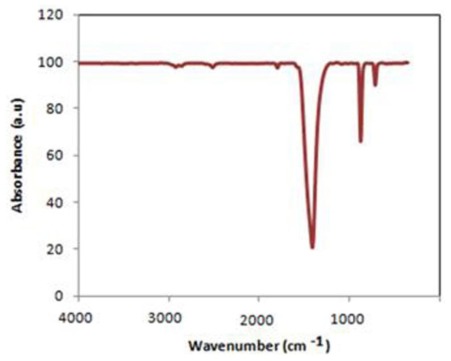
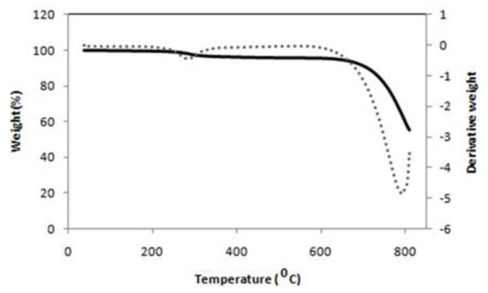
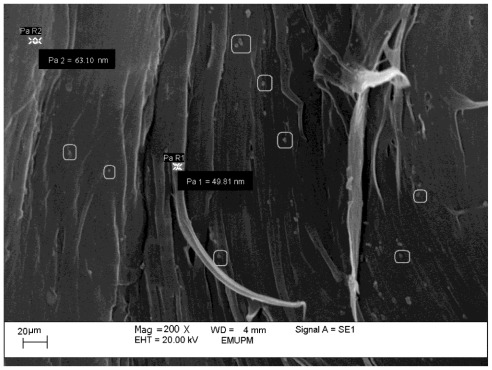
- TEM showed cubic CaCO3 nanoparticles with an average size of 62 nm, calculated from 10 randomly chosen particles; FTIR confirmed calcite and stearic acid coating, and TGA showed stearic acid degradation at 260 °C and CaCO3 decomposition at 720 °C.
- Tensile modulus increased with CaCO3 nanoparticle loading, while tensile strength and elongation at break improved up to 1 wt% CaCO3 and then decreased at higher loadings due to agglomeration.
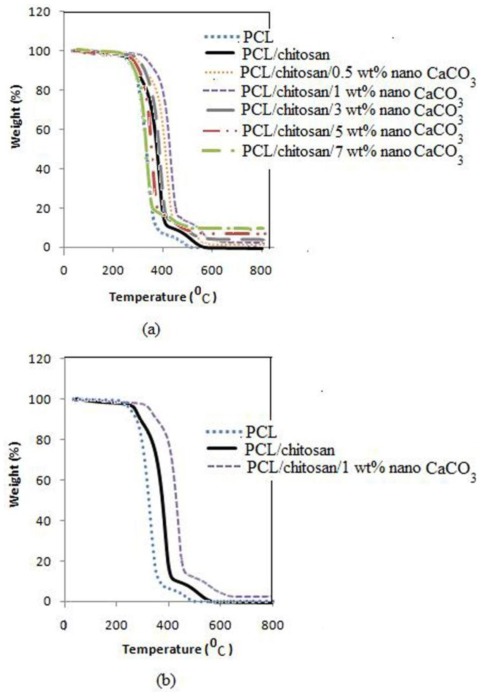
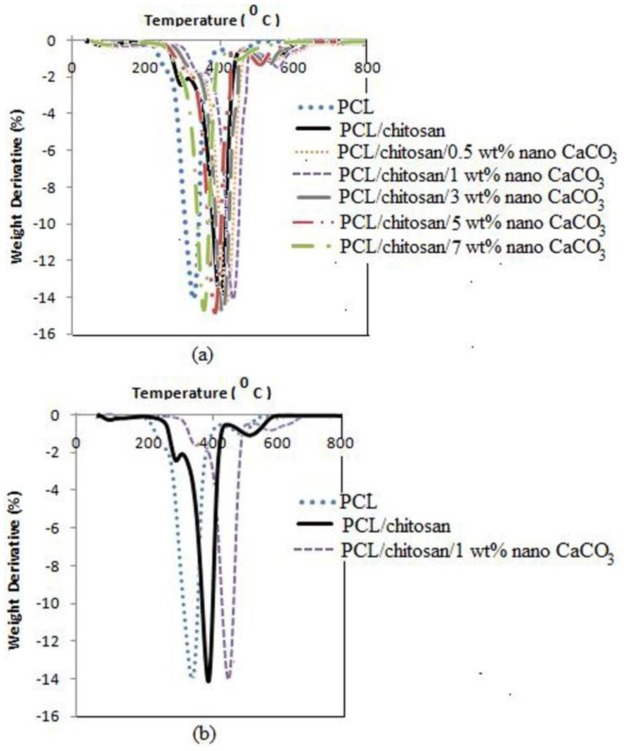
- Thermal stability improved at 1 wt% CaCO3: onset decomposition temperature increased from 223 °C for PCL and 231.45 °C for PCL/chitosan to 258.76 °C, and the second-stage Tmax increased from 382.89 °C to 446.87 °C; the conclusion states thermal degradation temperature increased up to 64 °C at 1 wt% nano-CaCO3.
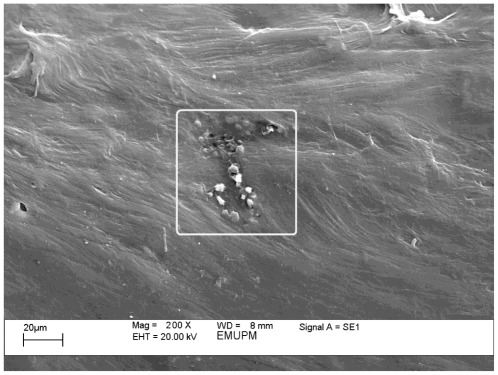
- SEM and TEM showed a smoother, more homogeneous fractured surface and good dispersion at 1 wt% CaCO3, whereas at 5 wt% higher agglomeration occurred, consistent with lower tensile strength.
Methods
- PCL/chitosan/CaCO3 nanocomposites were prepared by melt blending in a Brabender Plastograph at 50 rpm, 20 min, and 100 °C; PCL/chitosan was fixed at 90/10 wt%, with 0.5, 1, 3, 5, or 7 wt% CaCO3 nanoparticles, then compression molded into 1 mm sheets.
- Materials included commercial PCL (CAPA6500, Solvay), chitosan with 85% deacetylation and average molecular weight 345,500 g·mol−1, and stearic acid-coated CaCO3 nanoparticles.
- Characterization used FTIR, TEM (Hitachi H-7100, 200 kV), tensile testing (Instron, ASTM D638-5, 5 mm/min, average of five measurements), TGA (35–800 °C, 10 °C/min, nitrogen), and SEM (Leo 1455 VP).
Limitations
- The paper does not state a limitations section or explicit limitations.
- Evident from the text: the nanocomposite study uses only the PCL/chitosan 90/10 wt% ratio, chosen as optimum from Table 2, so other blend ratios are not tested with CaCO3.
- Evident from the text: despite motivation for antibacterial packaging, no biodegradability, antibacterial, or packaging-performance tests are reported; TEM particle size is based on 10 randomly chosen particles, and tensile results are averages of five measurements without reported statistical uncertainty.
Model-written summary. Check it against the paper before relying on it.
Integrity signals
Registry
Cites
Statistics
Figures
Verification
Claims the paper makes
0 Valid · 0 Not valid · 16 Not checked · 27 Own results and interpretations
A result the paper reports from its own data — it cites no other source for it, so there is none to check. The quote shows it is in the paper.
In the paper
“The sizes of the randomly selected CaCO3 nanoparticle in PCL/chitosan/CaCO3, as displayed in Figure 7, are 49.81 and 63.10 nm.”
§ Enhancement of Mechanical and Thermal Properties of Polycaprolactone/Chitosan Blend by Calcium Carbonate Nanoparticles > 2. Results and Discussion > 2.2. Results of Nanocomposites Characterization
plain- Asserted: passes — The authors put it forward as true.
- Checkable: passes — It can be checked against evidence.
- Load-bearing: unclear — It is unclear whether the paper’s conclusions depend on it.
- Based: passes — The paper gives a reason why it holds.
A result the paper states — it cites no source for it, so there is none to check. The quote shows it is in the paper.
In the paper
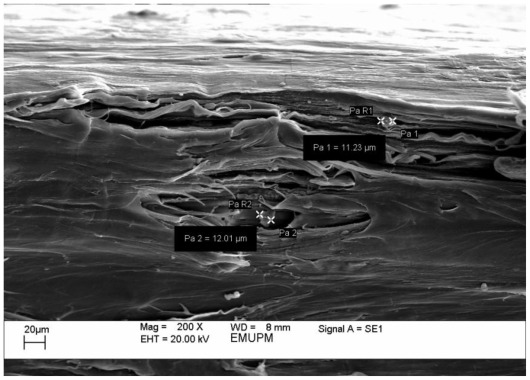
“Figure 6 shows that the PCL/chitosan composite possesses a stretched and porous surface.”
§ Enhancement of Mechanical and Thermal Properties of Polycaprolactone/Chitosan Blend by Calcium Carbonate Nanoparticles > 2. Results and Discussion > 2.2. Results of Nanocomposites Characterization
plain- Asserted: passes — The authors put it forward as true.
- Checkable: passes — It can be checked against evidence.
- Load-bearing: unclear — It is unclear whether the paper’s conclusions depend on it.
- Based: passes — The paper gives a reason why it holds.
A result the paper reports from its own data — it cites no other source for it, so there is none to check. The quote shows it is in the paper.
In the paper
“CaCO3 nanoparticles raise the temperature at which the degradation process initiates.”
§ Enhancement of Mechanical and Thermal Properties of Polycaprolactone/Chitosan Blend by Calcium Carbonate Nanoparticles > 2. Results and Discussion > 2.2. Results of Nanocomposites Characterization
plainstates a cause- Asserted: passes — The authors put it forward as true.
- Checkable: passes — It can be checked against evidence.
- Load-bearing: passes — The paper’s conclusions depend on it.
- Based: passes — The paper gives a reason why it holds.
A result the paper reports from its own data — it cites no other source for it, so there is none to check. The quote shows it is in the paper.
In the paper
“TEM micrograph displays good dispersion of CaCO3 at lower nanoparticle loading within the matrix.”
- Also stated in: § 2.2. Results of Nanocomposites Characterization · plain
“Figure 9 shows good dispersion of 1 wt% of nano CaCO3”
- Also stated in: § 4. Conclusions · plain
“TEM micrographs show good dispersion of nanoparticles within the matrix at 1 wt% nano CaCO3”
§ Enhancement of Mechanical and Thermal Properties of Polycaprolactone/Chitosan Blend by Calcium Carbonate Nanoparticles > Abstract
plain- Asserted: passes — The authors put it forward as true.
- Checkable: passes — It can be checked against evidence.
- Load-bearing: passes — The paper’s conclusions depend on it.
- Based: passes — The paper gives a reason why it holds.
- Also stated in: § 2.2. Results of Nanocomposites Characterization · plain
A result the paper states — it cites no source for it, so there is none to check. The quote shows it is in the paper.
In the paper
“Compared to that of the pristine composite, thermal degradation temperature increases up to 64 °C at 1 wt% of nano-sized CaCO3 content in PCL/chitosan nanocomposite.”
§ Enhancement of Mechanical and Thermal Properties of Polycaprolactone/Chitosan Blend by Calcium Carbonate Nanoparticles > 4. Conclusions
plainstates a cause- Asserted: passes — The authors put it forward as true.
- Checkable: passes — It can be checked against evidence.
- Load-bearing: passes — The paper’s conclusions depend on it.
- Based: passes — The paper gives a reason why it holds.
16 more claims
Create a free account to see all 43 claims and to verify the 35 references still open.
- It may state two separate claims as one. 21
- Probably not a substantial claim. 3
Citations
Cites
SINHARAY, S., & BOUSMINA, M. (2005) · Progress in Materials Science · doi:10.1016/j.pmatsci.2005.05.002 · Cited by 1,611
Chemical syntheses of biodegradable polymers
Okada, M. (2002) · Progress in Polymer Science · doi:10.1016/s0079-6700(01)00039-9 · Cited by 1,199
Polypropylene/calcium carbonate nanocomposites
Chan, C.-M., Wu, J., Li, J.-X., & Cheung, Y.-K. (2002) · Polymer · doi:10.1016/s0032-3861(02)00120-9 · Cited by 930
Use of chitosan as a biomaterial: Studies on its safety and hemostatic potential
Rao, S. B., & Sharma, C. P. (1997) · Journal of Biomedical Materials Research · doi:10.1002/(sici)1097-4636(199701)34:1<21::aid-jbm4>3.0.co;2-p · Cited by 767
Toughening of polypropylene with calcium carbonate particles
Zuiderduin, W. C. J., Westzaan, C., Huétink, J., & Gaymans, R. J. (2003) · Polymer · doi:10.1016/s0032-3861(02)00769-3 · Cited by 681
Polymer–clay nanocomposites: exfoliation of organophilic montmorillonite nanolayers in polystyrene
Fu, X., & Qutubuddin, S. (2001) · Polymer · doi:10.1016/s0032-3861(00)00385-2 · Cited by 614
Properties of thermoplastic blends: starch–polycaprolactone
Averous, L. (2000) · Polymer · doi:10.1016/s0032-3861(99)00636-9 · Cited by 566
Biopolymer chitosan/montmorillonite nanocomposites: Preparation and characterization
Wang, S. F., Shen, L., Tong, Y. J., Chen, L., Phang, I. Y., Lim, P. Q., & Liu, T. X. (2005) · Polymer Degradation and Stability · doi:10.1016/j.polymdegradstab.2005.03.001 · Cited by 511
Bartczak, Z., Argon, A. S., Cohen, R. E., & Weinberg, M. (1999) · Polymer · doi:10.1016/s0032-3861(98)00444-3 · Cited by 508
Nanofillers in polymeric matrix: a study on silica reinforced PA6
Reynaud, E., Jouen, T., Gauthier, C., Vigier, G., & Varlet, J. (2001) · Polymer · doi:10.1016/s0032-3861(01)00446-3 · Cited by 442
Characterization of chitosan–polycaprolactone blends for tissue engineering applications
Sarasam, A., & Madihally, S. V. (2005) · Biomaterials · doi:10.1016/j.biomaterials.2005.01.071 · Cited by 413
Casariego, A., Souza, B. W. S., Cerqueira, M. A., Teixeira, J. A., Cruz, L., Díaz, R., & Vicente, A. A. (2009) · Food Hydrocolloids · doi:10.1016/j.foodhyd.2009.02.007 · Cited by 407
Jiang, L., Zhang, J., & Wolcott, M. P. (2007) · Polymer · doi:10.1016/j.polymer.2007.11.001 · Cited by 396
Rheological and mechanical properties of PVC/CaCO3 nanocomposites prepared by in situ polymerization
Xie, X., Liu, Q.-X., Li, R. K. Y., Zhou, X., Zhang, Q., Yu, Z., & Mai, Y. (2004) · Polymer · doi:10.1016/j.polymer.2004.07.045 · Cited by 388
Crystallization and impact energy of polypropylene/CaCO3 nanocomposites with nonionic modifier
Zhang, Q.-X., Yu, Z.-Z., Xie, X.-L., & Mai, Y.-W. (2004) · Polymer · doi:10.1016/j.polymer.2004.06.044 · Cited by 284
Plastics Additives: An A-Z reference
Pritchard, G. (1998) · Polymer science and technology/Polymer science and technology series · doi:10.1007/978-94-011-5862-6 · Cited by 275
Physical properties and biodegradability of maleated-polycaprolactone/starch composite
Wu, C.-S. (2003) · Polymer Degradation and Stability · doi:10.1016/s0141-3910(02)00393-2 · Cited by 250
Ahmad, M. B., Tay, M. Y., Shameli, K., Hussein, M. Z., & Lim, J. J. (2011) · International Journal of Molecular Sciences · doi:10.3390/ijms12084872 · Cited by 192
Phase structure and mechanical properties of ternary polypropylene/elastomer/nano-CaCO3 composites
Guo, C. J., Mai, Y. L., Rong, M. Z., Ruan, W., & Zhang, M. Q. (2007) · Composites Science and Technology · doi:10.1016/j.compscitech.2007.05.022 · Cited by 158
Zhang, W., Chen, D., Zhao, Q.-B., & Fang, Y. (2003) · Polymer · doi:10.1016/j.polymer.2003.10.046 · Cited by 151
Lorenzo, M. L. D., Errico, M. E., & Avella, M. (2002) · Journal of Materials Science · doi:10.1023/a:1015358425449 · Cited by 151
Jiang, L., Lam, Y. C., Tam, K. C., Chua, T. H., Sim, G. W., & Ang, L. S. (2005) · Polymer · doi:10.1016/j.polymer.2004.11.001 · Cited by 146
Górna, K., Hund, M., Vučak, M., Gröhn, F., & Wegner, G. (2007) · Materials Science and Engineering A · doi:10.1016/j.msea.2007.05.045 · Cited by 140
Effect of nano-CaCO3 on mechanical properties of PVC and PVC Blendex blend
Chen, N., Wan, C., Zhang, Y., & Zhang, Y. (2004) · Polymer Testing · doi:10.1016/s0142-9418(03)00076-x · Cited by 132
Morphology and mechanical properties of polypropylene/calcium carbonate nanocomposites
Yang, K., Yang, Q., Li, G., Sun, Y., & Feng, D. (2006) · Materials Letters · doi:10.1016/j.matlet.2005.10.020 · Cited by 132
Shan, D., Wang, S., Xue, H., & Cosnier, S. (2007) · Electrochemistry Communications · doi:10.1016/j.elecom.2006.10.032 · Cited by 128
Cao, A. (2002) · Polymer · doi:10.1016/s0032-3861(01)00658-9 · Cited by 108 · cited 1×
“Some particular features of PCL include flexibility, low Tg (−61 °C), and low melting point (65 °C), comparatively high price, and a fairly long biodegradability cycle [14,15].”
BackgroundIkejima, T., & Inoue, Y. (2000) · Carbohydrate Polymers · doi:10.1016/s0144-8617(99)00105-8 · Cited by 102
Synthesis and characterization of chitosan-graft-polycaprolactone copolymers
Liu, L., Li, Y., Liu, H., & Fang, Y. (2004) · European Polymer Journal · doi:10.1016/j.eurpolymj.2004.07.016 · Cited by 102
Fuad, M. Y. A., Hanim, H., Zarina, R., Ishak, Z. A. M., & Hassan, A. (2010) · Express Polymer Letters · doi:10.3144/expresspolymlett.2010.76 · Cited by 97
Thermophysical properties of polycaprolactone/chitosan blend membranes
Wan, Y., Lu, X., Dalai, S., & Zhang, J. (2009) · Thermochimica Acta · doi:10.1016/j.tca.2009.01.007 · Cited by 82
Evaluation of dispersion of nano-CaCO3 particles in polypropylene matrix based on fractal method
Liang, J. (2007) · Composites Part A Applied Science and Manufacturing · doi:10.1016/j.compositesa.2007.01.011 · Cited by 62
Calil, M. R., Gaboardi, F., Guedes, C. G. F., & Rosa, D. S. (2006) · Polymer Testing · doi:10.1016/j.polymertesting.2006.01.019 · Cited by 55
Mechanical and thermal properties of unsaturated polyester/calcium carbonate nanocomposites
Baskaran, R., Sarojadevi, M., & Vijayakumar, C. T. (2011) · Journal of Reinforced Plastics and Composites · doi:10.1177/0731684411424630 · Cited by 50
Mechanical performance of nano-CaCO3 filled polystyrene composites
Gao, Y., Liu, L., & Zhang, Z. (2009) · Acta Mechanica Solida Sinica · doi:10.1016/s0894-9166(09)60386-4 · Cited by 44
Dispersion of nano CaCO3 on PVC and its influence on mechanical and thermal properties
Shimpi, N. G., Verma, J., & Mishra, S. (2010) · Journal of Composite Materials · doi:10.1177/0021998309344637 · Cited by 43
Abdolmohammadi, S., Yunus, W. M. Z. W., Rahman, M. Z. A., & Azowa Ibrahim, N. (2011) · Journal of Reinforced Plastics and Composites · doi:10.1177/0731684411410338 · Cited by 28
Self-citationThen, Y. Y., Ibrahim, N. A., & Wan Yunus, W. M. Z. (2011) · Journal of Polymers and the Environment · doi:10.1007/s10924-011-0284-6 · Cited by 9
Self-citationSurface treatments for particulate fillers in plastics
Gilbert, M. (1998) · Polymer science and technology/Polymer science and technology series · doi:10.1007/978-94-011-5862-6_66 · Cited by 6
Cited by
Khalil, H. P. S. A., Chong, E. W. N., Owolabi, F. A. T., Asniza, M., Tye, Y. Y., Rizal, S., Rawi, N. F. M., Kassim, M. H. M., Nurmiati, Z., & Tahir, P. M. (2018) · Journal of Applied Polymer Science · doi:10.1002/app.47251 · Cited by 164
Improving aging resistance and fatigue performance of asphalt binders using inorganic nanoparticles
Nazari, H., Naderi, K., & Nejad, F. M. (2018) · Construction and Building Materials · doi:10.1016/j.conbuildmat.2018.03.107 · Cited by 162
Yadav, V. K., Yadav, K. K., Cabral-Pinto, M. M. S., Choudhary, N., Gnanamoorthy, G., Tirth, V., Prasad, S., Khan, A. H., Islam, S., & Khan, N. A. (2021) · Applied Sciences · doi:10.3390/app11094212 · Cited by 124
Fused deposition processing polycaprolactone of composites for biomedical applications
Prasad, A. S., & Kandasubramanian, B. (2019) · Polymer-Plastics Technology and Materials · doi:10.1080/25740881.2018.1563117 · Cited by 110
Functionalized Antimicrobial Nanofibers: Design Criteria and Recent Advances
Hamdan, N., Yamin, A., Hamid, S. A., Khodir, W. K. W. A., & Guarino, V. (2021) · Journal of Functional Biomaterials · doi:10.3390/jfb12040059 · Cited by 106
Metadata
- Authors
- Abdolmohammadi, S., Siyamak, S., Ibrahim, N. A., Yunus, W. M. Z. W., Rahman, M. Z. A., Azizi, S., & Fatehi, A.
- Affiliations
- Universiti Putra Malaysia (MY)
- National Defence University of Malaysia (MY)
- Corresponding author
- Abdolmohammadi, Sanaz
- Ibrahim, Nor Azowa
- Venue
- International Journal of Molecular Sciences
- Publisher
- MDPI AG
- Published
- 2012-04-10
- Volume
- 13
- Issue
- 4
- Pages
- 4508-4522
- ISSN
- 1422-0067 (ISSN-L)
- PMC
- PMC3344229
- OpenAlex
- W2010679382
- Semantic Scholar
- 4be008901d511e5ff455625d40eaade594404a10
- Cited by
- 192
- References
- 41
- Citations by year
- 2026: 8 · 2025: 16 · 2024: 12 · 2023: 18 · 2022: 19 · 2021: 16 · 2020: 19 · 2019: 24 · 2018: 18 · 2017: 11 · 2016: 15 · 2015: 8 · 2014: 7 · 2013: 1
- FWCI
- 1.67
- Type
- journal article
- Language
- en
- Open access
- gold
- doi.org
- Licence
- Locations
- International Journal of Molecular Sciences (publishedVersion, cc-by)
- Europe PMC (PubMed Central) (publishedVersion, cc-by)
- PubMed Central (publishedVersion, cc-by)
- PubMed (publishedVersion)
- Universiti Putra Malaysia Institutional Repository (Universiti Putra Malaysia) (acceptedVersion)
- Funders
- Universiti Putra Malaysia
- Topics
- Physical Sciences › Materials Science › Biomaterials › biodegradable polymer synthesis and properties
- Physical Sciences › Materials Science › Polymers and Plastics › Polymer Nanocomposites and Properties
- Physical Sciences › Engineering › Biomedical Engineering › Bone Tissue Engineering Materials
- Keywords
- polycaprolactone, chitosan, calcium carbonate nanoparticles, polymer blend nanocomposites, mechanical properties, thermal stability, tensile strength, elongation at break, fracture morphology, nanoparticle dispersion, melt blending
- MeSH terms
- Calcium Carbonate, Materials Testing, Polyesters, Surface Properties, Tensile Strength, Microscopy, Electron, Transmission, Chitosan, Nanoparticles, Nanocomposites, Mechanical Phenomena
About these checks
Registry, retraction, Cites and statistics results are computed, not judged, with one exception: a printed reference that no index lists is read once by a model before it counts as a citation error. Claims are extracted by a model and kept only when their quote appears verbatim in the text; each cited source is then checked, with a model’s help, for whether it says what the claim relies on. Those verdicts can be wrong — read the claim’s quote and the cited source before relying on one.
A language model drew the claims from the paper on 2026-11-22, under version 3 of the claim definition (model deepseek-v4.1-flash, prompt extract-v3).
A second model labelled each claim on 2026-11-22 (model jev-1.13-20260917, definition revision gold-guideline-v0.2).
Statistics and arithmetic are recomputed, not judged.
Confidence bands are shown only for fields calibrated on our annotated test set. None is calibrated yet, so no band is shown.
What counts as a claim ›How we measure confidence ›How we check this ›
Are you an author, or do you see a problem with this page? Request a review
Data sources
Bibliographic data: Semantic Scholar, OpenAlex, Crossref.
Contains information from the Semantic Scholar Academic Graph Datasets, made available under the ODC Attribution License (ODC-BY 1.0).
Semantic Scholar’s data is described in: Kinney, R., et al. (2023). The Semantic Scholar Open Data Platform. arXiv:2301.10140.
