

The Role of Glucose Transporters in Brain Disease: Diabetes and Alzheimer’s Disease
Open accessThe DOI matches its Crossref record; 195 of the 198 references it cites were found in a registry or an index.
Abstract
The occurrence of altered brain glucose metabolism has long been suggested in both diabetes and Alzheimer’s diseases. However, the preceding mechanism to altered glucose metabolism has not been well understood. Glucose enters the brain via glucose transporters primarily present at the blood-brain barrier. Any changes in glucose transporter function and expression dramatically affects brain glucose homeostasis and function. In the brains of both diabetic and Alzheimer’s disease patients, changes in glucose transporter function and expression have been observed, but a possible link between the altered glucose transporter function and disease progress is missing. Future recognition of the role of new glucose transporter isoforms in the brain may provide a better understanding of brain glucose metabolism in normal and disease states. Elucidation of clinical pathological mechanisms related to glucose transport and metabolism may provide common links to the etiology of these two diseases. Considering these facts, in this review we provide a current understanding of the vital roles of a variety of glucose transporters in the normal, diabetic and Alzheimer’s disease brain.
Overview
The claims and statistics of this paper haven’t been checked yet.
Free: it reads the open-access text and checks the first 5 claims that cite a source we can check. Create a free account to check every claim.
Integrity signals
Registry
Cites
Statistics
Figures
Verification
Claims the paper makes
The claims and statistics of this paper haven’t been checked yet.
Free: it reads the open-access text and checks the first 5 claims that cite a source we can check. Create a free account to check every claim.
Claims other papers make about this one
Each is checked against this paper’s own text: does it say what the citing paper says it does?
In the citing paper
“They have the ability to directly affect their target, since SGLT1 and SGLT2 co-receptors are expressed in the human central nervous system and play an important role in maintaining glucose homeostasis.”
From Neuroprotective effect of SGLT2 inhibitors. (2021) · cites this paper as [18]
Self-check
Percentages, sums and reported differences re-computed from the paper’s own numbers.
The self-check needs the paper’s full text.
Citations
Cites
1 retracted
- Retracted
Alzheimer's disease: the amyloid cascade hypothesis
Hardy, J. A., & Higgins, G. A. (1992) · Science · doi:10.1126/science.1566067 · Cited by 7,484 · cited 1×
“Furthermore, overproduction of amyloid beta peptide (Aβ) along with early onset familial AD is suggested to be a key player in AD [129].”
BackgroundThe Pathobiology of Diabetic Complications
Brownlee, M. (2005) · Diabetes · doi:10.2337/diabetes.54.6.1615 · Cited by 5,339
Grundke-Iqbal, I., Iqbal, K., Tung, Y. C., Quinlan, M., Wisniewski, H. M., & Binder, L. I. (1986) · Proceedings of the National Academy of Sciences · doi:10.1073/pnas.83.13.4913 · Cited by 3,676
Neurofibrillary tangles but not senile plaques parallel duration and severity of Alzheimer's disease
Arriagada, P. V., Growdon, J. H., Hedley-Whyte, E. T., & Hyman, B. T. (1992) · Neurology · doi:10.1212/wnl.42.3.631 · Cited by 2,668
Brain Metabolism during Fasting*
Owen, O. E., Morgan, A. P., Kemp, H. G., Sullivan, J. M., Herrera, M. G., & Cahill, G. F. (1967) · Journal of Clinical Investigation · doi:10.1172/jci105650 · Cited by 1,646
Sequence and Structure of a Human Glucose Transporter
Mueckler, M., Caruso, C., Baldwin, S. A., Panico, M., Blench, I., Morris, H. R., Allard, W. J., Lienhard, G. E., & Lodish, H. F. (1985) · Science · doi:10.1126/science.3839598 · Cited by 1,547
Insulin receptors are widely distributed in the central nervous system of the rat
HAVRANKOVA, J., ROTH, J., & BROWNSTEIN, M. (1978) · Nature · doi:10.1038/272827a0 · Cited by 1,111
Glucose transporters in the 21st Century
Thorens, B., & Mueckler, M. (2010) · American Journal of Physiology-Endocrinology and Metabolism · doi:10.1152/ajpendo.00712.2009 · Cited by 1,013 · cited 1×
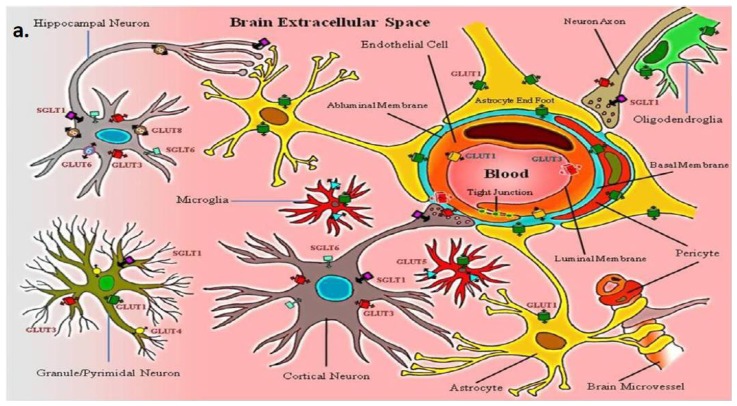
“Expression of different isoforms of both the GLUT and SGLT families has been shown to be cell type specific [22,24,25] (Table 1 and Figure 1a).”
Background(1995) · PubMed Central · doi:10.2967/jnumed.120.252510a · Cited by 996
Research works printed but not linked: 1
- Shah K.K. Abbruscato T.J. Function of sodium/glucose co-transporter at the blood-brain barrier in diabetes Fourth Annual Diabetes Drug Discovery: New Diabetes Drug Targets and Candidates Cambridge Healthtech Institute Boston, MA, USA 2011
Cited by
Items 301–336 of 336
BT2 as a novel therapeutic compound for Alzheimer’s disease
Mullins, C. A. (2023) · ThinkTech (Texas Tech University)
Striatal and hypothalamic control of food intake and glucose metabolism
Koekkoek, L. L. (2022) · UvA-DARE (University of Amsterdam)
Bitiktas, S., Yiğit, S., Yeşilyurt, İ., Gül, H. F., Erkan, O., Gulakar, B., Aydın, Z. C., & Kahraman, A. A. (2026) · Journal of Biochemical and Molecular Toxicology · doi:10.1002/jbt.71059
Bagheri, T., Bennett, V., Buck, A., Gordge, K., Green, I., Kang, E., Kim, N., McCue, C., Mehta, U., Morken, S., et al. (2016) · University Libraries (University of Maryland) · doi:10.13016/m2120n
Revisiting alzheimer’s disease: the mitochondrial and metabolic nexus shaping neurodegeneration
Kumari, S., SINGH, A. P., & Singh, A. P. (2025) · The Journal of Multidisciplinary Research · doi:10.37022/tjmdr.v5i3.780
Kirkpatrick, G., & McFarland, A. (2015)
Rabelo Bezerra, J., & Andrade, G. (2023) · LA Referencia (Red Federada de Repositorios Institucionales de Publicaciones Científicas) · doi:10.5281/zenodo.13799392
Neth, B. J. (2016) · WakeSpace Scholarship (Wake Forest University)
Friedrich, M. U. (2019) · Online Publication Service of Würzburg University (Würzburg University) · doi:10.25972/opus-18479
Lissner, L. J. (2021) · LA Referencia (Red Federada de Repositorios Institucionales de Publicaciones Científicas)
山中, 聡. (2017) · Institutional Repositories DataBase (IRDB)
The involvement of mitochondrial fission, fusion and biogenesis and autophagy in the diabetic brain
Santos, R. X. (2014) · Portuguese National Funding Agency for Science, Research and Technology (RCAAP Project by FCT)
Jansen, V. (2015) · SUNScholar (Stellenbosch University)
Neuron-glia interactions in patients with type 2 diabetes
Kalsbeek, M. J. T. (2020) · UvA-DARE (University of Amsterdam)
Effect of Sex on Brain Metabolism and Intracellular Stress in Type 2 Diabetes
Alves, M. I. N. (2019) · Portuguese National Funding Agency for Science, Research and Technology (RCAAP Project by FCT)
Internship Reports and Monograph entitled “Advances in the Immunotherapies for Alzheimer’s Disease”
Ferreira, M. D. P. (2020) · Portuguese National Funding Agency for Science, Research and Technology (RCAAP Project by FCT)
Ferreira, M. D. P. (2020) · Portuguese National Funding Agency for Science, Research and Technology (RCAAP Project by FCT)
Zhang, Y., Ding, N., Hao, X., Zhao, J., Zhao, Y., Li, Y., & Li, Z. (2022) · doi:10.3389/fnagi.2022.1018371.s001
Díaz, R. G. (2017) · LA Referencia (Red Federada de Repositorios Institucionales de Publicaciones Científicas)
Bruns, I. (2019) · Gutenberg Open Science · doi:10.25358/openscience-2822
Azam, A. A. (2020) · Universiti Putra Malaysia Institutional Repository (Universiti Putra Malaysia)
Pena, G. S. (2023) · University Libraries (University of Maryland) · doi:10.13016/gmbq-2nnn
New pharmacotherapeutic approaches in targeting neurodegenerative processes
Narbute, K. (2020) · E-resource repository of the University of Latvia (University of Latvia)
de Boeckel, C. Z. (2016) · LA Referencia (Red Federada de Repositorios Institucionales de Publicaciones Científicas)
Sousa, P. N. D. [. (2023) · LA Referencia (Red Federada de Repositorios Institucionales de Publicaciones Científicas)
Luke-Aliga, U. L., Okafor, P. N., I, E. S., & Onyeabo, C. (2025) · IDOSR JOURNAL OF SCIENTIFIC RESEARCH · doi:10.59298/idosrjsr/2024/10.1.42480
Neurotransmitter-Related Molecular Modeling Studies
Nowaczyk, A., & Grześk, G. (2022) · MDPI eBooks · doi:10.3390/books978-3-0365-4278-2
dos Santos, J. P. A. (2017) · Americanae (AECID Library)
Multifactorial approach to non-viral gene therapy: development of an efficient system for the retina
Calado, S. D. A. M. (2016) · Portuguese National Funding Agency for Science, Research and Technology (RCAAP Project by FCT)
Brain and Carbohydrate Metabolism
Çavuşoğlu, M. (2024) · doi:10.69860/nobel.9786053359371.10
Tau phosphorylation as adaptive response to metabolic dysfunction in the brain
van der Harg, J. M. (2017) · UvA-DARE (University of Amsterdam)
Prando, S. (2020) · Digital Library of Theses and Dissertations (Universidade de São Paulo) · doi:10.11606/t.5.2020.tde-31012020-093951
Umemoto, H., Ito, A., Nushida, H., Kurata, H., Yoshino, T., Tokunaga, I., Iseki, H., & Nishimura, A. (2026) · The Journal of Medical Investigation · doi:10.2152/jmi.73.360
Metadata
- Authors
- Shah, K., DeSilva, S., & Abbruscato, T.
- Affiliations
- Texas Tech University Health Sciences Center (US)
- Corresponding author
- Abbruscato, Thomas
- ORCID
- Abbruscato, Thomas
- Venue
- International Journal of Molecular Sciences
- Publisher
- MDPI AG
- Published
- 2012-10-03
- Volume
- 13
- Issue
- 10
- Pages
- 12629-12655
- ISSN
- 1422-0067 (ISSN-L)
- PMC
- PMC3497292
- OpenAlex
- W2065380426
- Cited by
- 288
- References
- 198
- Citations by year
- 2026: 14 · 2025: 27 · 2024: 25 · 2023: 27 · 2022: 33 · 2021: 23 · 2020: 29 · 2019: 23 · 2018: 15 · 2017: 22 · 2016: 25 · 2015: 10 · 2014: 12 · 2013: 3
- FWCI
- 0.73
- Type
- journal article
- Language
- en
- Open access
- gold
- doi.org
- Licence
- Locations
- International Journal of Molecular Sciences (publishedVersion, cc-by)
- PubMed Central (publishedVersion, cc-by)
- PubMed (publishedVersion)
- DOAJ (DOAJ: Directory of Open Access Journals) (submittedVersion, cc-by-sa)
- Funders
- National Institutes of Health
- National Institute of Neurological Disorders and Stroke (R01NS076012)
- Topics
- Life Sciences › Neuroscience › Neurology › Barrier Structure and Function Studies
- Life Sciences › Biochemistry, Genetics and Molecular Biology › Molecular Biology › Metabolism, Diabetes, and Cancer
- Life Sciences › Neuroscience › Cellular and Molecular Neuroscience › Alzheimer's disease research and treatments
- Keywords
- glucose transporters, brain glucose metabolism, diabetes mellitus, Alzheimer's disease, blood-brain barrier, glucose transporter isoforms
- MeSH terms
- Alzheimer Disease, Animals, Blood-Brain Barrier, Brain, Diabetes Mellitus, Glucose, Humans, Glucose Transport Proteins, Facilitative
About these checks
Registry, retraction, Cites and statistics results are computed, not judged, with one exception: a printed reference that no index lists is read once by a model before it counts as a citation error. Claims are extracted by a model and kept only when their quote appears verbatim in the text; each cited source is then checked, with a model’s help, for whether it says what the claim relies on. Those verdicts can be wrong — read the claim’s quote and the cited source before relying on one.
Statistics and arithmetic are recomputed, not judged.
Confidence bands are shown only for fields calibrated on our annotated test set. None is calibrated yet, so no band is shown.
What counts as a claim ›How we measure confidence ›How we check this ›
Are you an author, or do you see a problem with this page? Request a review
Data sources
Bibliographic data: Semantic Scholar, OpenAlex, Crossref.
Contains information from the Semantic Scholar Academic Graph Datasets, made available under the ODC Attribution License (ODC-BY 1.0).
Semantic Scholar’s data is described in: Kinney, R., et al. (2023). The Semantic Scholar Open Data Platform. arXiv:2301.10140.
