

The DOI matches its Crossref record; 103 of the 107 references it cites were found in a registry or an index.
Markers of T Cell Senescence in Humans
Open accessAbstract
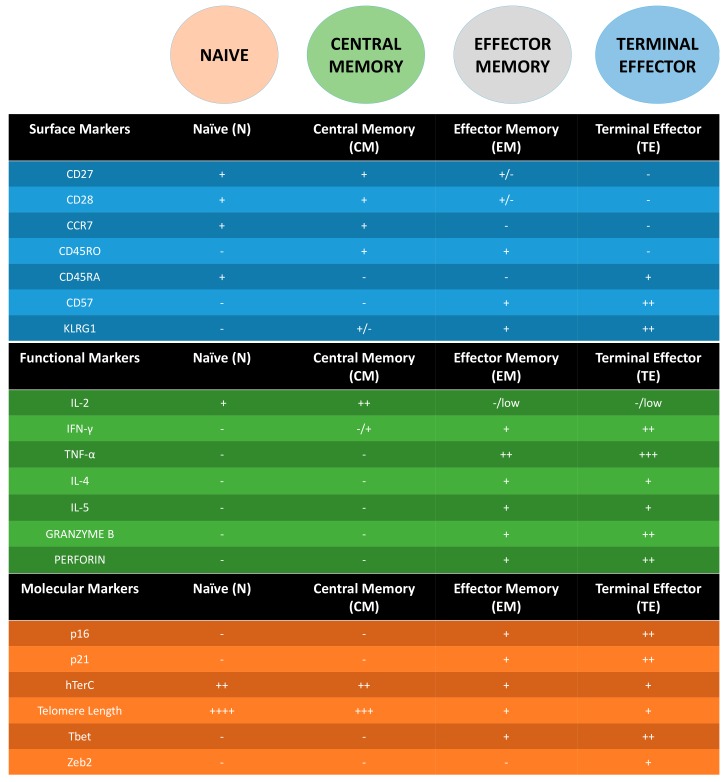
Many countries are facing the aging of their population, and many more will face a similar obstacle in the near future, which could be a burden to many healthcare systems. Increased susceptibility to infections, cardiovascular and neurodegenerative disease, cancer as well as reduced efficacy of vaccination are important matters for researchers in the field of aging. As older adults show higher prevalence for a variety of diseases, this also implies higher risk of complications, including nosocomial infections, slower recovery and sequels that may reduce the autonomy and overall quality of life of older adults. The age-related effects on the immune system termed as “immunosenescence” can be exemplified by the reported hypo-responsiveness to influenza vaccination of the elderly. T cells, which belong to the adaptive arm of the immune system, have been extensively studied and the knowledge gathered enables a better understanding of how the immune system may be affected after acute/chronic infections and how this matters in the long run. In this review, we will focus on T cells and discuss the surface and molecular markers that are associated with T cell senescence. We will also look at the implications that senescent T cells could have on human health and diseases. Finally, we will discuss the benefits of having these markers for investigators and the future work that is needed to advance the field of T cell senescence markers.
Overview
The claims and statistics of this paper haven’t been checked yet.
Run the check — free, no account needed. It reads the open-access text and checks the sources it cites.
Integrity signals
Registry
Cites
Statistics
Figures
Verification
Claims the paper makes
The claims and statistics of this paper haven’t been checked yet.
Run the check — free, no account needed. It reads the open-access text and checks the sources it cites.
Claims other papers make about this one
Each is checked against this paper’s own text: does it say what the citing paper says it does?
The source backs part of the claim, not all of it — or backs it for a different population, condition or comparison.
In the citing paper
“Some markers that are used to identify naïve and memory T cell subsets in humans such as CD45RA [352] (see section III.9 Immune senescence (aging) of human T cells) are not suitable for phenotyping murine T cell subsets, mainly because they do not allow reasonable separation in discrete positive and negative fractions.”
From Guidelines for the use of flow cytometry and cell sorting in immunological studies (third edition) (2021) · cites this paper as [352]
Experimental — accuracy not yet measuredThe cited source says what the claim attributes to it.
In the citing paper
“Phenotyping of naïve and memory T cell subsets by flow cytometry relies on a combination of markers that are acquired or lost during T cell differentiation, from naïve and memory to terminally differentiated T cells [352].”
From Guidelines for the use of flow cytometry and cell sorting in immunological studies (third edition) (2021) · cites this paper as [352]
Self-check
Percentages, sums and reported differences re-computed from the paper’s own numbers.
The self-check needs the paper’s full text.
Citations
Cites
Adverse Renal Effects of Immune Checkpoint Inhibitors: A Narrative Review
Wanchoo, R., Karam, S., Uppal, N. N., Barta, V. S., Deray, G., Devoe, C., Launay‐Vacher, V., Jhaveri, K. D., & on behalf of Cancer and Kidney International Network Workgroup on Immune Checkpoint Inhibitors (2017) · American Journal of Nephrology · doi:10.1159/000455014 · Cited by 15,320
The senescence-associated secretory phenotype: the dark side of tumor suppression
Coppé, J.-P., Desprez, P.-Y., Krtolica, A., & Campisi, J. (2010) · Annual Review of Pathology: Mechanisms of Disease · doi:10.1146/annurev-pathol-121808-102144 · Cited by 5,206
The future of immune checkpoint therapy
Sharma, P., & Allison, J. P. (2015) · Science · doi:10.1126/science.aaa8172 · Cited by 4,878
Wherry, E. J. (2011) · Nature Immunology · doi:10.1038/ni.2035 · Cited by 4,062
Restoring function in exhausted CD8 T cells during chronic viral infection
Barber, D. L., Wherry, E. J., Masopust, D., Zhu, B., Allison, J. P., Sharpe, A. H., Freeman, G. J., & Ahmed, R. (2005) · Nature · doi:10.1038/nature04444 · Cited by 4,057
Chronic Inflammation (Inflammaging) and Its Potential Contribution to Age-Associated Diseases
Franceschi, C., & Campisi, J. (2014) · The Journals of Gerontology Series A: Biological Sciences and Medical Sciences · doi:10.1093/gerona/glu057 · Cited by 3,891
Differentiation of Effector CD4 T Cell Populations
Zhu, J., Yamane, H., & Paul, W. E. (2010) · Annual Review of Immunology · doi:10.1146/annurev-immunol-030409-101212 · Cited by 3,452
Cellular senescence: from physiology to pathology
Muñoz-Espín, D., & Serrano, M. (2014) · Nature Reviews Molecular Cell Biology · doi:10.1038/nrm3823 · Cited by 2,818
Weber, J. S., D’Angelo, S. P., Minor, D. R., Hodi, F. S., Gutzmer, R., Neyns, B., Höeller, C., Khushalani, N. I., Miller, W. H., Lao, C. D., et al. (2015) · The Lancet Oncology · doi:10.1016/s1470-2045(15)70076-8 · Cited by 2,725
Pathogen Recognition by the Innate Immune System
Kumar, H., Kawai, T., & Akira, S. (2011) · International Reviews of Immunology · doi:10.3109/08830185.2010.529976 · Cited by 2,368
Research works printed but not linked: 4
- The World Bank (1993). Investing in Health: World Development Indicators, Oxford University Press.
- Janeway, C.A., Travers, P., Walport, M., and Shlomchik, M.J. (2017, June 10). B-cell activation by armed helper T cells, Immunobiology: The Immune System in Health and Disease, Available online: https://www.ncbi.nlm.nih.gov/books/NBK27142/.
- Janeway, C.A., Travers, P., Walport, M., and Shlomchik, M.J. (2017, June 11). Macrophage activation by armed CD4 TH1 cells, Immunobiology: The Immune System in Health and Disease, Available online: https://www.ncbi.nlm.nih.gov/books/NBK27153/.
- Janeway, C.A., Travers, P., Walport, M., and Shlomchik, M.J. (2017, June 12). T cell-mediated cytotoxicity, Immunobiology: The Immune System in Health and Disease, Available online: https://www.ncbi.nlm.nih.gov/books/NBK27101/.
Cited by
Sorted by citations
CD8 T Cell Exhaustion During Chronic Viral Infection and Cancer
McLane, L. M., Abdel-Hakeem, M. S., & Wherry, E. J. (2019) · Annual Review of Immunology · doi:10.1146/annurev-immunol-041015-055318 · Cited by 2,054
Immunosenescence and Inflamm-Aging As Two Sides of the Same Coin: Friends or Foes?
Fulop, T., Larbi, A., Dupuis, G., Le Page, A., Frost, E. H., Cohen, A. A., Witkowski, J. M., & Franceschi, C. (2018) · Frontiers in Immunology · doi:10.3389/fimmu.2017.01960 · Cited by 1,364
Self-citationGuidelines for the use of flow cytometry and cell sorting in immunological studies (second edition)
Cossarizza, A., Chang, H., Radbruch, A., Acs, A., Adam, D., Adam‐Klages, S., Agace, W. W., Aghaeepour, N., Akdiş, M., Allez, M., et al. (2019) · European Journal of Immunology · doi:10.1002/eji.201970107 · Cited by 1,007
Guidelines for the use of flow cytometry and cell sorting in immunological studies (third edition)
Cossarizza, A., Chang, H., Radbruch, A., Abrignani, S., Addo, R., Akdis, M., Andrä, I., Andreata, F., Annunziato, F., Arranz, E., et al. (2021) · European Journal of Immunology · doi:10.1002/eji.202170126 · Cited by 531
Immunology of aging: the birth of inflammaging
Fulop, T., Larbi, A., Pawelec, G., Khalil, A., Cohen, A. A., Hirokawa, K., Witkowski, J. M., & Franceschi, C. (2021) · Clinical Reviews in Allergy & Immunology · doi:10.1007/s12016-021-08899-6 · Cited by 464
Self-citation
Metadata
- Authors
- Xu, W., & Larbi, A.
- Affiliations
- Agency for Science, Technology and Research (SG)
- Corresponding author
- Larbi, Anis
- ORCID
- Venue
- International Journal of Molecular Sciences
- Publisher
- MDPI AG
- Published
- 2017-08-10
- Volume
- 18
- Issue
- 8
- Pages
- 1742
- ISSN
- 1422-0067 (ISSN-L)
- PMC
- PMC5578132
- OpenAlex
- W2744554795
- Cited by
- 261
- References
- 107
- Citations by year
- 2026: 16 · 2025: 26 · 2024: 47 · 2023: 24 · 2022: 32 · 2021: 48 · 2020: 28 · 2019: 23 · 2018: 16 · 2017: 1
- FWCI
- 2.28
- Type
- journal article
- Language
- en
- Open access
- gold
- doi.org
- Licence
- Locations
- International Journal of Molecular Sciences (publishedVersion, cc-by)
- Europe PMC (PubMed Central) (publishedVersion, cc-by)
- PubMed Central (publishedVersion, cc-by)
- PubMed (publishedVersion)
- National University of Singapore (submittedVersion)
- DOAJ (DOAJ: Directory of Open Access Journals) (submittedVersion, cc-by-sa)
- DR-NTU (Nanyang Technological University) (submittedVersion, cc-by)
- Funders
- Graduiertenakademie, Technische Universität Dresden
- Topics
- Life Sciences › Biochemistry, Genetics and Molecular Biology › Cell Biology › Telomeres, Telomerase, and Senescence
- Life Sciences › Immunology and Microbiology › Immunology › T-cell and B-cell Immunology
- Life Sciences › Biochemistry, Genetics and Molecular Biology › Aging › Genetics, Aging, and Longevity in Model Organisms
- Keywords
- T cell senescence, immunosenescence, T-cell markers, aging, older adults, influenza vaccination, age-related immune decline
- MeSH terms
- Immunosenescence, Aging, Cell Differentiation, Humans, T-Lymphocytes, Immunophenotyping, Cellular Senescence
About these checks
Registry, retraction, Cites and statistics results are computed, not judged, with one exception: a printed reference that no index lists is read once by a model before it counts as a citation error. Claims are extracted by a model and kept only when their quote appears verbatim in the text; each cited source is then checked, with a model’s help, for whether it says what the claim relies on. Those verdicts can be wrong — read the claim’s quote and the cited source before relying on one.
Statistics and arithmetic are recomputed, not judged.
Confidence bands are shown only for fields calibrated on our annotated test set. None is calibrated yet, so no band is shown.
What counts as a claim ›How we measure confidence ›How we check this ›
Are you an author, or do you see a problem with this page? Request a review
