

Insulin-Like Growth Factor (IGF) System in Liver Diseases
Open accessThe DOI matches its Crossref record; 182 of the 189 references it cites were found in a registry or an index, and 1 are not checked yet.
Abstract
Hepatocyte differentiation, proliferation, and apoptosis are affected by growth factors produced in liver. Insulin-like growth factor 1 and 2 (IGF1 and IGF2) act in response to growth hormone (GH). Other IGF family components include at least six binding proteins (IGFBP1 to 6), manifested by both IGFs develop due to interaction through the type 1 receptor (IGF1R). The data based on animal models and/or in vitro studies suggest the role of IGF system components in cellular aspects of hepatocarcinogenesis (cell cycle progression, uncontrolled proliferation, cell survival, migration, inhibition of apoptosis, protein synthesis and cell growth), and show that systemic IGF1 administration can reduce fibrosis and ameliorate general liver function. In epidemiologic and clinicopathological studies on chronic liver disease (CLD), lowered serum levels, decreased tissue expression of IGF1, elevated production of IGF1R and variable IGF2 expression has been noted, from the start of preneoplastic alterations up to the developed hepatocellular carcinoma (HCC) stage. These changes result in well-known clinical symptoms of IGF1 deficiency. This review summarized the current data of the complex role of IGF system components in the most common CLD (nonalcoholic fatty liver disease, cirrhosis, and hepatocellular carcinoma). Better recognition and understanding of this system can contribute to discovery of new and improved versions of current preventive and therapeutic actions in CLD.
Overview
The claims and statistics of this paper haven’t been checked yet.
Free: it reads the open-access text and checks the first 5 claims that cite a source we can check. Create a free account to check every claim.
Integrity signals
Registry
Cites
Statistics
Figures
Verification
Claims the paper makes
The claims and statistics of this paper haven’t been checked yet.
Free: it reads the open-access text and checks the first 5 claims that cite a source we can check. Create a free account to check every claim.
Claims other papers make about this one
Each is checked against this paper’s own text: does it say what the citing paper says it does?
The source backs part of the claim, not all of it — or backs it for a different population, condition or comparison.
In the citing paper
“Experimental data show that low doses of IGF-1 increase bone mass in cirrhotic rats [65,69,70].”
From Bone diseases in patients with chronic liver disease (2019) · cites this paper as [70]
Experimental — accuracy not yet measured
Self-check
Percentages, sums and reported differences re-computed from the paper’s own numbers.
The self-check needs the paper’s full text.
Citations
Cites
Vernon, G., Baranova, A., & Younossi, Z. M. (2011) · Alimentary Pharmacology & Therapeutics · doi:10.1111/j.1365-2036.2011.04724.x · Cited by 3,074 · cited 2×
“NASH can progress to cirrhosis and its related complications [26,29].”
BackgroundDAUGHADAY, W. H., & ROTWEIN, P. (1989) · Endocrine Reviews · doi:10.1210/edrv-10-1-68 · Cited by 1,725 · cited 1×
“They are functionally related to insulin but have a much higher growth-promoting activity [6,7].”
BackgroundLiver Failure and Defective Hepatocyte Regeneration in Interleukin-6-Deficient Mice
Cressman, D. E., Greenbaum, L. E., DeAngelis, R. A., Ciliberto, G., Furth, E. E., Poli, V., & Taub, R. (1996) · Science · doi:10.1126/science.274.5291.1379 · Cited by 1,538 · cited 1×
“IGF1 plays role in supporting proliferation of hepatocytes and accelerating DNA synthesis [74], together with IL-6, TNF-α, HGF and TGF-α/EGF systems [75,76].”
BackgroundThe Somatomedin Hypothesis: 2001
Le Roith, D., Bondy, C., Yakar, S., Liu, J.-L., & Butler, A. (2001) · Endocrine Reviews · doi:10.1210/edrv.22.1.0419 · Cited by 1,257
The Insulin-Like Growth Factor-Binding Protein (IGFBP) Superfamily*
Hwa, V., Oh, Y., & Rosenfeld, R. G. (1999) · Endocrine Reviews · doi:10.1210/edrv.20.6.0382 · Cited by 1,079 · cited 1×
“In addition, IGFBPs’ activity is also regulated by IGFBP proteases [14,19,24,25].”
BackgroundInsulin‐like growth factors I and II
HUMBEL, R. E. (1990) · European Journal of Biochemistry · doi:10.1111/j.1432-1033.1990.tb15595.x · Cited by 999 · cited 2×
“In mammals, liver-derived endocrine IGF1 mediates the growth promoting effects of growth hormone (GH) during postnatal life, whereas IGF2 stimulates placental and fetal growth, and is less GH dependent than IGF1 [8,9].”
BackgroundMechanisms of hepatic fibrogenesis
Lee, U. E., & Friedman, S. L. (2011) · Best Practice & Research Clinical Gastroenterology · doi:10.1016/j.bpg.2011.02.005 · Cited by 923
Mechanisms of Organ Injury and Repair by Macrophages
Vannella, K. M., & Wynn, T. A. (2017) · Annual Review of Physiology · doi:10.1146/annurev-physiol-022516-034356 · Cited by 656
Liver regeneration. 2. Role of growth factors and cytokines in hepatic regeneration.
Fausto, N., Laird, A. D., & Webber, E. M. (1995) · The FASEB Journal · doi:10.1096/fasebj.9.15.8529831 · Cited by 619
From NAFLD to NASH to cirrhosis—new insights into disease mechanisms
Wree, A., Broderick, L., Canbay, A., Hoffman, H. M., & Feldstein, A. E. (2013) · Nature Reviews Gastroenterology & Hepatology · doi:10.1038/nrgastro.2013.149 · Cited by 609 · cited 2×
“%) in the absence of significant alcohol intake, is recognized as the most common cause and form of CLD, and is estimated to affect 30% of adults and 10% of children in the United States [28], with its worldwide prevalence continuously increasing, in correlation with the growing obesity epidemic [26,29,30].”
BackgroundThe insulin-like growth factor I receptor: a key to tumor growth?
Baserga, R. (1995) · PubMed · Cited by 552
The Insulin-Like Growth Factor-Binding Protein (IGFBP) Superfamily
Hwa, V. (1999) · Endocrine Reviews · doi:10.1210/er.20.6.761 · Cited by 466
Role of the liver in the control of carbohydrate and lipid homeostasis
Postic, C., Dentin, R., & Girard, J. (2004) · Diabetes & Metabolism · doi:10.1016/s1262-3636(07)70133-7 · Cited by 448 · cited 2×
“Generally, the components of IGF system are hepatoprotective, playing a very important role in hormonal and metabolic effects [1,17,18,20].”
BackgroundSvegliati-Baroni, G., Ridolfi, F., Di Sario, A., Casini, A., Marucci, L., Gaggiotti, G., Orlandoni, P., Macarri, G., Perego, L., Benedetti, A., et al. (1999) · Hepatology · doi:10.1002/hep.510290632 · Cited by 320 · cited 2×
“Likewise, IGF1 increased type I collagen gene expression and accumulation in HSC culture media, through a PI3-K and extracellular-regulated kinase (ERK)-dependent mechanisms [66].”
BackgroundLivingstone, C. (2013) · Endocrine-Related Cancer · doi:10.1530/erc-13-0231 · Cited by 296
Wheatcroft, S. B., & Kearney, M. T. (2009) · Trends in Endocrinology & Metabolism · doi:10.1016/j.tem.2009.01.002 · Cited by 278 · cited 1×
“Generally, the components of IGF system are hepatoprotective, playing a very important role in hormonal and metabolic effects [1,17,18,20].”
BackgroundHuman conditions of insulin-like growth factor-I (IGF-I) deficiency
Puche, J. E., & Castilla-Cortázar, I. (2012) · Journal of Translational Medicine · doi:10.1186/1479-5876-10-224 · Cited by 268 · cited 6×
“It was proven, by numerous studies, that treatment with IGF1 can be beneficial in liver cirrhosis [35].”
BackgroundInfluentialRole of liver biopsy in nonalcoholic fatty liver disease.
Nalbantoglu, I., & Brunt, E. M. (2014) · PubMed · doi:10.3748/wjg.v20.i27.9026 · Cited by 236 · cited 4×
“NASH can progress to cirrhosis and its related complications [26,29].”
BackgroundInfluentialIdentification and characterization of genes associated with human hepatocellular carcinogenesis.
Kondoh, N., Wakatsuki, T., Ryo, A., Hada, A., Aihara, T., Horiuchi, S., Goseki, N., Matsubara, O., Takenaka, K., Shichita, M., et al. (1999) · PubMed · Cited by 229
Tovar, V., Alsinet, C., Villanueva, A., Hoshida, Y., Chiang, D. Y., Solé, M., Thung, S., Moyano, S., Toffanin, S., Mínguez, B., et al. (2010) · Journal of Hepatology · doi:10.1016/j.jhep.2010.01.015 · Cited by 223 · cited 1×
“Administration of IGF1R-selective inhibitors (A12) reduced IGF1-induced effects and was associated with a significant reduction of HCC tumor growth [87].”
BackgroundThe Insulin-Like Growth Factor System in Cancer
Weroha, S. J., & Haluska, P. (2012) · Endocrinology and Metabolism Clinics of North America · doi:10.1016/j.ecl.2012.04.014 · Cited by 213 · cited 2×
“They are functionally related to insulin but have a much higher growth-promoting activity [6,7].”
BackgroundThe relative roles of growth hormone and IGF-1 in controlling insulin sensitivity
Clemmons, D. R. (2004) · Journal of Clinical Investigation · doi:10.1172/jci200420660 · Cited by 203 · cited 2×
“Generally, the components of IGF system are hepatoprotective, playing a very important role in hormonal and metabolic effects [1,17,18,20].”
BackgroundCariani, E., Lasserre, C., Seurin, D., Hamelin, B., Kemeny, F., Franco, D., Czech, M., Ullrich, A., & Bréchot, C. (1988) · PubMed · Cited by 193
The role of growth hormone and insulin-like growth factor-I in the liver
Takahashi, Y. (2017) · International Journal of Molecular Sciences · doi:10.3390/ijms18071447 · Cited by 193 · cited 3×
“Concerning the role of the GH/IGF1 system in the pathogenesis of NAFLD/NASH, it has been reported that decrease in the levels of system components is closely associated with the progression of NAFLD [33].”
BackgroundAlexia, C., Fallot, G., Lasfer, M., Schweizer-Groyer, G., & Groyer, A. (2004) · Biochemical Pharmacology · doi:10.1016/j.bcp.2004.05.029 · Cited by 191
What about non-alcoholic fatty liver disease as a new criterion to define metabolic syndrome?
Tarantino, G. (2013) · World Journal of Gastroenterology · doi:10.3748/wjg.v19.i22.3375 · Cited by 166 · cited 1×
“It is also recognized that NAFLD is the hepatic manifestation of metabolic syndrome [31].”
BackgroundIGF-I induces senescence of hepatic stellate cells and limits fibrosis in a p53-dependent manner
Nishizawa, H., Iguchi, G., Fukuoka, H., Takahashi, M., Suda, K., Bando, H., Matsumoto, R., Yoshida, K., Odake, Y., Ogawa, W., et al. (2016) · Scientific Reports · doi:10.1038/srep34605 · Cited by 164 · cited 3×
“The animal models have also allowed to confirm that, especially IGF1, directly inactivates HSCs, limits fibrosis in a p53-dependent manner, and may be applied to treat liver cirrhosis [41].”
BackgroundDesbois-Mouthon, C., Baron, A., Blivet-Van Eggelpoël, M.-J., Fartoux, L., Venot, C., Bladt, F., Housset, C., & Rosmorduc, O. (2009) · Clinical Cancer Research · doi:10.1158/1078-0432.ccr-08-2980 · Cited by 157 · cited 2×
“IGF1R and its substrates, IRS1 and IRS2, were overexpressed in five human hepatoma cell lines (HepG2, Hep3B, HuH7, HuH6, and PLC/PRF5) [88].”
BackgroundInflammation and fibrogenesis in steatohepatitis
Fujii, H., & Kawada, N. (2012) · Journal of Gastroenterology · doi:10.1007/s00535-012-0527-x · Cited by 155 · cited 1×
“Oxidative stress, cytokines and lipopolysaccharides can provoke activation of HSCs to myofibroblast phenotype [70].”
BackgroundCastilla‐Cortázar, I., Garcia‐Fernandez, M. I., Muguerza, B., Quiroga, J. A., Pérez, R. B., Santidrián, S., & Prìeto, J. (1997) · Gastroenterology · doi:10.1053/gast.1997.v113.pm9352873 · Cited by 140 · cited 1×
“and coagulation factor (II, VII, X) levels, as well as decrease in liver lipid peroxidation product, was observed [53].”
BackgroundEffect of intracellular lipid accumulation in a new model of non-alcoholic fatty liver disease
Chavez-Tapia, N. C., Rosso, N., & Tiribelli, C. (2012) · BMC Gastroenterology · doi:10.1186/1471-230x-12-20 · Cited by 137 · cited 1×
“Intracellular lipid accumulation was associated with an increment in IGF2 gene expression [68].”
BackgroundKaseb, A. O., Morris, J. S., Hassan, M. M., Siddiqui, A. M., Lin, E., Xiao, L., Abdalla, E. K., Vauthey, J., Aloia, T. A., Krishnan, S., et al. (2011) · Journal of Clinical Oncology · doi:10.1200/jco.2011.36.0636 · Cited by 137
Shimizu, M., Shirakami, Y., Sakai, H., Tatebe, H., Nakagawa, T., Hara, Y., Weinstein, I. B., & Moriwaki, H. (2008) · Cancer Letters · doi:10.1016/j.canlet.2007.11.026 · Cited by 135 · cited 1×
“Levels of activated IGF1R form (phosphorylated IGF1R protein) were elevated in human HCC cell lines in comparison with normal human hepatocytes [89].”
Coutant, A., Rescan, C., Gilot, D., Loyer, P., Guguen-Guillouzo, C., & Baffet, G. (2002) · Hepatology · doi:10.1053/jhep.2002.36160 · Cited by 135
Sunscreen use and malignant melanoma
Westerdahl, J., Ingvar, C., Måsbäck, A., & Olsson, H. (2000) · International Journal of Cancer · doi:10.1002/1097-0215(20000701)87:1<145::aid-ijc22>3.0.co;2-3 · Cited by 133
Role of Insulin-Like Growth Factor Iin Maintaining Normal Glucose Homeostasis
Clemmons, D. R. (2004) · Hormone Research in Paediatrics · doi:10.1159/000080763 · Cited by 130 · cited 2×
“Generally, the components of IGF system are hepatoprotective, playing a very important role in hormonal and metabolic effects [1,17,18,20].”
BackgroundBreuhahn, K., Vreden, S., Haddad, R., Beckebaum, S., Stippel, D., Flemming, P., Nussbaum, T., Caselmann, W. H., Haab, B. B., & Schirmacher, P. (2004) · Cancer Research · doi:10.1158/0008-5472.can-04-0292 · Cited by 130
Insulin-like growth factor (IGF) axis in cancerogenesis
Kasprzak, A., Kwasniewski, W., Adamek, A., & Gozdzicka-Jozefiak, A. (2017) · Mutation Research/Reviews in Mutation Research · doi:10.1016/j.mrrev.2016.08.007 · Cited by 130 · cited 2×
“The topic of whole IGF system in chronic liver diseases (CLD) that lead to primary liver cancer, is of particular interest, since a better understanding of the role of the IGF system in cancer could promote novel approaches to diagnosis and therapeutic strategies for this disease [15,25].”
BackgroundSelf-citationHepatocellular carcinoma: Where are we?
Mazzanti, R. (2016) · World Journal of Experimental Medicine · doi:10.5493/wjem.v6.i1.21 · Cited by 126
García-Galiano, D., Sanchez-Garrido, M. A., Espejo, I., Montero, J. L., Costán, G., Marchal, T., Membrives, A., Gallardo-Valverde, J. M., Muñoz-Castañeda, J. R., Arévalo, E., et al. (2007) · Obesity Surgery · doi:10.1007/s11695-007-9087-1 · Cited by 125
Ichikawa, T., Nakao, K., Hamasaki, K., FURUKAWA, R., Tsuruta, S., Ueda, Y., Taura, N., Shibata, H., Fujimoto, M., Toriyama, K., et al. (2007) · Hepatology International · doi:10.1007/s12072-007-9007-4 · Cited by 124 · cited 3×
“IGF1/IGFBP3 ratio revealed a tendency to decrease in patients with steatosis, confirmed by ultrasound and increased aminotransferases [111], as well as the ones with NAFLD and portal fibrosis [37].”
BackgroundEditorial: Insulin-Like Growth Factor I Receptor Signaling--Overlapping or Redundant Pathways?
LeRoith, D. (2000) · Endocrinology · doi:10.1210/endo.141.4.7475 · Cited by 121
Rosen, C. J. (1999) · Clinical Chemistry · doi:10.1093/clinchem/45.8.1384 · Cited by 121 · cited 1×
“1–8), IGF receptors (type I and II), and IGFBP-specific proteases [4,5].”
BackgroundInsulin-like growth factor-binding proteins: functional diversity or redundancy?
Murphy, L. (1998) · Journal of Molecular Endocrinology · doi:10.1677/jme.0.0210097 · Cited by 115 · cited 5×
“This can be increased to ~30 min if bound to IGFBP3 and up to ~15h in the ternary complex with IGFBP3 and ALS [16].”
BackgroundInfluentialChasing the recipe for a pro-regenerative immune system
Godwin, J. W., Pinto, A. R., & Rosenthal, N. A. (2017) · Seminars in Cell & Developmental Biology · doi:10.1016/j.semcdb.2016.08.008 · Cited by 114
Desbois‐Mouthon, C., Wendum, D., Cadoret, A., Rey, C., Leneuve, P., Blaise, A., Housset, C., Tronche, F., Le Bouc, Y., & Holzenberger, M. (2006) · The FASEB Journal · doi:10.1096/fj.05-4704fje · Cited by 112 · cited 1×
“IGF1 plays role in supporting proliferation of hepatocytes and accelerating DNA synthesis [74], together with IL-6, TNF-α, HGF and TGF-α/EGF systems [75,76].”
BackgroundRegulatory Actions of Insulin-like Growth Factor-binding Proteins
Rechler, M. M., & Clemmons, D. R. (1998) · Trends in Endocrinology and Metabolism · doi:10.1016/s1043-2760(98)00047-2 · Cited by 110 · cited 6×
“This can be increased to ~30 min if bound to IGFBP3 and up to ~15h in the ternary complex with IGFBP3 and ALS [16].”
BackgroundInfluentialInsulin-like growth factor-I and the liver
Bonefeld, K., & Møller, S. (2011) · Liver International · doi:10.1111/j.1478-3231.2010.02428.x · Cited by 107 · cited 6×
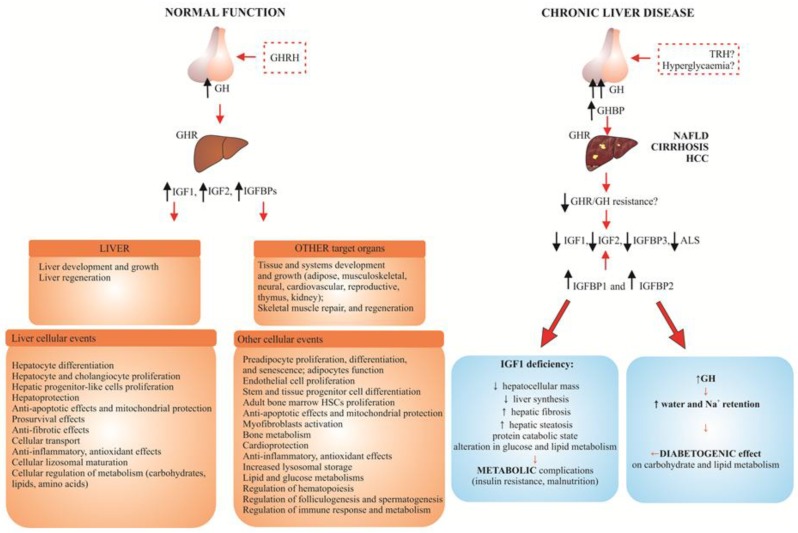
“Schematic presentation of the GH-IGF system in normal human liver function and in the most common chronic liver disease (NAFLD, liver cirrhosis and HCC) [25,34,35].”
BackgroundInfluentialMolecular Regulation of Insulin-like Growth Factor-I and Its Principal Binding Protein, IGFBP-3
Phillips, L. S., Pao, C., & Villafuerte, B. C. (1998) · Progress in nucleic acid research and molecular biology · doi:10.1016/s0079-6603(08)60894-6 · Cited by 106
Höpfner, M., Huether, A., Sutter, A. P., Baradari, V., Schuppan, D., & Scherübl, H. (2006) · Biochemical Pharmacology · doi:10.1016/j.bcp.2006.02.006 · Cited by 106 · cited 1×
“Inhibition of IGF1R by NVP-AEW541, or AVE 1642 (anti-IGF1R antibodies), results in cell degradation, growth inhibition and cell cycle arrest in HCC cell lines: SK-Hep-1, Hep-3B, Hep-G2 and Huh-7 [88,90].”
BackgroundThe Association Between IGF-1 Levels and the Histologic Severity of Nonalcoholic Fatty Liver Disease
Dichtel, L. E., Corey, K. E., Misdraji, J., Bredella, M. A., Schorr, M., Osganian, S. A., Young, B. J., Sung, J. C., & Miller, K. K. (2017) · Clinical and Translational Gastroenterology · doi:10.1038/ctg.2016.72 · Cited by 106 · cited 3×
“However, steatosis was not significantly associated with serum IGF1 levels by any measure [103].”
BackgroundArturi, F., Succurro, E., Procopio, C., Pedace, E., Mannino, G. C., Lugarà, M., Procopio, T., Andreozzi, F., Sciacqua, A., Hribal, M. L., et al. (2011) · The Journal of Clinical Endocrinology & Metabolism · doi:10.1210/jc.2011-1227 · Cited by 103 · cited 3×
“showed reduced IGF1 levels in NAFLD patients and suggested, that hepatic insulin resistance may affect IGF1 levels by modulating GH-stimulated synthesis of hepatic IGF1 [97].”
BackgroundHuynh, H. T., Chow, P. K. H., Ooi, L. L., & Soo, K. C. (2002) · PubMed · Cited by 102
Mazziotti, G., Sorvillo, F., Morisco, F., Carbone, A., Rotondi, M., Stornaiuolo, G., Precone, D. F., Cioffi, M., Gaeta, G. B., Caporaso, N., et al. (2002) · Cancer · doi:10.1002/cncr.11002 · Cited by 99 · cited 1×
“This reduction occurred about 9 months before HCC development [130].”
BackgroundSobrevals, L., Rodriguez, C., Romero-Trevejo, J. L., Gondi, G., Monreal, I., Pañeda, A., Juanarena, N., Arcelus, S., Razquin, N., Guembe, L., et al. (2010) · Hepatology · doi:10.1002/hep.23412 · Cited by 99 · cited 2×
“Additionally, it has been observed to upregulate hepatocyte growth factor (HGF) and matrix metalloproteinases (MMPs), downregulate tissue inhibitor of metalloproteinase 1 (TIMP-1) [56], reduce portal pressure, bacterial translocation and endotoxemia [55].”
BackgroundNishizawa, H., Takahashi, M., Fukuoka, H., Iguchi, G., Kitazawa, R., & Takahashi, Y. (2012) · Biochemical and Biophysical Research Communications · doi:10.1016/j.bbrc.2012.05.115 · Cited by 97 · cited 1×
“also improved after GH and IGF1 administration, suggesting that GH-independent, IGF1 action plays an essential role in the liver [40].”
BackgroundHCC Development Is Associated to Peripheral Insulin Resistance in a Mouse Model of NASH
De Minicis, S., Agostinelli, L., Rychlicki, C., Sorice, G. P., Saccomanno, S., Candelaresi, C., Giaccari, A., Trozzi, L., Pierantonelli, I., Mingarelli, E., et al. (2014) · PLoS ONE · doi:10.1371/journal.pone.0097136 · Cited by 97 · cited 2×
“According to the results of this research, CDAA model promoted the development of HCC from NAFLD/NASH in the presence of insulin resistance, but in the absence of cirrhosis [43].”
BackgroundResultGarcía-Fernández, M., Delgado, G., Puche, J. E., González-Barón, S., & Castilla Cortázar, I. (2008) · Endocrinology · doi:10.1210/en.2007-1190 · Cited by 95 · cited 1×
“IGF1 therapy has also been proved to revert insulin resistance, reduce cholesterol and triglycerides levels, and significantly increase FFA concentrations [52].”
BackgroundChen, D., Yoo, B. K., Santhekadur, P. K., Gredler, R., Bhutia, S. K., Das, S. K., Fuller, C., Su, Z.-Z., Fisher, P. B., & Sarkar, D. (2011) · Clinical Cancer Research · doi:10.1158/1078-0432.ccr-10-2774 · Cited by 89 · cited 2×
“Lower IGFBP7 expression correlated with poor postoperative prognosis and inversely with the stages and grades of HCC [168,169].”
BackgroundOsteopenia in rats with liver cirrhosis: Beneficial effects of IGF-I treatment
Cemborain, A., Castilla-Cortázar, I., García, M., Quirog, J., Muguerza, B., Picardi, A., Santidrián, S., & Prieto, J. (1998) · Journal of Hepatology · doi:10.1016/s0168-8278(98)80211-0 · Cited by 88 · cited 1×
“In other experimental models of CCl4-induced cirrhosis in animals, administration of rhIGF1 improved food intake [46], carbohydrates and amino acids intestinal absorption [47,48], muscle mass [46–48], osteopenia [49], testicular atrophy [50], and normalized testicular transferrin expression, as well as reduced serum l…”
BackgroundHribal, M. L., Procopio, T., Petta, S., Sciacqua, A., Grimaudo, S., Pipitone, R. M., Perticone, F., & Sesti, G. (2013) · The Journal of Clinical Endocrinology & Metabolism · doi:10.1210/jc.2012-3290 · Cited by 88 · cited 4×
“It has been shown that IGF1 has a direct an anti-inflammatory effect on hepatic cells [32].”
BackgroundInfluentialSumida, Y., Yonei, Y., Tanaka, S., Mori, K., Kanemasa, K., Imai, S., Taketani, H., Hara, T., Seko, Y., Ishiba, H., et al. (2015) · Hepatology Research · doi:10.1111/hepr.12408 · Cited by 86 · cited 2×
“pointed at significantly lower levels of IGF1 in NASH, compared with NAFLD patients [98].”
BackgroundResultHogg, K., Wood, C., McNeilly, A. S., & Duncan, W. C. (2011) · PLoS ONE · doi:10.1371/journal.pone.0024877 · Cited by 84 · cited 2×
“In adult sheep, maternal testosterone propionate exposure resulted in increased insulin secretion to glucose load, as well as histological presence of fatty liver independent of central obesity, with upregulation of IGF1 expression [39].”
BackgroundAssociation between hepatic steatosis and serum IGF1 and IGFBP-3 levels in a population-based sample
Völzke, H., Nauck, M., Rettig, R., Dörr, M., Higham, C., Brabant, G., & Wallaschofski, H. (2009) · European Journal of Endocrinology · doi:10.1530/eje-09-0374 · Cited by 84 · cited 1×
“IGF1/IGFBP3 ratio revealed a tendency to decrease in patients with steatosis, confirmed by ultrasound and increased aminotransferases [111], as well as the ones with NAFLD and portal fibrosis [37].”
BackgroundNormal levels of serum IGF-I: determinants and validity of current reference ranges
Brabant, G. E., & Wallaschofski, H. (2007) · Pituitary · doi:10.1007/s11102-007-0035-9 · Cited by 82
Insulin-like growth factor I improves intestinal barrier function in cirrhotic rats
Lorenzo-Zúñiga, V, Rodríguez-Ortigosa, C. M., Bartolí, R., Martínez-Chantar, M.-L., Martínez-Peralta, L., Pardo, A., Ojanguren, I., Quiroga, J., Planas, R., & Prieto, J. (2006) · Gut · doi:10.1136/gut.2005.079988 · Cited by 74
Insulin-like growth factor 1 in hepatocellular carcinoma and metastatic liver cancer in men
Stuver, S. O., Kuper, H., Τζώνου, Α., Λάγιου, Π., Spanos, E., Hsieh, C.-C., Mantzoros, C. S., & Trichopoulos, D. (2000) · International Journal of Cancer · doi:10.1002/1097-0215(20000701)87:1<118::aid-ijc17>3.0.co;2-w · Cited by 73 · cited 1×
“The reduction in IGF1 was greater for the virus-associated HCC than in noninfected HCC patients [143].”
BackgroundInsulin-like growth factor-I reverts testicular atrophy in rats with advanced cirrhosis
Castilla-Cortazar, I., Garcia, M., Quiroga, J., Diez, N., Diez-Caballero, F., Calvo, A., Diaz, M., & Prieto, J. (2000) · Hepatology · doi:10.1002/hep.510310308 · Cited by 71 · cited 1×
“In other experimental models of CCl4-induced cirrhosis in animals, administration of rhIGF1 improved food intake [46], carbohydrates and amino acids intestinal absorption [47,48], muscle mass [46–48], osteopenia [49], testicular atrophy [50], and normalized testicular transferrin expression, as well as reduced serum l…”
BackgroundCharacterization of the insulin-like growth factor axis in a human hepatoma cell line (PLC)
Scharf, J., Schmidt-Sandte, W., Pahernik, S. A., Ramadori, G., Braulke, T., & Hartmann, H. (1998) · Carcinogenesis · doi:10.1093/carcin/19.12.2121 · Cited by 71 · cited 1×
“In in vitro conditions, it has been shown that both IGFs and IGF1R are potent mitogens that contribute to liver carcinogenesis [80,81].”
BackgroundCarbone, D. L., Zuloaga, D. G., Hiroi, R., Foradori, C. D., Legare, M. E., & Handa, R. J. (2012) · Endocrinology · doi:10.1210/en.2011-1601 · Cited by 69 · cited 1×
“Rats with the history of prenatal administration of dexamethasone present NAFLD in adulthood, together with decreased IGF1 plasma concentrations [38].”
BackgroundCastilla‐Cortázar, I., Prìeto, J., Urdaneta, E., Pascual, M., Nunez, M., Zudaire, E., Garcia‐Fernandez, M. I., Quiroga, J. A., & Santidrián, S. (1997) · Gastroenterology · doi:10.1053/gast.1997.v113.pm9322513 · Cited by 69 · cited 1×
“In other experimental models of CCl4-induced cirrhosis in animals, administration of rhIGF1 improved food intake [46], carbohydrates and amino acids intestinal absorption [47,48], muscle mass [46–48], osteopenia [49], testicular atrophy [50], and normalized testicular transferrin expression, as well as reduced serum l…”
BackgroundCharacterization of the IGF axis components in isolated rat hepatic stellate cells
Scharf, J.-G., Knittel, T., Dombrowski, F., Müller, L., Saile, B., Braulke, T., Hartmann, H., & Ramadori, G. (1998) · Hepatology · doi:10.1002/hep.510270513 · Cited by 68 · cited 2×
“All that data suggests the important role of the IGF system components for supporting proliferation of hepatocytes and initiation of HSC proliferation during fibrogenesis [71,72].”
BackgroundWeng, C., Hsieh, Y., Tsai, C., Chu, Y.-H., Ueng, K., Liu, Y., Yeh, Y.-H., Su, S., Chen, Y., Chen, M., et al. (2010) · Annals of Surgical Oncology · doi:10.1245/s10434-009-0904-8 · Cited by 66 · cited 2×
“Moreover, combination of IGF2+3580 AA homozygosity and IGF2R 1619 GG homozygosity, showed low risk for HCC and presented a significant protective effect against HCC [175,176].”
BackgroundDonaghy, A. J., Delhanty, P. J. D., Ho, K. K. Y., Williams, R. L., & Baxter, R. C. (2002) · Journal of Hepatology · doi:10.1016/s0168-8278(02)00049-1 · Cited by 66 · cited 1×
“noted significantly decreased hepatic IGF1 and ALS mRNA (in parallel with serum proteins), as well as unchanged hepatic IGFBP3 mRNA expression [135].”
BackgroundAntifibrogenic effect in vivo of low doses of insulin-like growth factor-I in cirrhotic rats
Muguerza, B., Castilla‐Cortázar, I., Garcia‐Fernandez, M. I., Quiroga, J. A., Santidrián, S., & Prìeto, J. (2001) · Biochimica et Biophysica Acta (BBA) - Molecular Basis of Disease · doi:10.1016/s0925-4439(01)00045-x · Cited by 65 · cited 1×
“Additionally, it has been observed to upregulate hepatocyte growth factor (HGF) and matrix metalloproteinases (MMPs), downregulate tissue inhibitor of metalloproteinase 1 (TIMP-1) [56], reduce portal pressure, bacterial translocation and endotoxemia [55].”
BackgroundClinical significance of serum IGF-I, IGF-II and IGFBP-3 in liver cirrhosis
Wu, Y.-L. (2004) · World Journal of Gastroenterology · doi:10.3748/wjg.v10.i18.2740 · Cited by 63 · cited 5×
“Very low IGF2 values (<200 ng/mL) were poor prognostic factors, with patients dying within six months [115].”
BackgroundInfluentialSkrtic, S., Wallenius, V., Ekberg, S., Brenzel, A., Gressner, A. M., & Jansson, J.-O. (1997) · Endocrinology · doi:10.1210/endo.138.11.5540 · Cited by 62
Aleem, E., Nehrbass, D., Klimek, F., Mayer, D., & Bannasch, P. (2011) · Toxicologic Pathology · doi:10.1177/0192623310396905 · Cited by 62 · cited 2×
“Additionally to increased expression of IGF1R, increased levels of insulin receptor, IRS2, and MAPK were observed in the glycogen storing foci of the altered hepatocytes [63].”
BackgroundPicardi, A., de Oliveira, A. C., Muguerza, B., Tosar, A., Quiroga, J. A., Castilla‐Cortázar, I., Santidrián, S., & Prìeto, J. (1997) · Journal of Hepatology · doi:10.1016/s0168-8278(97)80026-8 · Cited by 61 · cited 1×
“In other experimental models of CCl4-induced cirrhosis in animals, administration of rhIGF1 improved food intake [46], carbohydrates and amino acids intestinal absorption [47,48], muscle mass [46–48], osteopenia [49], testicular atrophy [50], and normalized testicular transferrin expression, as well as reduced serum l…”
BackgroundFuture therapy for non‐alcoholic fatty liver disease
Issa, D., Patel, V. A., & Sanyal, A. J. (2018) · Liver International · doi:10.1111/liv.13676 · Cited by 60 · cited 2×
“The pathogenesis of NAFLD includes metabolic stress to the liver, associated with insulin resistance with downstream cell stress from reactive oxygen species, and unfolded protein response, with activation of inflammatory and fibrotic pathways [30].”
BackgroundNaguib, R., & El-Shikh, W. (2011) · PubMed · Cited by 59
The expression of insulin-like growth factor binding proteins in human hepatocellular carcinoma
Gong, Y., Cui, L., & Minuk, G. Y. (2000) · Molecular and Cellular Biochemistry · doi:10.1023/a:1007010818094 · Cited by 58 · cited 1×
“The downregulation in expression of IGFBP1, -3 and -4 mRNA in HCC tissues was observed when compared to cirrhotic and normal liver tissues [91,166].”
BackgroundNonalcoholic fatty liver disease is associated with increased GHBP and reduced GH/IGF‐I levels
Fusco, A., Miele, L., D’Uonnolo, A., Forgione, A., Riccardi, L., Cefalo, C., Barini, A., Bianchi, A., Giampietro, A., Cimino, V., et al. (2012) · Clinical Endocrinology · doi:10.1111/j.1365-2265.2011.04291.x · Cited by 58 · cited 3×
“Others confirmed that IGF1 levels were negatively associated with hepatic steatosis [109].”
BackgroundScharf, J., Ramadori, G. P., & Dombrowski, F. (2000) · Laboratory Investigation · doi:10.1038/labinvest.3780147 · Cited by 57 · cited 1×
“The altered gene expression in glycogen-storing preneoplastic hepatic foci, especially the upregulation of IGF1 and IGFBP4, with the downregulation of IGFBP1, resemble the insulin-dependent regulation of these components in normal rat hepatocytes [62].”
BackgroundDiversification of the insulin-like growth factor 1 gene in mammals
Rotwein, P. S. (2017) · PLoS ONE · doi:10.1371/journal.pone.0189642 · Cited by 57 · cited 1×
“The IGF1 gene is well-conserved among 25 different mammalian species representing 15 different orders and ranging over ~180 million years of evolutionary diversification [12].”
BackgroundHao, C., Geng, Y., Li, F., Tong, Y., Su, D., Duan, J.-L., & Li, Y. (2011) · APOPTOSIS · doi:10.1007/s10495-011-0634-9 · Cited by 56 · cited 1×
“Enhanced IGF1 signaling (silencing IGF1R expression by addition of IGF1 or small interference RNA) inhibits oxidative-stress induced apoptosis in human umbilical vein endothelial cells (HUVECs), by reducing mitochondrial dysfunction [67].”
BackgroundLei, T., & Ling, X. (2015) · World Journal of Gastroenterology · doi:10.3748/wjg.v21.i35.10137 · Cited by 56 · cited 1×
“In HCC cell lines (Hepa1-6 and H22), IGF1 did not change the CTSB mRNA levels, but prolonged the half-life of cathepsin B [82].”
BackgroundWang, Z. (2003) · World Journal of Gastroenterology · doi:10.3748/wjg.v9.i2.267 · Cited by 56 · cited 1×
“IGF2 mRNA levels were higher in liver tumor tissue than in that of normal rats [59].”
BackgroundUchida, K., Kondo, M., Takeda, S., Osada, H., Takahashi, T., Takahashi, T., Nakao, A., Takahashi, T., & Takahashi, T. (1997) · Molecular Carcinogenesis · Cited by 54
Dai, B., Ruan, B., Wu, J., Wang, J., Shang, R., Sun, W., Li, X., Dou, K., Wang, D., & Li, Y. (2014) · PubMed Central · Cited by 53
Bae, M.-H., Lee, M.-J., Bae, S., Lee, O., Lee, Y. M., Park, B. C., & Kim, K.-W. (1998) · Cancer Letters · doi:10.1016/s0304-3835(98)00044-5 · Cited by 53 · cited 2×
“Inhibition of IGF2 mRNA and protein levels was associated with decreased cell proliferative activity in these cell lines [80,83,86].”
BackgroundDong, Z. (2005) · World Journal of Gastroenterology · doi:10.3748/wjg.v11.i30.4655 · Cited by 51 · cited 2×
“IGF2 mRNA expression was present in all HCC tissues, and was absent in noncancerous tissues [154].”
BackgroundChishima, S., Kogiso, T., Matsushita, N., Hashimoto, E., & Tokushige, K. (2017) · Internal Medicine · doi:10.2169/internalmedicine.56.7626 · Cited by 51 · cited 4×
“IGFBP3 levels were higher in NAFLD patients [109], as well as in cases of advanced steatosis in biopsy-confirmed NAFLD [106].”
BackgroundInfluentialSu, W., Lee, K., Yeh, Y., Soon, M., Wang, C., Yu, M., & Wang, S. (2010) · Journal of Clinical Laboratory Analysis · doi:10.1002/jcla.20320 · Cited by 50 · cited 1×
“showed lower IGF1 levels in HCC patients with HCV and/or HBV than those not infected, as well as lower levels of IGF1 in the HCV+ group than in the HBV+ group [144].”
BackgroundRanke, M. B., Kp, M., Schweizer, R., Stadler, B., Schleicher, S., Elmlinger, M. W., & Flehmig, B. (2003) · Hormone Research in Paediatrics · doi:10.1159/000073229 · Cited by 49 · cited 2×
“This diminution is similar to cases of poor nutrition, disturbed hepatic function, and decreased GH secretion [158].”
BackgroundSedlaczek, N., Hasilík, A., Neuhaus, P., Schuppan, D., & Herbst, H. (2003) · British Journal of Cancer · doi:10.1038/sj.bjc.6600777 · Cited by 48 · cited 3×
“High focal expression of IGF2 RNA was found in some hepatocytes of all livers with HBV- or HCV-induced cirrhosis, but in only one of the cirrhoses with a nonviral etiology [136].”
BackgroundResultTomimaru, Y., Eguchi, H., Wada, H., Kobayashi, S., Marubashi, S., Tanemura, M., Umeshita, K., Kim, T., Wakasa, K., Doki, Y., et al. (2012) · International Journal of Cancer · doi:10.1002/ijc.25994 · Cited by 47 · cited 2×
“Lower IGFBP7 expression correlated with poor postoperative prognosis and inversely with the stages and grades of HCC [168,169].”
BackgroundColak, Y., Senates, E., Ozturk, O., Yilmaz, Y., Zemheri, E., Yilmaz Enc, F., Ulasoglu, C., Aksaray, S., Bozbeyoglu, S. G., Kiziltas, S., et al. (2012) · European Journal of Gastroenterology & Hepatology · doi:10.1097/meg.0b013e32834e8041 · Cited by 46 · cited 1×
“Serum IGFBP5 levels were also correlated with fibrosis and NASH scores in NAFLD [102].”
BackgroundKang, G. H., Lee, B. S., Lee, E. S., Kim, S. H., Lee, H. Y., & Kang, D. Y. (2014) · Gut and Liver · doi:10.5009/gnl.2014.8.1.79 · Cited by 46 · cited 1×
“Studies performed on IGF1R tissue expression, showed that tumor expression was significantly higher than in the surrounding tissue and correlated with the HCC differentiation and cirrhosis, but not to the number or size of tumors, HBV infection, and AFP level [170,171].”
BackgroundKasprzak, A., & Adamek, A. (2012) · International Journal of Oncology · doi:10.3892/ijo.2012.1666 · Cited by 46
Self-citationShao, Y., Huang, C.-C., Lin, S.-D., Hsu, C., & Cheng, A. (2012) · Clinical Cancer Research · doi:10.1158/1078-0432.ccr-11-2853 · Cited by 46
Evidence of autocrine regulation in human hepatoma cell lines
Tsai, T., Yauk, Y., Chou, C., Lp, T., Chang, C., Hu, C., Han, S., & Su, T. (1988) · Biochemical and Biophysical Research Communications · doi:10.1016/s0006-291x(88)81186-0 · Cited by 45 · cited 2×
“Inhibition of IGF2 mRNA and protein levels was associated with decreased cell proliferative activity in these cell lines [80,83,86].”
BackgroundSerum insulin-like growth factor-II as a serologic marker of small hepatocellular carcinoma
Tsai, J., Jeng, J., Chuang, L., You, H.-L., WANG, L., Hsieh, M., Chen, S. C., Chuang, W., Lin, Z., Yu, M., et al. (2005) · Scandinavian Journal of Gastroenterology · doi:10.1080/00365520410009311 · Cited by 45 · cited 1×
“The multivariate analysis showed, that either IGF2 or AFP are associated with an increased risk of HCC presence [155].”
BackgroundAleem, E. A., El-Shayeb, A. F., Habachi, N. E., Mansour, A. R., Gowily, A., & HELA, A. (2011) · Oncology Letters · doi:10.3892/ol.2011.546 · Cited by 45 · cited 7×
“IGFBP3 S ↑[106,109] ↓[118,121,123,125,128] ⇓[121,133,141,157]”
BackgroundResultInfluentialCianfarani, S., Inzaghi, E., Alisi, A., Germani, D., Puglianiello, A., & Nobili, V. (2014) · The Journal of Pediatrics · doi:10.1016/j.jpeds.2014.01.052 · Cited by 44 · cited 4×
“Observations regarding NAFLD in children seem to be interesting, with IGF1/IGFBP3 ratio recognized as the major predictor of liver inflammation [105].”
BackgroundInfluentialKessler, S. M., Laggai, S., Van Wonterg, E., Gemperlein, K., Müller, R., Haybaeck, J., Vandenbroucke, R. E., Ogris, M., Libert, C., & Kiemer, A. K. (2016) · Frontiers in Physiology · doi:10.3389/fphys.2016.00147 · Cited by 44
Recent Insights into Insulin-Like Growth Factor Binding Protein 2 Transcriptional Regulation
Shin, M., Kang, H. S., Park, J. H., Bae, J., Song, D., & Im, S. (2017) · Endocrinology and Metabolism · doi:10.3803/enm.2017.32.1.11 · Cited by 44 · cited 1×
“1–8), IGF receptors (type I and II), and IGFBP-specific proteases [4,5].”
BackgroundIGFBP-1 and IGF-I as markers for advanced fibrosis in NAFLD – a pilot study
Hagström, H., Stål, P., Hultcrantz, R., Brismar, K., & Ansurudeen, I. (2017) · Scandinavian Journal of Gastroenterology · doi:10.1080/00365521.2017.1379556 · Cited by 44 · cited 16×
“The downregulation in expression of IGFBP1, -3 and -4 mRNA in HCC tissues was observed when compared to cirrhotic and normal liver tissues [91,166].”
BackgroundInfluentialChun, Y., Huang, M., Rink, L. A., & von Mehren, M. (2014) · World Journal of Surgical Oncology · doi:10.1186/1477-7819-12-231 · Cited by 43 · cited 3×
“IGF2 expression was increased in tumor and adjacent background, nontumor tissue [164].”
BackgroundLuo, S.-M., Tan, W.-M., Deng, W.-X., Zhuang, S.-M., & Luo, J.-W. (2005) · World Journal of Gastroenterology · doi:10.3748/wjg.v11.i27.4272 · Cited by 42 · cited 1×
“On the contrary, in some studies, IGF1 mRNA expression was higher—but IGFBP3 mRNA expression was lower—when tumor tissues were compared to that of adjacent nontumor tissue [165].”
ResultLi, F., Fan, Y., Gao, S., Sun, F., Yang, Y., & Wang, K. (2014) · Genes, Chromosomes and Cancer · doi:10.1002/gcc.22120 · Cited by 41 · cited 2×
“Elevated IGFBP7 methylation frequency was significantly higher in HCC with vascular invasion than without this complication [160].”
BackgroundThe risk of osteoporosis in patients with liver cirrhosis: a meta‐analysis of literature studies
Lupoli, R., Di Minno, A., Spadarella, G., Ambrosino, P., Panico, A., Tarantino, L., Lupoli, G., Lupoli, G., & Di Minno, M. N. D. (2016) · Clinical Endocrinology · doi:10.1111/cen.12780 · Cited by 41
Presnell, S. C., Stolz, D. B., Mars, W. M., Jo, M., Michalopoulos, G. K., & Strom, S. C. (1997) · Molecular Carcinogenesis · doi:10.1002/(sici)1098-2744(199704)18:4<244::aid-mc8>3.0.co;2-d · Cited by 40
Lin, S., Hsieh, S.-H., Hsu, H.-L., Lai, M., Kan, L.-S., & Au, L. C. (1997) · The Journal of Biochemistry · doi:10.1093/oxfordjournals.jbchem.a021814 · Cited by 40 · cited 1×
“Inhibition of IGF2 mRNA and protein levels was associated with decreased cell proliferative activity in these cell lines [80,83,86].”
BackgroundCastilla-Cortázar, I., Picardi, A., Tosar, A., Ainzúa, J., Urdaneta, E., García, M., Pascual, M., Quiroga, J., & Prieto, J. (1999) · American Journal of Physiology-Gastrointestinal and Liver Physiology · doi:10.1152/ajpgi.1999.276.1.g37 · Cited by 40 · cited 1×
“In other experimental models of CCl4-induced cirrhosis in animals, administration of rhIGF1 improved food intake [46], carbohydrates and amino acids intestinal absorption [47,48], muscle mass [46–48], osteopenia [49], testicular atrophy [50], and normalized testicular transferrin expression, as well as reduced serum l…”
BackgroundXu, M., Zheng, X., Jiang, F., & Qiu, W. (2018) · Journal of Cellular Biochemistry · doi:10.1002/jcb.26776 · Cited by 40 · cited 1×
“Recently published data reveals, that miR-190b inhibition suppressed lipid accumulation and improved insulin sensitivity by targeting IGF1 and ADAMTS9, suggesting that miR-190b inhibition may be a therapeutic strategy against NAFLD [113].”
BackgroundCastilla‐Cortázar, I. (2004) · World Journal of Gastroenterology · doi:10.3748/wjg.v10.i17.2529 · Cited by 39 · cited 1×
“In other experimental models of CCl4-induced cirrhosis in animals, administration of rhIGF1 improved food intake [46], carbohydrates and amino acids intestinal absorption [47,48], muscle mass [46–48], osteopenia [49], testicular atrophy [50], and normalized testicular transferrin expression, as well as reduced serum l…”
BackgroundWeber, M. M., Auernhammer, C. J., Lee, P., Engelhardt, D., & Zachoval, R. (2002) · Hormone Research in Paediatrics · doi:10.1159/000057960 · Cited by 39 · cited 3×
“After liver transplantation, a significant increase in IGF2 levels was noted in almost all patients [132].”
BackgroundInsulin‐like growth factor binding protein‐related protein 1 contributes to hepatic fibrogenesis
Guo, X. H., Liu, L. X., Zhang, H. Y., Zhang, Q. Q., Li, Y., Tian, X. X., & Qiu, Z. H. (2014) · Journal of Digestive Diseases · doi:10.1111/1751-2980.12126 · Cited by 39 · cited 19×
“Early cultured, rat HSCs are more susceptible to IGF1 mitogenic action than culture-activated HSCs. Higher expression of IGF1R and lower of IGFBP3 and -4, were observed in early cultured HSCs.”
BackgroundInfluentialBrenzel, A., & Gressner, A. M. (1996) · cclm · doi:10.1515/cclm.1996.34.5.401 · Cited by 36 · cited 2×
“All that data suggests the important role of the IGF system components for supporting proliferation of hepatocytes and initiation of HSC proliferation during fibrogenesis [71,72].”
BackgroundLiang, S., Yu, Z., Song, X., Wang, Y., Li, M., & Xue, J. (2018) · Hormone and Metabolic Research · doi:10.1055/s-0043-124970 · Cited by 36 · cited 2×
“Similar results were observed in children and adolescents [100,101].”
ResultÇolakoğlu, Ö., Taşkıran, B., Colakoğlu, G., Kızıldağ, S., Ozcan Ari, F., & Ünsal, B. (2007) · The Turkish Journal of Gastroenterology · Cited by 35
Runchey, S. S., Boyko, E. J., Ioannou, G. N., & Utzschneider, K. M. (2013) · Journal of Gastroenterology and Hepatology · doi:10.1111/jgh.12437 · Cited by 35 · cited 1×
“Moreover, the correlation between IGF1/IGFBP3 and severity of NAFLD retains significance, after adjustment for age, gender, race/ethnicity, homeostasis model assessment for insulin resistance (HOMA-IR) and adiposity [112].”
BackgroundDevelopmental changes of Insulin-like growth factors in the liver and muscle of chick embryos
Liu, Y., Guo, W., Pu, Z., Li, X., Lei, X., Yao, J., & Yang, X. (2016) · Poultry Science · doi:10.3382/ps/pew043 · Cited by 35 · cited 1×
“The circulating IGFs do not represent the true level of tissue secretion, though they may reflect organ development to some extent [2].”
BackgroundIGF-1 levels in different stages of liver steatosis and its association with metabolic syndrome.
Mallea-Gil, S., Ballarino, M. C., Spiraquis, A., Iriarte, M., Kura, M., Gimenez, S., Oneto, A., Guitelman, M. A., Machado, R. A., & Miguel, C. M. (2012) · PubMed · Cited by 33
Serum concentrations of insulin-like growth factor-I (IGF-I) in patients with liver cirrhosis.
Vyzantiadis, T., Theodoridou, S., Γιουλεμέ, Ό., Harsoulis, P., Evgenidis, N., & Vyzantiadis, A. (2003) · PubMed · Cited by 33
Cho, E. J., Lee, J., Yoo, J., Choi, W.-M., Lee, M. J., Cho, Y., Lee, Y. B., Lee, Y. B., Kwon, J. H., Yu, S. J., et al. (2013) · Clinical Cancer Research · doi:10.1158/1078-0432.ccr-12-3443 · Cited by 32 · cited 1×
“Lower plasma IGF1 levels were significantly correlated with advanced clinical parameters, shorter time to progression and poor overall survival [140,141,145–149], even in patients that underwent transarterial chemoembolization (TACE) [148–152] or other types of curative treatment, such as surgical resection or percuta…”
BackgroundLiang, S., Cheng, X., Hu, Y., Song, R., & Li, G. (2017) · Acta Paediatrica · doi:10.1111/apa.13685 · Cited by 32 · cited 2×
“Similar results were observed in children and adolescents [100,101].”
ResultGene regulation by growth hormone
Rotwein, P. S., & Chia, D. J. (2009) · Pediatric Nephrology · doi:10.1007/s00467-009-1258-y · Cited by 31
Predictive Value of Serum Insulin-like Growth Factor-1 in Hepatocellular Carcinoma
Elmashad, N. M., Ibrahim, W. S., Mayah, W. W., Farouk, M., AboAli, L., Taha, A. A., & Elmashad, W. M. (2015) · Asian Pacific Journal of Cancer Prevention · doi:10.7314/apjcp.2015.16.2.613 · Cited by 31
Pattern and profile of chronic liver disease in acute on chronic liver failure
Abbas, Z., & Shazi, L. (2015) · Hepatology International · doi:10.1007/s12072-015-9627-z · Cited by 31 · cited 1×
“Diseases, which are classified as CLDs, include: compensated cirrhosis of any etiology, chronic hepatitis, alcoholic liver disease (ALD), nonalcoholic fatty liver disease (NAFLD), cholestatic liver disease, and metabolic liver disease [26,27].”
BackgroundGH is a regulator of IGF2 promoter-specific transcription in human liver
von Horn, H., Ekström, C., Ellis, E. C. S., Olivecrona, H., Einarsson, C., Tally, M., & Ekström, T. J. (2002) · Journal of Endocrinology · doi:10.1677/joe.0.1720457 · Cited by 30 · cited 1×
“However, results of in vivo and in vitro studies, describing GH as a physiological regulator of IGF2 gene expression in humans in a promoter-specific way are also present [11].”
ResultPhosphorylated IGFBP-1 as a non-invasive predictor of liver fat in NAFLD
Petäjä, E. M., Zhou, Y., Havana, M., Hakkarainen, A., Lundbom, N. M. I., Ihalainen, J., & Yki‐Järvinen, H. (2016) · Scientific Reports · doi:10.1038/srep24740 · Cited by 29 · cited 1×
“Fasting serum phosphorylated IGFBP1 (fS-pIGFBP1) can be used as one of the top noninvasive predictors of liver fat in NAFLD [110].”
BackgroundStudy, F. J., Adachi, Y., Nojima, M., Mori, M., Matsunaga, Y., Akutsu, N., Sasaki, S., Endo, T., Kurozawa, Y., Wakai, K., et al. (2016) · Tumor Biology · doi:10.1007/s13277-016-5360-z · Cited by 29 · cited 2×
“After controlling for some data (hepatitis infection, BMI, smoking and alcohol abuse), a higher molar difference of IGFBP3 and IGF1 was connected with a decreased hepatoma risk, more than IGFBP3 alone [159].”
BackgroundYan, J., YANG, X., Li, L., Liu, P., Wu, H., Liu, Z., Li, Q., LIAO, G., & Wang, X. (2017) · Oncology Letters · doi:10.3892/ol.2017.5934 · Cited by 29 · cited 1×
“Low levels of IGFBP3 expression in HCCs were correlated with tumor size, tumor multiplicity, node, metastasis, clinical stage and shorter survival time [167].”
BackgroundKhoshnood, A., Toosi, M. N., Faravash, M. J., Esteghamati, A., Froutan, H., Ghofrani, H., Kalani, M., Miroliaee, A., Abdollahi, A., & Andrabi, Y. (2013) · Hepatitis Monthly · doi:10.5812/hepatmon.6181 · Cited by 28 · cited 1×
“The negative correlation between IGF1 and MELD was found [125,126,128].”
BackgroundVera, M., Sobrevals, L., Zaratiegui, M., Martinez, L., Palencia, B., Rodríguez‐Ortigosa, C. M., Prìeto, J., & Fortes, P. (2006) · Gene Therapy · doi:10.1038/sj.gt.3302858 · Cited by 27 · cited 1×
“Hence, it was concluded that rSV40-mediated, sustained expression of IGF1 in the liver slowed cirrhosis progression [45].”
BackgroundCastro, G. R. A., Coelho, J. C. U., Parolin, M. B., Matias, J. E. F., & de Freitas, A. C. T. (2013) · Annals of Transplantation · doi:10.12659/aot.883819 · Cited by 26 · cited 5×
“IGFBP3 S ↑[106,109] ↓[118,121,123,125,128] ⇓[121,133,141,157]”
BackgroundResultInfluentialWang, J., Li, Y., Deng, M., Jiang, H., Guo, L., Zhou, W.-J., & Ruan, B. (2017) · Oncotarget · doi:10.18632/oncotarget.19186 · Cited by 26 · cited 5×
“IGFBP3 S ↑[106,109] ↓[118,121,123,125,128] ⇓[121,133,141,157]”
BackgroundInfluentialIncreased IGF‐I : IGFBP‐3 ratio in patients with hepatocellular carcinoma
Mattera, D., Capuano, G., Colao, A., Pivonello, R., Manguso, F., Puzziello, A., & D’Agostino, L. (2003) · Clinical Endocrinology · doi:10.1046/j.1365-2265.2003.01909.x · Cited by 25 · cited 3×
“In HCC patients, the IGFBP3 concentration was significantly lower than in cirrhotic ones [121,133,141,157].”
BackgroundZhang, Y. L., Zhang, Q.-Q., Guo, X.-H., Zhang, H.-Y., & Liu, L.-X. (2014) · World Journal of Gastroenterology · doi:10.3748/wjg.v20.i21.6523 · Cited by 25 · cited 1×
“Additionally, the authors showed that the overexpression of IGFBPrP1 induced hepatocyte apoptosis and HSC activation in a Smad-dependent manner [57].”
BackgroundCouvert, P., Carrié, A., Pariès, J., Vaysse, J., Miroglio, A., Kerjean, A., Nahon, P., Chelly, J., Trinchet, J., Beaugrand, M., et al. (2008) · World Journal of Gastroenterology · doi:10.3748/wjg.14.5419 · Cited by 24 · cited 1×
“Hypomethylation at the IGF2 locus may be predictive for HCC in cases of liver cirrhosis and hepatitis C infection [173,174].”
BackgroundRaslan, H. M., Elhosary, Y. A., Ezzat, W. M., Rasheed, E. A., & Rasheed, M. (2010) · Transactions of the Royal Society of Tropical Medicine and Hygiene · doi:10.1016/j.trstmh.2010.01.012 · Cited by 22 · cited 2×
“Similar observations, such as those of IGF1 and IGF2, were done for IGFBP3 levels, which were significantly lower in cirrhotic patients than in controls [118,121,125,128], in children [123], as well as in comparison with people with chronic hepatitis C [117,118].”
ResultIGF axis and other factors in HPV-related and HPV-unrelated carcinogenesis (Review)
Durzyńska, J. (2014) · Oncology Reports · doi:10.3892/or.2014.3505 · Cited by 22 · cited 2×
“In addition, IGFBPs’ activity is also regulated by IGFBP proteases [14,19,24,25].”
BackgroundAscites from patients with alcoholic liver cirrhosis contains higher IGF‐I bioactivity than serum
Jeyaratnaganthan, N., Grønbæk, H., Holland‐Fischer, P., Espelund, U. S., Chen, J., Flyvbjerg, A., Vilstrup, H., & Frystyk, J. (2009) · Clinical Endocrinology · doi:10.1111/j.1365-2265.2009.03707.x · Cited by 21 · cited 1×
“In alcoholic cirrhosis, serum IGFBP1 and IGFBP2 levels were elevated when compared with controls [119].”
BackgroundYan, X. (2013) · World Journal of Gastroenterology · doi:10.3748/wjg.v19.i36.6084 · Cited by 20 · cited 1×
“On the other, 2-FAA-induced, rat hepatoma model, dynamic expression and alterations in IGF1R and IGF1R mRNA, were observed in different stages of malignant transformation [64].”
BackgroundMukherjee, B., Ghosh, S., Das, T., & Doloi, M. (2005) · Journal of Carcinogenesis · doi:10.1186/1477-3163-4-12 · Cited by 20 · cited 1×
“The expression of IGF2 was found to be predominant in the HCC, but seen also at the peripheral cells of spongiosis hepatis, which are believed to be the precursors of Ito cell carcinoma [60].”
The Circulating IGF System in Hepatocellular Carcinoma: The Impact of Liver Status and Treatment
Espelund, U. S., Grønbæk, H., Villadsen, G. E., Simonsen, K., Vestergaard, P. F., Jørgensen, J. O. L., Flyvbjerg, A., Vilstrup, H., & Frystyk, J. (2015) · Growth Hormone & IGF Research · doi:10.1016/j.ghir.2015.05.002 · Cited by 20 · cited 2×
“In cases of HCC, significant reduction of serum IGF1 levels as compared to cirrhosis [121,133,140,141] and healthy controls [133,140,142] was observed.”
BackgroundIGF-I and IGFBP-3 serum levels in patients hospitalized for complications of liver cirrhosis
Ronsoni, M. F., Lazzarotto, C., Fayad, L., Silva, M. C., Nogueira, C. L., Bazzo, M. L., Narciso-Schiavon, J. L., Dantas-Corrêa, E. B., & Schiavon, L. D. L. (2013) · Annals of Hepatology · doi:10.1016/s1665-2681(19)31009-9 · Cited by 20 · cited 5×
“IGFBP3 S ↑[106,109] ↓[118,121,123,125,128] ⇓[121,133,141,157]”
BackgroundResultInfluentialQiu, L., Yao, D., Zong, L., Lu, Y., Huang, H., Wu, W., & Wu, X. (2008) · PubMed · Cited by 19
Couvert, P., Carrié, A., du Montcel, S. T., Vaysse, J., Sutton, A., Barget, N., Trinchet, J., Beaugrand, M., Ganne‐Carrié, N., Giral, P., et al. (2012) · Clinics and Research in Hepatology and Gastroenterology · doi:10.1016/j.clinre.2012.06.013 · Cited by 19 · cited 1×
“Hypomethylation at the IGF2 locus may be predictive for HCC in cases of liver cirrhosis and hepatitis C infection [173,174].”
BackgroundYao, Y., Mao, W., Dong, M., Donglei, Y., Li, W., & Chen, Y. (2017) · Clinical Laboratory · doi:10.7754/clin.lab.2016.160732 · Cited by 17 · cited 1×
“Also, in patients undergoing liver resection for HCC, preoperative low and delayed recovery of IGF1 levels at 30 days after surgery were independent risk factors for early recurrence of this cancer [153].”
BackgroundLahm, H., Gittner, K., Krebs, O., Sprague, L., Deml, E., Oesterle, D., Hoeflich, A., Wanke, R., & Wolf, E. (2002) · Growth Hormone & IGF Research · doi:10.1054/ghir.2002.0261 · Cited by 16 · cited 1×
“IGF2 overexpression was connected with HCC hypervascularization [83,84].”
BackgroundAdamek, A., Kasprzak, A., MIKOŒ, H., Przybyszewska, W., Seraszek‐Jaros, A., Czajka, A., Sterzyńska, K., & Mozer‐Lisewska, I. (2013) · Oncology Reports · doi:10.3892/or.2013.2546 · Cited by 15
Self-citationCho, E. J., Kim, H., Lee, J., Yoo, J., Choi, W., Cho, Y. Y., Lee, M. J., Cho, Y., Lee, D. H., Lee, Y. B., et al. (2014) · PLoS ONE · doi:10.1371/journal.pone.0090862 · Cited by 15 · cited 1×
“8 months) proved that IGF1 level was an independent predictor of poorer survival [151].”
BackgroundLee, S. H., Chung, Y., Kim, J. A., Lee, D., Jin, Y., Shim, J. H., Jang, M. K., Cho, E. Y., Shin, E., Lee, J., et al. (2011) · Liver International · doi:10.1111/j.1478-3231.2011.02648.x · Cited by 15 · cited 2×
“in IGF2 was independently connected with HCC recurrence after curative surgical resection [177].”
BackgroundLiu, S., LIU, Y., & Jiang, X. (2015) · Experimental and Therapeutic Medicine · doi:10.3892/etm.2015.2949 · Cited by 15
Circulating insulin-like growth factor-binding protein 3 as prognostic biomarker in liver cirrhosis
Corrêa, C. G., Colombo, B. D. S., Ronsoni, M. F., Silva, P. E. S. E., Fayad, L., Silva, T. E., Wildner, L. M., Bazzo, M. L., Dantas-Corrêa, E. B., Narciso-Schiavon, J. L., et al. (2016) · World Journal of Hepatology · doi:10.4254/wjh.v8.i17.739 · Cited by 15 · cited 2×
“Negative correlations with Child–Pugh and MELD scores, creatinine, INR, total bilirubin and aPTT ratio were present [121,125,128,134].”
BackgroundLee, D. H., Lee, J., Jung, Y. J., Gim, J., Kim, W. K., Kim, B. G., Lee, K. L., Cho, Y., Yoo, J., Lee, M., et al. (2017) · PLoS ONE · doi:10.1371/journal.pone.0170394 · Cited by 14
Insulin-like growth factor-II is a useful marker to detect hepatocellular carcinoma?
Morace, C., Cucunato, M., Bellerone, R., Caro, G. D., Crinò, S. F., Fortiguerra, A., Spadaro, F., Zirilli, A., Alibrandi, A., Consolo, P., et al. (2012) · European Journal of Internal Medicine · doi:10.1016/j.ejim.2012.04.014 · Cited by 13 · cited 1×
“Strong correlation between IGF2 and AFP levels and tumor diameter was found [156].”
BackgroundVoci, A., Arvigo, M., Massajoli, M., Garrone, S., Bottazzi, C., Demori, I., & Gallo, G. (1999) · European Journal of Endocrinology · doi:10.1530/eje.0.1400577 · Cited by 13 · cited 1×
“Moreover the role of the liver in the secretion of IGF1 and IGFBPs, is not only under endocrine and nutritional control, but also under autocrine and paracrine control [3].”
BackgroundLarrea, C. D. C., Inma, & coaut. (1999) · Cited by 13
Salso, A., Tisone, G., Tariciotti, L., Lenci, I., Manzia, T. M., & Baiocchi, L. (2014) · BioMed Research International · doi:10.1155/2014/240873 · Cited by 12 · cited 1×
“In cases with IGF1 levels persistently lower than 90 mUI/mL, later than one week from surgical procedure, short-term survival time was observed in less than 13% [131].”
BackgroundFactors correlated with serum insulin-like growth factor-I levels in health check-up subjects
Matsumoto, R., Koga, M., Kasayama, S., Fukuoka, H., Iguchi, G., Odake, Y., Yoshida, K., Bando, H., Suda, K., Nishizawa, H., et al. (2018) · Growth Hormone & IGF Research · doi:10.1016/j.ghir.2018.01.003 · Cited by 12
Abdel‐Wahab, R., Shehata, S., Hassan, M. M., Xiao, L., Lee, J., Cheung, S. H., Essa, H. H., Hassabo, H. M., Shalaby, A. S., Mosad, E., et al. (2015) · Oncotarget · doi:10.18632/oncotarget.4176 · Cited by 10
Dehghani, S. M., Karamifar, H., Hamzavi, S. S., Haghighat, M., & Malek‐Hosseini, S. A. (2012) · Experimental and Clinical Transplantation · doi:10.6002/ect.2011.0095 · Cited by 10 · cited 3×
“Similar observations, such as those of IGF1 and IGF2, were done for IGFBP3 levels, which were significantly lower in cirrhotic patients than in controls [118,121,125,128], in children [123], as well as in comparison with people with chronic hepatitis C [117,118].”
BackgroundResultRashad, N. M., El‐Shal, A. S., Abdelbary, E. H., Abowarda, M. H., & Hegazy, O. (2014) · Cytokine · doi:10.1016/j.cyto.2014.02.006 · Cited by 9 · cited 2×
“Moreover, combination of IGF2+3580 AA homozygosity and IGF2R 1619 GG homozygosity, showed low risk for HCC and presented a significant protective effect against HCC [175,176].”
BackgroundDong, Z., Yao, M., Wang, L., Yan, X., Gu, X., Shi, Y., Yao, N., Qiu, L., Wu, W., & Yao, D. (2013) · Tumor Biology · doi:10.1007/s13277-013-0912-y · Cited by 9 · cited 1×
“Studies performed on IGF1R tissue expression, showed that tumor expression was significantly higher than in the surrounding tissue and correlated with the HCC differentiation and cirrhosis, but not to the number or size of tumors, HBV infection, and AFP level [170,171].”
BackgroundDifferential expression of insulin-like growth factor 1 in human primary liver cancer.
池田, 泰., 梶山, 潔., 山下, 洋., Ikegami, T., Uchiyama, H., Soejima, Y., Kawanaka, H., Ikeda, T., Morita, M., Oki, E., et al. (2013) · 福岡医学雑誌 · doi:10.15017/1398601 · Cited by 9
Adamek, A., Kasprzak, A., Seraszek‐Jaros, A., Mikoś, H., Bura, A., & Mozer‐Lisewska, I. (2012) · Współczesna Onkologia · doi:10.5114/wo.2012.29291 · Cited by 9
Self-citationNedić, O., Malenković, V., Đukanović, B., & Baričević-Jones, I. (2008) · The International Journal of Biological Markers · doi:10.5301/jbm.2009.3068 · Cited by 9 · cited 4×
“On the contrary, the IGF1/IGFBP3 ratio decreased in patients with liver cancer [142].”
BackgroundInfluentialKasprzak, A. (2015) · World Journal of Gastroenterology · doi:10.3748/wjg.v21.i13.3867 · Cited by 7
Self-citationThe Role of Insulin-Like Growth Factor-1 on Steatohepatitis
Bulur, O., Dal, K., Ertugrul, D., Aydogan, Y., Beyan, E., Karadağ, İ., & Ünsal, O. (2016) · Value in Health · doi:10.1016/j.jval.2016.08.544 · Cited by 7 · cited 2×
“IGF1 levels were lower in steatosis with normal (SNLFT) and disturbed liver function tests (SDLFT) in humans with NAFLD [96].”
BackgroundResultHuman insulin-related DNA sequences map to chromosomes 2 and 11
Rotwein, P. S., Naylor, S. L., & Chirgwin, J. M. (1986) · Somatic Cell and Molecular Genetics · doi:10.1007/bf01671947 · Cited by 6
Makovicky, P., Tumova, E., Volek, Z., Makovický, P., Vodičková, Ľ., Slyšková, J., Svoboda, M., Rejhova, A., Vodička, P., Samaşcă, G., et al. (2014) · Pathology - Research and Practice · doi:10.1016/j.prp.2014.08.007 · Cited by 6 · cited 1×
“At the end of experiment (at necropsy), IGF1 was moderately higher in NAFLD than in control groups [42].”
BackgroundRaslan, H. M., Ezzat, W. M., Radwan, M. M., & Rasheed, E. A. (2007) · DOAJ (DOAJ: Directory of Open Access Journals) · Cited by 5
Colombo, B. D. S., Ronsoni, M. F., Silva, P. E. S. E., Fayad, L., Wildner, L. M., Bazzo, M. L., Dantas-Corrêa, E. B., Narciso-Schiavon, J. L., & Schiavon, L. D. L. (2016) · Biomarkers · doi:10.1080/1354750x.2016.1252949 · Cited by 5
HIV/HCV Co-infection, Liver Disease Progression, and Age-Related IGF-1 Decline
Quinn, J., Astemborski, J. A., Mehta, S. H., Kirk, G. D., Thomas, D. L., & Balagopal, A. (2017) · Pathogens and Immunity · doi:10.20411/pai.v2i1.183 · Cited by 5 · cited 1×
“In coinfected HCV/HIV patients, long term reduction of IGF1 levels was also significantly associated with liver stiffness, evaluated in elastography, regardless of HIV status and age [127].”
BackgroundRaslan, H. M., Ezzat, W. M., Radwan, M. M., & Rasheed, E. A. (2007) · Archives of Medical Science · Cited by 5
The role of insulin - like growth factor - 1 on steatohepatitis.
Dal, K., Bulur, O., Ata, N., Yeniova, A. Ö., Baser, S. M., Karakaya, S., Ünsal, Ö. Ö., Dağdeviren, M., Karadağ, İ., Beyan, E., et al. (2017) · PubMed · Cited by 5
Zhang, Q., Zhang, Z., Fang, Q., Fu-yun, G., Zhao, Q., Yang, Y., Su, H., & Liu, Y. (2012) · PubMed · doi:10.3760/cma.j.issn.1007-3418.2012.03.012 · Cited by 4 · cited 1×
“demonstrated a significantly decreased expression of IGF1 mRNA, as well as IGFBP3 and IGF1 proteins in nonalcoholic fatty steatosis, in immortalized human hepatocyte models, as compared with the control group [65].”
ResultJh, S., & Bc, P. (1995) · PubMed · Cited by 4
E, C. Y., Cai, Y., Bz, S., Guan, L. Y., & Jiang, T. (2017) · PubMed · Cited by 4
Cited by
Rinella, M. E., Neuschwander-Tetri, B. A., Siddiqui, M. S., Abdelmalek, M. F., Caldwell, S., Barb, D., Kleiner, D. E., & Loomba, R. (2023) · Hepatology · doi:10.1097/hep.0000000000000323 · Cited by 2,667
Cusi, K., Isaacs, S., Barb, D., Basu, R., Caprio, S., Garvey, W. T., Kashyap, S., Mechanick, J. I., Mouzaki, M., Nadolsky, K., et al. (2022) · Endocrine Practice · doi:10.1016/j.eprac.2022.03.010 · Cited by 1,021
MAPK/ERK Signaling Pathway in Hepatocellular Carcinoma
Moon, H., & Ro, S. W. (2021) · Cancers · doi:10.3390/cancers13123026 · Cited by 326
“Signaling through IGF1R plays an important role in tumorigenesis in the liver and is one of the hallmarks of HCC [53,54].”
BackgroundMultiomics study of nonalcoholic fatty liver disease
Sveinbjornsson, G., Ulfarsson, M. O., Thorolfsdottir, R. B., Jonsson, B. A., Einarsson, E., Gunnlaugsson, G., Rognvaldsson, S., Arnar, D. O., Baldvinsson, M., Bjarnason, R. G., et al. (2022) · Nature Genetics · doi:10.1038/s41588-022-01199-5 · Cited by 236
Lonardo, A., Mantovani, A., Lugari, S., & Targher, G. (2019) · International Journal of Molecular Sciences · doi:10.3390/ijms20112841 · Cited by 120
“Based on the finding that untreated AGHD patients exhibit a metabolic syndrome-like phenotype, which is strongly and bi-directionally associated with NAFLD, a potential association between GHD and NAFLD was suggested [134].”
Background
Metadata
- Authors
- Adamek, A., & Kasprzak, A.
- Affiliations
- Poznan University of Medical Sciences (PL)
- Corresponding author
- Adamek, Agnieszka
- Venue
- International Journal of Molecular Sciences
- Publisher
- MDPI AG
- Published
- 2018-04-27
- Volume
- 19
- Issue
- 5
- Pages
- 1308
- ISSN
- 1422-0067 (ISSN-L)
- PMC
- PMC5983723
- OpenAlex
- W2800431474
- Cited by
- 284
- References
- 189
- Citations by year
- 2026: 24 · 2025: 30 · 2024: 36 · 2023: 44 · 2022: 53 · 2021: 41 · 2020: 31 · 2019: 25
- FWCI
- 3.73
- Type
- journal article
- Language
- en
- Open access
- gold
- doi.org
- Licence
- Locations
- International Journal of Molecular Sciences (publishedVersion, cc-by)
- Europe PMC (PubMed Central) (publishedVersion, cc-by)
- PubMed Central (publishedVersion, cc-by)
- PubMed (publishedVersion)
- Topics
- Health Sciences › Medicine › Endocrinology, Diabetes and Metabolism › Growth Hormone and Insulin-like Growth Factors
- Health Sciences › Medicine › Hepatology › Liver physiology and pathology
- Health Sciences › Medicine › Hepatology › Liver Disease Diagnosis and Treatment
- Keywords
- insulin-like growth factor system, insulin-like growth factor I, insulin-like growth factor II, IGF binding proteins, IGF-1 receptor, chronic liver disease, non-alcoholic fatty liver disease, liver cirrhosis, hepatocellular carcinoma, hepatocarcinogenesis, liver fibrosis, growth hormone, hepatocyte proliferation, apoptosis
- MeSH terms
- Animals, Cell Line, Carcinoma, Hepatocellular, Humans, Insulin-Like Growth Factor I, Insulin-Like Growth Factor II, Liver Cirrhosis, Liver Cirrhosis, Experimental, Liver Diseases, Liver Neoplasms, Liver Neoplasms, Experimental, Models, Animal, Non-alcoholic Fatty Liver Disease
About these checks
Registry, retraction, Cites and statistics results are computed, not judged, with one exception: a printed reference that no index lists is read once by a model before it counts as a citation error. Claims are extracted by a model and kept only when their quote appears verbatim in the text; each cited source is then checked, with a model’s help, for whether it says what the claim relies on. Those verdicts can be wrong — read the claim’s quote and the cited source before relying on one.
Statistics and arithmetic are recomputed, not judged.
Confidence bands are shown only for fields calibrated on our annotated test set. None is calibrated yet, so no band is shown.
What counts as a claim ›How we measure confidence ›How we check this ›
Are you an author, or do you see a problem with this page? Request a review
Data sources
Bibliographic data: Semantic Scholar, OpenAlex, Crossref.
Contains information from the Semantic Scholar Academic Graph Datasets, made available under the ODC Attribution License (ODC-BY 1.0).
Semantic Scholar’s data is described in: Kinney, R., et al. (2023). The Semantic Scholar Open Data Platform. arXiv:2301.10140.
