

Insulin-Like Growth Factor (IGF) System in Liver Diseases
Open accessThe DOI matches its Crossref record; 182 of the 189 references it cites were found in a registry or an index, and 1 are not checked yet.
Abstract
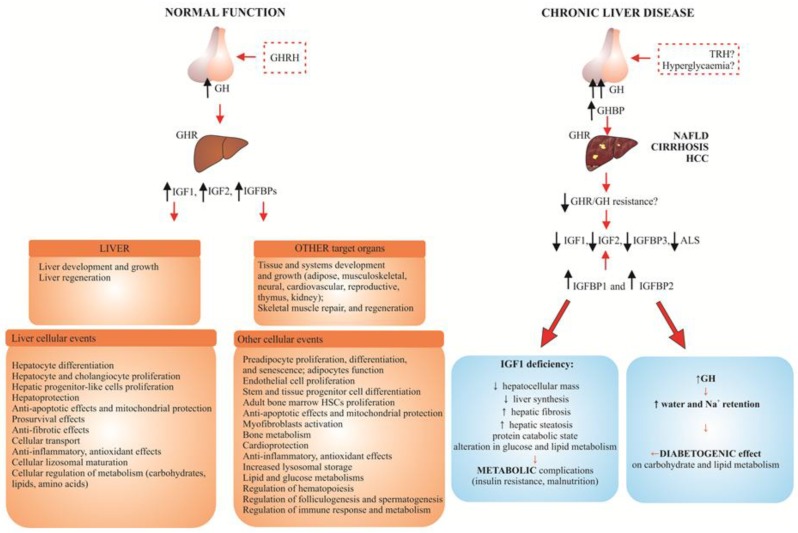
Hepatocyte differentiation, proliferation, and apoptosis are affected by growth factors produced in liver. Insulin-like growth factor 1 and 2 (IGF1 and IGF2) act in response to growth hormone (GH). Other IGF family components include at least six binding proteins (IGFBP1 to 6), manifested by both IGFs develop due to interaction through the type 1 receptor (IGF1R). The data based on animal models and/or in vitro studies suggest the role of IGF system components in cellular aspects of hepatocarcinogenesis (cell cycle progression, uncontrolled proliferation, cell survival, migration, inhibition of apoptosis, protein synthesis and cell growth), and show that systemic IGF1 administration can reduce fibrosis and ameliorate general liver function. In epidemiologic and clinicopathological studies on chronic liver disease (CLD), lowered serum levels, decreased tissue expression of IGF1, elevated production of IGF1R and variable IGF2 expression has been noted, from the start of preneoplastic alterations up to the developed hepatocellular carcinoma (HCC) stage. These changes result in well-known clinical symptoms of IGF1 deficiency. This review summarized the current data of the complex role of IGF system components in the most common CLD (nonalcoholic fatty liver disease, cirrhosis, and hepatocellular carcinoma). Better recognition and understanding of this system can contribute to discovery of new and improved versions of current preventive and therapeutic actions in CLD.
Overview
The claims and statistics of this paper haven’t been checked yet.
Free: it reads the open-access text and checks the first 5 claims that cite a source we can check. Create a free account to check every claim.
Integrity signals
Registry
Cites
Statistics
Figures
Verification
Claims the paper makes
The claims and statistics of this paper haven’t been checked yet.
Free: it reads the open-access text and checks the first 5 claims that cite a source we can check. Create a free account to check every claim.
Claims other papers make about this one
Each is checked against this paper’s own text: does it say what the citing paper says it does?
The source backs part of the claim, not all of it — or backs it for a different population, condition or comparison.
In the citing paper
“Experimental data show that low doses of IGF-1 increase bone mass in cirrhotic rats [65,69,70].”
From Bone diseases in patients with chronic liver disease (2019) · cites this paper as [70]
Experimental — accuracy not yet measured
Self-check
Percentages, sums and reported differences re-computed from the paper’s own numbers.
The self-check needs the paper’s full text.
Citations
Cites
Vernon, G., Baranova, A., & Younossi, Z. M. (2011) · Alimentary Pharmacology & Therapeutics · doi:10.1111/j.1365-2036.2011.04724.x · Cited by 3,074 · cited 2×
“NASH can progress to cirrhosis and its related complications [26,29].”
BackgroundDAUGHADAY, W. H., & ROTWEIN, P. (1989) · Endocrine Reviews · doi:10.1210/edrv-10-1-68 · Cited by 1,725 · cited 1×
“They are functionally related to insulin but have a much higher growth-promoting activity [6,7].”
BackgroundLiver Failure and Defective Hepatocyte Regeneration in Interleukin-6-Deficient Mice
Cressman, D. E., Greenbaum, L. E., DeAngelis, R. A., Ciliberto, G., Furth, E. E., Poli, V., & Taub, R. (1996) · Science · doi:10.1126/science.274.5291.1379 · Cited by 1,538 · cited 1×
“IGF1 plays role in supporting proliferation of hepatocytes and accelerating DNA synthesis [74], together with IL-6, TNF-α, HGF and TGF-α/EGF systems [75,76].”
BackgroundThe Somatomedin Hypothesis: 2001
Le Roith, D., Bondy, C., Yakar, S., Liu, J.-L., & Butler, A. (2001) · Endocrine Reviews · doi:10.1210/edrv.22.1.0419 · Cited by 1,257
The Insulin-Like Growth Factor-Binding Protein (IGFBP) Superfamily*
Hwa, V., Oh, Y., & Rosenfeld, R. G. (1999) · Endocrine Reviews · doi:10.1210/edrv.20.6.0382 · Cited by 1,079 · cited 1×
“In addition, IGFBPs’ activity is also regulated by IGFBP proteases [14,19,24,25].”
BackgroundInsulin‐like growth factors I and II
HUMBEL, R. E. (1990) · European Journal of Biochemistry · doi:10.1111/j.1432-1033.1990.tb15595.x · Cited by 999 · cited 2×
“In mammals, liver-derived endocrine IGF1 mediates the growth promoting effects of growth hormone (GH) during postnatal life, whereas IGF2 stimulates placental and fetal growth, and is less GH dependent than IGF1 [8,9].”
BackgroundMechanisms of hepatic fibrogenesis
Lee, U. E., & Friedman, S. L. (2011) · Best Practice & Research Clinical Gastroenterology · doi:10.1016/j.bpg.2011.02.005 · Cited by 923
Mechanisms of Organ Injury and Repair by Macrophages
Vannella, K. M., & Wynn, T. A. (2017) · Annual Review of Physiology · doi:10.1146/annurev-physiol-022516-034356 · Cited by 656
Liver regeneration. 2. Role of growth factors and cytokines in hepatic regeneration.
Fausto, N., Laird, A. D., & Webber, E. M. (1995) · The FASEB Journal · doi:10.1096/fasebj.9.15.8529831 · Cited by 619
From NAFLD to NASH to cirrhosis—new insights into disease mechanisms
Wree, A., Broderick, L., Canbay, A., Hoffman, H. M., & Feldstein, A. E. (2013) · Nature Reviews Gastroenterology & Hepatology · doi:10.1038/nrgastro.2013.149 · Cited by 609 · cited 2×
“%) in the absence of significant alcohol intake, is recognized as the most common cause and form of CLD, and is estimated to affect 30% of adults and 10% of children in the United States [28], with its worldwide prevalence continuously increasing, in correlation with the growing obesity epidemic [26,29,30].”
Background
Cited by
Rinella, M. E., Neuschwander-Tetri, B. A., Siddiqui, M. S., Abdelmalek, M. F., Caldwell, S., Barb, D., Kleiner, D. E., & Loomba, R. (2023) · Hepatology · doi:10.1097/hep.0000000000000323 · Cited by 2,667
Cusi, K., Isaacs, S., Barb, D., Basu, R., Caprio, S., Garvey, W. T., Kashyap, S., Mechanick, J. I., Mouzaki, M., Nadolsky, K., et al. (2022) · Endocrine Practice · doi:10.1016/j.eprac.2022.03.010 · Cited by 1,021
MAPK/ERK Signaling Pathway in Hepatocellular Carcinoma
Moon, H., & Ro, S. W. (2021) · Cancers · doi:10.3390/cancers13123026 · Cited by 326
“Signaling through IGF1R plays an important role in tumorigenesis in the liver and is one of the hallmarks of HCC [53,54].”
BackgroundMultiomics study of nonalcoholic fatty liver disease
Sveinbjornsson, G., Ulfarsson, M. O., Thorolfsdottir, R. B., Jonsson, B. A., Einarsson, E., Gunnlaugsson, G., Rognvaldsson, S., Arnar, D. O., Baldvinsson, M., Bjarnason, R. G., et al. (2022) · Nature Genetics · doi:10.1038/s41588-022-01199-5 · Cited by 236
Lonardo, A., Mantovani, A., Lugari, S., & Targher, G. (2019) · International Journal of Molecular Sciences · doi:10.3390/ijms20112841 · Cited by 120
“Based on the finding that untreated AGHD patients exhibit a metabolic syndrome-like phenotype, which is strongly and bi-directionally associated with NAFLD, a potential association between GHD and NAFLD was suggested [134].”
BackgroundYamanaka, K., Haraguchi, Y., Takahashi, H., Kawashima, I., & Shimizu, T. (2023) · Scientific Reports · doi:10.1038/s41598-023-27629-w · Cited by 132
Bone diseases in patients with chronic liver disease
Jeong, H., & Kim, D. (2019) · International Journal of Molecular Sciences · doi:10.3390/ijms20174270 · Cited by 113
“Experimental data show that low doses of IGF-1 increase bone mass in cirrhotic rats [65,69,70].”
BackgroundAssociations between “Cancer Risk”, “Inflammation” and “Metabolic Syndrome”: A Scoping Review
Vitale, E., Rizzo, A., Santa, K., & Jirillo, E. (2024) · Biology · doi:10.3390/biology13050352 · Cited by 153
“Additionally, the compounded relation between T2DM and cancer may indirectly depend on the same risk factor: obesity [54].”
BackgroundKnuppel, A., Fensom, G. K., Watts, E. L., Gunter, M. J., Murphy, N., Papier, K., Perez-Cornago, A., Schmidt, J. A., Smith Byrne, K., Travis, R. C., et al. (2020) · Cancer Research · doi:10.1158/0008-5472.can-20-1281 · Cited by 96
“Case–control studies suggest that low serum IGF-I concentrations might be caused by decreased hepatic reserve in nonalcoholic fatty liver disease, liver cirrhosis, and hepatocellular carcinoma (39).”
BackgroundAtabaki-Pasdar, N., Ohlsson, M., Viñuela, A., Frau, F., Pomares-Millan, H., Haid, M., Jones, A. G., Thomas, E. L., Koivula, R. W., Kurbasic, A., et al. (2020) · PLOS Medicine · doi:10.1371/journal.pmed.1003149 · Cited by 97
Zhen, N., Gu, S., Ma, J., Zhu, J., Yin, M., Xu, M., Wang, J., Huang, N. J., Cui, Z., Bian, Z., et al. (2019) · Theranostics · doi:10.7150/thno.29515 · Cited by 99
“PI3K-Akt signaling are the principal downstream of IGF2/IGF1R signaling [48].”
BackgroundLadang, A., Beaudart, C., Reginster, J., Al‐Daghri, N. M., Bruyère, O., Burlet, N., Cesari, M., Cherubini, A., da Silva, M. C., Cooper, C. C., et al. (2023) · Calcified Tissue International · doi:10.1007/s00223-022-01054-z · Cited by 99
A Microphysiological System for Studying Nonalcoholic Steatohepatitis
Kostrzewski, T., Maraver, P., Ouro‐Gnao, L., Levi, A., Snow, S., Miedzik, A., Rombouts, K., & Hughes, D. (2020) · Hepatology Communications · doi:10.1002/hep4.1450 · Cited by 77
Ngo, M.-H. T., Jeng, H.-Y., Kuo, Y., Nanda, J. D., Brahmadhi, A., Ling, T., Chang, T., & Huang, Y. (2021) · International Journal of Molecular Sciences · doi:10.3390/ijms22041931 · Cited by 88
Epigenetic Mechanisms Involved in HCV-Induced Hepatocellular Carcinoma (HCC)
Zhao, P., Malik, S., & Xing, S. (2021) · Frontiers in Oncology · doi:10.3389/fonc.2021.677926 · Cited by 86
Nachit, M., & Leclercq, I. A. (2019) · Clinical Science · doi:10.1042/cs20180421 · Cited by 73
Jiang, B., Zhou, X., Yang, T., Wang, L., Feng, L., Wang, Z., Xu, J., Jing, W., Wang, T., Su, H., et al. (2023) · Frontiers in Cardiovascular Medicine · doi:10.3389/fcvm.2023.1088575 · Cited by 76
“The IGF pathway plays a key role in antiapoptosis, stimulating proliferation, activating angiogenesis, and initiating and maintaining tumorigenesis (86).”
BackgroundFederico, A., Dallio, M., Masarone, M., Gravina, A. G., Sarno, R. D., Tuccillo, C., Cossiga, V., Lama, S., Stiuso, P., Morisco, F., et al. (2019) · Oxidative Medicine and Cellular Longevity · doi:10.1155/2019/8742075 · Cited by 74
Soluble Klotho Improves Hepatic Glucose and Lipid Homeostasis in Type 2 Diabetes
Gu, H., Jiang, W., You, N., Huang, X., Li, Y., Peng, X., Dong, R., Wang, Z., Zhu, Y., Wu, K., et al. (2020) · Molecular Therapy — Methods & Clinical Development · doi:10.1016/j.omtm.2020.08.002 · Cited by 71
“IR contributes to the pathogenesis of T2D and is exacerbated by crosstalk with the homologous IGF1R.21,22 Intracellular lipid accumulation is associated with increased IGF2 levels and decreased IGF1 levels in the serum, and both of these molecules are ligands of IGF1R.22,23 Our experiments suggested that sKL could imp…”
BackgroundKey Players of Hepatic Fibrosis
Dawood, R. M., El-Meguid, M. A., Salum, G. M., & Awady, M. K. E. (2020) · Journal of Interferon & Cytokine Research · doi:10.1089/jir.2020.0059 · Cited by 73
“Levels of insulin-like growth factor 1 (IGF-1), which is a central controller of intermediary metabolism, lessen in liver cirrhosis; therefore, IGF-1 treatment might recover liver function and reduce oxidative liver injury (Adamek and Kasprzak 2018).”
Disrupting Insulin and IGF Receptor Function in Cancer
Cao, J., & Yee, D. (2021) · International Journal of Molecular Sciences · doi:10.3390/ijms22020555 · Cited by 68
“Dysregulation of the IGF system contributes to the progression of multiple chronic liver diseases, such as nonalcoholic fatty liver disease (NAFLD), which may gradually promote hepatocarcinogenesis [19].”
BackgroundNatural Sulfur-Containing Compounds: An Alternative Therapeutic Strategy against Liver Fibrosis
Milito, A., Brancaccio, M., D’Argenio, G., & Castellano, I. (2019) · Cells · doi:10.3390/cells8111356 · Cited by 63
“Among the other factors affecting liver fibrosis is endothelin 1 (ET-1), a peptide widely distributed in the liver, which induces HSC proliferation [25] and the decrease of insulin-like growth factor (IGF), involved in the differentiation, proliferation, and apoptosis of hepatocytes [26].”
BackgroundLuo, X., Jiang, X., Li, J., Bai, Y., Li, Z., Wei, P., Sun, S., Liang, Y., Han, S., Li, X., et al. (2019) · Cell Death and Disease · doi:10.1038/s41419-019-1670-6 · Cited by 62
Silva, F. G., Silva, S. R., Pereira, A. M. F., Cerqueira, J. O. L., & Conceição, C. (2024) · Animals · doi:10.3390/ani14071130 · Cited by 105
“IGFs are synthesized in the liver in response to the growth hormone (GH) [328], and some IGFBPs are synthesized in the lactocytes of the mammary gland [329].”
BackgroundMukama, T., Srour, B., Johnson, T., Katzke, V. A., & Kaaks, R. (2023) · The Journal of Clinical Endocrinology & Metabolism · doi:10.1210/clinem/dgad212 · Cited by 60
Beletskiy, A., Chesnokova, E., & Bal, N. V. (2021) · International Journal of Molecular Sciences · doi:10.3390/ijms22041849 · Cited by 69
Moon, H., Cho, K., Shin, S., Kim, D. Y., Han, K., & Ro, S. W. (2019) · International Journal of Molecular Sciences · doi:10.3390/ijms20030581 · Cited by 61
“IGFs and their receptors (IGF-1R, IGF-2R) also regulate metabolic processes such as lipogenesis, and glycogen storage in the liver [88].”
BackgroundExtra-Hepatic Manifestations and Complications of Nonalcoholic Fatty Liver Disease
Ballestri, S., Mantovani, A., Nascimbeni, F., Lugari, S., & Lonardo, A. (2019) · Future Medicinal Chemistry · doi:10.4155/fmc-2019-0003 · Cited by 56
Role of thyroid hormones in craniofacial development
Leitch, V. D., Bassett, J. H. D., & Williams, G. R. (2020) · Nature Reviews Endocrinology · doi:10.1038/s41574-019-0304-5 · Cited by 57
Physiopathology of Lifestyle Interventions in Non-Alcoholic Fatty Liver Disease (NAFLD)
Carneros, D., López‐Lluch, G., & Bustos, M. (2020) · Nutrients · doi:10.3390/nu12113472 · Cited by 51
“However, it is not clear if the reduction of IGF-I secretion is caused by the damage of liver parenchyma or if the altered GH/IGF-I ratio is the cause of the damage to liver cells [114].”
BackgroundInsulin-like Growth Factor-2 (IGF-2) in Fibrosis
Zhu, Y., Chen, L., Song, B., Cui, Z., Chen, G., Yu, Z., & Song, B. (2022) · Biomolecules · doi:10.3390/biom12111557 · Cited by 53
“IGF-2 is the most abundant IGF in adult circulation, with circulating concentrations three times higher than those of IGF-1 [3].”
BackgroundSchneider, C. V., Schneider, K. M., Conlon, D. M., Park, J., Vujkovic, M., Zandvakili, I., Ko, Y.-A., Trautwein, C., Carr, R. M., Strnad, P., et al. (2021) · Med · doi:10.1016/j.medj.2021.04.011 · Cited by 44
Non-coding RNA basis of muscle atrophy
Liu, Q., Deng, J., Qiu, Y., Gao, J., Li, J., Guan, L., Lee, H., Zhou, Q., & Xiao, J. (2021) · Molecular Therapy — Nucleic Acids · doi:10.1016/j.omtn.2021.10.010 · Cited by 47
“Of note, IGF-2, which is the predominant circulating IGF, also acts in response to GH and promotes placental and fetal growth.(111) Several ncRNAs have been reported to regulate IGF-1 signaling in skeletal muscle.”
BackgroundXie, M., Sun, M., Ji, X., Li, D., Chen, X., Zhang, B., Huang, W., Zhang, T., Wang, Y., Tian, D., et al. (2022) · Theranostics · doi:10.7150/thno.65775 · Cited by 49
“Unlike IGF1, which is decreased in HCC and whose lower levels may be a potential risk factor for HCC progression, IGF2 is significantly increased in HCC and serum IGF2 levels are associated with extrahepatic metastasis [26, 27].”
Yao, Y., Miao, X., Zhu, D., Li, D., Zhang, Y., Song, C., & Liu, K. (2019) · Endocrine · doi:10.1007/s12020-019-01982-1 · Cited by 43
Fritsche, K., Ziková, A., Marx‐Stoelting, P., & Braeuning, A. (2023) · International Journal of Molecular Sciences · doi:10.3390/ijms24032686 · Cited by 45
“IGF-2 can be a key factor in steatosis initiation [91].”
BackgroundLaboratory investigations in the diagnosis and follow-up of GH-related disorders
Schilbach, K., & Bidlingmaier, M. (2019) · Archives of Endocrinology and Metabolism · doi:10.20945/2359-3997000000192 · Cited by 46
Insulin/IGF signaling and discoidin domain receptors: An emerging functional connection
Vella, V., Malaguarnera, R., Nicolosi, M. L., Morrione, A., & Belfiore, A. (2019) · Biochimica et Biophysica Acta (BBA) - Molecular Cell Research · doi:10.1016/j.bbamcr.2019.118522 · Cited by 44
Alexopoulos, T., Vasilieva, L., Kontogianni, M. D., Tenta, R., Georgiou, A., Stroumpouli, E., Mani, I., & Alexopoulou, A. (2021) · American Journal of Physiology-Gastrointestinal and Liver Physiology · doi:10.1152/ajpgi.00184.2021 · Cited by 40
Biomarkers for Hepatocellular Carcinoma: From Origin to Clinical Diagnosis
Omar, M. A., Omran, M. M., Farid, K., Tabll, A. A., Shahein, Y. E., Emran, T. M., Petrovic, A. G., Lučić, N. R., Smolić, R., Kovac, T., et al. (2023) · Biomedicines · doi:10.3390/biomedicines11071852 · Cited by 49
“Patients with HCC have significantly lower blood concentrations of IGF-I (three times lower) than IGF II compared with the levels in patients without HCC [62,63].”
BackgroundMetformin Impairs Glutamine Metabolism and Autophagy in Tumour Cells
Saladini, S., Aventaggiato, M., Barreca, F., Morgante, E., Sansone, L., Russo, M. A., & Tafani, M. (2019) · Cells · doi:10.3390/cells8010049 · Cited by 42
Fahlbusch, P., Knebel, B., Hörbelt, T., Barbosa, D. M., Nikolic, A., Jacob, S., Al‐Hasani, H., de Velde, F. V., Nieuwenhove, Y. V., Müller‐Wieland, D., et al. (2020) · International Journal of Molecular Sciences · doi:10.3390/ijms21114144 · Cited by 41
“In the circulation, approximately 90% of IGF1 is bound to IGFBP3 [19].”
BackgroundGrowth hormone deficiency and NAFLD: An overlooked and underrecognized link
Doycheva, I., Erickson, D. Z., & Watt, K. D. S. (2022) · Hepatology Communications · doi:10.1002/hep4.1953 · Cited by 39
“IGF1/IGFBP- 3 ratio is used as a marker of IGF1 bioavailability.[20] IGF1 binds to its receptor located in multiple cell types and tissues, but can also bind with less affinity to the insulin receptor.”
MethodMetabolic Health and Disease: A Role of Osteokines?
Shimonty, A., Bonewald, L. F., & Huot, J. R. (2023) · Calcified Tissue International · doi:10.1007/s00223-023-01093-0 · Cited by 43
“Circulating IGF-1 is lower in patients with NAFLD, NASH, and liver cirrhosis, and has shown to correlate with disease progression, including liver steatosis, the degree of fibrosis, and the severity of cirrhosis (see review) [100].”
BackgroundSMN Depleted Mice Offer a Robust and Rapid Onset Model of Nonalcoholic Fatty Liver Disease
Deguise, M., Pileggi, C. A., Repentigny, Y. D., Beauvais, A., Tierney, A., Chehadé, L., Michaud, J., Hurtado, M. L., Lamont, D. J., Atrih, A., et al. (2021) · Cellular and Molecular Gastroenterology and Hepatology · doi:10.1016/j.jcmgh.2021.01.019 · Cited by 40
“Interestingly, IGF1 depletion may lead to insulin sensitivity.(47,60) It is unclear whether IGF1 reduction is an initiator or a consequence of NAFLD.”
BackgroundBiadgo, B., Tamir, W., & Ambachew, S. (2020) · The Review of Diabetic Studies · doi:10.1900/rds.2020.16.24 · Cited by 40
“IGF-1 and insulin fully activate IGF-1R and insulin receptor, but they can also interact with each other and activate the other receptor with low affinity [17, 26, 32, 33].”
BackgroundInfluentialPan, J., Li, C., Zhou, T., Yu, M., Chen, X., Jiang, W., Li, Y., Yu, C., & Shen, Z. (2021) · Journal of Gastroenterology and Hepatology · doi:10.1111/jgh.15627 · Cited by 35
Type 2 Diabetes Mellitus and Liver Disease: Across the Gut–Liver Axis from Fibrosis to Cancer
Manilla, V., Santopaolo, F., Gasbarrini, A., & Ponziani, F. R. (2023) · Nutrients · doi:10.3390/nu15112521 · Cited by 41
“In rat models of early HCC, IGF-2 was expressed in the cytoplasm of both precancerous liver cells and malignant hepatocytes, but also in the rough endoplasmic reticulum and mitochondria of malignant hepatocytes, and seemed to promote hepatocytes proliferation by using both paracrine and autocrine mechanisms [61].”
BackgroundZhang, Q., Ren, H., Ge, L., Zhang, W., Song, F., & Huang, P. C. (2023) · Cancer Cell International · doi:10.1186/s12935-023-02861-6 · Cited by 42
Cui, F., & He, X. (2022) · Inflammation Research · doi:10.1007/s00011-022-01557-3 · Cited by 37
“IGF-1 with similar structure to insulin exerts a variety of biological functions, including blood sugar regulation [7, 8].”
BackgroundCai, W., Ma, Y., Li, S., Cao, N., Gao, J., Zhou, S., & Tang, X. (2023) · BMC Cancer · doi:10.1186/s12885-023-10561-7 · Cited by 33
“IGF-1R overexpression is associated with an increased risk of developing cancers, including HCC [9, 10], and the expression and activation of IGF-1R are related to drug resistance in tumors.”
BackgroundDifferential production of insulin-like growth factor-binding proteins in liver fibrosis progression
Martínez‐Castillo, M., Rosique-Oramas, D., Medina‐Ávila, Z., Pérez-Hernández, J. L., la Tijera, F. H., Santana‐Vargas, D., Montalvo-Jave, E. E., Sánchez-Ávila, J. F., Torre, A., Kershenobich, D., et al. (2020) · Molecular and Cellular Biochemistry · doi:10.1007/s11010-020-03728-4 · Cited by 35
He, S., Yang, J., Jiang, S., Li, Y., & Han, X. (2020) · Cancer Cell International · doi:10.1186/s12935-020-01496-1 · Cited by 34
RetractedLong noncoding RNA H19 – a new player in the pathogenesis of liver diseases
Yang, Z., Zhang, T., Han, S., Kusumanchi, P., Huda, N., Jiang, Y., & Liangpunsakul, S. (2020) · Translational research · doi:10.1016/j.trsl.2020.11.010 · Cited by 34
García‐Domínguez, X., Marco‐Jiménez, F., Peñaranda, D. S., Diretto, G., García‐Carpintero, V., Cañizares, J., & Vicente, J. S. (2020) · Scientific Reports · doi:10.1038/s41598-020-68195-9 · Cited by 35
Aging reduces liver resiliency by dysregulating Hedgehog signaling
Maeso‐Díaz, R., Dalton, G. D., Oh, S., Du, K., Tang, L., Chen, T., Dutta, R. K., Hartman, J. H., Meyer, J. N., & Diehl, A. M. (2022) · Aging Cell · doi:10.1111/acel.13530 · Cited by 32
Effects and potential mechanisms of IGF1/IGF1R in the liver fibrosis: A review
Gui, R., Li, W., Li, Z., Wang, H., Wu, Y., Jiao, W., Zhao, G., Shen, Y., Wang, L., Zhang, J., et al. (2023) · International Journal of Biological Macromolecules · doi:10.1016/j.ijbiomac.2023.126263 · Cited by 35
Hong, S. E., Mun, S. J., Lee, Y. J., Yoo, T., Suh, K., Kang, K. W., Son, M. J., Kim, W. K., & Choi, M. (2025) · Nature Genetics · doi:10.1038/s41588-025-02237-8 · Cited by 45
“4), for example, insulin-like growth factor (IGF) signaling, an inhibitory signal against inflammation and fibrosis originating from the hepatocytes 43,44 , acts on endothelial cells and is downregulated in MASH (Fig.”
Kasprzak, A., & Szaflarski, W. (2020) · International Journal of Molecular Sciences · doi:10.3390/ijms21196995 · Cited by 31
Self-citationMechanisms Underlying Hepatocellular Carcinoma Progression in Patients with Type 2 Diabetes
Shi, T., Kobara, H., Oura, K., & Masaki, T. (2021) · Journal of Hepatocellular Carcinoma · doi:10.2147/jhc.s274933 · Cited by 34
IGF1R controls mechanosignaling in myofibroblasts required for pulmonary alveologenesis
He, H., Snowball, J. M., Sun, F., Na, C.-L., & Whitsett, J. A. (2021) · JCI Insight · doi:10.1172/jci.insight.144863 · Cited by 31
“Although IGF1 and IGF2 are primarily produced by the liver (40), both ligands and Igf1r are expressed in the developing lung, with Igf1r broadly expressed in lung mesenchymal and epithelial cells (LGEA database, https://research.cchmc.org/pbge/lunggens/mainportal.html) (24).”
MicroRNAs regulating SOX2 in cancer progression and therapy response
Mirzaei, S., Saebfar, H., Gholami, M. H., Hashemi, F., Zarrabi, A., Zabolian, A., Entezari, M., Hushmandi, K., Samarghandian, S., Aref, A. R., et al. (2021) · Expert Reviews in Molecular Medicine · doi:10.1017/erm.2021.15 · Cited by 29
Okamoto, K., Koda, M., Okamoto, T., Onoyama, T., Miyoshi, K., Kishina, M., Matono, T., Kato, J., Tokunaga, S., Sugihara, T., et al. (2020) · PLoS ONE · doi:10.1371/journal.pone.0219412 · Cited by 28
Seol, H. S., Akiyama, Y., Lee, S.-E., Shimada, S., & Jang, S. J. (2020) · Scientific Reports · doi:10.1038/s41598-020-77960-9 · Cited by 26
The GH-IGF-1 Axis in Circadian Rhythm
Wang, W., Duan, X., Huang, Z., Pan, Q., Chen, C., & Guo, L. (2021) · Frontiers in Molecular Neuroscience · doi:10.3389/fnmol.2021.742294 · Cited by 35
Sarcopenia in liver cirrhosis: Prevalence, pathophysiology and therapeutic strategies
Fox, R., Stenning, K., Slee, A., Macnaughtan, J., & Davies, N. A. (2022) · Analytical Biochemistry · doi:10.1016/j.ab.2022.114581 · Cited by 28
Hu, D., Ge, Y., Cui, Y., Li, K., Chen, J., Zhang, C., Liu, Q., He, L., Chen, W., Chen, J., et al. (2022) · Oxidative Medicine and Cellular Longevity · doi:10.1155/2022/6831779 · Cited by 27
“Among IGFBPs, IGFBP3 is the major carrier of IGF-1 and regulates its biological activity with the highest content and strongest binding ability [17].”
BackgroundSzydłowska, J., Gorecka, A., Stępień, J., Rysz, I., & Beń‐Skowronek, I. (2024) · International Journal of Molecular Sciences · doi:10.3390/ijms25073966 · Cited by 30
“An increase in IGF-2 levels has been observed, which is consistent with the development of both steatosis and fibrosis [80].”
BackgroundSzilveszter, R.-M., Muntean, M., & Florea, A. (2024) · Biomolecules · doi:10.3390/biom14060656 · Cited by 33
“Conversely, IGFBP gene expression became undetectable in hepatoma cells with high proliferation [40].”
BackgroundSabbah, N., Wolf, P. S., Piedvache, C., Trabado, S., Verdelet, T., Cornu, C., Souberbielle, J., & Chanson, P. (2021) · Endocrine Connections · doi:10.1530/ec-21-0175 · Cited by 28
“Insulin resistance (17) and diabetes (18) regardless of obesity (19) also modify IGF-1 levels, even in acromegalic patients (20), as do nutritional disorders (21), renal failure, and hepatic insufficiency (22).”
Lin, C.-H., Kuo, J. C., Li, D., Koenig, A. B., Pan, A., Yan, P. S., Bai, X., Lee, R. J., & Ghoshal, K. (2022) · Frontiers in Cell and Developmental Biology · doi:10.3389/fcell.2022.853652 · Cited by 27
“Additionally, BRD4 was found to be enriched at SEs surrounding (upstream, downstream, or within) AXL, EHF, FOXM1, IGF1R, RAD51B, RAD51D, STAT6, and TRIB3 genes, most of which are linked to HCC pathogenesis (Adamek and Kasprzak, 2018; Shen et al., 2019; Qi et al., 2020; Batur et al., 2021; Luan et al., 2021).”
BackgroundThe neural stem cell secretome across neurodevelopment
Dause, T. J., Denninger, J. K., Smith, B. M., & Kirby, E. D. (2022) · Experimental Neurology · doi:10.1016/j.expneurol.2022.114142 · Cited by 27
“In addition to being secreted by the liver (Adamek and Kasprzak, 2018), IGF2 is also synthesized locally in the hippocampus, where it is necessary to maintain the rglNSC pool and support the survival of adultborn neurons (Bracko et al., 2012; Ziegler et al., 2012).”
BackgroundWan, Z., Zhang, X., Luo, Y., & Zhao, B. (2019) · Genetic Testing and Molecular Biomarkers · doi:10.1089/gtmb.2019.0063 · Cited by 28
Pati, P., Valcin, J. A., Zhang, D., Neder, T. H., Millender-Swain, T., Allan, J. M., Sedaka, R. S., Jin, C., Becker, B., Pollock, D. M., et al. (2021) · American Journal of Physiology-Regulatory, Integrative and Comparative Physiology · doi:10.1152/ajpregu.00128.2020 · Cited by 25
Gao, R., Wang, J., He, X., Wang, T., Zhou, L., Ren, Z., Yang, J., Xiang, X., Wen, S., Yu, Z., et al. (2022) · Frontiers in Endocrinology · doi:10.3389/fendo.2022.967016 · Cited by 30
“IGFBP7 acts in response to growth hormone and involves in cell cycle progression, cell survival, migration and protein synthesis (38).”
BackgroundPeixe, C. R., Sanchez-García, M. L., Grossman, A. B., Korbonits, M., & Marques, P. (2022) · Growth Hormone & IGF Research · doi:10.1016/j.ghir.2022.101467 · Cited by 21
Zhou, X., Tan, B., Gui, W., Zhou, C., Zhao, H., Lin, X., & Li, H. (2023) · Molecular Medicine · doi:10.1186/s10020-023-00752-0 · Cited by 22
“An increasing body of evidence suggests that IGF2 plays a key role in cell proliferation and organ growth and participates in the development of numerous diseases, such as cancers, cardiovascular diseases, and CLD (Bergman et al. 2013; Adamek and Kasprzak 2018).”
BackgroundMolecular Mechanisms Linking Nonalcoholic Steatohepatitis to Cancer
Wegermann, K., Hyun, J., & Diehl, A. M. (2021) · Clinical Liver Disease · doi:10.1002/cld.1006 · Cited by 20
Lai, M., Dillon, S. T., Gu, X., Morhardt, T. L., Xu, Y., Chan, N. Y., Xiong, B., Can, H., Ngo, L. H., Jin, L., et al. (2024) · Hepatology Communications · doi:10.1097/hc9.0000000000000586 · Cited by 24
Dey, S., Liu, S., Factora, T. D., Taleb, S., Riverahernandez, P., Udari, L., Zhong, X., Wan, J., & Kota, J. (2020) · BMC Cancer · doi:10.1186/s12885-020-07135-2 · Cited by 24
Hammoudeh, S. M., Hammoudeh, A. M., Bhamidimarri, P. M., Mahboub, B. H., Halwani, R., Hamid, Q. A., Rahmani, M., & Hamoudi, R. (2021) · World Journal of Gastroenterology · doi:10.3748/wjg.v27.i21.2850 · Cited by 21
Mao, D., Lau, E. S. H., Wu, H., Yang, A., Fan, B., Shi, M., Tam, C. H. T., Chow, E., Kong, A. P. S., Ronald, C. W., et al. (2022) · Hepatology Communications · doi:10.1002/hep4.1891 · Cited by 21
Potential Therapeutic Strategies to Combat HCC
Altaf, S., Saleem, F., Sher, A. A., & Ali, A. (2022) · Current Molecular Pharmacology · doi:10.2174/1874467215666220103111009 · Cited by 22
Effects of Obesity and Calorie Restriction on Cancer Development
Sergeeva, E. Y., Ruksha, T. G., & Fefelova, Y. A. (2023) · International Journal of Molecular Sciences · doi:10.3390/ijms24119601 · Cited by 24
“Hepatocellular carcinoma IGF/PI3K/AKT; IGF1 Up-regulation Stimulation of DNA synthesis and cyclin D1 expression, inhibition of proteasome-mediated cathepsin B (CTSB) degradation in hepatocellular carcinoma cells; Adamek 2018 [30]”
BackgroundHu, W., Yuan, C., Luo, H., Hu, S., Shen, L., Chen, L., Xu, D., & Wang, H. (2020) · Toxicology Letters · doi:10.1016/j.toxlet.2020.06.008 · Cited by 19
Mechanistic study of the cause of decreased blood 1,25-Dihydroxyvitamin D in sepsis
Li, C.-H., Tang, X., Wasnik, S., Wang, X., Zhang, J., Xu, Y., Lau, K. ‐. W., Nguyen, H. B., & Baylink, D. J. (2019) · BMC Infectious Diseases · doi:10.1186/s12879-019-4529-7 · Cited by 19
Vesting, A. J., Jaïs, A., Klemm, P., Steuernagel, L., Wienand, P., Fog-Tonnesen, M., Hvid, H., Schumacher, A., Kukat, C., Nolte, H., et al. (2022) · Molecular Metabolism · doi:10.1016/j.molmet.2022.101626 · Cited by 18
“Extensive data exist revealing impaired GH downstream signaling and low IGF1 expression in human NASH and HCC as a result of in fl am-mation [44 e 48].”
BackgroundUnraveling the Molecular Mechanisms Involved in HCV-Induced Carcinogenesis
Heredia-Torres, T. G., Rincón‐Sánchez, A. R., Lozano-Sepúlveda, S. A., Galán-Huerta, K. A., Arellanos-Soto, D., García‐Hernández, M., Garza-Juárez, A. D. J., & Rivas-Estilla, A. M. (2022) · Viruses · doi:10.3390/v14122762 · Cited by 24
Association between Serum GDF-15, Myostatin, and Sarcopenia in Cardiovascular Surgery Patients
Nishikawa, R., Fukuda, T., Haruyama, A., Shibasaki, I., Yamaguchi, S., Arikawa, T., Obi, S., Amano, H., Yagi, H., Sakuma, M., et al. (2022) · IJC Heart & Vasculature · doi:10.1016/j.ijcha.2022.101114 · Cited by 23
“These findings suggested that training leads to muscle growth, in part by increasing IGF-1 levels, which in turn increases the “braking” function of myostatin.”
BackgroundInfluentialAssociation of chronic liver disease with bone diseases and muscle weakness
Saeki, C., Saito, M., & Tsubota, A. (2024) · Journal of Bone and Mineral Metabolism · doi:10.1007/s00774-023-01488-x · Cited by 21
“Furthermore, IGF-1 can inhibit or improve hepatic inflammation and fibrosis, suggesting that dysregulated IGF-1 in CLD may further exacerbate CLD pathology [106–108].”
Zhu, J., Guo, J., Liu, Z., Liu, J., Yuan, A., Chen, H., Qiu, J., Dou, X., Lu, D., & Le, Y. (2024) · Chemico-Biological Interactions · doi:10.1016/j.cbi.2024.111162 · Cited by 24
Zhao, Q., He, Y., Wang, K., Wang, C., Wu, H., Gao, L., Hu, A., Yang, W., & Wang, S. (2020) · Nutrition and Cancer · doi:10.1080/01635581.2020.1862255 · Cited by 17
Metformin treatment of juvenile mice alters aging-related developmental and metabolic phenotypes
Zhu, Y. X., Fang, Y., Medina, D., Bartke, A., & Yuan, R. (2021) · Mechanisms of Ageing and Development · doi:10.1016/j.mad.2021.111597 · Cited by 20
Time-restricted feeding reduces cardiovascular disease risk in obese mice
Pati, P., Miguel, C. D., Paul, J. R., Zhang, D., Colson, J. C., Allan, J. M., Edell, C., Rhoads, M. K., Dunaway, L. S., Biswal, S. N., et al. (2025) · JCI Insight · doi:10.1172/jci.insight.160257 · Cited by 22
“Insulin-like growth factor 1 (IGF-1) is a liver-derived hormone with insulin-like effects (37) and affects vascular function.”
Chronic estrone exposure affects spermatogenesis and sperm quality in zebrafish (Danio rerio)
Ribeiro, Y. M., Moreira, D. P., Weber, A. A., Miranda, T. G. R., Bazzoli, N., & Rizzo, E. (2022) · Environmental Toxicology and Pharmacology · doi:10.1016/j.etap.2022.104058 · Cited by 15
IGF2-NR4A2 Signaling Regulates Macrophage Subtypes to Attenuate Liver Cirrhosis
Yao, L., Hu, X., Yuan, M., Zhang, Q., Liu, P., Yang, L., Dai, K., & Jiang, Y. (2023) · Journal of Clinical and Translational Hepatology · doi:10.14218/jcth.2022.00392 · Cited by 21
Dairy consumption and hepatocellular carcinoma risk
Melnik, B. C. (2021) · Annals of Translational Medicine · doi:10.21037/atm-2020-ubih-06 · Cited by 19
“IGF-1/IGF-1 receptor signaling plays a critical role in hepatocarcinogenesis (45-51), whereas blocking of IGF-1 receptor pathway is regarded as a treatment option in HCC (52-60).”
BackgroundInfluentialKong, T., Gu, Y., Sun, L., Zhou, R., Li, J., & Shi, J. (2023) · Endocrine Journal · doi:10.1507/endocrj.ej23-0157 · Cited by 18
HCV and HCC Tango—Deciphering the Intricate Dance of Disease: A Review Article
Milošević, I., Todorović, N., Filipović, A., Simić, J., Marković, M., Stevanović, O., Malinić, J., Katanić, N., Mitrović, N., & Nikolic, N. (2023) · International Journal of Molecular Sciences · doi:10.3390/ijms242216048 · Cited by 18
Zhu, X.-Y., Liu, W., Hou, X., Zong, C., Yu, W., Shen, Z.-M., Qu, S., Tao, M., Xue, M., Zhou, D.-Y., et al. (2024) · Journal of Advanced Research · doi:10.1016/j.jare.2024.12.008 · Cited by 19
“In addition, the deletion of IGF2BP1 in HCC-derived HepG2 cells inhibited the tumor growth during the Xenograft studies[33–35].”
Metadata
- Authors
- Adamek, A., & Kasprzak, A.
- Affiliations
- Poznan University of Medical Sciences (PL)
- Corresponding author
- Adamek, Agnieszka
- Venue
- International Journal of Molecular Sciences
- Publisher
- MDPI AG
- Published
- 2018-04-27
- Volume
- 19
- Issue
- 5
- Pages
- 1308
- ISSN
- 1422-0067 (ISSN-L)
- PMC
- PMC5983723
- OpenAlex
- W2800431474
- Cited by
- 284
- References
- 189
- Citations by year
- 2026: 24 · 2025: 30 · 2024: 36 · 2023: 44 · 2022: 53 · 2021: 41 · 2020: 31 · 2019: 25
- FWCI
- 3.73
- Type
- journal article
- Language
- en
- Open access
- gold
- doi.org
- Licence
- Locations
- International Journal of Molecular Sciences (publishedVersion, cc-by)
- Europe PMC (PubMed Central) (publishedVersion, cc-by)
- PubMed Central (publishedVersion, cc-by)
- PubMed (publishedVersion)
- Topics
- Health Sciences › Medicine › Endocrinology, Diabetes and Metabolism › Growth Hormone and Insulin-like Growth Factors
- Health Sciences › Medicine › Hepatology › Liver physiology and pathology
- Health Sciences › Medicine › Hepatology › Liver Disease Diagnosis and Treatment
- Keywords
- insulin-like growth factor system, insulin-like growth factor I, insulin-like growth factor II, IGF binding proteins, IGF-1 receptor, chronic liver disease, non-alcoholic fatty liver disease, liver cirrhosis, hepatocellular carcinoma, hepatocarcinogenesis, liver fibrosis, growth hormone, hepatocyte proliferation, apoptosis
- MeSH terms
- Animals, Cell Line, Carcinoma, Hepatocellular, Humans, Insulin-Like Growth Factor I, Insulin-Like Growth Factor II, Liver Cirrhosis, Liver Cirrhosis, Experimental, Liver Diseases, Liver Neoplasms, Liver Neoplasms, Experimental, Models, Animal, Non-alcoholic Fatty Liver Disease
About these checks
Registry, retraction, Cites and statistics results are computed, not judged, with one exception: a printed reference that no index lists is read once by a model before it counts as a citation error. Claims are extracted by a model and kept only when their quote appears verbatim in the text; each cited source is then checked, with a model’s help, for whether it says what the claim relies on. Those verdicts can be wrong — read the claim’s quote and the cited source before relying on one.
Statistics and arithmetic are recomputed, not judged.
Confidence bands are shown only for fields calibrated on our annotated test set. None is calibrated yet, so no band is shown.
What counts as a claim ›How we measure confidence ›How we check this ›
Are you an author, or do you see a problem with this page? Request a review
Data sources
Bibliographic data: Semantic Scholar, OpenAlex, Crossref.
Contains information from the Semantic Scholar Academic Graph Datasets, made available under the ODC Attribution License (ODC-BY 1.0).
Semantic Scholar’s data is described in: Kinney, R., et al. (2023). The Semantic Scholar Open Data Platform. arXiv:2301.10140.
