

The DOI matches its Crossref record; 141 of the 142 references it cites were found in a registry or an index.
The Role of AMPK in the Regulation of Skeletal Muscle Size, Hypertrophy, and Regeneration
Open accessAbstract
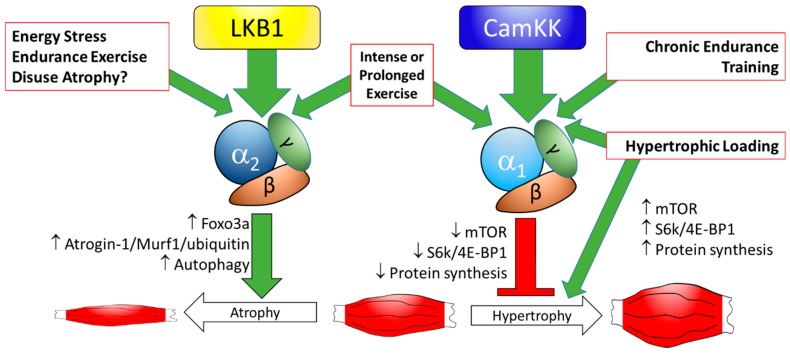
AMPK (5’-adenosine monophosphate-activated protein kinase) is heavily involved in skeletal muscle metabolic control through its regulation of many downstream targets. Because of their effects on anabolic and catabolic cellular processes, AMPK plays an important role in the control of skeletal muscle development and growth. In this review, the effects of AMPK signaling, and those of its upstream activator, liver kinase B1 (LKB1), on skeletal muscle growth and atrophy are reviewed. The effect of AMPK activity on satellite cell-mediated muscle growth and regeneration after injury is also reviewed. Together, the current data indicate that AMPK does play an important role in regulating muscle mass and regeneration, with AMPKα1 playing a prominent role in stimulating anabolism and in regulating satellite cell dynamics during regeneration, and AMPKα2 playing a potentially more important role in regulating muscle degradation during atrophy.
Overview
The claims and statistics of this paper haven’t been checked yet.
Run the check — free, no account needed. It reads the open-access text and checks the sources it cites.
Integrity signals
Registry
Cites
Statistics
Figures
Verification
Claims the paper makes
The claims and statistics of this paper haven’t been checked yet.
Run the check — free, no account needed. It reads the open-access text and checks the sources it cites.
Claims other papers make about this one
Each is checked against this paper’s own text: does it say what the citing paper says it does?
The check wasn’t confident either way, so it gives no verdict — never disputed.
In the citing paper
“AMPK can inhibit RNA polymerase I activity through multiple mechanisms, including suppression of TIF-1A function and modulation of chromatin accessibility at rDNA loci”
From Ribosome Biogenesis as a Putative Bottleneck to Skeletal Muscle Hypertrophy: Mechanisms, Human Evidence, and Practical Modulators (2026) · cites this paper as [62]
Experimental — accuracy not yet measuredThe check wasn’t confident either way, so it gives no verdict — never disputed.
In the citing paper
“A novel biomechanical stimulus might successfully initiate Pol I, but concurrent metabolic stress might abort snoRNA-guided processing downstream, leading to aborted assembly despite massive precursor transcripts [60,62].”
From Ribosome Biogenesis as a Putative Bottleneck to Skeletal Muscle Hypertrophy: Mechanisms, Human Evidence, and Practical Modulators (2026) · cites this paper as [62]
Experimental — accuracy not yet measured
Self-check
Percentages, sums and reported differences re-computed from the paper’s own numbers.
The self-check needs the paper’s full text.
Citations
Cites
Repertoires of Autophagy in the Pathogenesis of Ocular Diseases
Li, Y., Jiang, Q. L., Cao, G.-F., Yao, J., & Yan, B. (2015) · Cellular Physiology and Biochemistry · doi:10.1159/000373980 · Cited by 16,351
AMPK and mTOR regulate autophagy through direct phosphorylation of Ulk1
Kim, J., Kundu, M., Viollet, B., & Guan, K.-L. (2011) · Nature Cell Biology · doi:10.1038/ncb2152 · Cited by 7,227
Role of AMP-Activated Protein Kinase in Mechanism of Metformin Action
Zhou, G., Myers, R., Li, Y., Chen, Y., Shen, X., Fenyk-Melody, J., Wu, M., Ventre, J., Doebber, T., Fujii, N., et al. (2001) · Journal of Clinical Investigation · doi:10.1172/jci13505 · Cited by 5,652
AMPK: guardian of metabolism and mitochondrial homeostasis
Herzig, S., & Shaw, R. J. (2017) · Nature Reviews Molecular Cell Biology · doi:10.1038/nrm.2017.95 · Cited by 4,192
AMPK Phosphorylation of Raptor Mediates a Metabolic Checkpoint
Gwinn, D. M., Shackelford, D. B., Egan, D. F., Mihaylova, M. M., Mery, A., Vasquez, D. S., Turk, B. E., & Shaw, R. J. (2008) · Molecular Cell · doi:10.1016/j.molcel.2008.03.003 · Cited by 3,849
AMPK regulates energy expenditure by modulating NAD+ metabolism and SIRT1 activity
Cantó, C., Gerhart-Hines, Z., Feige, J. N., Lagouge, M., Noriega, L., Milne, J. C., Elliott, P. J., Puigserver, P., & Auwerx, J. (2009) · Nature · doi:10.1038/nature07813 · Cited by 3,300
The mechanisms of action of metformin
Rena, G., Hardie, D. G., & Pearson, E. R. (2017) · Diabetologia · doi:10.1007/s00125-017-4342-z · Cited by 2,287
Corton, J. M., Gillespie, J. G., Hawley, S. A., & Hardie, D. G. (1995) · European Journal of Biochemistry · doi:10.1111/j.1432-1033.1995.tb20498.x · Cited by 1,232
Merrill, G. F., Kurth, E. J., Hardie, D. G., & Winder, W. W. (1997) · American Journal of Physiology-Endocrinology and Metabolism · doi:10.1152/ajpendo.1997.273.6.e1107 · Cited by 1,048
Rheb Binds and Regulates the mTOR Kinase
Long, X., Lin, Y., Ortiz-Vega, S., Yonezawa, K., & Avruch, J. (2005) · Current Biology · doi:10.1016/j.cub.2005.02.053 · Cited by 1,005
Cited by
Sorted by citations
Mechanisms of IGF-1-Mediated Regulation of Skeletal Muscle Hypertrophy and Atrophy
Yoshida, T., & Delafontaine, P. (2020) · Cells · doi:10.3390/cells9091970 · Cited by 772
“Importantly, IGF-1 level is reduced in both of these atrophying conditions and Akt is inhibited in skeletal muscle, although the role of AMPK (which is known to inhibit Akt/mTOR and activate FoxO [78,92]) in relation to IGF-1 signaling in atrophying conditions is not clear.”
BackgroundSarcopenia and Muscle Aging: A Brief Overview
Dao, T., Green, A. E., Kim, Y.-A., Bae, S., Ha, K., Gariani, K., Lee, M.-R., Menzies, K. J., & Ryu, D. (2020) · Endocrinology and Metabolism · doi:10.3803/enm.2020.405 · Cited by 249
Huang, Y., Zhu, X., Chen, K., Lang, H., Zhang, Y., Hou, P., Ran, L., Zhou, M., Zheng, J., Yi, L., et al. (2019) · Aging · doi:10.18632/aging.101910 · Cited by 167
“AMPK, a potential longevity target [66], plays an important role in the regulation of skeletal muscle mass and regeneration [67].”
BackgroundVarghese, S., Rao, S., Khattak, A., Zamir, F., & Chaari, A. (2024) · Nutrients · doi:10.3390/nu16213663 · Cited by 152
The flesh texture of teleost fish: Characteristics and interventional strategies
Wang, Z., Qiao, F., Zhang, W., Parisi, G., Du, Z., & Zhang, M. (2023) · Reviews in Aquaculture · doi:10.1111/raq.12849 · Cited by 139
Metadata
- Authors
- Thomson, D. M.
- Affiliations
- Brigham Young University (US)
- Corresponding author
- Thomson, David M.
- ORCID
- Thomson, David M.
- Venue
- International Journal of Molecular Sciences
- Publisher
- MDPI AG
- Published
- 2018-10-11
- Volume
- 19
- Issue
- 10
- Pages
- 3125
- ISSN
- 1422-0067 (ISSN-L)
- PMC
- PMC6212977
- OpenAlex
- W2896374260
- Cited by
- 267
- References
- 142
- Citations by year
- 2026: 29 · 2025: 36 · 2024: 41 · 2023: 52 · 2022: 40 · 2021: 31 · 2020: 24 · 2019: 13 · 2018: 1
- FWCI
- 1.68
- Type
- journal article
- Language
- en
- Open access
- gold
- dx.doi.org
- Licence
- Locations
- International Journal of Molecular Sciences (publishedVersion, cc-by)
- Europe PMC (PubMed Central) (publishedVersion, other-oa)
- PubMed Central (publishedVersion, cc-by)
- PubMed (publishedVersion)
- DOAJ (DOAJ: Directory of Open Access Journals) (submittedVersion, cc-by-sa)
- Topics
- Life Sciences › Biochemistry, Genetics and Molecular Biology › Molecular Biology › Muscle Physiology and Disorders
- Life Sciences › Biochemistry, Genetics and Molecular Biology › Molecular Biology › Metabolism, Diabetes, and Cancer
- Health Sciences › Nursing › Nutrition and Dietetics › Muscle metabolism and nutrition
- Keywords
- AMPK, skeletal muscle growth, muscle hypertrophy, muscle atrophy, muscle regeneration, satellite cells, LKB1, AMPKα1, AMPKα2, muscle metabolism, myogenesis
- MeSH terms
- Animals, Energy Metabolism, Enzyme Activation, Humans, Hypertrophy, Organ Size, Regeneration, Wound Healing, Signal Transduction, Biomarkers, Muscle, Skeletal, Muscle Fibers, Skeletal, Muscle Development, AMP-Activated Protein Kinases
About these checks
Registry, retraction, Cites and statistics results are computed, not judged, with one exception: a printed reference that no index lists is read once by a model before it counts as a citation error. Claims are extracted by a model and kept only when their quote appears verbatim in the text; each cited source is then checked, with a model’s help, for whether it says what the claim relies on. Those verdicts can be wrong — read the claim’s quote and the cited source before relying on one.
Statistics and arithmetic are recomputed, not judged.
Confidence bands are shown only for fields calibrated on our annotated test set. None is calibrated yet, so no band is shown.
What counts as a claim ›How we measure confidence ›How we check this ›
Are you an author, or do you see a problem with this page? Request a review
