

The DOI matches its Crossref record; 151 of the 154 references it cites were found in a registry or an index.
Risk Factors and Emerging Therapies in Amyotrophic Lateral Sclerosis
Open accessAbstract
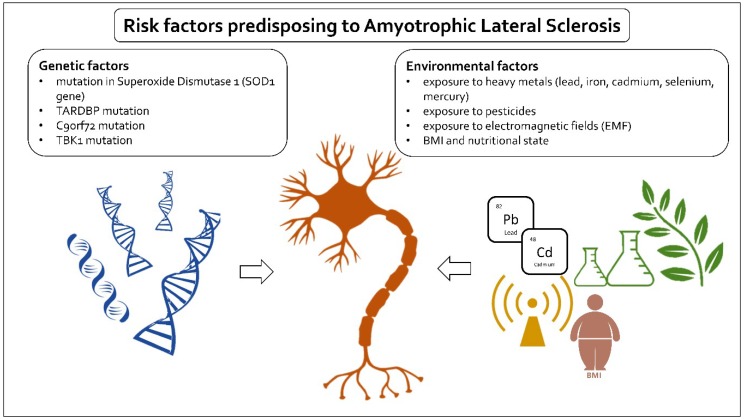
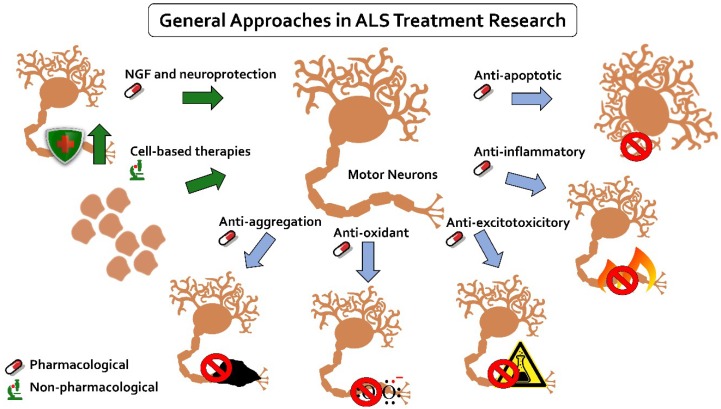
Amyotrophic lateral sclerosis (ALS) is a fatal progressive neurodegenerative disease characterized by a permanent degeneration of both upper and lower motor neurons. Many different genes and pathophysiological processes contribute to this disease, however its exact cause remains unclear. Therefore, it is necessary to understand this heterogeneity to find effective treatments. In this review, we focus on selected environmental and genetic risk factors predisposing to ALS and highlight emerging treatments in ALS therapy. Of numerous defective genes associated with ALS, we focus on four principal genes that have been identified as definite causes of ALS: the SOD1 gene, C9orf72, TDP-43, as well as the recently identified TBK1. We also provide up-to-date information on selected environmental factors that have historically been considered as key players in ALS development and pathogenesis. In parallel to our survey of known risk factors, we also discuss emerging ALS stem cell therapies and experimental medicines currently undergoing phase II and III clinical trials.
Overview
The claims and statistics of this paper haven’t been checked yet.
Run the check — free, no account needed. It reads the open-access text and checks the sources it cites.
Integrity signals
Registry
Cites
Statistics
Figures
Verification
Claims the paper makes
The claims and statistics of this paper haven’t been checked yet.
Run the check — free, no account needed. It reads the open-access text and checks the sources it cites.
Claims other papers make about this one
Each is checked against this paper’s own text: does it say what the citing paper says it does?
In the citing paper
“two recognized therapeutic agents have been classified as disease-modifying drugs, with riluzole being the most widely used (6). Despite its ability to slow the progression of ALS, its effectiveness is limited.”
From Modulation of the gut–brain axis via the gut microbiota: a new era in treatment of amyotrophic lateral sclerosis (2023) · cites this paper as [6]
Self-check
Percentages, sums and reported differences re-computed from the paper’s own numbers.
The self-check needs the paper’s full text.
Citations
Cites
McCord, J. M., & Fridovich, I. (1969) · Journal of Biological Chemistry · doi:10.1016/s0021-9258(18)63504-5 · Cited by 12,952
Polazzi, E., Mengoni, I., Caprini, M., Peña‐Altamira, E., Kurtys, E., & Monti, B. (2012) · Neurosignals · doi:10.1159/000337115 · Cited by 9,023
Rosen, D. R., Siddique, T., Patterson, D., Figlewicz, D. A., Sapp, P., Hentati, A., Donaldson, D., Goto, J., O'Regan, J. P., Deng, H.-X., et al. (1993) · Nature · doi:10.1038/362059a0 · Cited by 7,062
DeJesus-Hernandez, M., Mackenzie, I. R., Boeve, B. F., Boxer, A. L., Baker, M., Rutherford, N. J., Nicholson, A. M., Finch, N. A., Flynn, H., Adamson, J., et al. (2011) · Neuron · doi:10.1016/j.neuron.2011.09.011 · Cited by 4,936 · cited 1×
“In FTD, it has been detected in 25% of all patients with familial ALS, underlining the importance of the hypothesis that classical ALS and FTD represent the extremes of a single mutation spectrum [41].”
BackgroundA Hexanucleotide Repeat Expansion in C9ORF72 Is the Cause of Chromosome 9p21-Linked ALS-FTD
Renton, A. E., Majounie, E., Waite, A., Simón-Sánchez, J., Rollinson, S., Gibbs, J. R., Schymick, J. C., Laaksovirta, H., van Swieten, J. C., Myllykangas, L., et al. (2011) · Neuron · doi:10.1016/j.neuron.2011.09.010 · Cited by 4,409
Arai, T., Hasegawa, M., Akiyama, H., Ikeda, K., Nonaka, T., Mori, H., Mann, D., Tsuchiya, K., Yoshida, M., Hashizume, Y., et al. (2006) · Biochemical and Biophysical Research Communications · doi:10.1016/j.bbrc.2006.10.093 · Cited by 2,732
Mutations in the FUS/TLS Gene on Chromosome 16 Cause Familial Amyotrophic Lateral Sclerosis
Kwiatkowski, T. J., Bosco, D. A., LeClerc, A. L., Tamrazian, E., Vanderburg, C. R., Russ, C., Davis, A., Gilchrist, J. M., Kasarskis, E. J., Munsat, T. L., et al. (2009) · Science · doi:10.1126/science.1166066 · Cited by 2,624
Zelko, I. N., Mariani, T. J., & Folz, R. J. (2002) · Free Radical Biology and Medicine · doi:10.1016/s0891-5849(02)00905-x · Cited by 2,212
Toxic Metals and Oxidative Stress Part I: Mechanisms Involved in Me-tal induced Oxidative Damage
Nuran Ercal, B. S. P., Hande Gurer-Orhan, B. S. P., & Nukhet Aykin-Burns, B. S. P. (2001) · Current Topics in Medicinal Chemistry · doi:10.2174/1568026013394831 · Cited by 1,944
Rowland, L. P., & Shneider, N. A. (2001) · New England Journal of Medicine · doi:10.1056/nejm200105313442207 · Cited by 1,913
Research works printed but not linked: 1
- Parry, 2016, Ursodeoxycholic Acid May Slow the Progression of Amyotrophic Lateral Sclerosis, Ann. Neurodegener. Dis., 1, 1013
Cited by
Sorted by citations
Excitatory Amino Acid Transporters in Physiology and Disorders of the Central Nervous System
Malik, A. R., & Willnow, T. E. (2019) · International Journal of Molecular Sciences · doi:10.3390/ijms20225671 · Cited by 170
Tripathi, M. K., Kartawy, M., & Amal, H. (2020) · Redox Biology · doi:10.1016/j.redox.2020.101567 · Cited by 163
Peng, B., Yang, Q., B Joshi, R., Liu, Y., Akbar, M., Song, B.-J., Zhou, S., & Wang, X. (2020) · International Journal of Molecular Sciences · doi:10.3390/ijms21072316 · Cited by 156
Role of Edaravone as a Treatment Option for Patients with Amyotrophic Lateral Sclerosis
Cho, H., & Shukla, S. (2020) · Pharmaceuticals · doi:10.3390/ph14010029 · Cited by 124
Abati, E., Bresolin, N., Comi, G. P., & Corti, S. P. (2020) · Expert Opinion on Therapeutic Targets · doi:10.1080/14728222.2020.1738390 · Cited by 107
Metadata
- Authors
- Nowicka, N., Juranek, J., Juranek, J. K., & Wojtkiewicz, J.
- Affiliations
- University of Warmia and Mazury in Olsztyn (PL)
- Institute of Psychology (PL)
- Corresponding author
- Nowicka, Natalia
- Wojtkiewicz, Joanna
- Venue
- International Journal of Molecular Sciences
- Publisher
- MDPI AG
- Published
- 2019-05-28
- Volume
- 20
- Issue
- 11
- Pages
- 2616
- ISSN
- 1422-0067 (ISSN-L)
- PMC
- PMC6600314
- OpenAlex
- W2947955929
- Cited by
- 106
- References
- 154
- Citations by year
- 2026: 11 · 2025: 10 · 2024: 11 · 2023: 22 · 2022: 17 · 2021: 12 · 2020: 20 · 2019: 3
- FWCI
- 1.74
- Type
- journal article
- Language
- en
- Open access
- gold
- dx.doi.org
- Licence
- Locations
- International Journal of Molecular Sciences (publishedVersion, cc-by)
- PubMed Central (publishedVersion, cc-by)
- PubMed (publishedVersion)
- DOAJ (DOAJ: Directory of Open Access Journals) (submittedVersion)
- Funders
- Narodowym Centrum Nauki (OPUS/2017/25/B/NZ4/00435)
- Topics
- Health Sciences › Medicine › Clinical Neurology › Amyotrophic Lateral Sclerosis Research
- Life Sciences › Neuroscience › Cellular and Molecular Neuroscience › Alzheimer's disease research and treatments
- Life Sciences › Neuroscience › Cellular and Molecular Neuroscience › Hereditary Neurological Disorders
- Keywords
- amyotrophic lateral sclerosis, risk factors, genetic risk factors, environmental risk factors, SOD1, C9orf72, TDP-43, TBK1, motor neuron degeneration, stem cell therapy, experimental treatment, clinical trials
- MeSH terms
- Superoxide Dismutase-1, C9orf72 Protein, Amyotrophic Lateral Sclerosis, Animals, DNA-Binding Proteins, Humans, Genetic Therapy, Genetic Predisposition to Disease, Molecular Targeted Therapy
About these checks
Registry, retraction, Cites and statistics results are computed, not judged, with one exception: a printed reference that no index lists is read once by a model before it counts as a citation error. Claims are extracted by a model and kept only when their quote appears verbatim in the text; each cited source is then checked, with a model’s help, for whether it says what the claim relies on. Those verdicts can be wrong — read the claim’s quote and the cited source before relying on one.
Statistics and arithmetic are recomputed, not judged.
Confidence bands are shown only for fields calibrated on our annotated test set. None is calibrated yet, so no band is shown.
What counts as a claim ›How we measure confidence ›How we check this ›
Are you an author, or do you see a problem with this page? Request a review
