

Influence of Acrylamide Administration on the Neurochemical Characteristics of Enteric Nervous System (ENS) Neurons in the Porcine Duodenum
Open accessThe DOI matches its Crossref record; 77 of the 77 references it cites were found in a registry or an index.
Abstract
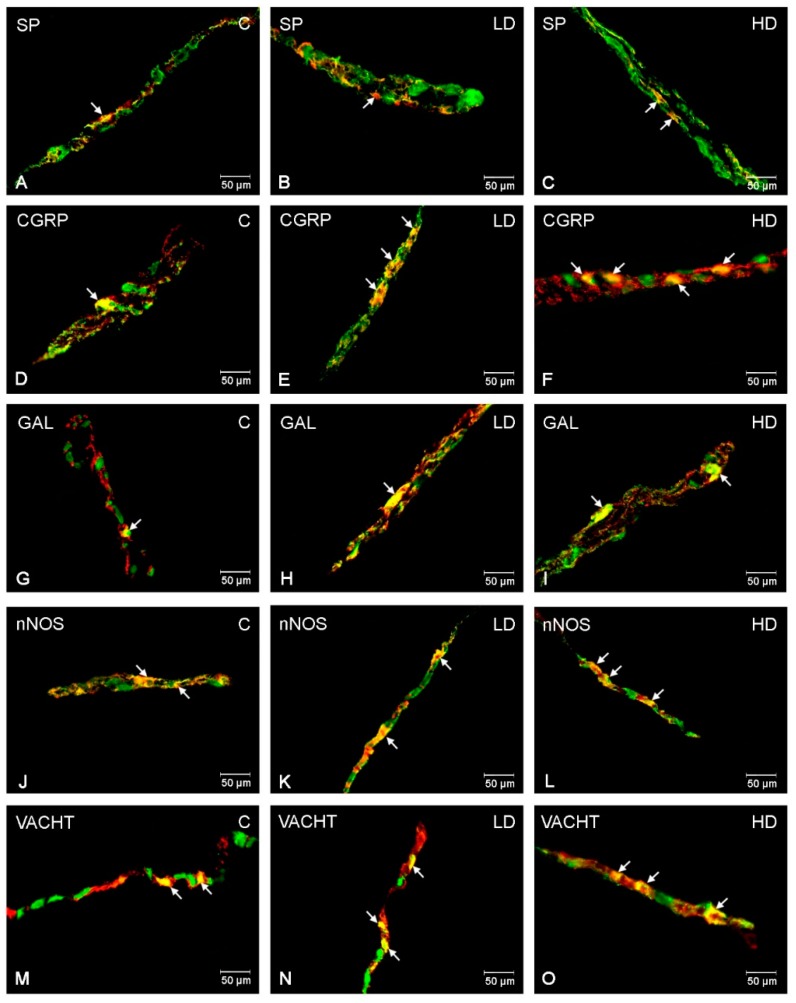
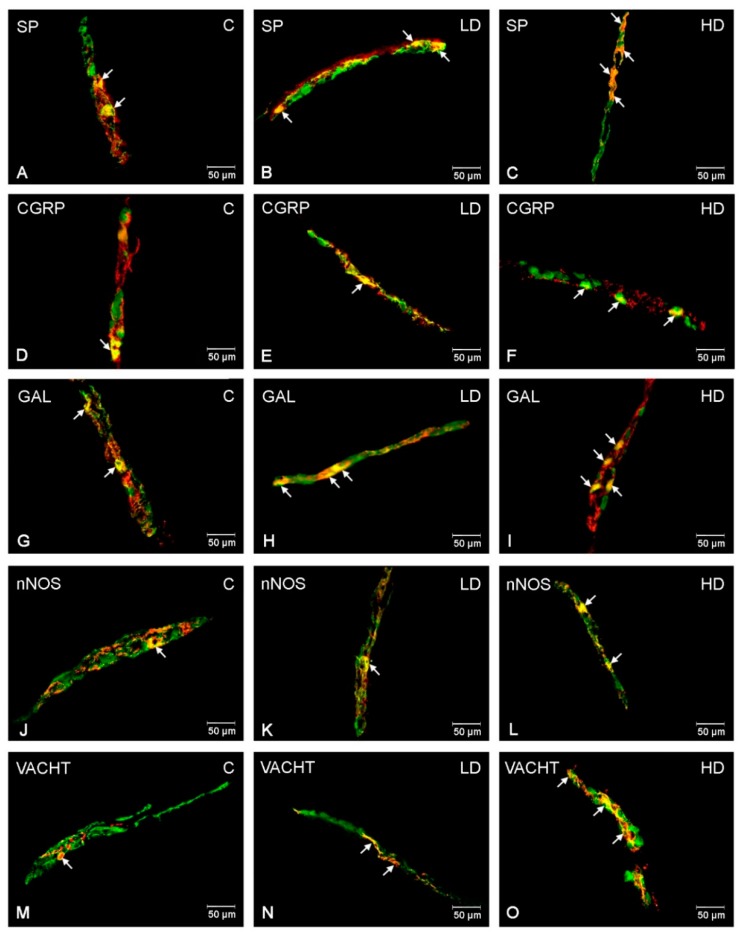
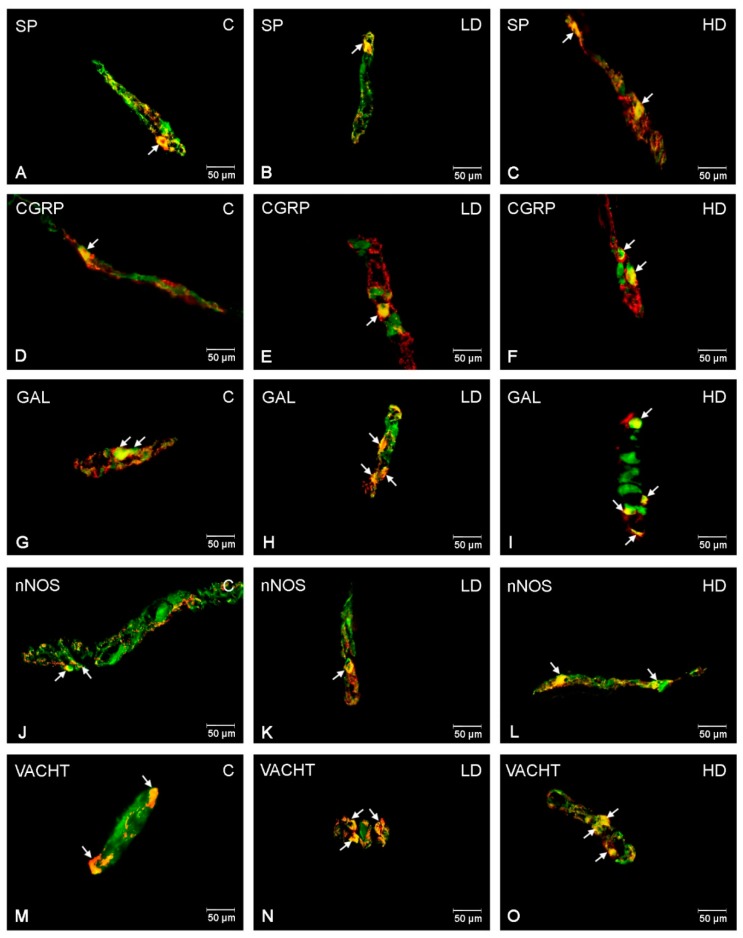
The digestive tract, especially the small intestine, is one of the main routes of acrylamide absorption and is therefore highly exposed to the toxic effect of acrylamide contained in food. The aim of this experiment was to elucidate the effect of low (tolerable daily intake—TDI) and high (ten times higher than TDI) doses of acrylamide on the neurochemical phenotype of duodenal enteric nervous system (ENS) neurons using the pig as an animal model. The experiment was performed on 15 immature gilts of the Danish Landrace assigned to three experimental groups: control (C) group—pigs administered empty gelatine capsules, low dose (LD) group—pigs administered capsules with acrylamide at the TDI dose (0.5 μg/kg body weight (b.w.)/day), and the high dose (HD) group—pigs administered capsules with acrylamide at a ten times higher dose than the TDI (5 μg/kg b.w./day) with a morning feeding for 4 weeks. Administration of acrylamide, even in a low (TDI) dose, led to an increase in the percentage of enteric neurons immunoreactive to substance P (SP), calcitonin gene-related peptide (CGRP), galanin (GAL), neuronal nitric oxide synthase (nNOS), and vesicular acetylcholine transporter (VACHT) in the porcine duodenum. The severity of the changes clearly depended on the dose of acrylamide and the examined plexus. The obtained results suggest the participation of these neuroactive substances in acrylamide-inducted plasticity and the protection of ENS neurons, which may be an important line of defence from the harmful action of acrylamide.
Overview
The claims and statistics of this paper haven’t been checked yet.
Free: it reads the open-access text and checks the first 5 claims that cite a source we can check. Create a free account to check every claim.
Integrity signals
Registry
Cites
Statistics
Figures
Verification
Claims the paper makes
The claims and statistics of this paper haven’t been checked yet.
Free: it reads the open-access text and checks the first 5 claims that cite a source we can check. Create a free account to check every claim.
Claims other papers make about this one
Each is checked against this paper’s own text: does it say what the citing paper says it does?
The source backs part of the claim, not all of it — or backs it for a different population, condition or comparison.
In the citing paper
“Both treatments led to significant increases in the percentage of neurons immunoreactive to substance P (SP), CGRP, galanin, nNOS, and vesicular acetylcholine transporter (VACHT), although the high dose exerted more intense changes.”
From Effects of Coffee and Its Components on the Gastrointestinal Tract and the Brain–Gut Axis (2020) · cites this paper as [194]
Experimental — accuracy not yet measured
Self-check
Percentages, sums and reported differences re-computed from the paper’s own numbers.
The self-check needs the paper’s full text.
Citations
Cites
Vagus nerve stimulation attenuates the systemic inflammatory response to endotoxin
Borovikova, L. V., Ivanova, S., Zhang, M., Yang, H., Botchkina, G. I., Watkins, L. R., Wang, H., Abumrad, N., Eaton, J. W., & Tracey, K. J. (2000) · Nature · doi:10.1038/35013070 · Cited by 4,211 · cited 3×
“The anti-inflammatory action of ACh was also observed in human blood macrophages during LPS administration expressed as an elevated level of TNF-α, IL-6, IL-18 [69].”
BackgroundKararli, T. T. (1995) · Biopharmaceutics & Drug Disposition · doi:10.1002/bdd.2510160502 · Cited by 1,459 · cited 1×
“The pig is an omnivorous animal whose anatomical and histological structure is highly comparable with the human body [74].”
BackgroundThe enteric nervous system and gastrointestinal innervation: integrated local and central control
Furness, J. B., Callaghan, B. P., Rivera, L. R., & Cho, H.-J. (2014) · Advances in Experimental Medicine and Biology · doi:10.1007/978-1-4939-0897-4_3 · Cited by 827
Harrison, S. (2001) · The International Journal of Biochemistry & Cell Biology · doi:10.1016/s1357-2725(01)00031-0 · Cited by 447
Arvidsson, U., Riedl, M., Elde, R., & Meister, B. (1997) · The Journal of Comparative Neurology · doi:10.1002/(sici)1096-9861(19970224)378:4<454::aid-cne2>3.0.co;2-1 · Cited by 435 · cited 1×
“In turn, VACHT, as a cholinergic component, stimulates smooth muscle contractility and the secretion of digestive enzymes [31].”
BackgroundHuman exposure and internal dose assessments of acrylamide in food
Dybing, E., Farmer, P. B., Andersen, M., Fennell, T. R., Lalljie, S. P. D., Müller, D. J. G., Olin, S., Petersen, B. J., Schlatter, J., Scholz, G., et al. (2005) · Food and Chemical Toxicology · doi:10.1016/j.fct.2004.11.004 · Cited by 395 · cited 1×
“Since the presence of ACM in food products has been confirmed, numerous toxicological studies have been conducted to investigate its effect on living organisms [2,3].”
BackgroundLANG, R., GUNDLACH, A., & KOFLER, B. (2007) · Pharmacology & Therapeutics · doi:10.1016/j.pharmthera.2007.05.009 · Cited by 376 · cited 3×
“GAL is also thought to regulate numerous physiological actions in the mammalian digestive tract, including the secretion of digestive enzymes and hydrochloric acid secretion, regulation of peristalsis, and the release of other neurotransmitters [29].”
BackgroundThe Changing View of Acrylamide Neurotoxicity
LoPachin, R. M. (2004) · NeuroToxicology · doi:10.1016/j.neuro.2004.01.004 · Cited by 310
Acrylamide: Review of Toxicity Data and Dose-Response Analyses for Cancer and Noncancer Effects
Shipp, A., Lawrence, G., Gentry, R., McDonald, T., Bartow, H., Bounds, J., Macdonald, N., Clewell, H., Allen, B., & Van Landingham, C. (2006) · Critical Reviews in Toxicology · doi:10.1080/10408440600851377 · Cited by 305 · cited 3×
“Since the presence of ACM in food products has been confirmed, numerous toxicological studies have been conducted to investigate its effect on living organisms [2,3].”
BackgroundResultPain and inflammatory bowel disease.
Bielefeldt, K., Davis, B., & Binion, D. G. (2009) · Inflammatory Bowel Diseases · doi:10.1002/ibd.20848 · Cited by 304
Cited by
Effects of Coffee and Its Components on the Gastrointestinal Tract and the Brain–Gut Axis
Iriondo-DeHond, A., Uranga, J. A., del Castillo, M. D., & Abalo, R. (2020) · Nutrients · doi:10.3390/nu13010088 · Cited by 126
“In this case too, the interpretation given by the authors is that all these changes may be compensatory plastic effects in an attempt to protect neurons from damage and restore enteric neuronal homeostasis [194].”
BackgroundDietary Acrylamide: A Detailed Review on Formation, Detection, Mitigation, and Its Health Impacts
Govindaraju, I., Maidin, S., Chakraborty, I., Rahman, M. H., Biswas, R., & Mazumder, N. (2024) · Foods · doi:10.3390/foods13040556 · Cited by 98
“It was observed that even low amounts of acrylamide altered the ENS neurons, which can induce gastrointestinal disorders [57].”
BackgroundLi, Y., Fang, R., Liu, Z., Jiang, L., Zhang, J., Li, H., Liu, C., & Li, F. (2020) · Chemosphere · doi:10.1016/j.chemosphere.2020.128238 · Cited by 101
Kinoshita, Y., Niwa, H., Uchida‐Fujii, E., & Nukada, T. (2021) · Scientific Reports · doi:10.1038/s41598-021-91425-7 · Cited by 63
Burster, T., Traut, R., Yermekkyzy, Z., Mayer, K., Westhoff, M., Bischof, J., & Knippschild, U. (2021) · Frontiers in Cell and Developmental Biology · doi:10.3389/fcell.2021.695325 · Cited by 54
Metadata
- Authors
- Palus, K., & Całka, J.
- Affiliations
- University of Warmia and Mazury in Olsztyn (PL)
- Corresponding author
- Palus, Katarzyna
- Venue
- International Journal of Molecular Sciences
- Publisher
- MDPI AG
- Published
- 2019-12-18
- Volume
- 21
- Issue
- 1
- Pages
- 15
- ISSN
- 1422-0067 (ISSN-L)
- PMC
- PMC6982244
- OpenAlex
- W2995561472
- Cited by
- 22
- References
- 77
- Citations by year
- 2026: 2 · 2025: 1 · 2024: 3 · 2021: 12 · 2020: 4
- FWCI
- 3.09
- Type
- journal article
- Language
- en
- Open access
- gold
- dx.doi.org
- Licence
- Locations
- International Journal of Molecular Sciences (publishedVersion, cc-by)
- Europe PMC (PubMed Central) (publishedVersion, cc-by)
- PubMed Central (publishedVersion, cc-by)
- PubMed (publishedVersion)
- Funders
- Ministerstwo Nauki i Szkolnictwa Wyższego (No. 05-1/KNOW2/2015)
- Uniwersytet Warmińsko-Mazurski w Olsztynie (statutory research: grant No 15.610.003-300)
- Topics
- Life Sciences › Agricultural and Biological Sciences › Food Science › Potato Plant Research
- Health Sciences › Medicine › Gastroenterology › Gastrointestinal motility and disorders
- Life Sciences › Neuroscience › Cellular and Molecular Neuroscience › Neuropeptides and Animal Physiology
- Keywords
- acrylamide, enteric nervous system, neurochemical phenotype, substance P, calcitonin gene-related peptide, galanin, neuronal nitric oxide synthase, vesicular acetylcholine transporter, dose-dependent neurotoxicity, tolerable daily intake, neuroplasticity, porcine model, food-derived acrylamide
- MeSH terms
- Animals, Duodenum, Fluorescent Antibody Technique, Myenteric Plexus, Neurons, Submucous Plexus, Swine, Enteric Nervous System, Acrylamide
About these checks
Registry, retraction, Cites and statistics results are computed, not judged, with one exception: a printed reference that no index lists is read once by a model before it counts as a citation error. Claims are extracted by a model and kept only when their quote appears verbatim in the text; each cited source is then checked, with a model’s help, for whether it says what the claim relies on. Those verdicts can be wrong — read the claim’s quote and the cited source before relying on one.
Statistics and arithmetic are recomputed, not judged.
Confidence bands are shown only for fields calibrated on our annotated test set. None is calibrated yet, so no band is shown.
What counts as a claim ›How we measure confidence ›How we check this ›
Are you an author, or do you see a problem with this page? Request a review
Data sources
Bibliographic data: Semantic Scholar, OpenAlex, Crossref.
Contains information from the Semantic Scholar Academic Graph Datasets, made available under the ODC Attribution License (ODC-BY 1.0).
Semantic Scholar’s data is described in: Kinney, R., et al. (2023). The Semantic Scholar Open Data Platform. arXiv:2301.10140.
