

The DOI matches its Crossref record; 137 of the 138 references it cites were found in a registry or an index.
Role of Alcohol Drinking in Alzheimer’s Disease, Parkinson’s Disease, and Amyotrophic Lateral Sclerosis
Open accessAbstract
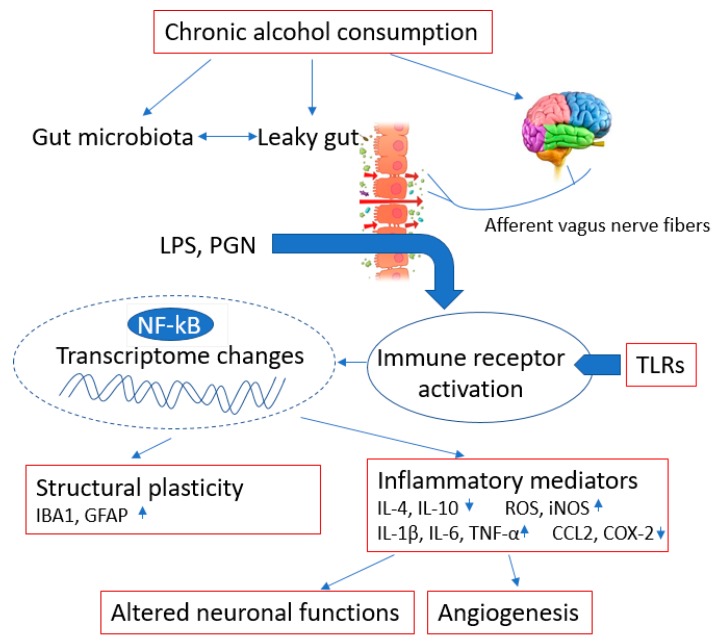
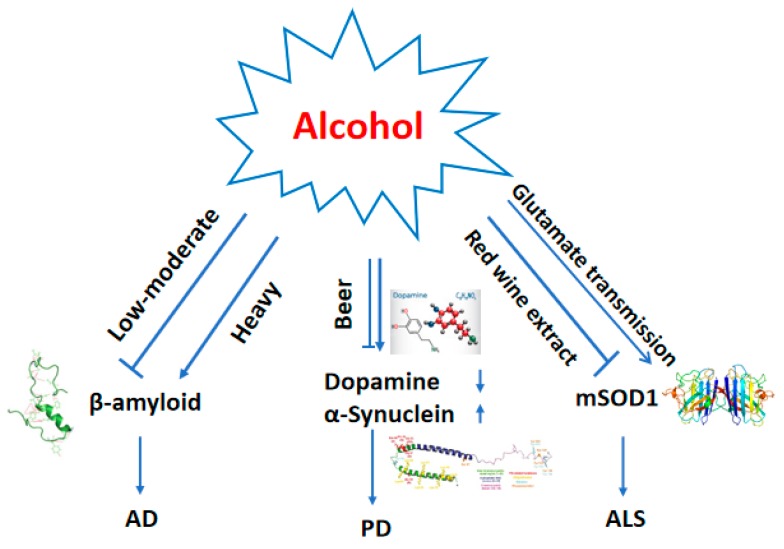
Neurodegenerative diseases, including Alzheimer’s disease (AD), Parkinson’s disease (PD) and amyotrophic lateral sclerosis (ALS), increase as the population ages around the world. Environmental factors also play an important role in most cases. Alcohol consumption exists extensively and it acts as one of the environmental factors that promotes these neurodegenerative diseases. The brain is a major target for the actions of alcohol, and heavy alcohol consumption has long been associated with brain damage. Chronic alcohol intake leads to elevated glutamate-induced excitotoxicity, oxidative stress and permanent neuronal damage associated with malnutrition. The relationship and contributing mechanisms of alcohol with these three diseases are different. Epidemiological studies have reported a reduction in the prevalence of Alzheimer’s disease in individuals who drink low amounts of alcohol; low or moderate concentrations of ethanol protect against β-amyloid (Aβ) toxicity in hippocampal neurons; and excessive amounts of ethanol increase accumulation of Aβ and Tau phosphorylation. Alcohol has been suggested to be either protective of, or not associated with, PD. However, experimental animal studies indicate that chronic heavy alcohol consumption may have dopamine neurotoxic effects through the induction of Cytochrome P450 2E1 (CYP2E1) and an increase in the amount of α-Synuclein (αSYN) relevant to PD. The findings on the association between alcohol consumption and ALS are inconsistent; a recent population-based study suggests that alcohol drinking seems to not influence the risk of developing ALS. Additional research is needed to clarify the potential etiological involvement of alcohol intake in causing or resulting in major neurodegenerative diseases, which will eventually lead to potential therapeutics against these alcoholic neurodegenerative diseases.
Overview
The claims and statistics of this paper haven’t been checked yet.
Run the check — free, no account needed. It reads the open-access text and checks the sources it cites.
Integrity signals
Registry
Cites
Statistics
Figures
Verification
Claims the paper makes
The claims and statistics of this paper haven’t been checked yet.
Run the check — free, no account needed. It reads the open-access text and checks the sources it cites.
Claims other papers make about this one
Each is checked against this paper’s own text: does it say what the citing paper says it does?
In the citing paper
“The role of CYP2E1 in brain ethanol metabolism and its association with alcohol-mediated oxidative neuronal injury155–160 and aging-related AD and PD161 have also been suggested.”
From Advanced glycation end products (AGEs) and other adducts in aging-related diseases and alcohol-mediated tissue injury (2021) · cites this paper as [161]
Self-check
Percentages, sums and reported differences re-computed from the paper’s own numbers.
The self-check needs the paper’s full text.
Citations
Cites
Hughes, A. J., Daniel, S. E., Kilford, L., & Lees, A. J. (1992) · Journal of Neurology, Neurosurgery & Psychiatry · doi:10.1136/jnnp.55.3.181 · Cited by 10,378
Kalia, L. V., & Lang, A. E. (2015) · The Lancet · doi:10.1016/s0140-6736(14)61393-3 · Cited by 6,184
El Escorial revisited: revised criteria for the diagnosis of amyotrophic lateral sclerosis
Brooks, B. R., Miller, R. G., Swash, M., & Munsat, T. L. (2000) · Amyotrophic Lateral Sclerosis and Other Motor Neuron Disorders · doi:10.1080/146608200300079536 · Cited by 5,433
Wine, alcohol, platelets, and the French paradox for coronary heart disease
Renaud, S., & de Lorgeril, M. (1992) · The Lancet · doi:10.1016/0140-6736(92)91277-f · Cited by 3,700
Ageing as a risk factor for neurodegenerative disease
Hou, Y., Dan, X., Babbar, M., Wei, Y., Hasselbalch, S. G., Croteau, D. L., & Bohr, V. A. (2019) · Nature Reviews Neurology · doi:10.1038/s41582-019-0244-7 · Cited by 3,310
Diagnostic Criteria for Parkinson Disease
Gelb, D. J., Oliver, E., & Gilman, S. (1999) · Archives of Neurology · doi:10.1001/archneur.56.1.33 · Cited by 2,822
The epidemiology of Parkinson's disease: risk factors and prevention
Ascherio, A., & Schwarzschild, M. A. (2016) · The Lancet Neurology · doi:10.1016/s1474-4422(16)30230-7 · Cited by 1,930
Lindsay, J. (2002) · American Journal of Epidemiology · doi:10.1093/aje/kwf074 · Cited by 1,261
Ageing, neurodegeneration and brain rejuvenation
Wyss-Coray, T. (2016) · Nature · doi:10.1038/nature20411 · Cited by 1,147
The epidemiology of ALS: a conspiracy of genes, environment and time
Al‐Chalabi, A., & Hardiman, O. M. (2013) · Nature Reviews Neurology · doi:10.1038/nrneurol.2013.203 · Cited by 984
Cited by
Sorted by citations
Rungratanawanich, W., Qu, Y., Wang, X., Essa, M. M., & Song, B.-J. (2021) · Experimental & Molecular Medicine · doi:10.1038/s12276-021-00561-7 · Cited by 411
Self-citationMelatonin and Autophagy in Aging-Related Neurodegenerative Diseases
Luo, F., Sandhu, A. F., Rungratanawanich, W., Williams, G. E., Akbar, M. D., Zhou, S., Song, B., & Wang, X. (2020) · International Journal of Molecular Sciences · doi:10.3390/ijms21197174 · Cited by 162
Self-citationPervin, Z., & Stephen, J. M. (2021) · AIMS neuroscience · doi:10.3934/neuroscience.2021021 · Cited by 110
Hop, P. J., Zwamborn, R. A. J., Hannon, E. J., Shireby, G. L., Nabais, M. F., Walker, E., van Rheenen, W., van Vugt, J. J. F. A., Dekker, A. M., Westeneng, H., et al. (2022) · Science Translational Medicine · doi:10.1126/scitranslmed.abj0264 · Cited by 103
Evaluation of two different Cannabis sativa L. extracts as antioxidant and neuroprotective agents
Cásedas, G., Moliner, C., Maggi, F., Mazzara, E., & López, V. (2022) · Frontiers in Pharmacology · doi:10.3389/fphar.2022.1009868 · Cited by 56
Metadata
- Authors
- Peng, B., Yang, Q., B Joshi, R., Liu, Y., Akbar, M., Song, B.-J., Zhou, S., & Wang, X.
- Affiliations
- Brigham and Women's Hospital (US)
- Hubei Provincial Key Lab for Quality and Safety of Traditional Chinese Medicine Health Food, Jing Brand Research Institute, Daye 435100, China
- Departments of Neurosurgery, Brigham and Women’s Hospital, Harvard Medical School, Boston, MA 02115, USA
- National Institutes of Health (US)
- Corresponding author
- Zhou, Shuanhu
- Wang, Xin
- Venue
- International Journal of Molecular Sciences
- Publisher
- MDPI AG
- Published
- 2020-03-27
- Volume
- 21
- Issue
- 7
- Pages
- 2316
- ISSN
- 1422-0067 (ISSN-L)
- PMC
- PMC7177420
- OpenAlex
- W3013624048
- Cited by
- 156
- References
- 138
- Citations by year
- 2026: 13 · 2025: 38 · 2024: 34 · 2023: 30 · 2022: 24 · 2021: 15 · 2020: 2
- FWCI
- 2.72
- Type
- journal article
- Language
- en
- Open access
- gold
- dx.doi.org
- Licence
- Locations
- International Journal of Molecular Sciences (publishedVersion, cc-by)
- PubMed Central (publishedVersion, cc-by)
- PubMed (publishedVersion)
- DOAJ (DOAJ: Directory of Open Access Journals) (submittedVersion, cc-by-sa)
- Funders
- Brigham and Women's Hospital
- Topics
- Health Sciences › Medicine › Pathology and Forensic Medicine › Alcohol Consumption and Health Effects
- Life Sciences › Neuroscience › Cellular and Molecular Neuroscience › Alzheimer's disease research and treatments
- Health Sciences › Medicine › Clinical Neurology › Alcoholism and Thiamine Deficiency
- Keywords
- alcohol consumption, neurodegenerative diseases, Alzheimer's disease, Parkinson's disease, amyotrophic lateral sclerosis, ethanol, amyloid-beta, tau phosphorylation, excitotoxicity, oxidative stress, dopamine neurotoxicity, CYP2E1, alpha-synuclein, environmental risk factors
- MeSH terms
- Alcohol Drinking, Ethanol, Alzheimer Disease, Amyotrophic Lateral Sclerosis, Animals, Brain, Cell Line, Humans, Neurons, Parkinson Disease, Risk Factors, Amyloid beta-Peptides, Oxidative Stress, Disease Progression, Neurodegenerative Diseases, alpha-Synuclein
About these checks
Registry, retraction, Cites and statistics results are computed, not judged, with one exception: a printed reference that no index lists is read once by a model before it counts as a citation error. Claims are extracted by a model and kept only when their quote appears verbatim in the text; each cited source is then checked, with a model’s help, for whether it says what the claim relies on. Those verdicts can be wrong — read the claim’s quote and the cited source before relying on one.
Statistics and arithmetic are recomputed, not judged.
Confidence bands are shown only for fields calibrated on our annotated test set. None is calibrated yet, so no band is shown.
What counts as a claim ›How we measure confidence ›How we check this ›
Are you an author, or do you see a problem with this page? Request a review
