

The DOI matches its Crossref record; 112 of the 114 references it cites were found in a registry or an index.
Sex Hormone-Binding Globulin (SHBG) as an Early Biomarker and Therapeutic Target in Polycystic Ovary Syndrome
Open accessAbstract
Human sex hormone-binding globulin (SHBG) is a glycoprotein produced by the liver that binds sex steroids with high affinity and specificity. Clinical observations and reports in the literature have suggested a negative correlation between circulating SHBG levels and markers of non-alcoholic fatty liver disease (NAFLD) and insulin resistance. Decreased SHBG levels increase the bioavailability of androgens, which in turn leads to progression of ovarian pathology, anovulation and the phenotypic characteristics of polycystic ovarian syndrome (PCOS). This review will use a case report to illustrate the inter-relationships between SHBG, NAFLD and PCOS. In particular, we will review the evidence that low hepatic SHBG production may be a key step in the pathogenesis of PCOS. Furthermore, there is emerging evidence that serum SHBG levels may be useful as a diagnostic biomarker and therapeutic target for managing women with PCOS.
Overview
The claims and statistics of this paper haven’t been checked yet.
Run the check — free, no account needed. It reads the open-access text and checks the sources it cites.
Integrity signals
Registry
Cites
Statistics
Figures
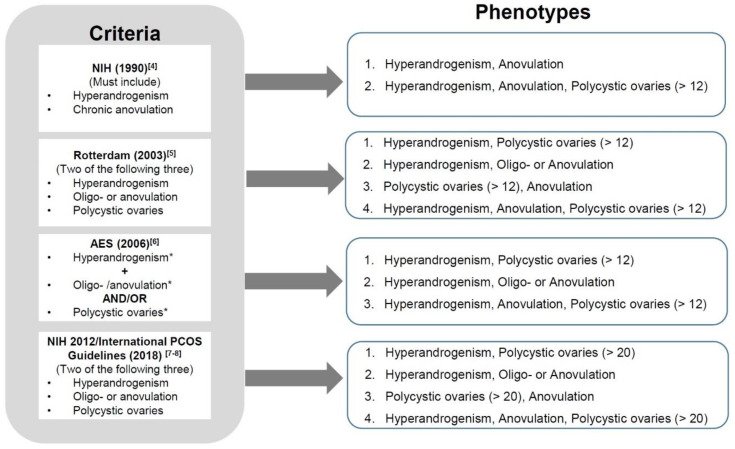
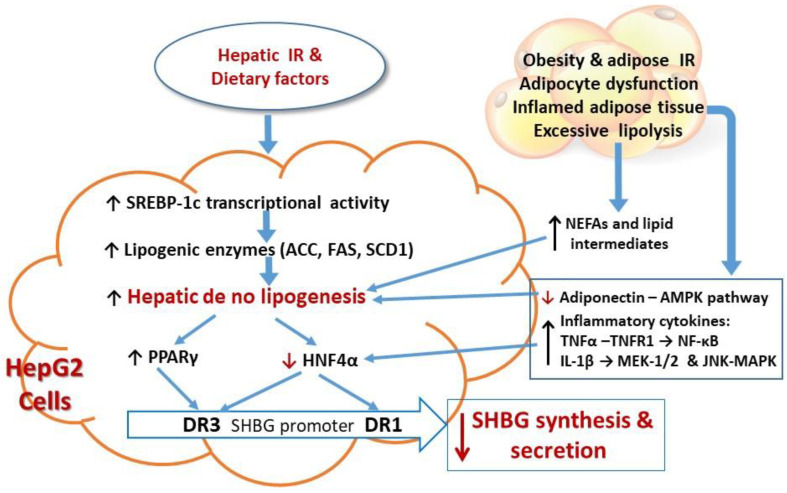
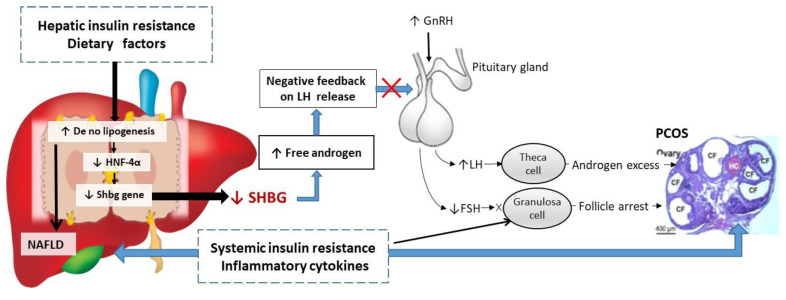
Verification
Claims the paper makes
The claims and statistics of this paper haven’t been checked yet.
Run the check — free, no account needed. It reads the open-access text and checks the sources it cites.
Claims other papers make about this one
Each is checked against this paper’s own text: does it say what the citing paper says it does?
The source backs part of the claim, not all of it — or backs it for a different population, condition or comparison.
In the citing paper
“Lower levels of the blood protein called sex hormone-binding globulin (SHBG) are advised to indicate the anomalous cholesterol measurements which are connected to inhibited insulin signaling, for instance, PCOS [112].”
From Nutritional and herbal interventions for polycystic ovary syndrome (PCOS): a comprehensive review of dietary approaches, macronutrient impact, and herbal medicine in management (2025) · cites this paper as [112]
Experimental — accuracy not yet measuredThe source backs part of the claim, not all of it — or backs it for a different population, condition or comparison.
In the citing paper
“Together with free T, SHBG has recently been recognized a useful diagnostic marker and therapeutic target for managing women with PCOS [195].”
From Role of sex hormone-binding globulin in the free hormone hypothesis and the relevance of free testosterone in androgen physiology (2022) · cites this paper as [195]
Experimental — accuracy not yet measured
Self-check
Percentages, sums and reported differences re-computed from the paper’s own numbers.
The self-check needs the paper’s full text.
Citations
Cites
Mechanisms of Insulin Action and Insulin Resistance
Petersen, M. C., & Shulman, G. I. (2018) · Physiological Reviews · doi:10.1152/physrev.00063.2017 · Cited by 3,028
Adolescence: A foundation for future health
Sawyer, S. M., Afifi, R. A., Bearinger, L. H., Blakemore, S.-J., Dick, B., Ezeh, A. C., & Patton, G. C. (2012) · The Lancet · doi:10.1016/s0140-6736(12)60072-5 · Cited by 2,635
Azziz, R., Carmina, E., Dewailly, D., Diamanti-Kandarakis, E., Escobar-Morreale, H. F., Futterweit, W., Janssen, O. E., Legro, R. S., Norman, R. J., Taylor, A. E., et al. (2009) · Fertility and Sterility · doi:10.1016/j.fertnstert.2008.06.035 · Cited by 2,132
Teede, H. J., Misso, M. L., Costello, M. F., Dokras, A., Laven, J., Moran, L., Piltonen, T., Norman, R. J., & the International PCOS Network (2018) · Clinical Endocrinology · doi:10.1111/cen.13795 · Cited by 1,823
Teede, H. J., Misso, M. L., Costello, M. F., Dokras, A., Laven, J., Moran, L., Piltonen, T., Norman, R. J., International PCOS Network, Andersen, M., et al. (2018) · Human Reproduction · doi:10.1093/humrep/dey256 · Cited by 1,593
Adipose tissue dysfunction as determinant of obesity-associated metabolic complications
Longo, M., Zatterale, F., Naderi, J., Parrillo, L., Formisano, P., Raciti, G. A., Beguinot, F., & Miele, C. (2019) · International Journal of Molecular Sciences · doi:10.3390/ijms20092358 · Cited by 1,575
Teede, H., Deeks, A., & Moran, L. (2010) · BMC Medicine · doi:10.1186/1741-7015-8-41 · Cited by 1,565
Bozdag, G., Mumusoglu, S., Zengin, D., Karabulut, E., & Yildiz, B. O. (2016) · Human Reproduction · doi:10.1093/humrep/dew218 · Cited by 1,526
DUNN, J. F., NISULA, B. C., & RODBARD, D. (1981) · The Journal of Clinical Endocrinology & Metabolism · doi:10.1210/jcem-53-1-58 · Cited by 1,238
Stefan, N., Häring, H., & Cusi, K. J. (2018) · The Lancet Diabetes & Endocrinology · doi:10.1016/s2213-8587(18)30154-2 · Cited by 874
Research works printed but not linked: 1
- Johnson, T., Kaplan, L., Ouyang, P., Rizza, R., and Health, N.I.O. (2012). Evidence-Based Methodology Workshop on Polycystic Ovary Syndrome.
Cited by
Sorted by citations
Stener-Victorin, E., Teede, H., Norman, R. J., Legro, R., Goodarzi, M. O., Dokras, A., Laven, J., Hoeger, K., & Piltonen, T. T. (2024) · Nature Reviews Disease Primers · doi:10.1038/s41572-024-00511-3 · Cited by 495
The Influence of Sex Hormones in Liver Function and Disease
Kasarinaite, A., Sinton, M. C., Saunders, P. T. K., & Hay, D. C. (2023) · Cells · doi:10.3390/cells12121604 · Cited by 139
Xing, C., Zhang, J., Zhao, H., & He, B. (2022) · International Journal of Women's Health · doi:10.2147/ijwh.s344542 · Cited by 118
Narinx, N., David, K., Walravens, J., Vermeersch, P., Claessens, F., Fiers, T., Lapauw, B., Antonio, L., & Vanderschueren, D. (2022) · Cellular and Molecular Life Sciences · doi:10.1007/s00018-022-04562-1 · Cited by 96
Cognition and mental health in menopause: A review
Hogervorst, E., Craig, J., & O’Donnell, E. (2021) · Best Practice & Research Clinical Obstetrics & Gynaecology · doi:10.1016/j.bpobgyn.2021.10.009 · Cited by 101
Metadata
- Authors
- Qu, X., & Donnelly, R.
- Affiliations
- University of Technology Sydney (AU)
- University of Nottingham (GB)
- Corresponding author
- Qu, Xianqin
- Venue
- International Journal of Molecular Sciences
- Publisher
- MDPI AG
- Published
- 2020-11-01
- Volume
- 21
- Issue
- 21
- Pages
- 8191
- ISSN
- 1422-0067 (ISSN-L)
- PMC
- PMC7663738
- OpenAlex
- W3096809272
- Cited by
- 210
- References
- 114
- Citations by year
- 2026: 40 · 2025: 46 · 2024: 47 · 2023: 35 · 2022: 29 · 2021: 13
- FWCI
- 16.98
- Type
- journal article
- Language
- en
- Open access
- gold
- doi.org
- Licence
- Locations
- International Journal of Molecular Sciences (publishedVersion, cc-by)
- PubMed Central (publishedVersion, cc-by)
- PubMed (publishedVersion)
- DOAJ (DOAJ: Directory of Open Access Journals) (submittedVersion)
- UTS ePRESS (University of Technology Sydney) (submittedVersion)
- Topics
- Health Sciences › Medicine › Reproductive Medicine › Ovarian function and disorders
- Health Sciences › Medicine › Endocrinology, Diabetes and Metabolism › Hormonal and reproductive studies
- Life Sciences › Biochemistry, Genetics and Molecular Biology › Genetics › Genetic and Kidney Cyst Diseases
- Keywords
- sex hormone-binding globulin, polycystic ovary syndrome, non-alcoholic fatty liver disease, insulin resistance, diagnostic biomarkers, therapeutic target, PCOS pathogenesis
- MeSH terms
- Female, Humans, Insulin Resistance, Polycystic Ovary Syndrome, Sensitivity and Specificity, Sex Hormone-Binding Globulin, Biomarkers, Young Adult, Molecular Targeted Therapy, Non-alcoholic Fatty Liver Disease
About these checks
Registry, retraction, Cites and statistics results are computed, not judged, with one exception: a printed reference that no index lists is read once by a model before it counts as a citation error. Claims are extracted by a model and kept only when their quote appears verbatim in the text; each cited source is then checked, with a model’s help, for whether it says what the claim relies on. Those verdicts can be wrong — read the claim’s quote and the cited source before relying on one.
Statistics and arithmetic are recomputed, not judged.
Confidence bands are shown only for fields calibrated on our annotated test set. None is calibrated yet, so no band is shown.
What counts as a claim ›How we measure confidence ›How we check this ›
Are you an author, or do you see a problem with this page? Request a review
