

Sarcopenic Obesity in Liver Cirrhosis: Possible Mechanism and Clinical Impact
Open accessThe DOI matches its Crossref record; 101 of the 101 references it cites were found in a registry or an index.
Abstract
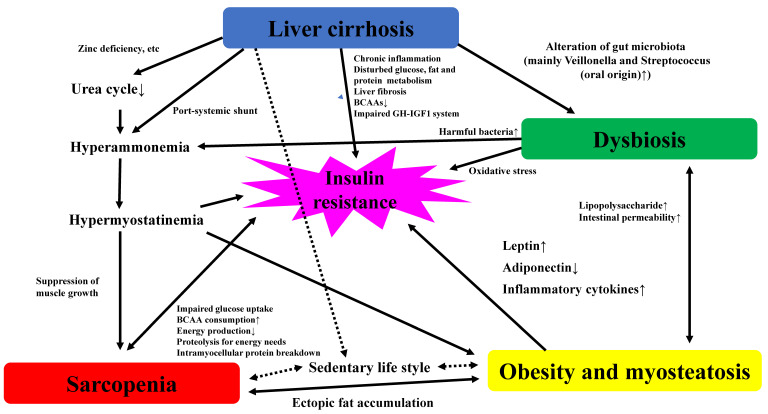
The picture of chronic liver diseases (CLDs) has changed considerably in recent years. One of them is the increase of non-alcoholic fatty liver disease. More and more CLD patients, even those with liver cirrhosis (LC), tend to be presenting with obesity these days. The annual rate of muscle loss increases with worsening liver reserve, and thus LC patients are more likely to complicate with sarcopenia. LC is also characterized by protein-energy malnutrition (PEM). Since the PEM in LC can be invariable, the patients probably present with sarcopenic obesity (Sa-O), which involves both sarcopenia and obesity. Currently, there is no mention of Sa-O in the guidelines; however, the rapidly increasing prevalence and poorer clinical consequences of Sa-O are recognized as an important public health problem, and the diagnostic value of Sa-O is expected to increase in the future. Sa-O involves a complex interplay of physiological mechanisms, including increased inflammatory cytokines, oxidative stress, insulin resistance, hormonal disorders, and decline of physical activity. The pathogenesis of Sa-O in LC is diverse, with a lot of perturbations in the muscle–liver–adipose tissue axis. Here, we overview the current knowledge of Sa-O, especially focusing on LC.
Overview
The claims and statistics of this paper haven’t been checked yet.
Free: it reads the open-access text and checks the first 5 claims that cite a source we can check. Create a free account to check every claim.
Integrity signals
Registry
Cites
Statistics
Figures
Verification
Claims the paper makes
The claims and statistics of this paper haven’t been checked yet.
Free: it reads the open-access text and checks the first 5 claims that cite a source we can check. Create a free account to check every claim.
Claims other papers make about this one
Each is checked against this paper’s own text: does it say what the citing paper says it does?
In the citing paper
“However, there are no internationally standardized criteria for diagnosing SO [22].”
From The critical role of oxidative stress in sarcopenic obesity (2021) · cites this paper as [22]
In the citing paper
“As mentioned earlier, physical inactivity and obesity increase the level of lipid circulation and myosteatosis in skeletal muscle, contributing to a decrease in muscle mass and strength and favoring sarcopenia and physical disabilities [14, 22, 66].”
From The critical role of oxidative stress in sarcopenic obesity (2021) · cites this paper as [22]
Self-check
Percentages, sums and reported differences re-computed from the paper’s own numbers.
The self-check needs the paper’s full text.
Citations
Cites
Sarcopenia: revised European consensus on definition and diagnosis
Cruz-Jentoft, A. J., Bahat, G., Bauer, J., Boirie, Y., Bruyère, O., Cederholm, T., Cooper, C., Landi, F., Rolland, Y., Sayer, A. A., et al. (2019) · Age and Ageing · doi:10.1093/ageing/afy169 · Cited by 13,818
Chalasani, N., Younossi, Z., Lavine, J. E., Charlton, M., Cusi, K., Rinella, M., Harrison, S. A., Brunt, E. M., & Sanyal, A. J. (2018) · Hepatology · doi:10.1002/hep.29367 · Cited by 7,239 · cited 1×
“In LC patients with Sa-O, caution should be exercised for the risk of progression of sarcopenia with weight loss, and patients who are advised to lose weight should be monitored for changes in body composition and muscle strength or physical activities, using appropriate assessment tools [88].”
MethodAsian Working Group for Sarcopenia: 2019 Consensus Update on Sarcopenia Diagnosis and Treatment
Chen, L.-K., Woo, J., Assantachai, P., Auyeung, T.-W., Chou, M.-Y., Iijima, K., Jang, H. C., Kang, L., Kim, M., Kim, S., et al. (2020) · Journal of the American Medical Directors Association · doi:10.1016/j.jamda.2019.12.012 · Cited by 7,070 · cited 2×
“Primary sarcopenia is defined as a condition in which SMM and muscle strength or physical function decline with aging, while secondary sarcopenia is defined as a condition in which SMM and muscle strength or physical function are impaired due to underlying diseases [3,4].”
BackgroundSarcopenia: revised European consensus on definition and diagnosis
Cruz-Jentoft, A. J., Bahat, G., Bauer, J., Boirie, Y., Bruyère, O., Cederholm, T., Cooper, C., Landi, F., Rolland, Y., Sayer, A. A., et al. (2019) · Age and Ageing · doi:10.1093/ageing/afz046 · Cited by 3,803 · cited 2×
“Primary sarcopenia is defined as a condition in which SMM and muscle strength or physical function decline with aging, while secondary sarcopenia is defined as a condition in which SMM and muscle strength or physical function are impaired due to underlying diseases [3,4].”
BackgroundInflammatory Mechanisms in Obesity
Gregor, M. F., & Hotamisligil, G. S. (2011) · Annual Review of Immunology · doi:10.1146/annurev-immunol-031210-101322 · Cited by 3,754 · cited 1×
“In contrast, increase of a visceral fat induces inflammation, contributing to the sarcopenia incidence [49].”
BackgroundAlterations of the human gut microbiome in liver cirrhosis
Qin, N., Yang, F., Li, A., Prifti, E., Chen, Y., Shao, L., Guo, J., Le Chatelier, E., Yao, J., Wu, L., et al. (2014) · Nature · doi:10.1038/nature13568 · Cited by 2,177 · cited 2×
“Among these, 28 bacterial species were found to be abundant in cirrhotic patients, mostly of oral origin (mainly Veillonella and Streptococcus) [71].”
BackgroundGut microbiome and serum metabolome alterations in obesity and after weight-loss intervention
Liu, R., Hong, J., Xu, X., Feng, Q., Zhang, D., Gu, Y., Shi, J., Zhao, S., Liu, W., Wang, X., et al. (2017) · Nature Medicine · doi:10.1038/nm.4358 · Cited by 1,501 · cited 1×
“, elevated serum glutamate level) in obese subjects [75].”
BackgroundLong-term health benefits of physical activity – a systematic review of longitudinal studies
Reiner, M., Niermann, C., Jekauc, D., & Woll, A. (2013) · BMC Public Health · doi:10.1186/1471-2458-13-813 · Cited by 1,447 · cited 1×
“Additionally, exercise has been widely recommended to improve SMM, muscle strength, and physical activities in older adults [91].”
BackgroundLiver inflammation and fibrosis
Koyama, Y., & Brenner, D. A. (2017) · Journal of Clinical Investigation · doi:10.1172/jci88881 · Cited by 1,295 · cited 1×
“LC patients are likely to be involved in insulin resistance and chronic inflammation [38].”
BackgroundRosenberg, I. H. (1989) · The American Journal of Clinical Nutrition · doi:10.1093/ajcn/50.5.1231 · Cited by 1,102
Cited by
Pathophysiology and mechanisms of primary sarcopenia (Review)
Nishikawa, H., Fukunishi, S., Asai, A., Yokohama, K., Nishiguchi, S., & Higuchi, K. (2021) · International Journal of Molecular Medicine · doi:10.3892/ijmm.2021.4989 · Cited by 234
“Patients with sarcopenic obesity have a poorer prognosis than those with sarcopenia alone or obesity alone (60).”
BackgroundSelf-citationCancer Cachexia: Its Mechanism and Clinical Significance
Nishikawa, H., Goto, M., Fukunishi, S., Asai, A., Nishiguchi, S., & Higuchi, K. (2021) · International Journal of Molecular Sciences · doi:10.3390/ijms22168491 · Cited by 233
“There are several reasons why it is difficult to develop diagnostic criteria for cachexia: (1) due to the effects of ascites and other factors, it is not easy to accurately assess the loss of skeletal muscle mass, which is the main cause of cachexia (in particular, the bioelectrical impedance analysis (BIA) method of…”
MethodSelf-citationThe critical role of oxidative stress in sarcopenic obesity
Gonzalez, A., Simon, F., Achiardi, O., Vilos, C., Cabrera, D., & Cabello-Verrugio, C. (2021) · Oxidative Medicine and Cellular Longevity · doi:10.1155/2021/4493817 · Cited by 79
“As mentioned earlier, physical inactivity and obesity increase the level of lipid circulation and myosteatosis in skeletal muscle, contributing to a decrease in muscle mass and strength and favoring sarcopenia and physical disabilities [14, 22, 66].”
BackgroundAzevedo, V. Z., Silaghi, C. A., Maurel, T., Silaghi, H., Ratziu, V., & Pais, R. (2022) · Frontiers in Nutrition · doi:10.3389/fnut.2021.774030 · Cited by 68
“Other Key Factors Nonetheless, muscle-liver crosstalk is influenced by numerous other factors, such as vitamin D deficiency, hormonal changes (GH; IGF-1; testosterone levels), low physical activity, aging, and diet composition (5, 15).”
BackgroundInfluentialChang, J., Höfer, P., Böhling, N., Lingohr, P., Manekeller, S., Kalff, J. C., Dohmen, J., Kaczmarek, D. J., Jansen, C., Meyer, C. H., et al. (2022) · JHEP Reports · doi:10.1016/j.jhepr.2022.100442 · Cited by 49
Metadata
- Authors
- Nishikawa, H., Enomoto, H., Nishiguchi, S., & Iijima, H.
- Affiliations
- Hyogo Medical University (JP)
- KANO General Hospital (JP)
- Corresponding author
- Nishikawa, Hiroki
- Venue
- International Journal of Molecular Sciences
- Publisher
- MDPI AG
- Published
- 2021-02-15
- Volume
- 22
- Issue
- 4
- Pages
- 1917
- ISSN
- 1422-0067 (ISSN-L)
- PMC
- PMC7919019
- OpenAlex
- W3129491662
- Cited by
- 56
- References
- 100
- Citations by year
- 2026: 10 · 2025: 4 · 2024: 12 · 2023: 14 · 2022: 9 · 2021: 7
- FWCI
- 1.40
- Type
- journal article
- Language
- en
- Open access
- gold
- doi.org
- Licence
- Locations
- International Journal of Molecular Sciences (publishedVersion, cc-by)
- PubMed Central (publishedVersion, cc-by)
- PubMed (publishedVersion)
- DOAJ (DOAJ: Directory of Open Access Journals) (submittedVersion)
- Topics
- Health Sciences › Medicine › Physiology (medical) › Nutrition and Health in Aging
- Health Sciences › Medicine › Hepatology › Liver Disease Diagnosis and Treatment
- Health Sciences › Medicine › Hepatology › Liver Disease and Transplantation
- Keywords
- sarcopenic obesity, liver cirrhosis, sarcopenia, obesity, protein-energy malnutrition, chronic liver disease, non-alcoholic fatty liver disease, muscle mass loss, inflammatory cytokines, oxidative stress, insulin resistance, endocrine disorders, physical inactivity, pathogenesis
- MeSH terms
- Adipose Tissue, Exercise Therapy, Fasting, Humans, Insulin Resistance, Liver Cirrhosis, Obesity, Protein-Energy Malnutrition, Cytokines, Sarcopenia, Dysbiosis
About these checks
Registry, retraction, Cites and statistics results are computed, not judged, with one exception: a printed reference that no index lists is read once by a model before it counts as a citation error. Claims are extracted by a model and kept only when their quote appears verbatim in the text; each cited source is then checked, with a model’s help, for whether it says what the claim relies on. Those verdicts can be wrong — read the claim’s quote and the cited source before relying on one.
Statistics and arithmetic are recomputed, not judged.
Confidence bands are shown only for fields calibrated on our annotated test set. None is calibrated yet, so no band is shown.
What counts as a claim ›How we measure confidence ›How we check this ›
Are you an author, or do you see a problem with this page? Request a review
Data sources
Bibliographic data: Semantic Scholar, OpenAlex, Crossref.
Contains information from the Semantic Scholar Academic Graph Datasets, made available under the ODC Attribution License (ODC-BY 1.0).
Semantic Scholar’s data is described in: Kinney, R., et al. (2023). The Semantic Scholar Open Data Platform. arXiv:2301.10140.
