

The DOI matches its Crossref record; 192 of the 194 references it cites were found in a registry or an index.
Tryptophan Metabolism and Gut-Brain Homeostasis
Open accessAbstract
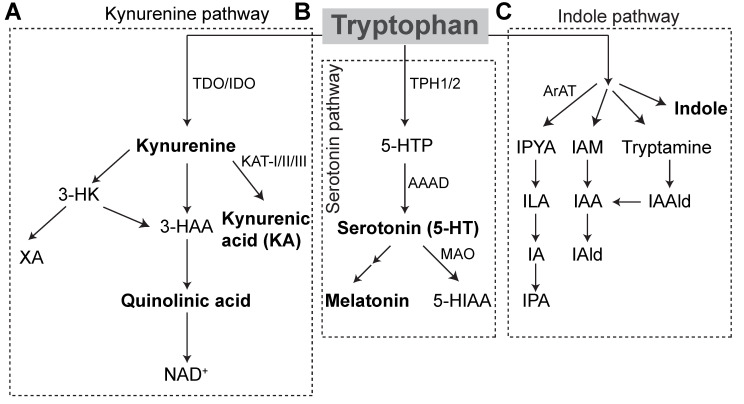
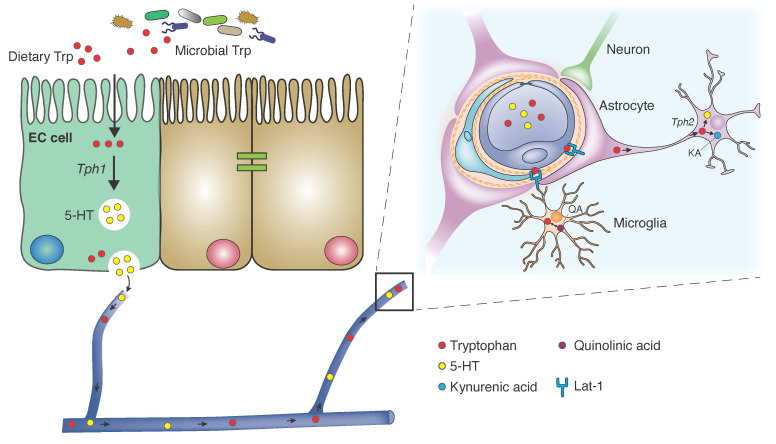
Tryptophan is an essential amino acid critical for protein synthesis in humans that has emerged as a key player in the microbiota-gut-brain axis. It is the only precursor for the neurotransmitter serotonin, which is vital for the processing of emotional regulation, hunger, sleep, and pain, as well as colonic motility and secretory activity in the gut. Tryptophan catabolites from the kynurenine degradation pathway also modulate neural activity and are active in the systemic inflammatory cascade. Additionally, tryptophan and its metabolites support the development of the central and enteric nervous systems. Accordingly, dysregulation of tryptophan metabolites plays a central role in the pathogenesis of many neurologic and psychiatric disorders. Gut microbes influence tryptophan metabolism directly and indirectly, with corresponding changes in behavior and cognition. The gut microbiome has thus garnered much attention as a therapeutic target for both neurologic and psychiatric disorders where tryptophan and its metabolites play a prominent role. In this review, we will touch upon some of these features and their involvement in health and disease.
Overview
The claims and statistics of this paper haven’t been checked yet.
Run the check — free, no account needed. It reads the open-access text and checks the sources it cites.
Integrity signals
Registry
Cites
Statistics
Figures
Verification
Claims the paper makes
The claims and statistics of this paper haven’t been checked yet.
Run the check — free, no account needed. It reads the open-access text and checks the sources it cites.
Claims other papers make about this one
Each is checked against this paper’s own text: does it say what the citing paper says it does?
In the citing paper
“these bacteria have been associated with the development of neuropsychiatric disorders, including autism spectrum disorders (205).”
From Signalling cognition: The gut microbiota and hypothalamic-pituitary-adrenal axis (2023) · cites this paper as [205]
Self-check
Percentages, sums and reported differences re-computed from the paper’s own numbers.
The self-check needs the paper’s full text.
Citations
Cites
1 retracted
Zhu, J., Wu, X., Owyang, C., & Li, Y. (2001) · The Journal of Physiology · doi:10.1111/j.1469-7793.2001.0431k.x · Cited by 226
RetractedNicotinic acetylcholine receptor α7 subunit is an essential regulator of inflammation
Wang, H., Yu, M., Ochani, M., Amella, C. A., Tanovic, M., Susarla, S., Li, J. H., Wang, H., Yang, H., Ulloa, L., et al. (2003) · Nature · doi:10.1038/nature01339 · Cited by 3,228
Gut Microbiota Regulation of Tryptophan Metabolism in Health and Disease
Agus, A., Planchais, J., & Sokol, H. (2018) · Cell Host & Microbe · doi:10.1016/j.chom.2018.05.003 · Cited by 3,180 · cited 3×
“The vast majority of TPH is absorbed in the small intestine [6].”
BackgroundInternational Union of Pharmacology classification of receptors for 5-hydroxytryptamine (Serotonin).
Hoyer, D., Clarke, D. E., Fozard, J. R., Hartig, P. R., Martin, G. R., Mylecharane, E. J., Saxena, P. R., & Humphrey, P. P. A. (1994) · Pharmacological Reviews · doi:10.1016/s0031-6997(25)06783-3 · Cited by 3,025
Metabolomics analysis reveals large effects of gut microflora on mammalian blood metabolites
Wikoff, W. R., Anfora, A. T., Liu, J., Schultz, P. G., Lesley, S. A., Peters, E. C., & Siuzdak, G. (2009) · Proceedings of the National Academy of Sciences · doi:10.1073/pnas.0812874106 · Cited by 2,677
Schizophrenia risk from complex variation of complement component 4
Sekar, A., Bialas, A. R., de Rivera, H., Davis, A., Hammond, T. R., Kamitaki, N., Tooley, K., Presumey, J., Baum, M., Van Doren, V., et al. (2016) · Nature · doi:10.1038/nature16549 · Cited by 2,394
Microbial tryptophan catabolites in health and disease
Roager, H. M., & Licht, T. R. (2018) · Nature Communications · doi:10.1038/s41467-018-05470-4 · Cited by 2,236
Gut microbiome alterations in Alzheimer’s disease
Vogt, N. M., Kerby, R. L., Dill-McFarland, K. A., Harding, S. J., Merluzzi, A. P., Johnson, S. C., Carlsson, C. M., Asthana, S., Zetterberg, H., Blennow, K., et al. (2017) · Scientific Reports · doi:10.1038/s41598-017-13601-y · Cited by 2,137
Serotonin, tryptophan metabolism and the brain-gut-microbiome axis
O’Mahony, S. M., Clarke, G., Borre, Y. E., Dinan, T. G., & Cryan, J. F. (2015) · Behavioural Brain Research · doi:10.1016/j.bbr.2014.07.027 · Cited by 2,012
Clarke, G., Grenham, S., Scully, P., Fitzgerald, P., Moloney, R. D., Shanahan, F., Dinan, T. G., & Cryan, J. F. (2013) · Molecular Psychiatry · doi:10.1038/mp.2012.77 · Cited by 1,893
Cited by
Sorted by citations
Functions of Gut Microbiota Metabolites, Current Status and Future Perspectives
Liu, J., Tan, Y., Cheng, H., Zhang, D., Feng, W., & Peng, C. (2022) · Aging and disease · doi:10.14336/ad.2022.0104 · Cited by 529
Molecular pathways of major depressive disorder converge on the synapse
Fries, G. R., Saldana, V. A., Finnstein, J., & Rein, T. (2023) · Molecular Psychiatry · doi:10.1038/s41380-022-01806-1 · Cited by 504
Signalling cognition: The gut microbiota and hypothalamic-pituitary-adrenal axis
Rusch, J. A., Layden, B. T., & Dugas, L. R. (2023) · Frontiers in Endocrinology · doi:10.3389/fendo.2023.1130689 · Cited by 415
Wang, G., Fan, Y., Zhang, G., Cai, S., Ma, Y., Yang, L., Wang, Y., Yu, H., Qiao, S., & Zeng, X. (2024) · Microbiome · doi:10.1186/s40168-024-01750-y · Cited by 325
Gut liver brain axis in diseases: the implications for therapeutic interventions
Yan, M., Man, S., Sun, B., Ma, L., Guo, L., Huang, L., & Gao, W. (2023) · Signal Transduction and Targeted Therapy · doi:10.1038/s41392-023-01673-4 · Cited by 314
Metadata
- Authors
- Roth, W., Zadeh, K., Vekariya, R., Ge, Y., & Mohamadzadeh, M.
- Affiliations
- University of Florida (US)
- Corresponding author
- Roth, William
- Mohamadzadeh, Mansour
- Venue
- International Journal of Molecular Sciences
- Publisher
- MDPI AG
- Published
- 2021-03-15
- Volume
- 22
- Issue
- 6
- Pages
- 2973
- ISSN
- 1422-0067 (ISSN-L)
- PMC
- PMC8000752
- OpenAlex
- W3137164735
- Cited by
- 519
- References
- 194
- Citations by year
- 2026: 102 · 2025: 150 · 2024: 139 · 2023: 72 · 2022: 46 · 2021: 10
- FWCI
- 6.30
- Type
- journal article
- Language
- en
- Open access
- gold
- doi.org
- Licence
- Locations
- International Journal of Molecular Sciences (publishedVersion, cc-by)
- PubMed Central (publishedVersion, cc-by)
- PubMed (publishedVersion)
- DOAJ (DOAJ: Directory of Open Access Journals) (submittedVersion, cc-by-sa)
- Funders
- National Institutes of Health (DK109560C, R01AI154630-01)
- Topics
- Life Sciences › Neuroscience › Biological Psychiatry › Tryptophan and brain disorders
- Life Sciences › Biochemistry, Genetics and Molecular Biology › Molecular Biology › Gut microbiota and health
- Life Sciences › Biochemistry, Genetics and Molecular Biology › Biochemistry › Amino Acid Enzymes and Metabolism
- Keywords
- tryptophan metabolism, gut-brain axis, gut microbiota, serotonin, kynurenine pathway, tryptophan catabolites, neuroinflammation, enteric nervous system, neurological disorders, mental illness, microbiota-targeted therapy
- MeSH terms
- Gastrointestinal Microbiome, Brain, Colon, Homeostasis, Humans, Hunger, Kynurenine, Pain, Serotonin, Sleep, Tryptophan, Enteric Nervous System
About these checks
Registry, retraction, Cites and statistics results are computed, not judged, with one exception: a printed reference that no index lists is read once by a model before it counts as a citation error. Claims are extracted by a model and kept only when their quote appears verbatim in the text; each cited source is then checked, with a model’s help, for whether it says what the claim relies on. Those verdicts can be wrong — read the claim’s quote and the cited source before relying on one.
Statistics and arithmetic are recomputed, not judged.
Confidence bands are shown only for fields calibrated on our annotated test set. None is calibrated yet, so no band is shown.
What counts as a claim ›How we measure confidence ›How we check this ›
Are you an author, or do you see a problem with this page? Request a review
