

The DOI matches its Crossref record; 168 of the 169 references it cites were found in a registry or an index.
The Gut-Brain Axis in Inflammatory Bowel Disease—Current and Future Perspectives
Open accessAbstract
The gut–brain axis is a bidirectional communication system driven by neural, hormonal, metabolic, immunological, and microbial signals. Signaling events from the gut can modulate brain function and recent evidence suggests that the gut–brain axis may play a pivotal role in linking gastrointestinal and neurological diseases. Accordingly, accumulating evidence has suggested a link between inflammatory bowel diseases (IBDs) and neurodegenerative, as well as neuroinflammatory diseases. In this context, clinical, epidemiological and experimental data have demonstrated that IBD predisposes a person to pathologies of the central nervous system (CNS). Likewise, a number of neurological disorders are associated with changes in the intestinal environment, which are indicative for disease-mediated gut–brain inter-organ communication. Although this axis was identified more than 20 years ago, the sequence of events and underlying molecular mechanisms are poorly defined. The emergence of precision medicine has uncovered the need to take into account non-intestinal symptoms in the context of IBD that could offer the opportunity to tailor therapies to individual patients. The aim of this review is to highlight recent findings supporting the clinical and biological link between the gut and brain, as well as its clinical significance for IBD as well as neurodegeneration and neuroinflammation. Finally, we focus on novel human-specific preclinical models that will help uncover disease mechanisms to better understand and modulate the function of this complex system.
Overview
The claims and statistics of this paper haven’t been checked yet.
Run the check — free, no account needed. It reads the open-access text and checks the sources it cites.
Integrity signals
Registry
Cites
Statistics
Figures
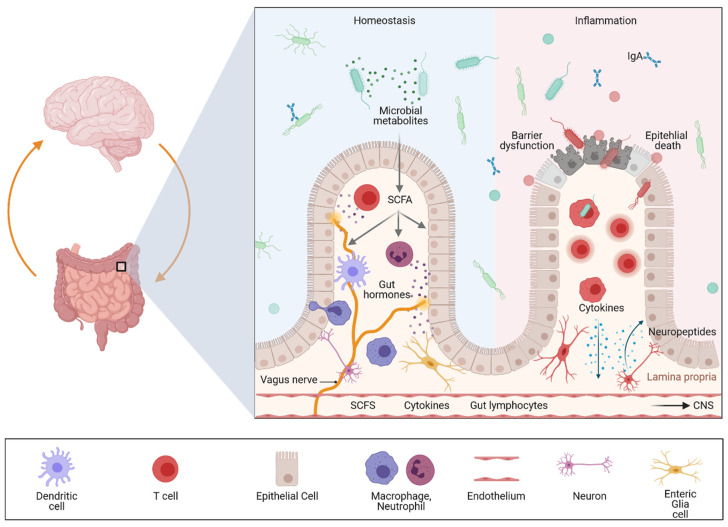
Verification
Claims the paper makes
The claims and statistics of this paper haven’t been checked yet.
Run the check — free, no account needed. It reads the open-access text and checks the sources it cites.
Claims other papers make about this one
Each is checked against this paper’s own text: does it say what the citing paper says it does?
In the citing paper
“The gut–brain axis is a complex bidirectional communication system driven by neural, hormonal, metabolic, immunological, and microbial signals [77,78].”
From Association between Childhood Onset Inflammatory Bowel Disease and Psychiatric Comorbidities in Adulthood (2023) · cites this paper as [78]
In the citing paper
“Signaling events from the gut can modulate brain function, and recent evidence suggests that the gut–brain axis may play a pivotal role in linking gastrointestinal and neuropsychiatric pathologies [78,79].”
From Association between Childhood Onset Inflammatory Bowel Disease and Psychiatric Comorbidities in Adulthood (2023) · cites this paper as [78]
Self-check
Percentages, sums and reported differences re-computed from the paper’s own numbers.
The self-check needs the paper’s full text.
Citations
Cites
Induction of Pluripotent Stem Cells from Adult Human Fibroblasts by Defined Factors
Takahashi, K., Tanabe, K., Ohnuki, M., Narita, M., Ichisaka, T., Tomoda, K., & Yamanaka, S. (2007) · Cell · doi:10.1016/j.cell.2007.11.019 · Cited by 20,221
Single Lgr5 stem cells build crypt-villus structures in vitro without a mesenchymal niche
Sato, T., Vries, R. G., Snippert, H. J., van de Wetering, M., Barker, N., Stange, D. E., van Es, J. H., Abo, A., Kujala, P., Peters, P. J., et al. (2009) · Nature · doi:10.1038/nature07935 · Cited by 7,204
Cerebral organoids model human brain development and microcephaly
Lancaster, M. A., Renner, M., Martin, C.-A., Wenzel, D., Bicknell, L. S., Hurles, M. E., Homfray, T., Penninger, J. M., Jackson, A. P., & Knoblich, J. A. (2013) · Nature · doi:10.1038/nature12517 · Cited by 5,372
A frameshift mutation in NOD2 associated with susceptibility to Crohn's disease
Ogura, Y., Bonen, D. K., Inohara, N., Nicolae, D. L., Chen, F. F., Ramos, R., Britton, H., Moran, T., Karaliuskas, R., Duerr, R. H., et al. (2001) · Nature · doi:10.1038/35079114 · Cited by 5,030
Gut microbiota regulate motor deficits and neuroinflammation in a model of Parkinson's disease
Sampson, T. R., Debelius, J. W., Thron, T., Janssen, S., Shastri, G. G., Ilhan, Z. E., Challis, C., Schretter, C. E., Rocha, S., Gradinaru, V., et al. (2016) · Cell · doi:10.1016/j.cell.2016.11.018 · Cited by 3,622
Host microbiota constantly control maturation and function of microglia in the CNS
Erny, D., Hrabě de Angelis, A. L., Jaitin, D., Wieghofer, P., Staszewski, O., David, E., Keren-Shaul, H., Mahlakoiv, T., Jakobshagen, K., Buch, T., et al. (2015) · Nature Neuroscience · doi:10.1038/nn.4030 · Cited by 3,569
Cortisone in Ulcerative Colitis
Truelove, S. C., & Witts, L. J. (1955) · BMJ · doi:10.1136/bmj.2.4947.1041 · Cited by 2,793
Genetics and pathogenesis of inflammatory bowel disease
Khor, B., Gardet, A., & Xavier, R. J. (2011) · Nature · doi:10.1038/nature10209 · Cited by 2,733
Cytokines in inflammatory bowel disease
Neurath, M. F. (2014) · Nature Reviews Immunology · doi:10.1038/nri3661 · Cited by 2,706
Self-citationGenetic risk and a primary role for cell-mediated immune mechanisms in multiple sclerosis
The International Multiple Sclerosis Genetics Consortium & The Wellcome Trust Case Control Consortium 2 (2011) · Nature · doi:10.1038/nature10251 · Cited by 2,697
Research works printed but not linked: 1
- Actis, 2019, The Human Gut: Inflammatory Remote Manifestations Regulated by the Microbiome, J. Gastric Disord. Ther., 4, 24
Cited by
Sorted by citations
Items 101–123 of 123
Zhuang, Y., Yang, H., Huang, X., Guo, G., Shi, Q., Lin, Y., Xue, W., Huang, Z., Zhou, S., Cai, J., et al. (2024) · All Life · doi:10.1080/26895293.2024.2422994
Ma, J., Tian, Y., Hu, J., Liang, Y., Tang, F.-D., & Zhang, Y. (2024) · Research Square · doi:10.21203/rs.3.rs-5352779/v1
Haedrich, J., & Huber, R. (2025) · Kompass Autoimmun · doi:10.1159/000548542
郭, 沛. (2025) · Traditional Chinese Medicine · doi:10.12677/tcm.2025.1412768
Ural, K. U. K., Erdoğan, H., ERDOĞAN, S., Paşa, S., DEĞER, T. B., Kizilkanat, A. İ., Balıkçı, C., & Sungur, A. (2025) · Muş Alparslan Üniversitesi Sağlık Bilimleri Dergisi · doi:10.71255/maunsbd.1636093
Liu, C., Liu, M., Liu, Y., Li, Y., Ma, M., Xu, L., Liu, P., & Liu, H. (2026) · Journal of Neuroinflammation · doi:10.1186/s12974-025-03676-0
MacKrill, K. (2026) · International Journal of Behavioral Medicine · doi:10.1007/s12529-026-10449-3
Gabriel-Segard, T. (2023) · theses.fr (ABES) · doi:10.70675/2f469c9fz7a22z4f47z9e37zcf0e1f890660
Good, S. D., Volkmann, E. R., Basnayake, C., & Ross, L. (2026) · Expert Review of Clinical Immunology · doi:10.1080/1744666x.2026.2663044
Gupta, D., Gupta, M. K., Parveen, F., & Agarwal, A. (2026) · Human Nutrition & Metabolism · doi:10.1016/j.hnm.2026.200369
Repurposing anti-inflammatory therapeutics for disorders of the microbiome-gut-brain axis
Habib, Y. H., Gwaily, N. A., Ali, M. Y., Fawzy, M. A., Zakaria, M. A., & Ali, M. A. (2026) · Journal of Neuroimmunology · doi:10.1016/j.jneuroim.2026.579000
Li, J., Ru, W., ZHAO, Y., & Liu, C. (2026) · Journal of Inflammation Research · doi:10.2147/jir.s604053
Didamoony, M. A., Shokr, M. M., Eladawy, R. M., & Ahmed, L. A. (2026) · Inflammopharmacology · doi:10.1007/s10787-026-02303-5
Griesbaum, M., Vogl, T., Visschedijk, M. C., Festen, E. A. M., Dijkstra, G. D. H., Weinberger, A., Segal, E., Weersma, R. K., & Bourgonje, A. R. (2026) · iScience · doi:10.1016/j.isci.2026.116828
Use of Antihistamine Drugs in Colitis: A Review
Bogielski, B., Gach, D., Michalczyk, K., Skrzep-Poloczek, B., Stojko, M., Zalejska–Fiolka, J., & Stygar, D. M. (2026) · Pharmaceuticals · doi:10.3390/ph19071124
Dream processes and affect regulation in psychotherapy: a longitudinal clinical case study
Bíró, D., Osváth, P., & Mészáros, M. (2026) · Research in Psychotherapy Psychopathology Process and Outcome · doi:10.4081/ripppo.2026.895
The Microbiome in the Development and Treatment of Inflammatory Bowel Disease
Zhetkenev, S., Konovalov, R., Akhmetkaliyev, A., & Sonnenberg-Riethmacher, E. (2026) · Biomedicines · doi:10.3390/biomedicines14081754
Gut–Brain–Skin Axis: From Mechanistic Insights to Translational Applications in Neurocosmetics
Zhao, R., Xu, H., Zhu, Y., Chang, H., Liu, B., & Liu, Z. (2026) · Dermatology and Therapy · doi:10.1007/s13555-026-01892-x
Martino, G., Merlo, E. M., Vicario, C. M., Bellone, F., Francesco, C. D., Feldt‐Rasmussen, U., Catalano, A., Fries, W., & Silvestro, O. (2026) · Research in Psychotherapy Psychopathology Process and Outcome · doi:10.4081/ripppo.2026.900
Nutritional regulation of gut-brain immune crosstalk across the lifespan
Zhou, Y., Toro, S. D., & Zeng, M. Y. (2026) · Gut Microbes · doi:10.1080/19490976.2026.2725371
A prospective case-control study of the gut bacteriome and mycobiome in glioblastomaPreprint
Herz, M., Schmid, K., Ankenbrand, M. J., Roth, E., Huenniger, K., Guendermann, N., Nickl, R., Kessler, A. F., Cattaneo, A., Monoranu, C. M., et al. (2026) · medRxiv · doi:10.64898/2026.09.23.26363766
Pryce, K., Hasan, F., Levano, S. R., Shea, K., Normatov, I., Rivas, Y., Fiori, K. P., & Tomer, G. (2026) · JPGN Reports · doi:10.1002/jpr3.70295
Metadata
- Authors
- Günther, C., Rothhammer, V., Karow, M., Neurath, M., & Winner, B.
- Affiliations
- Friedrich-Alexander-Universität Erlangen-Nürnberg (DE)
- Corresponding author
- Günther, Claudia
- Winner, Beate
- Venue
- International Journal of Molecular Sciences
- Publisher
- MDPI AG
- Published
- 2021-08-18
- Volume
- 22
- Issue
- 16
- Pages
- 8870
- ISSN
- 1422-0067 (ISSN-L)
- PMC
- PMC8396333
- OpenAlex
- W3196160028
- Cited by
- 123
- References
- 169
- Citations by year
- 2026: 27 · 2025: 32 · 2024: 33 · 2023: 22 · 2022: 8 · 2021: 1
- FWCI
- 2.37
- Type
- journal article
- Language
- en
- Open access
- gold
- doi.org
- Licence
- Locations
- International Journal of Molecular Sciences (publishedVersion, cc-by)
- PubMed Central (publishedVersion, cc-by)
- PubMed (publishedVersion)
- DOAJ (DOAJ: Directory of Open Access Journals) (submittedVersion, cc-by-sa)
- GoeScholar The Publication Server of the Georg-August-Universität Göttingen (Georg-August-Universität Göttingen) (submittedVersion, cc-by)
- OPUS Repository (Kooperativer Bibliotheksverbund Berlin-Brandenburg) (submittedVersion, cc-by)
- Funders
- Deutsche Forschungsgemeinschaft (WI 3567/2-1, 270949263/GRK2162, SPP1656, TRR241, FOR 2886, TRR30, GU 1431/5-15)
- Interdisciplinary Center for Clinical Research (IZKF) of the University Erlangen-Nuremberg (30, A75, P056, P068 Jochen-Kalden funding programme N5, N7)
- European Research Council (851693 HICI)
- Topics
- Health Sciences › Medicine › Gastroenterology › Inflammatory Bowel Disease
- Life Sciences › Biochemistry, Genetics and Molecular Biology › Molecular Biology › Gut microbiota and health
- Health Sciences › Medicine › Gastroenterology › Gastrointestinal motility and disorders
- Keywords
- gut-brain axis, inflammatory bowel disease, neurodegeneration, neuroinflammation, central nervous system, gut microbiota, two-way communication, precision medicine, preclinical models
- MeSH terms
- Animals, Brain, Central Nervous System Diseases, Humans, Inflammatory Bowel Diseases
About these checks
Registry, retraction, Cites and statistics results are computed, not judged, with one exception: a printed reference that no index lists is read once by a model before it counts as a citation error. Claims are extracted by a model and kept only when their quote appears verbatim in the text; each cited source is then checked, with a model’s help, for whether it says what the claim relies on. Those verdicts can be wrong — read the claim’s quote and the cited source before relying on one.
Statistics and arithmetic are recomputed, not judged.
Confidence bands are shown only for fields calibrated on our annotated test set. None is calibrated yet, so no band is shown.
What counts as a claim ›How we measure confidence ›How we check this ›
Are you an author, or do you see a problem with this page? Request a review
