

The DOI matches its Crossref record; 121 of the 123 references it cites were found in a registry or an index.
Angiogenesis in Chronic Inflammatory Skin Disorders
Open accessAbstract
Angiogenesis, the growth of new blood vessels from preexisting vessels, is associated with inflammation in various pathological conditions. Well-known angiogenetic factors include vascular endothelial growth factor (VEGF), angiopoietins, platelet-derived growth factor, transforming growth factor-β, and basic fibroblast growth factor. Yes-associated protein 1 (YAP) and transcriptional co-activator with PDZ-binding motif (TAZ) have recently been added to an important angiogenic factor. Accumulating evidence indicates associations between angiogenesis and chronic inflammatory skin diseases. Angiogenesis is deeply involved in the pathogenesis of psoriasis. VEGF, angiopoietins, tumor necrosis factor-a, interleukin-8, and interleukin-17 are unregulated in psoriasis and induce angiogenesis. Angiogenesis may be involved in the pathogenesis of atopic dermatitis, and in particular, mast cells are a major source of VEGF expression. Angiogenesis is an essential process in rosacea, which is induced by LL-37 from a signal cascade by microorganisms, VEGF, and MMP-3 from mast cells. In addition, angiogenesis by increased VEGF has been reported in chronic urticaria and hidradenitis suppurativa. The finding that VEGF is expressed in inflammatory skin lesions indicates that inhibition of angiogenesis is a useful strategy for treatment of chronic, inflammatory skin disorders.
Overview
The claims and statistics of this paper haven’t been checked yet.
Run the check — free, no account needed. It reads the open-access text and checks the sources it cites.
Integrity signals
Registry
Cites
Statistics
Figures
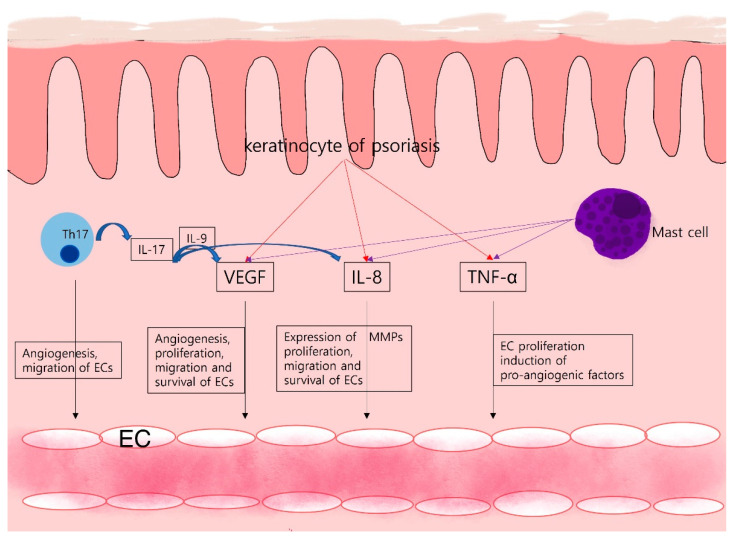
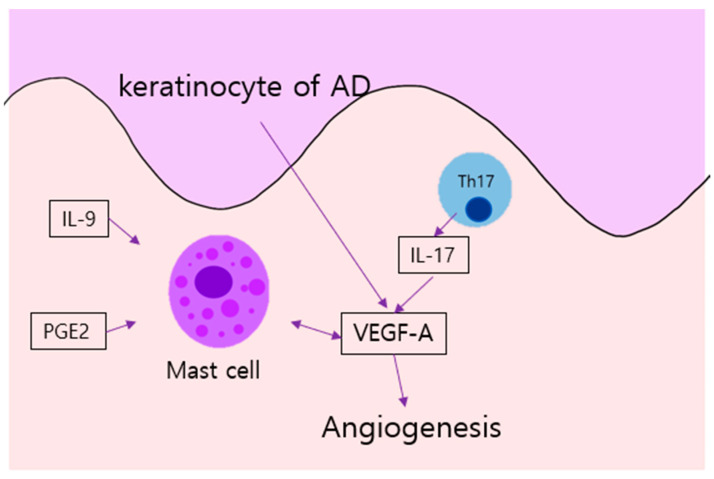
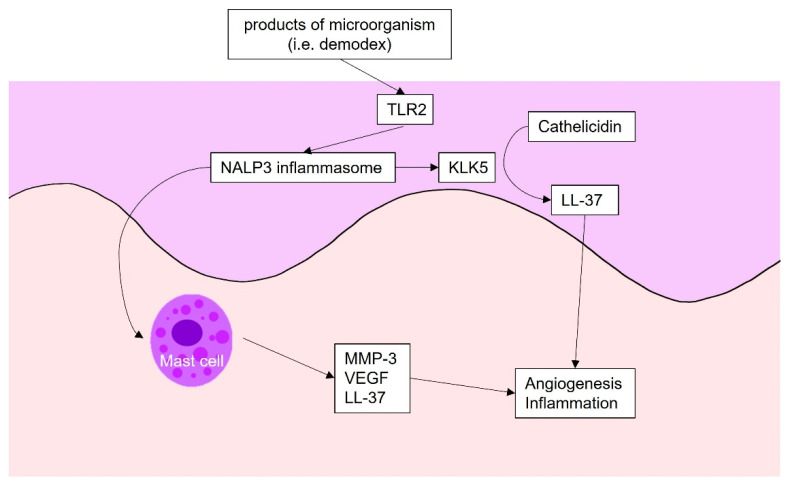
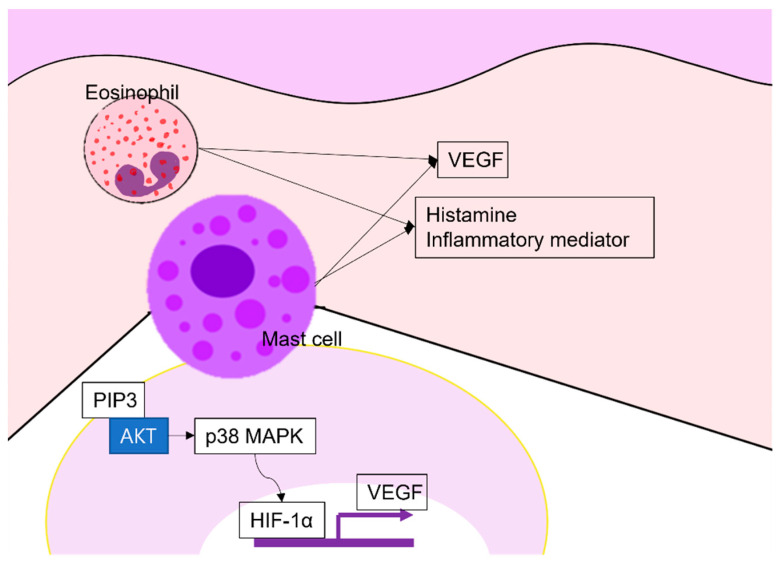
Verification
Claims the paper makes
The claims and statistics of this paper haven’t been checked yet.
Run the check — free, no account needed. It reads the open-access text and checks the sources it cites.
Claims other papers make about this one
Each is checked against this paper’s own text: does it say what the citing paper says it does?
The source backs part of the claim, not all of it — or backs it for a different population, condition or comparison.
In the citing paper
“Increasing real-world evidence also supports the durable efficacy and favorable long-term disease control achieved with selective IL-23 inhibitors [27,28].”
From The Cutaneous Immune Microenvironment in Selected Inflammatory Skin Diseases: Linking Histopathology, Mechanisms, and Targeted Therapy (2026) · cites this paper as [28]
Experimental — accuracy not yet measuredThe source backs part of the claim, not all of it — or backs it for a different population, condition or comparison.
In the citing paper
“Throughout this process, continuous exchange between keratinocytes and immune cells maintains a loop in which IL-23 sustains pathogenic T cells, IL-17 and IL-22 perpetuate epidermal alterations, and TNF-α amplifies inflammation across multiple cell types.”
From The Cutaneous Immune Microenvironment in Selected Inflammatory Skin Diseases: Linking Histopathology, Mechanisms, and Targeted Therapy (2026) · cites this paper as [28]
Experimental — accuracy not yet measuredThe source backs part of the claim, not all of it — or backs it for a different population, condition or comparison.
In the citing paper
“These reflect activation of the IL-23/Th17 axis.”
From The Cutaneous Immune Microenvironment in Selected Inflammatory Skin Diseases: Linking Histopathology, Mechanisms, and Targeted Therapy (2026) · cites this paper as [28]
Experimental — accuracy not yet measuredThe source backs part of the claim, not all of it — or backs it for a different population, condition or comparison.
In the citing paper
“In psoriasis, histopathological findings include acanthosis, parakeratosis, neutrophilic microabscesses, and prominent dermal vascular proliferation.”
From The Cutaneous Immune Microenvironment in Selected Inflammatory Skin Diseases: Linking Histopathology, Mechanisms, and Targeted Therapy (2026) · cites this paper as [28]
Experimental — accuracy not yet measuredThe check wasn’t confident either way, so it gives no verdict — never disputed.
In the citing paper
“In severe or refractory cases, systemic agents such as methotrexate, cyclosporine, and acitretin are used to broadly suppress immune activation and keratinocyte turnover, but their long-term use is limited by toxicity and lack of pathway specificity [28].”
From The Cutaneous Immune Microenvironment in Selected Inflammatory Skin Diseases: Linking Histopathology, Mechanisms, and Targeted Therapy (2026) · cites this paper as [28]
Experimental — accuracy not yet measured
Self-check
Percentages, sums and reported differences re-computed from the paper’s own numbers.
The self-check needs the paper’s full text.
Citations
Cites
Vascular Endothelial Growth Factor Is a Secreted Angiogenic Mitogen
Leung, D. W., Cachianes, G., Kuang, W.-J., Goeddel, D. V., & Ferrara, N. (1989) · Science · doi:10.1126/science.2479986 · Cited by 5,000
Tumor Cells Secrete a Vascular Permeability Factor That Promotes Accumulation of Ascites Fluid
Senger, D. R., Galli, S. J., Dvořàk, A. M., Perruzzi, C. A., Harvey, V. S., & Dvorak, H. F. (1983) · Science · doi:10.1126/science.6823562 · Cited by 3,969
VEGF in signaling and disease: beyond discovery and development
Apte, R. S., Chen, D. S., & Ferrara, N. (2019) · Cell · doi:10.1016/j.cell.2019.01.021 · Cited by 2,721
Isolation of a tumor factor responsible for angiogenesis
Folkman, J., Merler, E., Abernathy, C., & Williams, G. (1971) · The Journal of Experimental Medicine · doi:10.1084/jem.133.2.275 · Cited by 1,663
Identification of the KDR tyrosine kinase as a receptor for vascular endothelial cell growth factor
Terman, B. I., Dougher-Vermazen, M., Carrion, M. E., Dimitrov, D. S., Armellino, D. C., Gospodarowicz, D., & Böhlen, P. (1992) · Biochemical and Biophysical Research Communications · doi:10.1016/0006-291x(92)90483-2 · Cited by 1,519
Control of vascular morphogenesis and homeostasis through the angiopoietin–Tie system
Augustin, H. G., Koh, G. Y., Thurston, G., & Alitalo, K. K. (2009) · Nature Reviews Molecular Cell Biology · doi:10.1038/nrm2639 · Cited by 1,512
Interleukin-17 and Type 17 Helper T Cells
Miossec, P., Korn, T., & Kuchroo, V. K. (2009) · New England Journal of Medicine · doi:10.1056/nejmra0707449 · Cited by 1,409
YAP/TAZ upstream signals and downstream responses
Totaro, A., Panciera, T., & Piccolo, S. (2018) · Nature Cell Biology · doi:10.1038/s41556-018-0142-z · Cited by 1,086
Defective haematopoiesis and vasculogenesis in transforming growth factor-β1 knock out mice
Dickson, M. C., Martin, J. S., Cousins, F. M., Kulkarni, A. B., Karlsson, S., & Akhurst, R. J. (1995) · Development · doi:10.1242/dev.121.6.1845 · Cited by 1,029
Hippo–YAP/TAZ signalling in organ regeneration and regenerative medicine
Moya, I. M., & Halder, G. (2019) · Nature Reviews Molecular Cell Biology · doi:10.1038/s41580-018-0086-y · Cited by 981
Cited by
Sorted by citations
Pathological angiogenesis: mechanisms and therapeutic strategies
Dudley, A. C., & Griffioen, A. W. (2023) · Angiogenesis · doi:10.1007/s10456-023-09876-7 · Cited by 571
“Since these processes induce the expression of VEGF, which leads to the expansion of the dermal microvasculature [207, 208], it has been postulated that inhibition of angiogenesis might be a promising treatment approach.”
The Immunology of Psoriasis-Current Concepts in Pathogenesis
Sieminska, I., Pieniawska, M., & Grzywa, T. M. (2024) · Clinical Reviews in Allergy & Immunology · doi:10.1007/s12016-024-08991-7 · Cited by 346
“One of the histological hallmarks of psoriatic skin is increased dermal vascularity [287].”
BackgroundSkin Barrier Function: The Interplay of Physical, Chemical, and Immunologic Properties
Baker, P., Huang, C. Y., Radi, R., Moll, S., Jules, E., & Arbiser, J. L. (2023) · Cells · doi:10.3390/cells12232745 · Cited by 221
Dong, J., Wang, W., Zhou, W., Zhang, S., Li, M., Li, N., Pan, G., Zhang, X., Bai, J., & Zhu, C. (2022) · Biomaterials Research · doi:10.1186/s40824-022-00326-x · Cited by 117
Advances in 3D skin bioprinting for wound healing and disease modeling
Zhang, M., Zhang, C., Li, Z., Fu, X., & Huang, S. (2022) · Regenerative Biomaterials · doi:10.1093/rb/rbac105 · Cited by 118
“Changes of the vascular system also contribute to the development of many skin diseases, especially autoimmune diseases and skin tumors [169, 170].”
Metadata
- Authors
- Lee, H. J., Hong, Y. J., & Kim, M.
- Affiliations
- The Catholic University of Korea Yeouido St. Mary's Hospital (KR)
- Corresponding author
- Kim, Miri
- Venue
- International Journal of Molecular Sciences
- Publisher
- MDPI AG
- Published
- 2021-11-07
- Volume
- 22
- Issue
- 21
- Pages
- 12035
- ISSN
- 1422-0067 (ISSN-L)
- PMC
- PMC8584589
- OpenAlex
- W3212070111
- Semantic Scholar
- 5155b9747bd452bee5fcdea00619444cce1f7eac
- Cited by
- 211
- References
- 123
- Citations by year
- 2026: 31 · 2025: 63 · 2024: 55 · 2023: 43 · 2022: 19
- FWCI
- 3.07
- Type
- journal article
- Language
- en
- Open access
- gold
- doi.org
- Licence
- Locations
- International Journal of Molecular Sciences (publishedVersion, cc-by)
- Europe PMC (PubMed Central) (publishedVersion, other-oa)
- PubMed Central (publishedVersion, cc-by)
- PubMed (publishedVersion)
- DOAJ (DOAJ: Directory of Open Access Journals) (submittedVersion, cc-by-sa)
- Funders
- National Research Foundation of Korea (2018R1D1A1B07044100 and 2019R1F1A1059460)
- Topics
- Life Sciences › Biochemistry, Genetics and Molecular Biology › Molecular Biology › Angiogenesis and VEGF in Cancer
- Health Sciences › Medicine › Dermatology › Dermatology and Skin Diseases
- Health Sciences › Medicine › Oncology › Lymphatic System and Diseases
- Keywords
- angiogenesis, chronic inflammatory skin disease, psoriasis, atopic dermatitis, rosacea, chronic urticaria, hidradenitis suppurativa, vascular endothelial growth factor, angiopoietins, mast cells, YAP/TAZ signaling, angiogenesis inhibition, IL-17, interleukin-8, TNF-α, LL-37, MMP-3
- MeSH terms
- Animals, Chronic Disease, Dermatitis, Dermatitis, Atopic, Humans, Neovascularization, Pathologic, Psoriasis, Rosacea, Vascular Endothelial Growth Factor A, Angiopoietins
About these checks
Registry, retraction, Cites and statistics results are computed, not judged, with one exception: a printed reference that no index lists is read once by a model before it counts as a citation error. Claims are extracted by a model and kept only when their quote appears verbatim in the text; each cited source is then checked, with a model’s help, for whether it says what the claim relies on. Those verdicts can be wrong — read the claim’s quote and the cited source before relying on one.
Statistics and arithmetic are recomputed, not judged.
Confidence bands are shown only for fields calibrated on our annotated test set. None is calibrated yet, so no band is shown.
What counts as a claim ›How we measure confidence ›How we check this ›
Are you an author, or do you see a problem with this page? Request a review
