

Osteoporosis Due to Hormone Imbalance: An Overview of the Effects of Estrogen Deficiency and Glucocorticoid Overuse on Bone Turnover
Open accessThe DOI matches its Crossref record; 108 of the 108 references it cites were found in a registry or an index.
Abstract
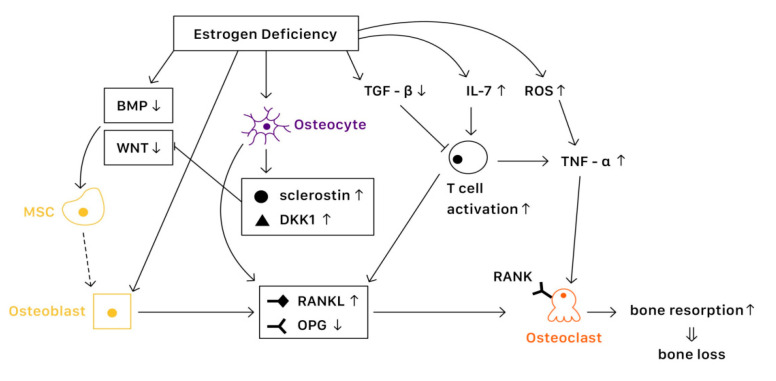
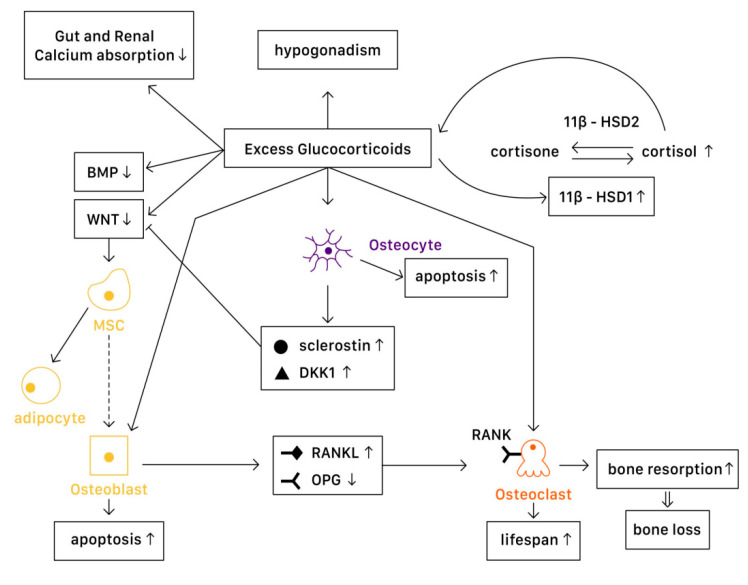
Osteoporosis is a serious health issue among aging postmenopausal women. The majority of postmenopausal women with osteoporosis have bone loss related to estrogen deficiency. The rapid bone loss results from an increase in bone turnover with an imbalance between bone resorption and bone formation. Osteoporosis can also result from excessive glucocorticoid usage, which induces bone demineralization with significant changes of spatial heterogeneities of bone at microscale, indicating potential risk of fracture. This review is a summary of current literature about the molecular mechanisms of actions, the risk factors, and treatment of estrogen deficiency related osteoporosis (EDOP) and glucocorticoid induced osteoporosis (GIOP). Estrogen binds with estrogen receptor to promote the expression of osteoprotegerin (OPG), and to suppress the action of nuclear factor-κβ ligand (RANKL), thus inhibiting osteoclast formation and bone resorptive activity. It can also activate Wnt/β-catenin signaling to increase osteogenesis, and upregulate BMP signaling to promote mesenchymal stem cell differentiation from pre-osteoblasts to osteoblasts, rather than adipocytes. The lack of estrogen will alter the expression of estrogen target genes, increasing the secretion of IL-1, IL-6, and tumor necrosis factor (TNF). On the other hand, excessive glucocorticoids interfere the canonical BMP pathway and inhibit Wnt protein production, causing mesenchymal progenitor cells to differentiate toward adipocytes rather than osteoblasts. It can also increase RANKL/OPG ratio to promote bone resorption by enhancing the maturation and activation of osteoclast. Moreover, excess glucocorticoids are associated with osteoblast and osteocyte apoptosis, resulting in declined bone formation. The main focuses of treatment for EDOP and GIOP are somewhat different. Avoiding excessive glucocorticoid use is mandatory in patients with GIOP. In contrast, appropriate estrogen supplement is deemed the primary treatment for females with EDOP of various causes. Other pharmacological treatments include bisphosphonate, teriparatide, and RANKL inhibitors. Nevertheless, more detailed actions of EDOP and GIOP along with the safety and effectiveness of medications for treating osteoporosis warrant further investigation.
Overview
The claims and statistics of this paper haven’t been checked yet.
Free: it reads the open-access text and checks the first 5 claims that cite a source we can check. Create a free account to check every claim.
Integrity signals
Registry
Cites
Statistics
Figures
Verification
Claims the paper makes
The claims and statistics of this paper haven’t been checked yet.
Free: it reads the open-access text and checks the first 5 claims that cite a source we can check. Create a free account to check every claim.
Claims other papers make about this one
Each is checked against this paper’s own text: does it say what the citing paper says it does?
The cited source says what the claim attributes to it.
In the citing paper
“In addition, estrogen can also increase TGF-β and osteoprotegerin (OPG) levels, which inhibit osteoclast differentiation [[58], [59], [60]].”
From Emerging role of liver-bone axis in osteoporosis (2024) · cites this paper as [59]
Self-check
Percentages, sums and reported differences re-computed from the paper’s own numbers.
The self-check needs the paper’s full text.
Citations
Cites
1 retracted
RETIRED: Osteoporosis in Menopause
Khan, A. A., Fortier, M. P., Fortier, M. P., Reid, R. L., Abramson, B. L., Blake, J. M., Desindes, S., Dodin, S., Graves, L. E., Guthrie, B., et al. (2014) · Journal of Obstetrics and Gynaecology Canada · doi:10.1016/s1701-2163(15)30489-8 · Cited by 68
RetractedEstrogen deficiency and bone loss: an inflammatory tale
Weitzmann, M. N. (2006) · Journal of Clinical Investigation · doi:10.1172/jci28550 · Cited by 990 · cited 5×
“The lack of estrogen will alter the expression of estroge t rget ge s, inc easing the secretion of IL-1, IL-6, and tumor necrosis factor (TNF).”
BackgroundInfluentialEastell, R., O'Neill, T. W., Hofbauer, L. C., Langdahl, B., Reid, I. R., Gold, D. T., & Cummings, S. R. (2016) · Nature Reviews Disease Primers · doi:10.1038/nrdp.2016.69 · Cited by 827 · cited 5×
“Moreover, estrogens stimulate the production of IGF1 and TGFβ by osteoblasts, enhancing bone formation [19].”
BackgroundInfluentialRecommendations for the prevention and treatment of glucocorticoid-induced osteoporosis: 2001 update
American College of Rheumatology Ad Hoc Committee on Glucocorticoid-Induced Osteoporosis (2001) · Arthritis & Rheumatism · doi:10.1002/1529-0131(200107)44:7<1496::aid-art271>3.0.co;2-5 · Cited by 647
Buckley, L., Guyatt, G., Fink, H. A., Cannon, M., Grossman, J., Hansen, K. E., Humphrey, M. B., Lane, N. E., Magrey, M., Miller, M., et al. (2017) · Arthritis Care & Research · doi:10.1002/acr.23279 · Cited by 579
Buckley, L., Guyatt, G., Fink, H. A., Cannon, M., Grossman, J., Hansen, K. E., Humphrey, M. B., Lane, N. E., Magrey, M., Miller, M., et al. (2017) · Arthritis & Rheumatology · doi:10.1002/art.40137 · Cited by 527
Saag, K. G., Zanchetta, J. R., Devogelaer, J., Adler, R. A., Eastell, R., See, K., Krege, J. H., Krohn, K., & Warner, M. R. (2009) · Arthritis & Rheumatism · doi:10.1002/art.24879 · Cited by 493 · cited 1×
“One randomized controlled trial showed significantly greater increases in spine and hip BMD in the teriparatide group compared with the alendronate group during a 36-months therapy [95].”
ResultThe mechanisms of estrogen regulation of bone resorption
Riggs, B. L. (2000) · Journal of Clinical Investigation · doi:10.1172/jci11468 · Cited by 446 · cited 2×
“Studi have also shown that estrogen deficiency directly affects cell differentiation and apoptosis [21].”
BackgroundNF-κB signaling and bone resorption
Abu-Amer, Y. (2013) · Osteoporosis International · doi:10.1007/s00198-013-2313-x · Cited by 340
Research works printed but not linked: 1
- Eisenberg Center at Oregon Health & Science University Osteoporosis Treatments That Help Prevent Broken Bones: A Guide for Women After Menopause Comparative Effectiveness Review Summary Guides for Consumers AHRQ Comparative Effectiveness Reviews Agency for Healthcare Research and Quality (US) Rockville, MD, USA 2005 21919254
Cited by
Jang, W. Y., Kim, M.-Y., & Cho, J. Y. (2022) · International Journal of Molecular Sciences · doi:10.3390/ijms232415482 · Cited by 196
“The activity of osteoclasts can be blocked by the actions of estrogen, while estrogen upregulates the production of osteoprotegerin (OPG) in osteoblasts [98].”
BackgroundPostmenopausal osteoporosis coexisting with sarcopenia: the role and mechanisms of estrogen
Lu, L., & Tian, L. (2023) · Journal of Endocrinology · doi:10.1530/joe-23-0116 · Cited by 193
Insights and implications of sexual dimorphism in osteoporosis
Zhang, Y., Xie, N., Sun, X., Nice, E. C., Liou, Y., Huang, C., Zhu, H., & Shen, Z. (2024) · Bone Research · doi:10.1038/s41413-023-00306-4 · Cited by 184
“285 Regarding osteoporosis, GCs and estrogens have opposing actions on multiple signaling pathways.”
BackgroundElectroactive Biomaterials for Facilitating Bone Defect Repair under Pathological Conditions
Heng, B. C., Bai, Y., Li, X., Lim, L. W., Li, W., Ge, Z., Zhang, X., & Deng, X. (2022) · Advanced Science · doi:10.1002/advs.202204502 · Cited by 178
Molecular and Cellular Mechanisms of Osteoporosis
Zhivodernikov, I. V., Kirichenko, T. V., Markina, Y. V., Postnov, A. Y., & Markin, A. M. (2023) · International Journal of Molecular Sciences · doi:10.3390/ijms242115772 · Cited by 166
“Estrogens also suppress the production of receptor activator of nuclear factor kappa-B (NF-κ B) ligand (RANKL) and increase the production of osteoprotegerin (OPG) by osteoblasts and lymphocytes, which maintain the RANKL/OPG ratio necessary for balanced bone remodeling [10–12].”
Background
Metadata
- Authors
- Cheng, C.-H., Chen, L.-R., & Chen, K.-H.
- Affiliations
- Mackay Memorial Hospital (TW)
- National Yang Ming Chiao Tung University (TW)
- Tzu Chi University (TW)
- Corresponding author
- Chen, Kuo-Hu
- Venue
- International Journal of Molecular Sciences
- Publisher
- MDPI AG
- Published
- 2022-01-25
- Volume
- 23
- Issue
- 3
- Pages
- 1376
- ISSN
- 1422-0067 (ISSN-L)
- PMC
- PMC8836058
- OpenAlex
- W4210278962
- Cited by
- 595
- References
- 108
- Citations by year
- 2026: 148 · 2025: 174 · 2024: 166 · 2023: 72 · 2022: 33
- FWCI
- 24.40
- Type
- journal article
- Language
- en
- Open access
- gold
- doi.org
- Licence
- Locations
- International Journal of Molecular Sciences (publishedVersion, cc-by)
- PubMed Central (publishedVersion, cc-by)
- PubMed (publishedVersion)
- DOAJ (DOAJ: Directory of Open Access Journals) (submittedVersion, cc-by-sa)
- Funders
- Taipei Tzu Chi Hospital (TCRD-TPE-110-06)
- Topics
- Health Sciences › Medicine › Orthopedics and Sports Medicine › Bone health and osteoporosis research
- Life Sciences › Biochemistry, Genetics and Molecular Biology › Molecular Biology › Bone Metabolism and Diseases
- Life Sciences › Biochemistry, Genetics and Molecular Biology › Endocrinology › Estrogen and related hormone effects
- Keywords
- glucocorticoid-induced osteoporosis, bone turnover, bone resorption, estrogen receptor, osteoprotegerin, RANKL, Wnt/β-catenin signaling, BMP signaling, mesenchymal stem cell differentiation, osteoclastogenesis, osteocyte apoptosis, postmenopausal women, estrogen replacement therapy, bisphosphonates, teriparatide, RANKL inhibitor, fracture risk
- MeSH terms
- Bone Resorption, Cell Differentiation, Estrogens, Female, Glucocorticoids, Humans, Osteoblasts, Osteoclasts, Osteocytes, Osteogenesis, Osteoporosis, Tumor Necrosis Factor-alpha, Bone Remodeling, Postmenopause, RANK Ligand
About these checks
Registry, retraction, Cites and statistics results are computed, not judged, with one exception: a printed reference that no index lists is read once by a model before it counts as a citation error. Claims are extracted by a model and kept only when their quote appears verbatim in the text; each cited source is then checked, with a model’s help, for whether it says what the claim relies on. Those verdicts can be wrong — read the claim’s quote and the cited source before relying on one.
Statistics and arithmetic are recomputed, not judged.
Confidence bands are shown only for fields calibrated on our annotated test set. None is calibrated yet, so no band is shown.
What counts as a claim ›How we measure confidence ›How we check this ›
Are you an author, or do you see a problem with this page? Request a review
Data sources
Bibliographic data: Semantic Scholar, OpenAlex, Crossref.
Contains information from the Semantic Scholar Academic Graph Datasets, made available under the ODC Attribution License (ODC-BY 1.0).
Semantic Scholar’s data is described in: Kinney, R., et al. (2023). The Semantic Scholar Open Data Platform. arXiv:2301.10140.
