

The DOI matches its Crossref record; 84 of the 84 references it cites were found in a registry or an index.
Unravelling the Adaptation Mechanisms to High Pressure in Proteins
Open accessPublished version of a preprint
Abstract
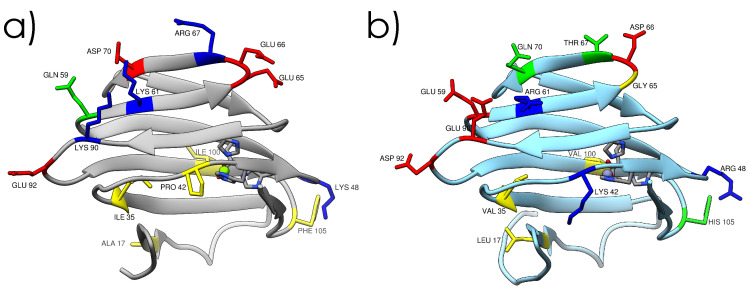
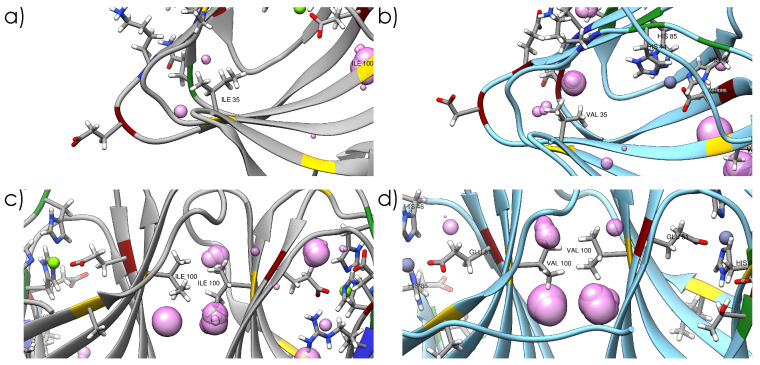
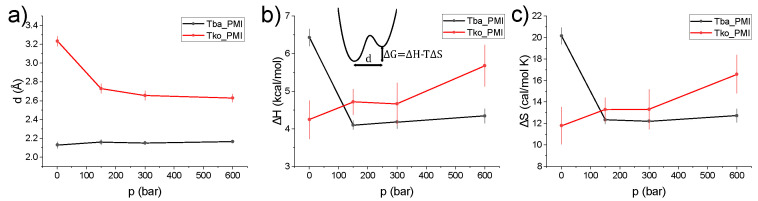
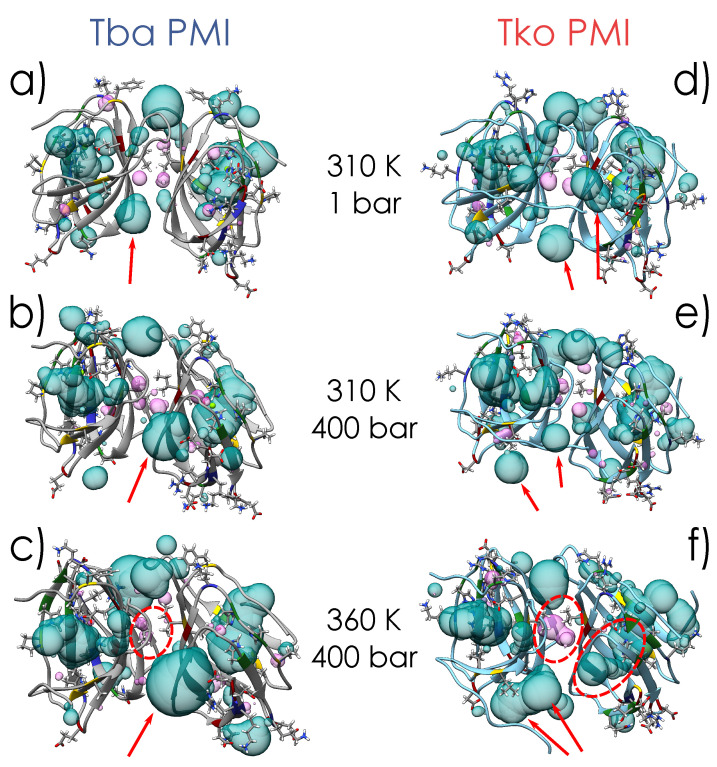
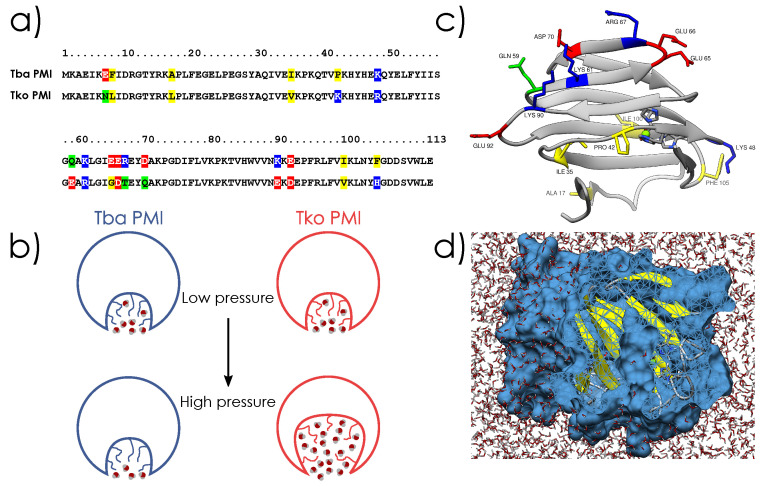
Life is thought to have appeared in the depth of the sea under high hydrostatic pressure. Nowadays, it is known that the deep biosphere hosts a myriad of life forms thriving under high-pressure conditions. However, the evolutionary mechanisms leading to their adaptation are still not known. Here, we show the molecular bases of these mechanisms through a joint structural and dynamical study of two orthologous proteins. We observed that pressure adaptation involves the decoupling of protein–water dynamics and the elimination of cavities in the protein core. This is achieved by rearranging the charged residues on the protein surface and using bulkier hydrophobic residues in the core. These findings will be the starting point in the search for a complete genomic model explaining high-pressure adaptation.
Overview
The claims and statistics of this paper haven’t been checked yet.
Run the check — free, no account needed. It reads the open-access text and checks the sources it cites.
Integrity signals
Registry
Cites
Statistics
Figures
Verification
Claims the paper makes
The claims and statistics of this paper haven’t been checked yet.
Run the check — free, no account needed. It reads the open-access text and checks the sources it cites.
Self-check
Percentages, sums and reported differences re-computed from the paper’s own numbers.
The self-check needs the paper’s full text.
Citations
Cites
VMD: visual molecular dynamics
Humphrey, W., Dalke, A., & Schulten, K. (1996) · Journal of Molecular Graphics · doi:10.1016/0263-7855(96)00018-5 · Cited by 66,952
UCSF Chimera—A visualization system for exploratory research and analysis
Pettersen, E. F., Goddard, T. D., Huang, C. C., Couch, G. S., Greenblatt, D. M., Meng, E. C., & Ferrin, T. E. (2004) · Journal of Computational Chemistry · doi:10.1002/jcc.20084 · Cited by 45,828
Highly accurate protein structure prediction with AlphaFold
Jumper, J., Evans, R., Pritzel, A., Green, T., Figurnov, M., Ronneberger, O., Tunyasuvunakool, K., Bates, R., Žídek, A., Potapenko, A., et al. (2021) · Nature · doi:10.1038/s41586-021-03819-2 · Cited by 43,764
Features and development of Coot
Emsley, P., Lohkamp, B., Scott, W. G., & Cowtan, K. (2010) · Acta Crystallographica Section D Biological Crystallography · doi:10.1107/s0907444910007493 · Cited by 29,915
Phaser crystallographic software
McCoy, A. J., Grosse-Kunstleve, R. W., Adams, P. D., Winn, M. D., Storoni, L. C., & Read, R. J. (2007) · Journal of Applied Crystallography · doi:10.1107/s0021889807021206 · Cited by 20,612
Kabsch, W. (2010) · Acta Crystallographica Section D Biological Crystallography · doi:10.1107/s0907444909047337 · Cited by 16,463
SWISS-MODEL: homology modelling of protein structures and complexes
Waterhouse, A., Bertoni, M., Bienert, S., Studer, G., Tauriello, G., Gumienny, R., Heer, F. T., de Beer, T. A. P., Rempfer, C., Bordoli, L., et al. (2018) · Nucleic Acids Research · doi:10.1093/nar/gky427 · Cited by 13,067
CHARMM‐GUI: A web‐based graphical user interface for CHARMM
Jo, S., Kim, T., Iyer, V. G., & Im, W. (2008) · Journal of Computational Chemistry · doi:10.1002/jcc.20945 · Cited by 9,284
Liebschner, D., Afonine, P. V., Baker, M. L., Bunkóczi, G., Chen, V. B., Croll, T. I., Hintze, B., Hung, L.-W., Jain, S., McCoy, A. J., et al. (2019) · Acta Crystallographica Section D Structural Biology · doi:10.1107/s2059798319011471 · Cited by 7,953
Use of bacteriophage T7 RNA polymerase to direct selective high-level expression of cloned genes
Studier, F. W., & Moffatt, B. A. (1986) · Journal of Molecular Biology · doi:10.1016/0022-2836(86)90385-2 · Cited by 6,405
Research works printed but not linked: 1
- 1884, Sur un Énoncé gènèral des lois des Équilibres chimiques, C. R. Acad. Sci., 99, 786
Metadata
- Authors
- Caliò, A., Dubois, C., Fontanay, S., Koza, M. M., Hoh, F., Roumestand, C., Oger, P., & Peters, J.
- Affiliations
- Lyon 1 Université (FR)
- Centre National de la Recherche Scientifique (FR)
- Institut Laue-Langevin (FR)
- Corresponding author
- Oger, Philippe
- Peters, Judith
- ORCID
- Venue
- International Journal of Molecular Sciences
- Publisher
- MDPI AG
- Published
- 2022-07-30
- Volume
- 23
- Issue
- 15
- Pages
- 8469
- ISSN
- 1422-0067 (ISSN-L)
- PMC
- PMC9369236
- OpenAlex
- W4289175460
- Cited by
- 12
- References
- 84
- Citations by year
- 2026: 1 · 2025: 3 · 2024: 3 · 2023: 4 · 2022: 1
- FWCI
- 0.90
- Type
- journal article
- Language
- en
- Open access
- gold
- doi.org
- Licence
- Locations
- International Journal of Molecular Sciences (publishedVersion, cc-by)
- bioRxiv (Cold Spring Harbor Laboratory) (acceptedVersion)
- PubMed Central (publishedVersion, cc-by)
- PubMed (publishedVersion)
- HAL (submittedVersion, other-oa)
- HAL (submittedVersion)
- DOAJ (DOAJ: Directory of Open Access Journals) (submittedVersion, cc-by-sa)
- Funders
- French National Research Agency (ANR 17-CE11-0012-01)
- Mission pour les Initiatives Transverses et Interdisciplinaires of the CNRS (ANR 17-CE11-0012-01)
- French Ministry of Science and Technology (ANR 17-CE11-0012-01)
- Topics
- Life Sciences › Biochemistry, Genetics and Molecular Biology › Molecular Biology › Protein Structure and Dynamics
- Life Sciences › Biochemistry, Genetics and Molecular Biology › Structural Biology › Enzyme Structure and Function
- Physical Sciences › Earth and Planetary Sciences › Geophysics › High-pressure geophysics and materials
- Keywords
- high-pressure adaptation, deep-sea fauna, deep biosphere, protein cavities, charged residues, hydrophobic core, protein structure and dynamics, orthologous proteins, adaptive evolution
- MeSH terms
- Acclimatization, Adaptation, Physiological, Hydrostatic Pressure
About these checks
Registry, retraction, Cites and statistics results are computed, not judged, with one exception: a printed reference that no index lists is read once by a model before it counts as a citation error. Claims are extracted by a model and kept only when their quote appears verbatim in the text; each cited source is then checked, with a model’s help, for whether it says what the claim relies on. Those verdicts can be wrong — read the claim’s quote and the cited source before relying on one.
Statistics and arithmetic are recomputed, not judged.
Confidence bands are shown only for fields calibrated on our annotated test set. None is calibrated yet, so no band is shown.
What counts as a claim ›How we measure confidence ›How we check this ›
Are you an author, or do you see a problem with this page? Request a review
How to cite
Cite CoChat for the checks on this page, and the paper for its own findings.
- This page
- CoChat. (2026). Citation check: Unravelling the Adaptation Mechanisms to High Pressure in Proteins. https://app.cochat.ai/papers/10.3390/ijms23158469
- The paper
- Caliò, A., Dubois, C., Fontanay, S., Koza, M. M., Hoh, F., Roumestand, C., Oger, P., & Peters, J. (2022). Unravelling the Adaptation Mechanisms to High Pressure in Proteins. International Journal of Molecular Sciences. https://doi.org/10.3390/ijms23158469
Data sources
Bibliographic data: Semantic Scholar, OpenAlex, Crossref.
Contains information from the Semantic Scholar Academic Graph Datasets, made available under the ODC Attribution License (ODC-BY 1.0).
Semantic Scholar’s data is described in: Kinney, R., et al. (2023). The Semantic Scholar Open Data Platform. arXiv:2301.10140.
