

Gamification in Digital Mental Health Interventions: A Systematic Review of the Engagement–Efficacy–Ethics Trilemma
Open accessThe DOI matches its Crossref record; 92 of the 98 references it cites were found in a registry or an index; none of the 282 sources its claims cite is checked for support yet.
Abstract
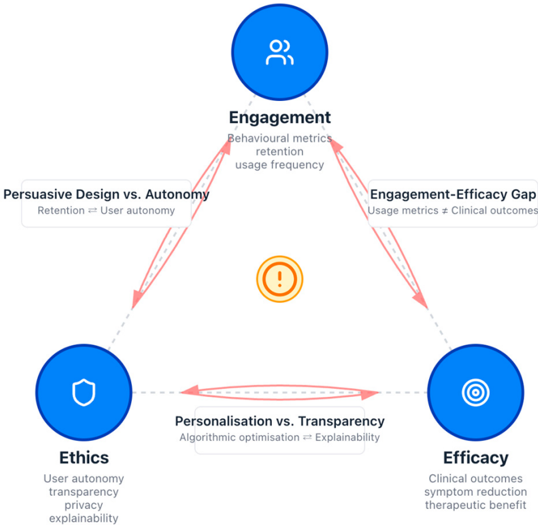
Digital Mental Health Interventions (DMHIs) offer a scalable solution to the global mental health crisis, yet their real-world impact is often hampered by low user engagement. Gamification has been widely adopted as a strategy to enhance adherence, but its implementation creates a complex and often unacknowledged “Engagement–Efficacy–Ethics Trilemma”. This systematic review synthesises the current literature to deconstruct this trilemma, arguing that an uncritical focus on maximising engagement can fail to improve—or may even undermine—clinical efficacy, while simultaneously introducing significant ethical risks. Our analysis reveals a persistent “Engagement–Efficacy Gap”, where increased usage of mobile health applications (mHealth apps) does not consistently translate to better therapeutic outcomes. Furthermore, we map the ethical landscape, identifying potential harms such as manipulation, psychological distress, and privacy violations that arise from persuasive design. The roles of Artificial Intelligence (AI) in personalising these experiences and Human–Computer Interaction (HCI) in mediating user responses are critically examined as key factors that both amplify and potentially mitigate the tensions of the trilemma. The findings indicate a pressing need for a paradigm shift toward an integrated approach that concurrently evaluates engagement, efficacy, and ethical integrity. We conclude by proposing a framework for responsible innovation, emphasising theory-driven design, co-design with users, and prioritising intrinsic motivation to harness the potential of gamified DMHIs safely and effectively. Following Preferred Reporting Items for Systematic Reviews and Meta-Analyses (PRISMA) guidelines, a systematic search was conducted across Scopus, Web of Science, MEDLINE, and PsycINFO for studies published between 2015 and 2025.
Overview
CoChat Summary
TL;DR
This systematic review of 50 studies uses a novel "Engagement–Efficacy–Ethics Trilemma" framework to argue that gamification in digital mental health interventions reliably boosts app engagement but does not consistently improve clinical outcomes, while introducing ethical risks such as manipulation, distress, and privacy violation. The authors call for a paradigm shift toward theory-driven, co-designed interventions that prioritise intrinsic motivation and evaluate engagement, efficacy, and ethics concurrently.
Key findings
- A persistent "Engagement–Efficacy Gap" exists: 35 of 50 studies reported gamification significantly enhanced engagement, motivation, and retention (e.g., the gamified app eQuoo retained 42% more participants than controls with 64.5% adherence), yet meta-analytic evidence found the number of gamification elements was not a significant predictor of efficacy (β = −0.03, ρ = 0.38) and did not significantly impact adherence (β = −1.93, ρ = 0.40); overall depressive symptom reduction was Hedges g = −0.27.
- Ethical concerns were raised in 22 of 50 studies, mapping engagement mechanics to harms including psychological distress (unattainable goals, leaderboards), cognitive manipulation, data exploitation/surveillance, behavioural addiction, and negative social comparison.
- AI acts as a "dual amplifier": personalisation and chatbots (e.g., Woebot, Wysa) may close the engagement–efficacy gap, but black-box algorithms, invasive data collection, and algorithmic bias intensify ethical tensions; Explainable AI is offered as a partial mitigator.
- HCI is positioned as the mediator where the trilemma is negotiated, with design choices (e.g., reflective mood journaling vs. emoji logging, moderated peer forums vs. competitive leaderboards) trading engagement against efficacy and ethics; 70% (35/50) of studies relied on extrinsic motivators such as rewards and progress tracking.
Methods
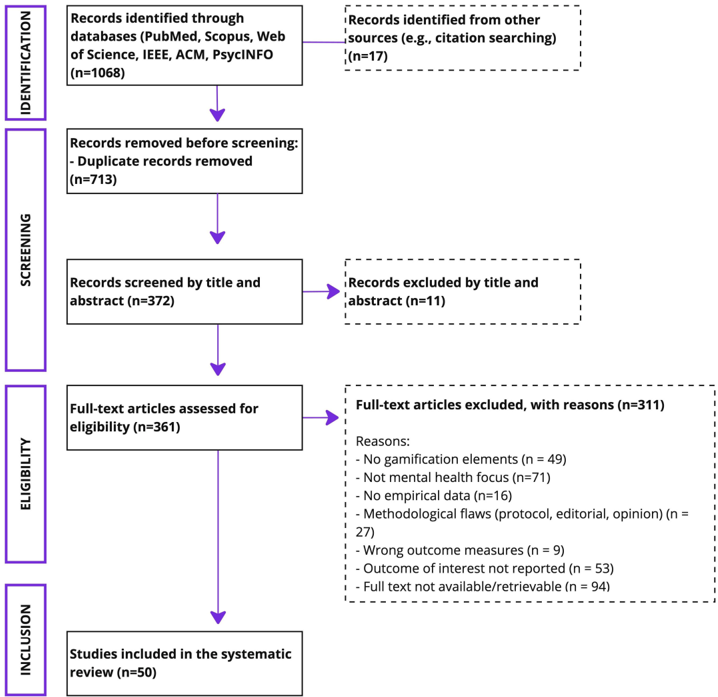
- Systematic review following PRISMA 2020 guidelines, with searches across Scopus, Web of Science, MEDLINE, and PsycINFO for studies published between January 2015 and June 2025.
- Inclusion required empirical studies, systematic reviews, or meta-analyses on gamified mental health interventions reporting engagement, efficacy, or ethics outcomes; exclusions removed conference abstracts, dissertations, grey literature, underpowered pilots, UX-only studies, and general wellness apps. This yielded 50 included studies.
- Studies were critically appraised with the Mixed Methods Appraisal Tool (MMAT 2018) and qualitatively coded across three dimensions (engagement, efficacy, ethics); the Trilemma framework emerged inductively from this synthesis. No new meta-analysis was performed — cited quantitative values are drawn from prior meta-analyses.
Limitations
- Stated by the paper: the field suffers from small sample sizes, heterogeneous methodologies and outcome measures, limited long-term/longitudinal data, geographic and cultural bias toward high-income Western contexts, insufficient ethical consideration, lack of standardised taxonomies, overreliance on self-report measures, limited focus on social/multiplayer features, underrepresentation of vulnerable groups, and technological constraints of emerging tools like VR.
- Stated by the paper: ethical discussions in the literature are often narrow, focused on research ethics rather than broader socio-political implications.
- Evident from the text: the review itself conducted no formal meta-analysis, so its quantitative claims rest on secondary citation of prior meta-analyses; the Trilemma is an inductively derived conceptual framework rather than an empirically validated model, and the authors note the field's conflicting results across diverse populations (addressed via an Analysis of Agreement and Divergence in Appendix E).
Model-written summary. Check it against the paper before relying on it.
Integrity signals
Registry
Cites
Statistics
Figures

Verification
Claims the paper makes
0 Valid · 17 Not valid · 128 Not checked · 82 Own results and interpretations
In the paper
“The most frequently cited ethical concern is the potential for psychological distress, which can manifest as stress from unattainable goals, anxiety from constant feedback, or demotivation from social comparison on leaderboards [25][26][27]29,30].”
§ Gamification in Digital Mental Health Interventions: A Systematic Review of the Engagement-Efficacy-Ethics Trilemma > 5. The Ethical Landscape: The Second Tension of the Trilemma
What the sources say
- Not matchedcites [25][26][27]29,30]
This doesn’t read as a citation we can look up.
plain- Asserted: passes — The authors put it forward as true.
- Checkable: passes — It can be checked against evidence.
- Load-bearing: passes — The paper’s conclusions depend on it.
- Based: passes — The paper gives a reason why it holds.
- Not matched
In the paper
“Meta-analyses and systematic reviews repeatedly find no significant difference in effectiveness for reducing symptoms of depression or anxiety between gamified and non-gamified apps [10].”
§ Gamification in Digital Mental Health Interventions: A Systematic Review of the Engagement-Efficacy-Ethics Trilemma > 4. The Engagement-Efficacy Gap: The First Tension of the Trilemma
What the sources say
- Not checked yetcites [10] Alzghoul, B. The Effectiveness of Gamification in Changing Health-related Behaviors: A Systematic Review and Meta-analysis. Open Public Health J. 2024, 17. [CrossRef] source
boosted- Asserted: passes — The authors put it forward as true.
- Checkable: passes — It can be checked against evidence.
- Load-bearing: passes — The paper’s conclusions depend on it.
- Based: passes — The paper gives a reason why it holds.
In the paper
“Behavioural Addiction/Compulsive Use Use of variable reward schedules and compelling feedback loops designed to maximise time-on-app rather than therapeutic benefit. [15]”
§ Gamification in Digital Mental Health Interventions: A Systematic Review of the Engagement-Efficacy-Ethics Trilemma > Behavioural Addiction/Compulsive Use
What the sources say
- Not checked yetcites [15] Coelho, L.; Reis, S.S. Ethical issues of gamification in healthcare: The need to be involved. In Handbook of Research on Solving Modern Healthcare Challenges with Gamification; IGI Global: Hershey, PA, USA, 2021; pp. 1-20. source
plainstates a cause- Asserted: passes — The authors put it forward as true.
- Checkable: passes — It can be checked against evidence.
- Load-bearing: passes — The paper’s conclusions depend on it.
- Based: passes — The paper gives a reason why it holds.
None of the sources cited for this claim have been checked yet.
In the paper
“This demonstrates a clear 'Engagement-Efficacy Gap' numerically: the presence of game mechanics does not statistically improve outcomes compared to non-gamified versions.”
§ Gamification in Digital Mental Health Interventions: A Systematic Review of the Engagement-Efficacy-Ethics Trilemma > 4. The Engagement-Efficacy Gap: The First Tension of the Trilemma
boosted- Asserted: passes — The authors put it forward as true.
- Checkable: passes — It can be checked against evidence.
- Load-bearing: passes — The paper’s conclusions depend on it.
- Based: passes — The paper gives a reason why it holds.
None of the sources cited for this claim have been checked yet.
In the paper
“A substantial portion of the reviewed literature (35 out of 50 studies) reports that gamification significantly enhances user engagement, motivation, and retention.”
§ Gamification in Digital Mental Health Interventions: A Systematic Review of the Engagement-Efficacy-Ethics Trilemma > 4. The Engagement-Efficacy Gap: The First Tension of the Trilemma
plainstates a cause- Asserted: passes — The authors put it forward as true.
- Checkable: passes — It can be checked against evidence.
- Load-bearing: passes — The paper’s conclusions depend on it.
- Based: passes — The paper gives a reason why it holds.
72 more claims
Create a free account to see all 227 claims and to verify the 276 references still open.
- It may state two separate claims as one. 108
- Probably not a substantial claim. 73
- The quote only partly states this claim. 3
Self-check
Percentages, sums and reported differences re-computed from the paper’s own numbers.
Each contradiction between two passages listed here was confirmed by an independent check.
Rated major: it would touch a result — a value a result rests on, reported and recomputed p-values on opposite sides of the significance level, two passages that conflict with no sign which is right, or a cited work retracted before this paper was published.
In the paper
§ Gamification in Digital Mental Health Interventions: A Systematic Review of the Engagement-Efficacy-Ethics Trilemma > 9. Conclusions
“The accumulated literature on gamification in digital mental health interventions reveals a compelling consensus that gamification enhances user engagement, boosts therapeutic efficacy, and offers novel opportunities for mental health promotion and treatment.”
§ Gamification in Digital Mental Health Interventions: A Systematic Review of the Engagement-Efficacy-Ethics Trilemma > 4. The Engagement-Efficacy Gap: The First Tension of the Trilemma
“Meta-analyses and systematic reviews repeatedly find no significant difference in effectiveness for reducing symptoms of depression or anxiety between gamified and non-gamified apps [10].”
Cited works that were retracted
Works this paper cites that were later retracted, from the retraction notices publishers deposit. Major when the notice came out before this paper was published.
Rated major: it would touch a result — a value a result rests on, reported and recomputed p-values on opposite sides of the significance level, two passages that conflict with no sign which is right, or a cited work retracted before this paper was published.
In the paper
“Castellano-Tejedor, C., and Cencerrado, A. (2024). Gamification for mental health and health psychology: Insights at the first quarter mark of the 21st century. Int. J. Environ. Res. Public Health, 21.”
Cited work 10.3390/ijerph21080990 · retracted 2024-07-28 · notice 10.3390/ijerph23050683 · this paper published 2026-02-06
Citations
Cites
1 retracted
Castellano-Tejedor, C., & Cencerrado, A. (2024) · International Journal of Environmental Research and Public Health · doi:10.3390/ijerph21080990 · Cited by 31
RetractedThe PRISMA 2020 statement: An updated guideline for reporting systematic reviews
Page, M. J., McKenzie, J. E., Bossuyt, P. M., Boutron, I., Hoffmann, T. C., Mulrow, C. D., Shamseer, L., Tetzlaff, J. M., Akl, E. A., Brennan, S. E., et al. (2021) · BMJ · doi:10.1136/bmj.n71 · Cited by 108,283
Ryan, R. M., & Deci, E. L. (2000) · American Psychologist · doi:10.1037//0003-066x.55.1.68 · Cited by 54,599
Revolutionizing healthcare: the role of artificial intelligence in clinical practice
Alowais, S. A., Alghamdi, S. S., Alsuhebany, N., Alqahtani, T., Alshaya, A. I., Almohareb, S. N., Aldairem, A., Alrashed, M., Bin Saleh, K., Badreldin, H. A., et al. (2023) · BMC Medical Education · doi:10.1186/s12909-023-04698-z · Cited by 3,146
A behavior model for persuasive design
Fogg, B. (2009) · Proceedings of the 4th International Conference on Persuasive Technology · doi:10.1145/1541948.1541999 · Cited by 2,328
Gamification for health and wellbeing: A systematic review of the literature
Johnson, D., Deterding, S., Kuhn, K.-A., Staneva, A., Stoyanov, S., & Hides, L. (2016) · Internet Interventions · doi:10.1016/j.invent.2016.10.002 · Cited by 1,237
Ethical and regulatory challenges of AI technologies in healthcare: A narrative review
Mennella, C., Maniscalco, U., De Pietro, G., & Esposito, M. (2024) · Heliyon · doi:10.1016/j.heliyon.2024.e26297 · Cited by 1,229
Malamed, C. (2012) · eLearn · doi:10.1145/2207270.2211316 · Cited by 1,104
Privacy and artificial intelligence: challenges for protecting health information in a new era
Murdoch, B. (2021) · BMC Medical Ethics · doi:10.1186/s12910-021-00687-3 · Cited by 991
Artificial intelligence for mental health and mental illnesses: an overview
Graham, S., Depp, C., Lee, E. E., Nebeker, C., Tu, X., Kim, H.-C., & Jeste, D. V. (2019) · Current Psychiatry Reports · doi:10.1007/s11920-019-1094-0 · Cited by 970
Bias in medical AI: Implications for clinical decision-making
Cross, J. L., Choma, M. A., & Onofrey, J. A. (2024) · PLOS Digital Health · doi:10.1371/journal.pdig.0000651 · Cited by 607
A Review of Explainable Artificial Intelligence in Healthcare
Sadeghi, Z., Alizadehsani, R., CIFCI, M. A., Kausar, S., Rehman, R., Mahanta, P., Bora, P. K., Almasri, A., Alkhawaldeh, R. S., Hussain, S., et al. (2024) · Computers and Electrical Engineering · doi:10.1016/j.compeleceng.2024.109370 · Cited by 598
Serious Games and Gamification for Mental Health: Current Status and Promising Directions
Fleming, T. M., Bavin, L., Stasiak, K., Hermansson-Webb, E., Merry, S. N., Cheek, C., Lucassen, M., Lau, H. M., Pollmuller, B., & Hetrick, S. (2017) · Frontiers in Psychiatry · doi:10.3389/fpsyt.2016.00215 · Cited by 582
Enhancing mental health with Artificial Intelligence: Current trends and future prospects
Olawade, D. B., Wada, O. Z., Odetayo, A., David-Olawade, A. C., Asaolu, F., & Eberhardt, J. (2024) · Journal of Medicine, Surgery, and Public Health · doi:10.1016/j.glmedi.2024.100099 · Cited by 514
Ethical implications of AI and robotics in healthcare: A review
Elendu, C., Amaechi, D. C., Elendu, T. C., Jingwa, K. A., Okoye, O. K., John Okah, M., Ladele, J. A., Farah, A. H., & Alimi, H. A. (2023) · Medicine · doi:10.1097/md.0000000000036671 · Cited by 370
Shaping the future of healthcare: ethical clinical challenges and pathways to trustworthy AI
Goktas, P., & Grzybowski, A. (2025) · Journal of Clinical Medicine · doi:10.3390/jcm14051605 · Cited by 336
Lau, H. M., Smit, J. H., Fleming, T. M., & Riper, H. (2017) · Frontiers in Psychiatry · doi:10.3389/fpsyt.2016.00209 · Cited by 328
Ethical and legal considerations in healthcare AI: innovation and policy for safe and fair use
Pham, T. (2025) · Royal Society Open Science · doi:10.1098/rsos.241873 · Cited by 261
Artificial intelligence in positive mental health: a narrative review
Thakkar, A., Gupta, A., & De Sousa, A. (2024) · Frontiers in Digital Health · doi:10.3389/fdgth.2024.1280235 · Cited by 251
Li, F., Ruijs, N., & Lu, Y. (2022) · AI · doi:10.3390/ai4010003 · Cited by 239
Exploring the Ethical Challenges of Conversational AI in Mental Health Care: Scoping Review
Rahsepar Meadi, M., Sillekens, T., Metselaar, S., van Balkom, A., Bernstein, J., & Batelaan, N. (2025) · JMIR Mental Health · doi:10.2196/60432 · Cited by 211
A Review on Explainable Artificial Intelligence for Healthcare: Why, How, and When?
Bharati, S., Mondal, M. R. H., & Podder, P. (2024) · IEEE Transactions on Artificial Intelligence · doi:10.1109/tai.2023.3266418 · Cited by 203
The application of artificial intelligence in the field of mental health: a systematic review
Dehbozorgi, R., Zangeneh, S., Khooshab, E., Nia, D. H., Hanif, H. R., Samian, P., Yousefi, M., Hashemi, F. H., Vakili, M., Jamalimoghadam, N., et al. (2025) · BMC Psychiatry · doi:10.1186/s12888-025-06483-2 · Cited by 193
Medical artificial intelligence ethics: A systematic review of empirical studies
Tang, L., Li, J., & Fantus, S. (2023) · DIGITAL HEALTH · doi:10.1177/20552076231186064 · Cited by 176
Digital privacy in mental healthcare: current issues and recommendations for technology use
Lustgarten, S. D., Garrison, Y. L., Sinnard, M. T., & Flynn, A. W. (2020) · Current Opinion in Psychology · doi:10.1016/j.copsyc.2020.03.012 · Cited by 175
Addressing algorithmic bias and the perpetuation of health inequities: An AI bias aware framework
Agarwal, R., Bjarnadottir, M., Rhue, L., Dugas, M., Crowley, K., Clark, J., & Gao, G. (2023) · Health Policy and Technology · doi:10.1016/j.hlpt.2022.100702 · Cited by 170
Saeidnia, H. R., Hashemi Fotami, S. G., Lund, B., & Ghiasi, N. (2024) · Social Sciences · doi:10.3390/socsci13070381 · Cited by 169
Operationalising ethics in artificial intelligence for healthcare: a framework for AI developers
Solanki, P., Grundy, J., & Hussain, W. (2023) · AI and Ethics · doi:10.1007/s43681-022-00195-z · Cited by 157
Human-Computer Interaction in Digital Mental Health
Balcombe, L., & De Leo, D. (2022) · Informatics · doi:10.3390/informatics9010014 · Cited by 120
A Review on Human–AI Interaction in Machine Learning and Insights for Medical Applications
Maadi, M., Akbarzadeh Khorshidi, H., & Aickelin, U. (2021) · International Journal of Environmental Research and Public Health · doi:10.3390/ijerph18042121 · Cited by 116
Pramana, G., Parmanto, B., Lomas, J., Lindhiem, O., Kendall, P. C., & Silk, J. (2018) · JMIR Serious Games · doi:10.2196/games.8902 · Cited by 113
Does the Digital Therapeutic Alliance Exist? Integrative Review
Malouin-Lachance, A., Capolupo, J., Laplante, C., & Hudon, A. (2025) · JMIR Mental Health · doi:10.2196/69294 · Cited by 103
The Promise of Explainable AI in Digital Health for Precision Medicine: A Systematic Review
Allen, B. (2024) · Journal of Personalized Medicine · doi:10.3390/jpm14030277 · Cited by 100
Six, S. G., Byrne, K. A., Tibbett, T. P., & Pericot-Valverde, I. (2021) · JMIR Mental Health · doi:10.2196/32199 · Cited by 95
Suharwardy, S., Ramachandran, M., Leonard, S. A., Gunaseelan, A., Lyell, D. J., Darcy, A., Robinson, A., & Judy, A. (2023) · AJOG Global Reports · doi:10.1016/j.xagr.2023.100165 · Cited by 93
Understanding persuasive software functionality in practice: a field trial of polar FT60
Harjumaa, M., Segerståhl, K., & B, H. O.-K. A. (2009) · International Conference on Persuasive Technology · doi:10.1145/1541948.1541952 · Cited by 78
The Role of AI in Serious Games and Gamification for Health: Scoping Review
Tolks, D., Schmidt, J. J., & Kuhn, S. (2024) · JMIR Serious Games · doi:10.2196/48258 · Cited by 72
Gamification: a Novel Approach to Mental Health Promotion
Cheng, C., & Ebrahimi, O. V. (2023) · Current Psychiatry Reports · doi:10.1007/s11920-023-01453-5 · Cited by 72
Birk, M. V., & Mandryk, R. L. (2019) · Journal of Medical Internet Research · doi:10.2196/10133 · Cited by 70
Jingili, N., Oyelere, S. S., Nyström, M. B. T., & Anyshchenko, L. (2023) · Frontiers in Digital Health · doi:10.3389/fdgth.2023.1239435 · Cited by 69
Human-Human vs Human-AI Therapy: An Empirical Study
Kuhail, M. A., Alturki, N., Thomas, J., Alkhalifa, A. K., & Alshardan, A. (2025) · International Journal of Human–Computer Interaction · doi:10.1080/10447318.2024.2385001 · Cited by 61
AI in Mental Health: A Review of Technological Advancements and Ethical Issues in Psychiatry
Poudel, U., Jakhar, S., Prakash, M., & Nepal, A. (2025) · Issues in Mental Health Nursing · doi:10.1080/01612840.2025.2502943 · Cited by 61
Zafar, F., Fakhare Alam, L., Vivas, R. R., Wang, J., Whei, S. J., Mehmood, S., Sadeghzadegan, A., Lakkimsetti, M., & Nazir, Z. (2024) · Cureus · doi:10.7759/cureus.56472 · Cited by 55
Gkintoni, E., Vantaraki, F., Skoulidi, C., Anastassopoulos, P., & Vantarakis, A. (2024) · Medicina · doi:10.3390/medicina60122085 · Cited by 54
Aschentrup, L., Steimer, P. A., Dadaczynski, K., Mc Call, T., Fischer, F., & Wrona, K. J. (2024) · BMC Public Health · doi:10.1186/s12889-023-17517-3 · Cited by 52
Unveiling Explainable AI in Healthcare: Current Trends, Challenges, and Future Directions
Noor, A. A., Manzoor, A., Mazhar Qureshi, M. D., Qureshi, M. A., & Rashwan, W. (2025) · WIREs Data Mining and Knowledge Discovery · doi:10.1002/widm.70018 · Cited by 52
Ethical considerations in the use of artificial intelligence in mental health
Warrier, U., Warrier, A., & Khandelwal, K. (2023) · The Egyptian Journal of Neurology, Psychiatry and Neurosurgery · doi:10.1186/s41983-023-00735-2 · Cited by 51
A meta-analysis of persuasive design, engagement, and efficacy in 92 RCTs of mental health apps
Valentine, L., Hinton, J. D. X., Bajaj, K., Boyd, L., O’Sullivan, S., Sorenson, R. P., Bell, I. H., Vega, M. S., Liu, P., Peters, W., et al. (2025) · npj Digital Medicine · doi:10.1038/s41746-025-01567-5 · Cited by 48
Litvin, S., Saunders, R., Jefferies, P., Seely, H., Pössel, P., & Lüttke, S. (2023) · JMIR Mental Health · doi:10.2196/47285 · Cited by 43
Lukka, L., & Palva, J. M. (2023) · JMIR Serious Games · doi:10.2196/42173 · Cited by 40
Ethics of Gamification in Health and Fitness-Tracking
Arora, C., & Razavian, M. (2021) · International Journal of Environmental Research and Public Health · doi:10.3390/ijerph182111052 · Cited by 40
Artificial intelligence-driven serious games in health care: scoping review
Abd-alrazaq, A., Abuelezz, I., Hassan, A., AlSammarraie, A., Alhuwail, D., Irshaidat, S., Abu Serhan, H., Ahmed, A., Alabed Alrazak, S., & Househ, M. (2022) · JMIR Serious Games · doi:10.2196/39840 · Cited by 39
Exploring the Role of Artificial Intelligence in Mental Healthcare: Progress, Pitfalls, and Promises
Espejo, G., Reiner, W., & Wenzinger, M. (2023) · Cureus · doi:10.7759/cureus.44748 · Cited by 35
HCI Contributions in Mental Health: A Modular Framework to Guide Psychosocial Intervention Design
Slovak, P., & Munson, S. A. (2024) · Proceedings of the CHI Conference on Human Factors in Computing Systems · doi:10.1145/3613904.3642624 · Cited by 34
Unveiling Explainable AI in Healthcare: Current Trends, Challenges, and Future Directions
Aziz, N. A., Manzoor, A., Mazhar Qureshi, M. D., Qureshi, M. A., & Rashwan, W. (2024) · doi:10.1101/2024.08.10.24311735 · Cited by 30
Bryant, B. R., Sisk, M. R., & McGuire, J. F. (2024) · JAMA Pediatrics · doi:10.1001/jamapediatrics.2024.3139 · Cited by 30
Spahl, W., Motta, V., Woodcock, K., & Rubeis, G. (2024) · JMIR Serious Games · doi:10.2196/64488 · Cited by 24
Smartphone-based serious games for mental health: a scoping review
Gómez-Cambronero, Á., Mann, A.-L., Mira, A., Doherty, G., & Casteleyn, S. (2024) · Multimedia Tools and Applications · doi:10.1007/s11042-024-18971-w · Cited by 22
Bantjes, J., Hunt, X., Cuijpers, P., Kazdin, A. E., Kennedy, C. J., Luedtke, A., Malenica, I., Petukhova, M., Sampson, N., Zainal, N. H., et al. (2024) · Behaviour Research and Therapy · doi:10.1016/j.brat.2024.104554 · Cited by 21
Alzghoul, B. (2024) · The Open Public Health Journal · doi:10.2174/0118749445234806240206094335 · Cited by 21
Isa, A. K. (2024) · World Journal of Advanced Research and Reviews · doi:10.30574/wjarr.2024.24.3.3997 · Cited by 21
Vindigni, G. (2023) · British Journal of Healthcare and Medical Research · doi:10.14738/bjhmr.103.14804 · Cited by 20
Collier, A. F., Hagemann, S., Trinidad, S. B., & Vigil-Hayes, M. (2023) · JMIR Formative Research · doi:10.2196/44926 · Cited by 16
Anvari, S. S., Hammer, J., & Wehbe, R. R. (2024) · Proceedings of the ACM on Human-Computer Interaction · doi:10.1145/3677090 · Cited by 13
Ethical Issues of Gamification in Healthcare: The Need to be Involved
Coelho, L., & Reis, S. (2021) · Advances in Medical Technologies and Clinical Practice · doi:10.4018/978-1-7998-7472-0.ch001 · Cited by 11
Amer, N. A., Abdelrazek, S., Eladrosy, W., El-Bakry, H., & Shohieb, S. M. (2024) · International Journal of Cognitive Therapy · doi:10.1007/s41811-024-00225-0 · Cited by 11
Sriwatanathamma, P., Sirivesmas, V., Simatrang, S., & Bhowmik, N. H. (2023) · JMIR Serious Games · doi:10.2196/41638 · Cited by 11
Unethical Gamification: A Literature Review
Al‐Msallam, S., Xi, N., & Hamari, J. (2023) · Proceedings of the Annual Hawaii International Conference on System Sciences · doi:10.24251/hicss.2023.136 · Cited by 11
Hewko, M., Gagnon Shaigetz, V., Smith, M. S., Kohlenberg, E., Ahmadi, P., Hernandez Hernandez, M. E., Proulx, C., Cabral, A., Segado, M., Chakrabarty, T., et al. (2025) · JMIR Serious Games · doi:10.2196/59514 · Cited by 10
Amo, V., Prentice, M., & Lieder, F. (2023) · JMIR Formative Research · doi:10.2196/44429 · Cited by 9
Varnfield, M., Rajesh, K., Redd, C., Gibson, S., Gwillim, L., & Polkinghorne, S. (2019) · 2019 41st Annual International Conference of the IEEE Engineering in Medicine and Biology Society (EMBC) · doi:10.1109/embc.2019.8857286 · Cited by 9
R Pozuelo, J., Nabulumba, C., Sikoti, D., Davis, M., Gumikiriza-Onoria, J. L., Kinyanda, E., Moffett, B., van Heerden, A., O'Mahen, H. A., Craske, M., et al. (2024) · JMIR Serious Games · doi:10.2196/59381 · Cited by 8
Amer, N. A., Shohieb, S. M., Eladrosy, W., Liu, S., Nam, Y., & Abdelrazek, S. (2024) · DIGITAL HEALTH · doi:10.1177/20552076241263317 · Cited by 8
Ethical Implications of Artificial Intelligence in the Healthcare Sector
Information Technology and Law Graduate Programme Ghana Institute of Management and Public Administration Greenhill, A., & Amedior, N. C. (2023) · Advances in Multidisciplinary and scientific Research Journal Publication · doi:10.22624/aims-/accrabespoke2023p1 · Cited by 8
The emergence of AI in mental health: A transformative journey
Dhiman, V. K. (2024) · World Journal of Advanced Research and Reviews · doi:10.30574/wjarr.2024.22.1.1298 · Cited by 8
Barkley, C., Nyakonda, C. N., Kuthyola, K., Ndlovu, P., Lee, D., Dallos, A., Kofi-Armah, D., Obeng, P., & Merrill, K. G. (2025) · International Journal of Environmental Research and Public Health · doi:10.3390/ijerph22081281 · Cited by 6
Pavarini, G., Reay, E., Crowe, E., Bhui, K., Fazel, M., Ma, M., Parker, M., & Smith, L. M. (2024) · doi:10.31219/osf.io/a6pvx · Cited by 6
Beyond algorithms: Ethical implications of AI in healthcare
Pathni, R. K. (2024) · Medical Journal Armed Forces India · doi:10.1016/j.mjafi.2024.10.014 · Cited by 5
Gordon, T. C., Kemp, A. H., & Edwards, D. J. (2024) · BMJ Open · doi:10.1136/bmjopen-2023-080972 · Cited by 4
Gamification and Retention in Mental Health Apps: Exploring the Role of User Engagement
Nagvanshi, S., Munshi, A., & Bhatnagar, S. (2025) · Addressing Practical Problems Through the Metaverse and Game-Inspired Mechanics · doi:10.4018/979-8-3693-8886-0.ch011 · Cited by 4
Exploring Gamification and Serious Games for Mental Health: A Narrative Review
M, A. E. V., Pricilla, S. E., Aishwarya, P. A. P., & Prasanth, K. (2024) · Cureus · doi:10.7759/cureus.74637 · Cited by 4
Zakaria, M. A. B., Hui, K. O., Subramaniam, H., Mat Rosly, M. B., Gill, J. S., En, L. Y., Sheng, Y. Z., Wong Joon Ip, J., Shanmugam, H., Soon Ken, C., et al. (2025) · Medicina · doi:10.3390/medicina61081404 · Cited by 3
Kapoor, U. (2025) · Addressing Practical Problems Through the Metaverse and Game-Inspired Mechanics · doi:10.4018/979-8-3693-8886-0.ch009 · Cited by 3
Sabbar, M. B., Davison, R., & Ushaw, G. (2025) · 2025 11th International Conference on Virtual Reality (ICVR) · doi:10.1109/icvr66534.2025.11172507 · Cited by 3
Lei, X. (2025) · Communications in Humanities Research · doi:10.54254/2753-7064/2025.ht26261 · Cited by 3
Quiet Pandemic Amid COVID-19: A literature review on gamification for mental health
Tayal, S., & Rajagopal, K. (2024) · Asia Pacific Journal of Health Management · doi:10.24083/apjhm.v19i2.3129 · Cited by 3
Potential Adverse Effects Caused by Gamification Elements in mHealth Apps
Rocha, I., & Silveira, M. S. (2024) · Journal of the Brazilian Computer Society · doi:10.5753/jbcs.2024.4310 · Cited by 2
Colton, E., McLean, C. P., Anderson, A. C., Hanegraaf, L., & Verdejo-García, A. (2026) · JMIR Serious Games · doi:10.2196/79784 · Cited by 2
Coelho, F., & Abreu, A. M. (2025) · 2025 IEEE Conference on Serious Games and Applications for Health (SeGAH) · doi:10.1109/segah65397.2025.11168435 · Cited by 2
Evaluating gamified interventions in healthcarepractice
Tera, T., Kelvin, K., & Tobiloba, B. (2024) · doi:10.31234/osf.io/z94eh · Cited by 2
Conducting Ethical Research with a Game-Based Intervention for Groups at Risk of Social Exclusion
Dunwell, I. (2012) · Lecture Notes in Computer Science · doi:10.1007/978-3-642-33542-6_79 · Cited by 2
Colton, E., Anderson, A., Hanegraaf, L., & Verdejo-Garcia, A. (2025) · doi:10.2196/preprints.79784 · Cited by 1
Barkley, C., Nyakonda, C. N., Kuthyola, K., Lee, D., Kofi-Armah, D., Obeng, P., Dallos, A., Ndlovu, P., & Merrill, K. (2025) · doi:10.2196/preprints.77524 · Cited by 1
Improving Student Mental Health Through Health Objectives in a Mobile App
Vinogradov, M., Chang, M., Lin, F., & Yan, Y. (2023) · Communications in Computer and Information Science · doi:10.1007/978-3-031-29548-5_8 · Cited by 1
Serious Games for Improving Mental Health: Status and Prospects
Huang, Y. (2024) · Lecture Notes in Education Psychology and Public Media · doi:10.54254/2753-7048/64/20240990 · Cited by 1
Bryant, B. R., Sisk, M. R., & McGuire, J. F. (2023) · Journal of the American Academy of Child & Adolescent Psychiatry · doi:10.1016/j.jaac.2023.09.143 · Cited by 1
Research works printed but not linked: 1
- Sticksen, D.; Prasad, P. AI and Mental Health: Reviewing the Landscape of Diagnosis, Therapy, and Digital Interventions; Alpha Press: Orlando, FL, USA, 2025.
Cited by
Big tech, the state, or you? Who is responsible for generative AI addiction?
Stahl, B. C., Ali, R., Hitcham, L., Liebherr, M., Murray, R., Vallejos, E. P., & Yankouskaya, A. (2026) · Behaviour and Information Technology · doi:10.1080/0144929x.2026.2663509 · Cited by 3
Mohiyeddini, C. (2026) · Frontiers in Medicine · doi:10.3389/fmed.2026.1810141 · Cited by 2
Han, E. K. L., Crane, L., & Woodcock, K. A. (2026) · Research Square · doi:10.21203/rs.3.rs-11086865/v1
Evaluating user enjoyment, engagement, and intention to play in edugames4all MicrobeQuest!
Molnar, A., & Kostkova, P. (2026) · Frontiers in Public Health · doi:10.3389/fpubh.2026.1789009
Marisa, ., Mutiara, G. A., Dewi, D. A., Ahmad, S. S. S., Noertjahyana, A., & Mauka, A. L. (2026) · International journal of intelligent engineering and systems · doi:10.22266/ijies2026.0630.31
Metadata
- Authors
- Ngabo-Woods, H., Dunai, L., Verdú, I. S., & Tîrșu, V.
- Affiliations
- Universitat Politècnica de València (ES)
- Technical University of Moldova (MD)
- Corresponding author
- Dunai, Larisa
- Venue
- Information
- Publisher
- MDPI AG
- Published
- 2026-02-06
- Volume
- 17
- Issue
- 2
- Pages
- 168
- ISSN
- 2078-2489 (ISSN-L)
- OpenAlex
- W7128157454
- Cited by
- 7
- References
- 92
- Citations by year
- 2026: 7
- FWCI
- 4.47
- Type
- journal article
- Language
- en
- Open access
- gold
- doi.org
- Licence
- Locations
- Information (publishedVersion, cc-by)
- DOAJ (DOAJ: Directory of Open Access Journals) (submittedVersion)
- Topics
- Social Sciences › Psychology › Applied Psychology › Digital Mental Health Interventions
- Social Sciences › Psychology › Developmental and Educational Psychology › Educational Games and Gamification
- Health Sciences › Health Professions › General Health Professions › Mobile Health and mHealth Applications
- Keywords
- gamification, digital mental health interventions, user engagement, clinical efficacy, ethical risks, persuasive design, mobile health apps, human-computer interaction, responsible innovation, co-design, intrinsic motivation, manipulation, privacy violations, psychological distress
About these checks
Registry, retraction, Cites and statistics results are computed, not judged, with one exception: a printed reference that no index lists is read once by a model before it counts as a citation error. Claims are extracted by a model and kept only when their quote appears verbatim in the text; each cited source is then checked, with a model’s help, for whether it says what the claim relies on. Those verdicts can be wrong — read the claim’s quote and the cited source before relying on one.
A language model drew the claims from the paper on 2026-11-23, under version 3 of the claim definition (model deepseek-v4.1-flash, prompt extract-v3).
A second model labelled each claim on 2026-11-23 (model jev-1.13-20260917, definition revision gold-guideline-v0.2).
Statistics and arithmetic are recomputed, not judged.
Confidence bands are shown only for fields calibrated on our annotated test set. None is calibrated yet, so no band is shown.
What counts as a claim ›How we measure confidence ›How we check this ›
Are you an author, or do you see a problem with this page? Request a review
Data sources
Bibliographic data: Semantic Scholar, OpenAlex, Crossref.
Contains information from the Semantic Scholar Academic Graph Datasets, made available under the ODC Attribution License (ODC-BY 1.0).
Semantic Scholar’s data is described in: Kinney, R., et al. (2023). The Semantic Scholar Open Data Platform. arXiv:2301.10140.
