

Virtual Reality Interventions for Needle-Related Procedural Pain, Fear and Anxiety—A Systematic Review and Meta-Analysis
Open accessThe DOI matches its Crossref record; 62 of the 63 references it cites were found in a registry or an index, and 1 are not checked yet.
Abstract
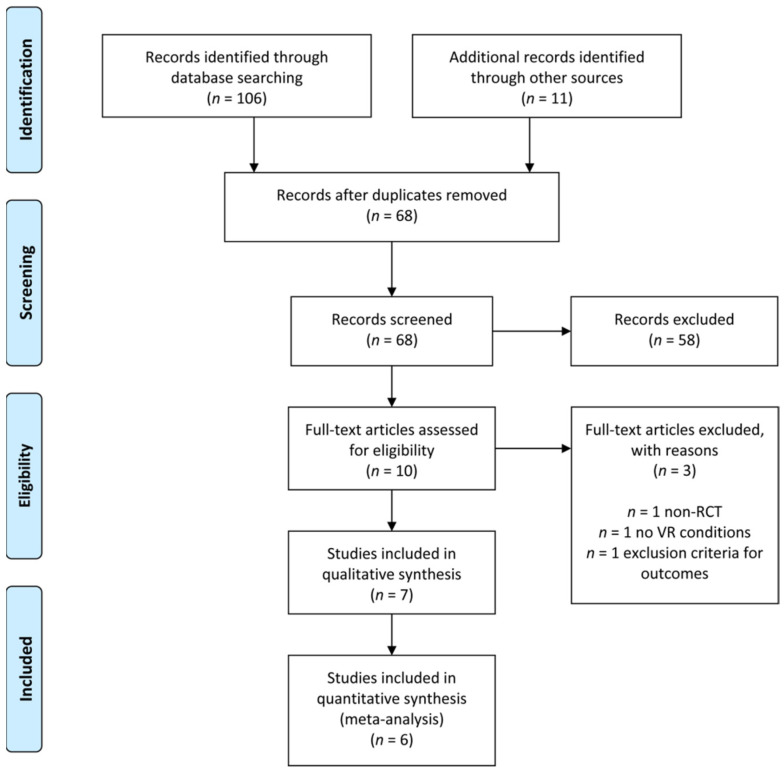
Needle-related procedures are often a source of pain, anxiety and fear in young patients. This systematic review aimed to investigate the effectiveness of virtual reality (VR) on reducing pain, fear and anxiety in pediatric patients undergoing needle-related procedures. Pain, anxiety, fear, changes in blood pressure and heart rate as well as satisfaction were evaluated as outcomes during needle-related procedures in VR compared with standard care conditions. A meta-analysis was performed, taking into account online databases. Two authors independently conducted literature searches in December 2020. The last search was conducted in March 2021 from a total of 106 records, 7 met our inclusion criteria. One study was excluded from the meta-analysis due to insufficient data. VR was applied as a distractor during venous access. Statistically significant benefits of using VR were shown in children’s pain scores, where VR significantly decreased symptoms (n = 3204 patients, MD = −2.85; 95% CI −3.57, −2.14, for the Wong–Baker Faces Pain Rating Scale and n = 2240 patients, MD = −0.19; 95% CI −0.58, 0.20, for the Faces Pain Scale—Revised). The analysis of fear, anxiety and satisfaction scores revealed no significant differences between the conditions, as the studies were too heterogeneous to be pooled. Distraction using virtual reality may be an effective intervention for reducing pain in children undergoing needle-related medical procedures. However, further research in the implementation of VR as a distractor for children and adolescents is required, due to the limited research into this field.
Overview
The claims and statistics of this paper haven’t been checked yet.
Free: it reads the open-access text and checks the first 5 claims that cite a source we can check. Create a free account to check every claim.
Integrity signals
Registry
Cites
Statistics
Figures





Verification
Claims the paper makes
The claims and statistics of this paper haven’t been checked yet.
Free: it reads the open-access text and checks the first 5 claims that cite a source we can check. Create a free account to check every claim.
Claims other papers make about this one
Each is checked against this paper’s own text: does it say what the citing paper says it does?
The cited source says what the claim attributes to it.
In the citing paper
“VR is a non-pharmacological pain relief method that helps reduce pain perception by diverting the patient’s attention.”
From A Pilot Study of Virtual Reality in Hemodialysis for Mitigating Pain and Anxiety: User Experiences and Perceptions (2025) · cites this paper as [24]
Self-check
Percentages, sums and reported differences re-computed from the paper’s own numbers.
The self-check needs the paper’s full text.
Citations
Cites
1 retracted
López-Valverde, N., Fernández, J. M., López‐Valverde, A., Juan, L. F. V., Ramírez, J. M., Fraile, J. F., Payo, J. H., Antona, L. B., de Sousa, B. M., & Bravo, M. (2020) · Journal of Clinical Medicine · doi:10.3390/jcm9041025 · Cited by 46
RetractedPreferred Reporting Items for Systematic Reviews and Meta-Analyses: the PRISMA statement
Moher, D., Liberati, A., Tetzlaff, J., Altman, D. G., & for the PRISMA Group (2009) · BMJ · doi:10.1136/bmj.b2535 · Cited by 83,823
Statistical power analysis for the behavioral sciences
(1990) · Computers, Environment and Urban Systems · doi:10.1016/0198-9715(90)90050-4 · Cited by 65,269
The Cochrane Collaboration's tool for assessing risk of bias in randomised trials
Higgins, J. P. T., Altman, D. G., Gotzsche, P. C., Juni, P., Moher, D., Oxman, A. D., Savovic, J., Schulz, K. F., Weeks, L., Sterne, J. A. C., et al. (2011) · BMJ · doi:10.1136/bmj.d5928 · Cited by 33,817
Statistical Power Analysis for the Behavioral Sciences
Cohen, J. (2013) · doi:10.4324/9780203771587 · Cited by 25,373
Dermyshi, E., Wang, Y., Yan, C., Hong, W., Qiu, G., Gong, X., & Zhang, T. (2017) · Neonatology · doi:10.1159/000454668 · Cited by 24,451
Preferred reporting items for systematic reviews and meta-analyses: The PRISMA statement
Moher, D., Liberati, A., Tetzlaff, J., & Altman, D. G. (2010) · International Journal of Surgery · doi:10.1016/j.ijsu.2010.02.007 · Cited by 12,156
Waddell, G., Newton, M., Henderson, I., Somerville, D., & Main, C. J. (1993) · Pain · doi:10.1016/0304-3959(93)90127-b · Cited by 3,167
Estimating effect sizes from pretest-posttest-control group designs
Morris, S. B. (2008) · Organizational Research Methods · doi:10.1177/1094428106291059 · Cited by 2,133
Virtual reality for stroke rehabilitation
Laver, K. E., George, S., Thomas, S., Deutsch, J. E., & Crotty, M. (2015) · Cochrane Database of Systematic Reviews · doi:10.1002/14651858.cd008349.pub3 · Cited by 1,131
Cited by
Mazgelytė, E., Rekienė, V., Dereškevičiūtė, E., Petrėnas, T., Songailienė, J., Utkus, A., Chomentauskas, G., & Karčiauskaitė, D. (2021) · Healthcare · doi:10.3390/healthcare9121729 · Cited by 76
“Recently published meta-analysis showed that VR technique was superior to the standard care methods in decreasing pain scores in the pediatric population exposed to needle-related medical procedures [17].”
BackgroundMethodRutkowski, S., Czech, O., Wrzeciono, A., Kiper, P., Szczepańska-Gieracha, J., & Malicka, I. (2021) · Complementary Therapies in Medicine · doi:10.1016/j.ctim.2021.102767 · Cited by 73
Self-citationWang, Y., Guo, L., & Xiong, X. (2022) · Frontiers in Psychology · doi:10.3389/fpsyg.2022.842847 · Cited by 58
“A recent meta-analysis attempted to analyze seven VR studies but could not demonstrate an advantage of VR because the studies were too heterogeneous to be pooled (Czech et al., 2021).”
MethodA New Virtual World? The Future of Immersive Environments in Anesthesiology
Alam, F., & Matava, C. T. (2022) · Anesthesia & Analgesia · doi:10.1213/ane.0000000000006118 · Cited by 55
Development of an Empathy-Centric Counseling Chatbot System Capable of Sentimental Dialogue Analysis
Trappey, A. J. C., Lin, A. P. C., Hsu, K. Y. K., Trappey, C. V., & Tu, K. L. K. (2022) · Processes · doi:10.3390/pr10050930 · Cited by 49
“In addition, other research performed meta-analyses and found that VR can be used as an effective intervention to distract patients with needle-related surgery and relieve pain in children [24].”
Metadata
- Authors
- Czech, O., Wrzeciono, A., Rutkowska, A., Guzik, A., Kiper, P., & Rutkowski, S.
- Affiliations
- Opole University of Technology (PL)
- University of Rzeszów (PL)
- Physical Medicine and Rehabilitation Unit, Azienda ULSS 3 Serenissima, 30126 Venice, Italy
- Corresponding author
- Rutkowski, Sebastian
- Venue
- Journal of Clinical Medicine
- Publisher
- MDPI AG
- Published
- 2021-07-23
- Volume
- 10
- Issue
- 15
- Pages
- 3248
- ISSN
- 2077-0383 (ISSN-L)
- PMC
- PMC8347054
- OpenAlex
- W3186317448
- Cited by
- 151
- References
- 62
- Citations by year
- 2026: 21 · 2025: 64 · 2024: 27 · 2023: 19 · 2022: 16 · 2021: 4
- FWCI
- 4.00
- Type
- journal article
- Language
- en
- Open access
- gold
- doi.org
- Licence
- Locations
- Journal of Clinical Medicine (publishedVersion, cc-by)
- PubMed Central (publishedVersion, cc-by)
- PubMed (publishedVersion)
- DOAJ (DOAJ: Directory of Open Access Journals) (submittedVersion, cc-by-sa)
- Funders
- European Respiratory Society
- Lloyd's Tercentenary Research Foundation
- Topics
- Health Sciences › Medicine › Pediatrics, Perinatology and Child Health › Pediatric Pain Management Techniques
- Physical Sciences › Computer Science › Human-Computer Interaction › Virtual Reality Applications and Impacts
- Health Sciences › Dentistry › Oral Surgery › Dental Anxiety and Anesthesia Techniques
- Keywords
- virtual reality, distraction therapy, procedural pain, needle-related procedures, pediatric patients, fear, anxiety, venous access, blood pressure, heart rate, patient satisfaction
About these checks
Registry, retraction, Cites and statistics results are computed, not judged, with one exception: a printed reference that no index lists is read once by a model before it counts as a citation error. Claims are extracted by a model and kept only when their quote appears verbatim in the text; each cited source is then checked, with a model’s help, for whether it says what the claim relies on. Those verdicts can be wrong — read the claim’s quote and the cited source before relying on one.
Statistics and arithmetic are recomputed, not judged.
Confidence bands are shown only for fields calibrated on our annotated test set. None is calibrated yet, so no band is shown.
What counts as a claim ›How we measure confidence ›How we check this ›
Are you an author, or do you see a problem with this page? Request a review
Data sources
Bibliographic data: Semantic Scholar, OpenAlex, Crossref.
Contains information from the Semantic Scholar Academic Graph Datasets, made available under the ODC Attribution License (ODC-BY 1.0).
Semantic Scholar’s data is described in: Kinney, R., et al. (2023). The Semantic Scholar Open Data Platform. arXiv:2301.10140.
