

Anti-Aspergillus Activities of the Respiratory Epithelium in Health and Disease
Open accessThe DOI matches its Crossref record; 84 of the 85 references it cites were found in a registry or an index.
Abstract
Respiratory epithelia fulfil multiple roles beyond that of gaseous exchange, also acting as primary custodians of lung sterility and inflammatory homeostasis. Inhaled fungal spores pose a continual antigenic, and potentially pathogenic, challenge to lung integrity against which the human respiratory mucosa has developed various tolerance and defence strategies. However, respiratory disease and immune dysfunction frequently render the human lung susceptible to fungal diseases, the most common of which are the aspergilloses, a group of syndromes caused by inhaled spores of Aspergillus fumigatus. Inhaled Aspergillus spores enter into a multiplicity of interactions with respiratory epithelia, the mechanistic bases of which are only just becoming recognized as important drivers of disease, as well as possible therapeutic targets. In this mini-review we examine current understanding of Aspergillus-epithelial interactions and, based upon the very latest developments in the field, we explore two apparently opposing schools of thought which view epithelial uptake of Aspergillus spores as either a curative or disease-exacerbating event.
Overview
The claims and statistics of this paper haven’t been checked yet.
Free: it reads the open-access text and checks the first 5 claims that cite a source we can check. Create a free account to check every claim.
Integrity signals
Registry
Cites
Statistics
Figures
Verification
Claims the paper makes
The claims and statistics of this paper haven’t been checked yet.
Free: it reads the open-access text and checks the first 5 claims that cite a source we can check. Create a free account to check every claim.
Claims other papers make about this one
Each is checked against this paper’s own text: does it say what the citing paper says it does?
The cited source says what the claim attributes to it.
In the citing paper
“Lung epithelia comprise the first line of host defense during interaction with Aspergillus (212, 213).”
From Aspergillus fumigatus and Aspergillosis in 2019 (2019) · cites this paper as [213]
Self-check
Percentages, sums and reported differences re-computed from the paper’s own numbers.
The self-check needs the paper’s full text.
Citations
Cites
Hidden Killers: Human Fungal Infections
Brown, G. D., Denning, D. W., Gow, N. A. R., Levitz, S. M., Netea, M. G., & White, T. C. (2012) · Science Translational Medicine · doi:10.1126/scitranslmed.3004404 · Cited by 4,284 · cited 1×
“Aspergillus-related diseases occur frequently in the human population and pathological outcomes are diverse [1].”
BackgroundSelf-citationSurface hydrophobin prevents immune recognition of airborne fungal spores
Aimanianda, V., Bayry, J., Bozza, S., Kniemeyer, O., Perruccio, K., Elluru, S. R., Clavaud, C., Paris, S., Brakhage, A. A., Kaveri, S. V., et al. (2009) · Nature · doi:10.1038/nature08264 · Cited by 792 · cited 2×
“In the context of healthy defence against inhaled fungal spores, RodA is argued as being a facilitator of immune evasion at the earliest of time points following spore inhalation [46].”
BackgroundInfluentialGravelat, F. N., Beauvais, A., Liu, H., Lee, M. J., Snarr, B. D., Chen, D., Xu, W., Kravtsov, I., Hoareau, C. M. Q., Vanier, G., et al. (2013) · PLoS Pathogens · doi:10.1371/journal.ppat.1003575 · Cited by 320 · cited 13×
“Deletion of agd3 attenuates A. fumigatus virulence in a leukopenic mouse model of invasive aspergillosis, demonstrating that deacetylation of GAG is required for full virulence of A. fumigatus [54].”
BackgroundInfluentialCunha, C., Di Ianni, M., Bozza, S., Giovannini, G., Zagarella, S., Zelante, T., D'Angelo, C., Pierini, A., Pitzurra, L., Falzetti, F., et al. (2010) · Blood · doi:10.1182/blood-2010-04-279307 · Cited by 286 · cited 11×
“Supporting a role for Dectin-1 in mediating curative spore clearance in vivo a high risk of invasive pulmonary aspergillosis has been reported in hematopoietic stem cell transplantees carrying a non-functional truncated version of Dectin-1 [59].”
BackgroundInfluentialSugui, J. A., Pardo, J., Chang, Y. C., Zarember, K. A., Nardone, G., Galvez, E. M., Müllbacher, A., Gallin, J. I., Simon, M. M., & Kwon-Chung, K. J. (2007) · Eukaryotic Cell · doi:10.1128/ec.00141-07 · Cited by 242 · cited 1×
“Abolition of Gt biosynthesis by deletion of GliP, encoding the Gt peptide synthase, strongly reduces the cytotoxic activity of culture filtrates and results in attenuated virulence in infected non-neutropenic mice [81,82].”
BackgroundGalactosaminogalactan, a New Immunosuppressive Polysaccharide of Aspergillus fumigatus
Fontaine, T., Delangle, A., Simenel, C., Coddeville, B., van Vliet, S. J., van Kooyk, Y., Bozza, S., Moretti, S., Schwarz, F., Trichot, C., et al. (2011) · PLoS Pathogens · doi:10.1371/journal.ppat.1002372 · Cited by 241 · cited 1×
“GAG is a heteroglycan composed of galactose and N-acetyl-galactosamine (GalNAc), produced by hyphae but not conidia [52], via the activity of the fungal epimerase Uge3.”
BackgroundConidial Hydrophobins of Aspergillus fumigatus
Paris, S., Debeaupuis, J.-P., Crameri, R., Carey, M., Charlès, F., Prévost, M. C., Schmitt, C., Philippe, B., & Latgé, J. P. (2003) · Applied and Environmental Microbiology · doi:10.1128/aem.69.3.1581-1588.2003 · Cited by 235 · cited 1×
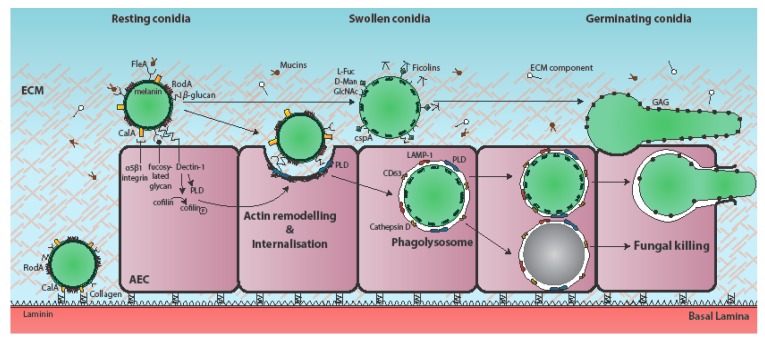
“fumigatus spores immunologically inert, but is shed from the spore surface during germination, is required for adherence to collagen, but not to A549 cells or other basement membrane components, such as laminin and fibronectin [24] (Figure 1).”
BackgroundSeidler, M. J., Salvenmoser, S., & Müller, F.-M. C. (2008) · Antimicrobial Agents and Chemotherapy · doi:10.1128/aac.00234-08 · Cited by 229 · cited 1×
“Although the propensity to form biofilms is not hindered by co-culture with human bronchial epithelial cells [86], too few intact epithelial cells remain after 2–3 days of co-culture to promote the study of the host-pathogen interaction over a sustained period of time.”
BackgroundAspergillus Cell Wall Melanin Blocks LC3-Associated Phagocytosis to Promote Pathogenicity
Akoumianaki, T., Kyrmizi, I., Valsecchi, I., Gresnigt, M. S., Samonis, G., Drakos, E., Boumpas, D., Muszkieta, L., Prevost, M.-C., Kontoyiannis, D. P., et al. (2016) · Cell Host & Microbe · doi:10.1016/j.chom.2015.12.002 · Cited by 218 · cited 1×
“fumigatus conidia and, in particular, cell wall melanin removal during germination, is required for the activation of a specialized autophagy pathway called LC3-associated phagocytosis (LAP) which ultimately results in fungal killing [65,66].”
BackgroundTomee, J. F. C., Wierenga, A. T. J., Hiemstra, P. S., & Kauffman, H. F. (1997) · The Journal of Infectious Diseases · doi:10.1086/517272 · Cited by 201 · cited 1×
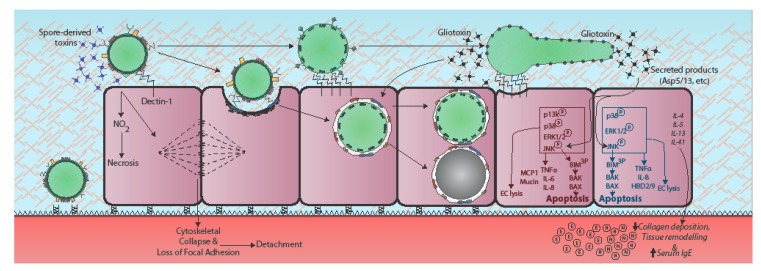
“fumigatus culture filtrate for 48 h is also abrogated by treating with serine protease inhibitors [71] (Figure 2).”
Background
Research works printed but not linked: 1
- Zheng J. Zuo J. Han Y. Zhang L. Yan L. Shen L. Jiang Y. Cao Y. Zhao J. Gliotoxin produced by Aspergillus fumigatus induces apoptosis of human bronchial epithelial cells via the Bcl-2 pathway Int. J. Clin. Exp. Med. 2017 10 12
Cited by
Aspergillus fumigatus and Aspergillosis in 2019
Latgé, J.-P., & Chamilos, G. (2019) · Clinical Microbiology Reviews · doi:10.1128/cmr.00140-18 · Cited by 1,400
Pathogenesis of Respiratory Viral and Fungal Coinfections
Salazar, F., Bignell, E., Brown, G. D., Cook, P. C., & Warris, A. (2021) · Clinical Microbiology Reviews · doi:10.1128/cmr.00094-21 · Cited by 178
“infection [206]) could facilitate fungal adhesion to the basal lamina (175, 207).”
BackgroundSelf-citationPathophysiological aspects of Aspergillus colonization in disease
Gago, S., Denning, D. W., & Bowyer, P. (2018) · Medical Mycology · doi:10.1093/mmy/myy076 · Cited by 135
Self-citationvan Rhijn, N., & Bromley, M. (2021) · Journal of Fungi · doi:10.3390/jof7050367 · Cited by 132
“When this barrier is damaged, spores which would ordinarily be cleared before they shed their immunoprotective outer coat [71], have the opportunity to swell and germinate, releasing a payload of allergenic proteins.”
BackgroundPathogenicity and virulence of Aspergillus fumigatus
Earle, K., Valero, C., Conn, D. P., Vere, G., Cook, P. C., Bromley, M., Bowyer, P., & Gago, S. (2023) · Virulence · doi:10.1080/21505594.2023.2172264 · Cited by 132
“Indeed, this is the case for SARS-CoV-2, where infection has been shown to alter the expression of ECM components like collagen, fibronectin, and laminin, which could promote A. fumigatus conidial adhesion [204,436].”
BackgroundMethod
Metadata
- Authors
- Bertuzzi, M., Hayes, G., Icheoku, U., Van Rhijn, N., Denning, D., Osherov, N., & Bignell, E.
- Affiliations
- University of Manchester (GB)
- North Devon District Hospital (GB)
- Manchester Fungal Infection Group, Faculty of Biology, Medicine and Health, University of Manchester, Manchester M13 9NT, UK
- Manchester University NHS Foundation Trust (GB)
- Tel Aviv University (IL)
- Corresponding author
- Bignell, Elaine
- Venue
- Journal of Fungi
- Publisher
- MDPI AG
- Published
- 2018-01-08
- Volume
- 4
- Issue
- 1
- Pages
- 8
- ISSN
- 2309-608X (ISSN-L)
- PMC
- PMC5872311
- OpenAlex
- W2782834892
- Cited by
- 64
- References
- 85
- Citations by year
- 2026: 2 · 2025: 4 · 2024: 8 · 2023: 8 · 2022: 11 · 2021: 13 · 2020: 4 · 2019: 8 · 2018: 5
- FWCI
- 1.10
- Type
- journal article
- Language
- en
- Open access
- gold
- doi.org
- Licence
- Locations
- Journal of Fungi (publishedVersion, cc-by)
- Europe PMC (PubMed Central) (publishedVersion, cc-by)
- PubMed Central (publishedVersion, cc-by)
- PubMed (publishedVersion)
- DOAJ (DOAJ: Directory of Open Access Journals) (submittedVersion, cc-by-sa)
- Research Explorer (The University of Manchester) (submittedVersion, cc-by)
- Funders
- Medical Research Council (G0501164, MR/L000822/1, MR/M02010X/1)
- Biotechnology and Biological Sciences Research Council (BB/G009619/1)
- Wellcome Trust (WT093596MA)
- Imperial College London (Division of Investigative Sciences PhD Studentships)
- Wellcome Trust Strategic Award (097377/Z/11/Z)
- BBSRC Doctoral Training Programme (BB/M011208/1)
- Israel Science Foundation (ISF No. 1347/14)
- Topics
- Health Sciences › Medicine › Infectious Diseases › Antifungal resistance and susceptibility
- Health Sciences › Medicine › Pulmonary and Respiratory Medicine › Asthma and respiratory diseases
- Life Sciences › Biochemistry, Genetics and Molecular Biology › Molecular Biology › Fungal and yeast genetics research
- Keywords
- Aspergillus fumigatus, aspergillosis, respiratory epithelium, fungal pathogenesis, lung inflammation, antifungal immunity
About these checks
Registry, retraction, Cites and statistics results are computed, not judged, with one exception: a printed reference that no index lists is read once by a model before it counts as a citation error. Claims are extracted by a model and kept only when their quote appears verbatim in the text; each cited source is then checked, with a model’s help, for whether it says what the claim relies on. Those verdicts can be wrong — read the claim’s quote and the cited source before relying on one.
Statistics and arithmetic are recomputed, not judged.
Confidence bands are shown only for fields calibrated on our annotated test set. None is calibrated yet, so no band is shown.
What counts as a claim ›How we measure confidence ›How we check this ›
Are you an author, or do you see a problem with this page? Request a review
Data sources
Bibliographic data: Semantic Scholar, OpenAlex, Crossref.
Contains information from the Semantic Scholar Academic Graph Datasets, made available under the ODC Attribution License (ODC-BY 1.0).
Semantic Scholar’s data is described in: Kinney, R., et al. (2023). The Semantic Scholar Open Data Platform. arXiv:2301.10140.
