

The DOI matches its Crossref record; 5 of the 5 references it cites were found in a registry or an index.
The Effects of Assumed AI vs. Human Authorship on the Perception of a GPT-Generated Text
Published version of a preprint
Abstract
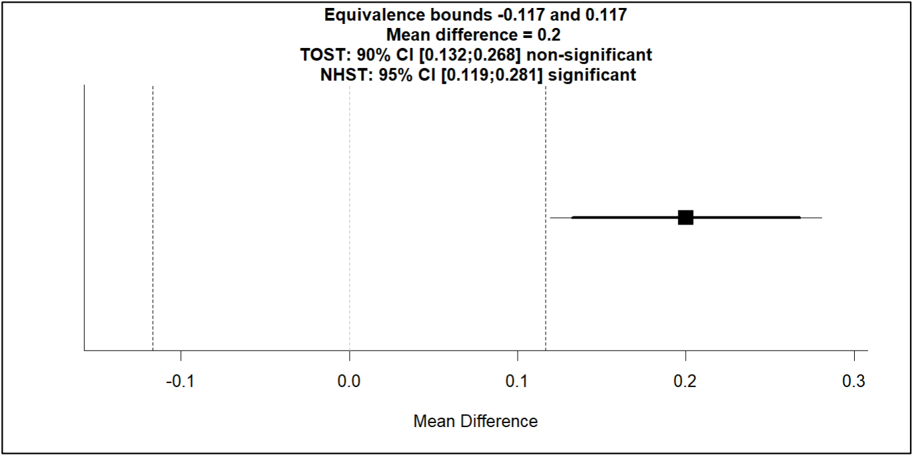
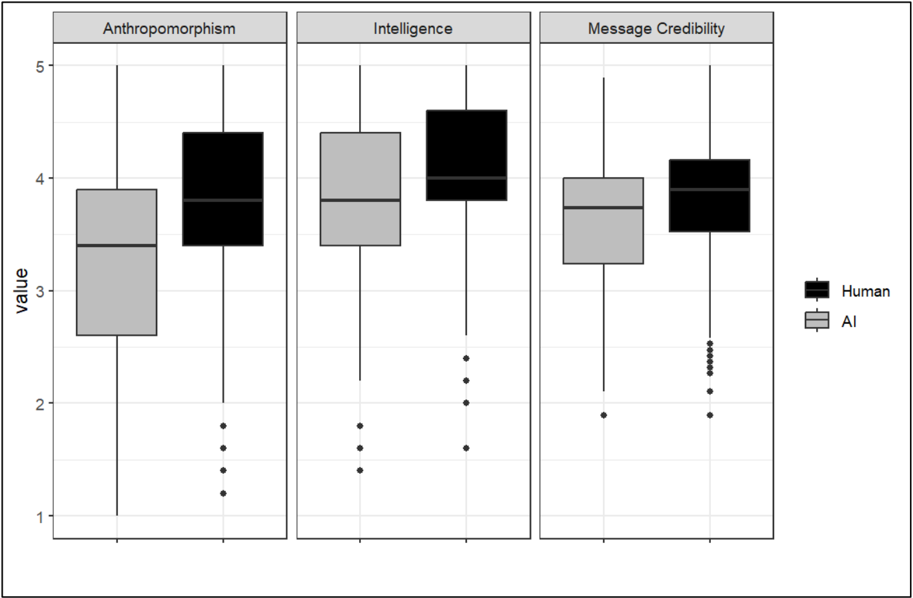
Artificial Intelligence (AI) has demonstrated its ability to undertake writing tasks, including automated journalism. Prior studies suggest no differences between human and AI authors regarding perceived message credibility. However, research on people’s perceptions of AI authorship on complex topics is lacking. In a between-groups experiment (N = 734), we examined the effect of labeled authorship on credibility perceptions of a GPT-written science journalism article. The results of an equivalence test showed that labeling a text as AI-written vs. human-written reduced perceived message credibility (d = 0.36). Moreover, AI authorship decreased perceived source credibility (d = 0.24), anthropomorphism (d = 0.67), and intelligence (d = 0.41). The findings are discussed against the backdrop of a growing availability of AI-generated content and a greater awareness of AI authorship.
Overview
The claims and statistics of this paper haven’t been checked yet.
Run the check — free, no account needed. It reads the open-access text and checks the sources it cites.
Integrity signals
Registry
Cites
Statistics
Figures
Verification
Claims the paper makes
The claims and statistics of this paper haven’t been checked yet.
Run the check — free, no account needed. It reads the open-access text and checks the sources it cites.
Claims other papers make about this one
Each is checked against this paper’s own text: does it say what the citing paper says it does?
The cited source says what the claim attributes to it.
In the citing paper
“Prior work shows that content labeled as machine-produced is often viewed more skeptically than identical human-attributed text.”
From Authorship Attribution and Trust in AI-Generated Scientific Texts: An Experimental Study (2026) · cites this paper as Lermann Henestrosa & Kimmerle, 2024
In the citing paper
“readers tend to rate human-written items as higher quality than machine-written ones (Lermann Henestrosa & Kimmerle, 2024).”
From Authorship Attribution and Trust in AI-Generated Scientific Texts: An Experimental Study (2026) · cites this paper as Lermann Henestrosa & Kimmerle, 2024
Self-check
Percentages, sums and reported differences re-computed from the paper’s own numbers.
The self-check needs the paper’s full text.
Citations
Cites
Language Models are Few-Shot Learners
Brown, T. B., Mann, B., Ryder, N., Subbiah, M., Kaplan, J., Dhariwal, P., Neelakantan, A., Shyam, P., Sastry, G., Askell, A., et al. (2020) · arXiv · doi:10.48550/arxiv.2005.14165 · Cited by 23,372
Equivalence Testing for Psychological Research: A Tutorial
Lakens, D., Scheel, A. M., & Isager, P. M. (2018) · Advances in Methods and Practices in Psychological Science · doi:10.1177/2515245918770963 · Cited by 1,560 · cited 1×
“For a detailed description of equivalence testing, see Lakens et al. (2018).”
Köbis, N., & Mossink, L. D. (2021) · Computers in Human Behavior · doi:10.1016/j.chb.2020.106553 · Cited by 406
Graefe, A., & Bohlken, N. (2020) · Media and Communication · doi:10.17645/mac.v8i3.3019 · Cited by 154 · cited 3×
“…from the field of automated journalism suggest that at least these texts do not differ from human-written texts in their perceived credibility (Graefe and Bohlken 2020; Jang et al. 2021; Tandoc et al. 2020; Wölker and Powell 2021) or that machine authorship has only a small negative effect on…”
The impact of text topic and assumed human vs. AI authorship on competence and quality assessment
Proksch, S., Schühle, J., Streeb, E., Weymann, F., Luther, T., & Kimmerle, J. (2024) · Frontiers in Artificial Intelligence · doi:10.3389/frai.2024.1412710 · Cited by 17
Self-citation
Research works printed but not linked: 18
- Appelman, 2016, Measuring Message Credibility: Construction and Validation of an Exclusive Scale, Journalism & Mass Communication Quarterly, 93, 59, 10.1177/1077699015606057 · DOI
- Bartneck, 2009, Measurement Instruments for the Anthropomorphism, Animacy, Likeability, Perceived Intelligence, and Perceived Safety of Robots, International Journal of Social Robotics, 1, 71, 10.1007/s12369-008-0001-3 · DOI · Paper page
- Bodani, 2023, Knowledge, Attitude, and Practices of General Population Toward Utilizing ChatGPT: A Cross-Sectional Study, SAGE Open, 13, 21582440231211079, 10.1177/21582440231211079 · DOI · Paper page
- Reiter, 2023, People Devalue Generative AI’s Competence but Not Its Advice in Addressing Societal and Personal Challenges, Communications Psychology, 1, 32, 10.1038/s44271-023-00032-x · DOI
- Cress, 2023, Co-Constructing Knowledge with Generative AI Tools: Reflections from a CSCL Perspective, International Journal of Computer-Supported Collaborative Learning, 18, 607, 10.1007/s11412-023-09409-w · DOI
- Flanagin, 2000, Perceptions of Internet Information Credibility, Journalism & Mass Communication Quarterly, 77, 515, 10.1177/107769900007700304 · DOI
- Jang, 2021, The Effects of Anthropomorphism on How People Evaluate Algorithm-Written News, Digital Journalism, 22, 103
- Jung, Yongnam, Chen, Cheng, Jang, Eunchae, and Sundar, S. Shyam (2024). Do We Trust ChatGPT as Much as Google Search and Wikipedia?. Extended Abstracts of the CHI Conference on Human Factors in Computing Systems, ACM. · DOI
- Lermann Henestrosa, Angelica, and Kimmerle, Joachim (2024). Understanding and Perception of Automated Text Generation among the Public: Two Surveys with Representative Samples in Germany. Behavioral Sciences, 14. · DOI
- Greving, 2023, Automated Journalism: The Effects of AI Authorship and Evaluative Information on the Perception of a Science Journalism Article, Computers in Human Behavior, 138, 107445, 10.1016/j.chb.2022.107445 · DOI
- Luther, 2024, Teaming up with an AI: Exploring Human–AI Collaboration in a Writing Scenario with ChatGPT, AI, 5, 1357, 10.3390/ai5030065 · DOI
- Oehler, 2024, The Role of Information Presentation for Wildlife Knowledge, Attitude, and Risk Perception, Conservation Science and Practice, 6, e13089, 10.1111/csp2.13089 · DOI
- Sundar, 1999, Exploring Receivers’ Criteria for Perception of Print and Online News, Journalism & Mass Communication Quarterly, 76, 373, 10.1177/107769909907600213 · DOI
- Tandoc, 2020, Man vs. Machine? The Impact of Algorithm Authorship on News Credibility, Digital Journalism, 8, 548, 10.1080/21670811.2020.1762102 · DOI
- Treves, 2013, Longitudinal Analysis of Attitudes Toward Wolves, Conservation Biology, 27, 315, 10.1111/cobi.12009 · DOI · Paper page
- Vaswani, Ashish, Shazeer, Noam, Parmar, Niki, Uszkoreit, Jakob, Jones, Llion, Gomez, Aidan N., Kaiser, Łukasz, and Polosukhin, Illia (2017). Attention Is All You Need. Advances in Neural Information Processing Systems, 30, Available online: https://proceedings.neurips.cc/paper/2017/hash/3f5ee243547dee91fbd053c1c4a845aa-Abstract.html.
- Wang, Sai, and Huang, Guanxiong (2024). The Impact of Machine Authorship on News Audience Perceptions: A Meta-Analysis of Experimental Studies. Communication Research, 00936502241229794. · DOI
- Powell, 2021, Algorithms in the Newsroom? News Readers’ Perceived Credibility and Selection of Automated Journalism, Journalism, 22, 86, 10.1177/1464884918757072 · DOI
Cited by
Sorted by citations
Mine over Yours: How Authorship Biases Evaluation in Generative Information Retrieval
Ryu, J., Kim, K., Kim, S., Eun, J., Oh, C., & Suh, B. (2026) · Proceedings of the 49th International ACM SIGIR Conference on Research and Development in Information Retrieval · doi:10.1145/3805712.3809948
Authorship Attribution and Trust in AI-Generated Scientific Texts: An Experimental Study
Matveev, M., & Matveeva, E. (2026) · Психология. Журнал Высшей школы экономики · doi:10.17323/1813-8918-2026-2-253-262
Metadata
- Authors
- Lermann Henestrosa, A., & Kimmerle, J.
- Affiliations
- Knowledge Construction Lab, Leibniz-Institut für Wissensmedien, 72076 Tübingen, Germany
- Venue
- Journalism and Media
- Publisher
- MDPI AG
- Published
- 2024-08-20
- Volume
- 5
- Issue
- 3
- Pages
- 1085-1097
- ISSN
- 2673-5172
- Cited by
- 53
- References
- 5
- Language
- en
- Funders
- Leibniz-Institut für Wissensmedien (STB Data Science)
About these checks
Registry, retraction, Cites and statistics results are computed, not judged, with one exception: a printed reference that no index lists is read once by a model before it counts as a citation error. Claims are extracted by a model and kept only when their quote appears verbatim in the text; each cited source is then checked, with a model’s help, for whether it says what the claim relies on. Those verdicts can be wrong — read the claim’s quote and the cited source before relying on one.
Statistics and arithmetic are recomputed, not judged.
Confidence bands are shown only for fields calibrated on our annotated test set. None is calibrated yet, so no band is shown.
What counts as a claim ›How we measure confidence ›How we check this ›
Are you an author, or do you see a problem with this page? Request a review
How to cite
Cite CoChat for the checks on this page, and the paper for its own findings.
- This page
- CoChat. (2026). Citation check: The Effects of Assumed AI vs. Human Authorship on the Perception of a GPT-Generated Text. https://app.cochat.ai/papers/10.3390/journalmedia5030069
- The paper
- Lermann Henestrosa, A., & Kimmerle, J. (2024). The Effects of Assumed AI vs. Human Authorship on the Perception of a GPT-Generated Text. Journalism and Media. https://doi.org/10.3390/journalmedia5030069
