

Self-Repair in Elicited Narrative Production in Speakers of Russian as the First (L1), Second (L2), and Heritage (HL) Language
Open accessThe DOI matches its Crossref record; 57 of the 58 references it cites were found in a registry or an index, and 1 are not checked yet; none of the 53 sources its claims cite is checked for support yet.
Abstract
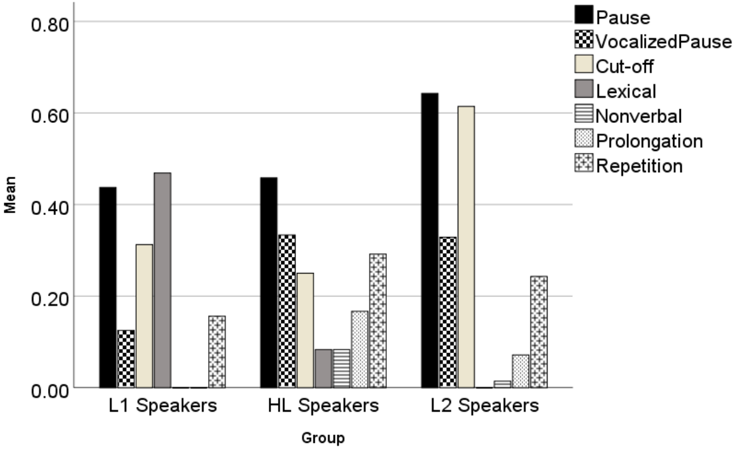
The current study investigates self-repairs in the speech of three groups of Russian speakers: monolingual controls (N = 12) residing in the Russian Federation, for whom Russian is their first dominant language (L1); bilingual Russian–Hebrew speaking participants (N = 12), who acquired Russian as their Heritage Language (HL) in contact with the dominant Societal Hebrew in Israel; and bilingual Russian–Chinese speakers (N = 12) residing in the Russian Federation at the time of testing, for whom Russian is their second language (L2). Picture-elicited narratives were coded for instances of self-repairs, split into Conceptualizer Repairs (C-repairs)—which imply pragmatic, semantic, or lexical changes—and Formulator Repairs (F-repairs), correcting different types of errors. In addition, self-repair initiators—such as cut-offs, hesitation pauses, and discourse markers—were annotated before each instance of self-repair. The results indicate that L2 speakers, in general, use self-repairs more frequently than L1 and HL speakers. L1 speakers hardly produced F-repairs, while HL and L2 speakers resorted to both C- and F-repairs. L1 speakers mainly used C-repairs for appropriacy, whereas HL and L2 speakers used C-repairs for rephrasing and lexical item change. As for F-repairs, HL speakers tended to change pronunciation and morphology, while L2 speakers implemented more morphological repairs. Lexical initiators of self-repairs were more common in L1 speech; however, in the L2 group we saw much more frequent cut-offs of repaired speech fragments. As such, varying self-repair strategies were employed by different speaker groups, shedding light on the underlying processes of language production. There was also evidence of cross-linguistic transfer of non-lexical self-repair initiators: HL speakers resorted to prolongations as initiators in HL-Russian (a strategy that is common in their dominant language, Hebrew), whereas L1 speakers used vocalized and silent pauses more frequently.
Overview
CoChat Summary
TL;DR
This study compares self-repair in picture-elicited narratives across three groups of Russian speakers (L1, heritage HL, and L2) and finds that L2 speakers self-repair most frequently, while L1 speakers rely almost exclusively on Conceptualizer repairs and HL/L2 speakers produce both Conceptualizer and Formulator repairs. The authors also report evidence of cross-linguistic transfer of non-lexical self-repair initiators (prolongations) from Hebrew into HL-Russian.
Key findings
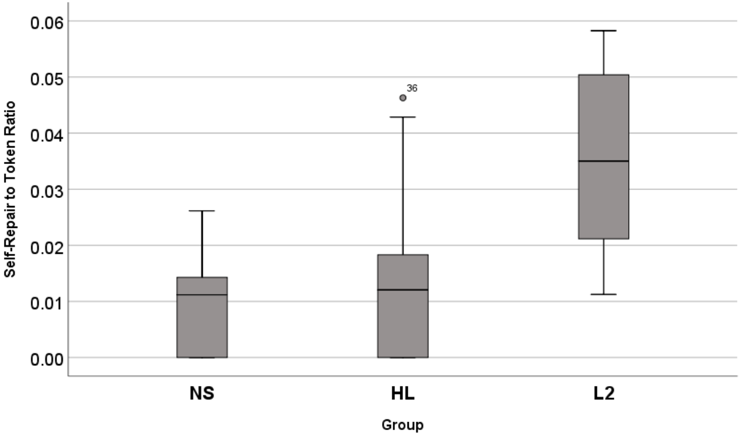
- Self-repair was used by 67% of L1 speakers, 58% of HL speakers, and 100% of L2 speakers; errors appeared in 33% of L1, 100% of HL, and 100% of L2 monologues. Self-repair-to-token ratio was 0.01 (L1), 0.01 (HL), and 0.04 (L2), with (L1 = HL) < L2 (F = 13.07, p < 0.001); error-to-token ratio was 0.005 (L1), 0.05 (HL), 0.16 (L2), with L1 < L2 < HL (F = 126.13, p < 0.001).
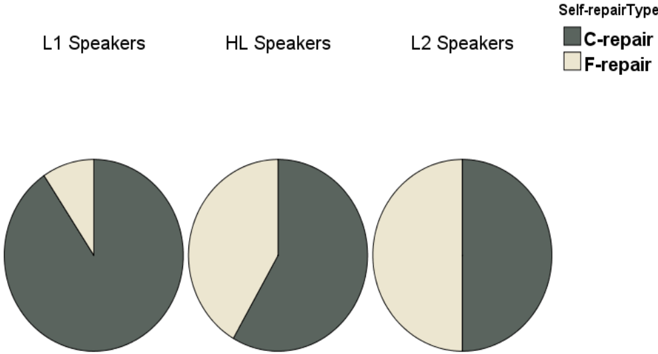
- The distribution of C-repairs versus F-repairs differed by group (χ²(2) = 15.53, p < 0.001): L1 vs HL (χ²(1) = 8.02, p = 0.005) and L1 vs L2 (χ²(1) = 15.50, p < 0.001) differed, but HL and L2 did not (χ²(1) = 0.50, p = 0.48). L1 speakers hardly produced F-repairs; HL and L2 speakers produced both types.
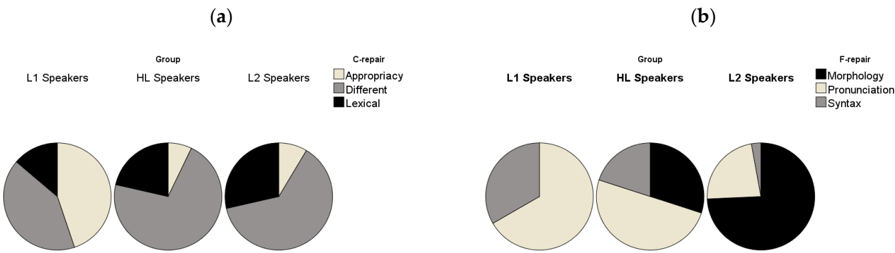
- Within C-repairs, L1 speakers mainly used appropriacy repairs, whereas HL and L2 speakers used repairs to restructure a phrase or change a lexical item. Within F-repairs, HL speakers changed pronunciation and morphology, while L2 speakers' most frequent F-repair was morphological; L1's infrequent F-repairs were pronunciation-based.
- Initiator devices differed for lexical initiators (H(3) = 41.69, p < 0.001) and cut-offs (H(3) = 4.68, p = 0.10): L1 speakers used lexical initiators more than HL (U = 236, p = 0.002) and L2 (U = 595, p < 0.001), while L2 speakers used cut-offs more than L1 (U = 782, p = 0.005) and HL (U = 534, p = 0.002). No group differences were found for pauses, vocalized pauses, non-verbal elements, prolongations, or repetitions, and no differences in the number of initiators per self-repair (F(123) = 1.958, p = 0.145; ~1.5 initiators per repair on average).
- Self-repair ratios did not correlate with proficiency in the HL group (self-rated proficiency r = −0.51, p = 0.09; vocabulary r = −0.28, p = 0.38) or the L2 group (r = 0.15, p = 0.64).
Methods
- Design: cross-group comparison of self-repair in elicited monologue-descriptions. Participants were 36 speakers in three groups of 12 (6 male, 6 female each): L1-Russian monolinguals in Russia (ages 18–21, M = 20, SD = 1); HL-Russian/L2-Hebrew speakers in Israel (ages 18–28, M = 24, SD = 3; Hebrew onset before age 5, M = 1, SD = 2); and L2-Russian/L1-Chinese students in St. Petersburg (ages 23–27, M = 25, SD = 1; Russian proficiency 4–5 on a 1–6 scale, M = 4.6, SD = 0.5).
- Materials: wordless comic strip by Herluf Bidstrup ("Hair loss treatment") used to elicit narratives. L1 and L2 narratives came from the St. Petersburg State University corpus "Balanced Annotated Text Library"; HL narratives were elicited in Israel following the same procedure and audio-recorded.
- Coding and analysis: transcripts annotated for self-repairs split into Conceptualizer repairs (Different, Appropriacy, Lexical, Determiner) and Formulator repairs (Pronunciation, Morphology, Syntax), plus preceding initiators (pauses, vocalized pauses, cut-offs, prolongations, repetitions, lexical initiators). Three independent annotators; average inter-rater reliability was 97% for self-repair overall and 97% for C-/F-repair types. Analyses used chi-squared tests, Kruskal-Wallis and Mann-Whitney tests, and correlations.
Limitations
- The paper contains no dedicated limitations section; the text states that error patterns across the HL and L2 groups were "beyond the scope of the current paper," and that some annotation cases (examples 7–8) remained unresolved as to whether they were Different or Lexical/Appropriacy C-repairs.
- Evident from the text: the sample is small (N = 12 per group), which the authors implicitly acknowledge by calling for future research on how elicitation methods affect self-repair across proficiency levels; the null proficiency correlations may reflect this limited power.
- Evident from the text: the HL proficiency measure is inconsistently reported (self-rated proficiency described as "on a scale of 0 to 5" but reported as M = 3.2, SD = 1, MIN-MAX: 0–4), and the L2 proficiency measure is a single institutional test score, so the proficiency analyses rest on coarse and partly inconsistent measures.
Model-written summary. Check it against the paper before relying on it.
Integrity signals
Registry
Cites
Statistics
Figures
Verification
Claims the paper makes
0 Valid · 1 Not valid · 46 Not checked · 85 Own results and interpretations
A result the paper reports from its own data — it cites no other source for it, so there is none to check. The quote shows it is in the paper.
In the paper
“HL speakers resorted to prolongations as initiators in HL-Russian (a strategy that is common in their dominant language, Hebrew), whereas L1 speakers used vocalized and silent pauses more frequently.”
§ Self-Repair in Elicited Narrative Production in Speakers of Russian as the First (L1), Second (L2), and Heritage (HL) Language > Abstract
plainstates an association- Asserted: passes — The authors put it forward as true.
- Checkable: passes — It can be checked against evidence.
- Load-bearing: passes — The paper’s conclusions depend on it.
- Based: passes — The paper gives a reason why it holds.
- Rests on an assumption not shown here.
A result the paper reports from its own data — it cites no other source for it, so there is none to check. The quote shows it is in the paper.
In the paper
“HL speakers resorted to prolongations as initiators in HL-Russian (a strategy that is common in their dominant language, Hebrew), whereas L1 speakers used vocalized and silent pauses more frequently.”
§ Self-Repair in Elicited Narrative Production in Speakers of Russian as the First (L1), Second (L2), and Heritage (HL) Language > Abstract
plainstates an association- Asserted: passes — The authors put it forward as true.
- Checkable: passes — It can be checked against evidence.
- Load-bearing: passes — The paper’s conclusions depend on it.
- Based: passes — The paper gives a reason why it holds.
A result the paper states — it cites no source for it, so there is none to check. The quote shows it is in the paper.
In the paper
“Preliminary observations have shown that online correction in monologic speech is more common, and that it is easier for an L1 speaker to remember a speech failure.”
§ Self-Repair in Elicited Narrative Production in Speakers of Russian as the First (L1), Second (L2), and Heritage (HL) Language > 1.1. Self-Repair in Spontaneous Speech
hedgedstates an association- Asserted: passes — The authors put it forward as true.
- Checkable: passes — It can be checked against evidence.
- Load-bearing: unclear — It is unclear whether the paper’s conclusions depend on it.
- Based: passes — The paper gives a reason why it holds.
A result the paper reports from its own data — it cites no other source for it, so there is none to check. The quote shows it is in the paper.
In the paper
“L1 speakers hardly produced F-repairs, while HL and L2 speakers resorted to both C-and F-repairs.”
§ Self-Repair in Elicited Narrative Production in Speakers of Russian as the First (L1), Second (L2), and Heritage (HL) Language > Abstract
plainn = 12- Asserted: passes — The authors put it forward as true.
- Checkable: passes — It can be checked against evidence.
- Load-bearing: passes — The paper’s conclusions depend on it.
- Based: passes — The paper gives a reason why it holds.
A result the paper reports from its own data — it cites no other source for it, so there is none to check. The quote shows it is in the paper.
In the paper
“As for F-repairs, HL speakers tended to change pronunciation and morphology, while L2 speakers implemented more morphological repairs.”
§ Self-Repair in Elicited Narrative Production in Speakers of Russian as the First (L1), Second (L2), and Heritage (HL) Language > Abstract
plainstates an associationn = 12- Asserted: passes — The authors put it forward as true.
- Checkable: passes — It can be checked against evidence.
- Load-bearing: passes — The paper’s conclusions depend on it.
- Based: passes — The paper gives a reason why it holds.
46 more claims
Create a free account to see all 132 claims and to verify the 31 references still open.
- It may state two separate claims as one. 56
- Probably not a substantial claim. 50
Self-check
Percentages, sums and reported differences re-computed from the paper’s own numbers.
Each contradiction between two passages listed here was confirmed by an independent check.
Rated minor: it would not touch a result — a value no result rests on, a p-value that stays on the same side of the significance level, or a conflict that is clerical, resolved elsewhere in the paper, or outside its own findings.
In the paper
§ Self-Repair in Elicited Narrative Production in Speakers of Russian as the First (L1), Second (L2), and Heritage (HL) Language > 3. Results
“In the case of L1 speakers, the infrequent F-repairs that were observed were due to a change in pronunciation.”
§ Self-Repair in Elicited Narrative Production in Speakers of Russian as the First (L1), Second (L2), and Heritage (HL) Language > 2.2. Materials, Coding, and Reliability
“Syntax (repair of a syntactic error) можно предположить что это самые волосы/те самые/которые он остригал (S12, L1, m.)”
Rated minor: it would not touch a result — a value no result rests on, a p-value that stays on the same side of the significance level, or a conflict that is clerical, resolved elsewhere in the paper, or outside its own findings.
In the paper
§ Self-Repair in Elicited Narrative Production in Speakers of Russian as the First (L1), Second (L2), and Heritage (HL) Language > 5. Conclusions
“L1 < L2 < HL”
§ Self-Repair in Elicited Narrative Production in Speakers of Russian as the First (L1), Second (L2), and Heritage (HL) Language > 3. Results
“The results indicated that there were significant differences for the error ratios, with the L2 group producing a significantly higher ratio of errors, as compared to the HL and L1 groups, and in turn the HL group was found to produce a significantly higher ratio of errors than their L1 peers”
Rated minor: it would not touch a result — a value no result rests on, a p-value that stays on the same side of the significance level, or a conflict that is clerical, resolved elsewhere in the paper, or outside its own findings.
In the paper
§ Self-Repair in Elicited Narrative Production in Speakers of Russian as the First (L1), Second (L2), and Heritage (HL) Language > 3. Results
“non-verbal elements (H(3) = 4.68, p = 0.10)”
§ Self-Repair in Elicited Narrative Production in Speakers of Russian as the First (L1), Second (L2), and Heritage (HL) Language > 3. Results
“repetitions (H(3) = 4.68, p = 0.46)”
Citations
Cites
The Preference for Self-Correction in the Organization of Repair in Conversation
Schegloff, E. A., Jefferson, G., & Sacks, H. (1977) · Language · doi:10.2307/413107 · Cited by 5,150
Monitoring and self-repair in speech.
Levelt, W. (1983) · Cognition · doi:10.1016/0010-0277(83)90026-4 · Cited by 1,676
Using uh and um in spontaneous speaking
Clark, H. (2002) · Cognition · doi:10.1016/s0010-0277(02)00017-3 · Cited by 1,235
The Influence of Planning and Task Type on Second Language Performance
Foster, P., & Skehan, P. (1996) · Studies in Second Language Acquisition · doi:10.1017/s0272263100015047 · Cited by 1,147
The Acquisition of Heritage Languages
Montrul, S. (2015) · doi:10.1017/cbo9781139030502 · Cited by 900
Heritage languages and their speakers: Opportunities and challenges for linguistics
Benmamoun, E., Montrul, S., & Polinsky, M. (2013) · Theoretical Linguistics · doi:10.1515/tl-2013-0009 · Cited by 758
Second Language Acquisition and the Critical Period Hypothesis
(1999) · Routledge eBooks · doi:10.4324/9781410601667 · Cited by 661
The Relevance of Repair to Syntax-for-Conversation
Schegloff, E. A. (1979) · Discourse and Syntax · doi:10.1163/9789004368897_012 · Cited by 654
Understanding the nature and outcomes of early bilingualism: Romance languages as heritage languages
Rothman, J. (2009) · International Journal of Bilingualism · doi:10.1177/1367006909339814 · Cited by 577
Tree, J. E. F. (1995) · Journal of Memory and Language · doi:10.1006/jmla.1995.1032 · Cited by 392
Research works printed but not linked: 18
- Akhutina, Tatiana V. 2007. Vygotsky-Luria-Leontiev's school of psycholinguistics: The mechanisms of language production. In Language in Action: Vygotsky and Leontievian Legacy Today. Edited by Riikka Alanen and Sari Pöyhönen. Newcastle: Cambridge Scholars Publishing, pp. 32-56.
- Bange, Pierre, and Sophie Kern. 1996. La régulation du discours en L1 et en L2 [Speech regulation in L1 and L2]. Études Romanes 35: 69-103.
- Belz, Malte. 2013. Disfluencies und Reparaturen bei Muttersprachlern und Lernern-Eine kontrastive Analyse [Disfluencies and Repairs in Native Speakers and Language Learners-A Contrastive Analysis]. Master's thesis, Humboldt-Universität, Berlin, Germany.
- Bogdanova-Beglarian, Natalia, and Ekaterina Baeva. 2018. Nonverbal elements in everyday Russian speech: An attempt at catego- rization. In Computational Models in Language and Speech, Proceedings of Computational Models in Language and Speech Workshop (CMLS 2018) Co-Located with the 15th TEL International Conference on Computational and Cognitive Linguistics (TEL 2018). Edited by Alexander Elizarov and Natalia Loukachevitch. Kazan: Federal University, N.I. Lobachevsky, Kazan: Institute of Mathematics and Mechanics, Moscow: Lomonosov Moscow State University, Kazan: Research Computing Center, vol. 2303, pp. 3-13.
- Bogdanova-Beglarian, Natalia V., and Kong Chunxia. 2020. Chinese speakers' 'strategies' of reading unfamiliar Russian words. Socio-and Psycholinguistic Studies 8: 32-39.
- Bogdanova-Beglarian, Natalia V., Olga V. Blinova, Kristina D. Zaides, and Tatiana Sherstinova. 2019. Korpus "Sbalansirovannaja annotirovannaja tekstoteka" (SAT): Izučenije specifiki russkoj monologičeskoj reči [Corpus "Balanced Annotated Text Library" (SAT): Study of the specifics of Russian monologue speech]. In Trudy Instituta russkogo jazyka im. V.V. Vinogradova. Moscow: IRJA RAN, vol. 21, pp. 111-26.
- Chunxia, Kong. 2022. Specifika nepodgotovlennogo čtenija na nerodnom jazyke (kompleksnoe issledovanie na materiale russkoj reči nositelej kitajskogo jazyka) [Specificity of Unprepared Reading in a Non-Native Language (a Complex Study Based on the Russian Speech of Native Speakers of Chinese)]. Ph.D. thesis, St. Petersburg State University, St. Petersburg, Russia.
- Gráf, Tomáš, and Lan-Fen Huang. 2018. False starts and self-corrections in learner English. In TaLC 2018: 13 Teaching and Language Corpora Conference 2018. Cambridge: University of Cambridge.
- Gulimire, A., and S. I. Titkova. 2018. The Russian language in China: Traditions and prospects. Modern Linguistic and Methodical-and- Didactic Researches 2: 48-55.
- Kibrik, A. A., and V. I. Podlesskaya. 2007. Speaker's self-repairs and other types of speech failures as an object of annotation in spoken speech corpora. Science-Technical Information [Naučno-texničeskaja informacija] 23: 2-23.
- Krashen, Stephen D. 1982. Principles and Practice in Second Language Acquisition. Oxford: Pergamon Press Inc.
- Kupina, M. E. 2020. Povtor-hesitacija i povtor-korrekcija v reči inostrancev na russkom jazyke [Repetition-hesitation and repetition- correction in the Russian speech of foreigners]. The Buryat State University Bulletin. Philology 2: 9-15.
- Levitsky, U. A. 2011. K voprosu o vtoroj kommunimacii [To the question of the second communication]. In Problemy Socio-i Psiholingvistiki [Problems of Socio-and Psycholinguistics]. Permskaja sociopsiholingvisticheskaja škola: Idei trjoh pokolenij. K 70-letiyu Ally Solomonovny Štern [Perm sociolinguistic school: Ideas of three generations. To Alla Solomonovna Stern's 70th anniversary]. Edited by Ye V. Yerofeeva. Perm: Perm State University, vol. 15, pp. 159-67.
- Limin', L. 2011. Russkii yazyk v Kitae: 1949-2009 [The Russian Language in China: 1949-2009]. Shanghai: Shanghai Foreign Language Education Press.
- Shriberg, Elizabeth E. 1994. Preliminaries to a Theory of Speech Disfluencies. Ph.D. dissertation, University of California, Berkeley, CA, USA.
- Von Humboldt, Wilhelm. 1984. O različii strienija čelovečeskih jazykov i ego vlijanija na duhovnoe razvitie čelovečestva [On the diversity of human language construction and its influence on the mental development of the human species]. In Selected Works on Linguistics. Edited by Wilhelm Von Humboldt. Moscow: Progress, pp. 68-69.
- Zaides, Kristina D. 2019. Ob unifikacii razmetki korpusa "Sbalansirovannaja annotirovannaja tekstoteka" [On unification of annotation of the "Balanced Annotated Text Library" corpus]. In Proceedings of International Conference "Corpus Linguistics-2019". Edited by V. P. Zakharov. St. Petersburg: St. Petersburg University Publication, pp. 332-39.
- Zuniga, Michael. 2015. The Role of Attention in L2 Speech Production. Unpublished Ph.D. dissertation, Université du Québec à Montréal, Montreal, QC, Canada.
Cited by
Still being checked.
Metadata
- Authors
- Bogdanova-Beglarian, N., Zaides, K., Verkhovtceva, T., Beradze, M., & Meir, N.
- Affiliations
- St Petersburg University (RU)
- Bar-Ilan University (IL)
- Corresponding author
- Meir, Natalia
- ORCID
- Venue
- Languages
- Publisher
- MDPI AG
- Published
- 2022-09-02
- Volume
- 7
- Issue
- 3
- Pages
- 229
- ISSN
- 2226-471X (ISSN-L)
- OpenAlex
- W4294176629
- Semantic Scholar
- c66e10bf7af46756d2217dc94b1db04d629818dd
- Cited by
- 4
- References
- 58
- Citations by year
- 2026: 1 · 2025: 2 · 2023: 1
- FWCI
- 0.47
- Type
- journal article
- Language
- en
- Open access
- gold
- doi.org
- Licence
- Locations
- Languages (publishedVersion, cc-by)
- DOAJ (DOAJ: Directory of Open Access Journals) (submittedVersion)
- Funders
- Saint Petersburg State University (#92562973, 552/21)
- Israel Science Foundation (ISF) (#92562973, 552/21)
- Topics
- Social Sciences › Psychology › Experimental and Cognitive Psychology › Phonetics and Phonology Research
- Social Sciences › Psychology › Developmental and Educational Psychology › Language Development and Disorders
- Life Sciences › Neuroscience › Cognitive Neuroscience › Neurobiology of Language and Bilingualism
- Keywords
- self-healing, heritage language, hesitation pauses, discourse markers, language transfer, language production
About these checks
Registry, retraction, Cites and statistics results are computed, not judged, with one exception: a printed reference that no index lists is read once by a model before it counts as a citation error. Claims are extracted by a model and kept only when their quote appears verbatim in the text; each cited source is then checked, with a model’s help, for whether it says what the claim relies on. Those verdicts can be wrong — read the claim’s quote and the cited source before relying on one.
A language model drew the claims from the paper on 2026-11-26, under version 3 of the claim definition (model deepseek-v4.1-flash, prompt extract-v3).
A second model labelled each claim on 2026-11-26 (model jev-1.13-20260917, definition revision gold-guideline-v0.2).
Statistics and arithmetic are recomputed, not judged.
Confidence bands are shown only for fields calibrated on our annotated test set. None is calibrated yet, so no band is shown.
What counts as a claim ›How we measure confidence ›How we check this ›
Are you an author, or do you see a problem with this page? Request a review
How to cite
Cite CoChat for the checks on this page, and the paper for its own findings.
- This page
- CoChat. (2026). Citation check: Self-Repair in Elicited Narrative Production in Speakers of Russian as the First (L1), Second (L2), and Heritage (HL) Language. https://app.cochat.ai/papers/10.3390/languages7030229
- The paper
- Bogdanova-Beglarian, N., Zaides, K., Verkhovtceva, T., Beradze, M., & Meir, N. (2022). Self-Repair in Elicited Narrative Production in Speakers of Russian as the First (L1), Second (L2), and Heritage (HL) Language. Languages. https://doi.org/10.3390/languages7030229
Data sources
Bibliographic data: Semantic Scholar, OpenAlex, Crossref.
Contains information from the Semantic Scholar Academic Graph Datasets, made available under the ODC Attribution License (ODC-BY 1.0).
Semantic Scholar’s data is described in: Kinney, R., et al. (2023). The Semantic Scholar Open Data Platform. arXiv:2301.10140.
