

Ambulatory Neuroproprioceptive Facilitation and Inhibition Physical Therapy Improves Clinical Outcomes in Multiple Sclerosis and Modulates Serum Level of Neuroactive Steroids: A Two-Arm Parallel-Group Exploratory Trial
Open accessThe DOI matches its Crossref record; 63 of the 64 references it cites were found in a registry or an index.
Abstract
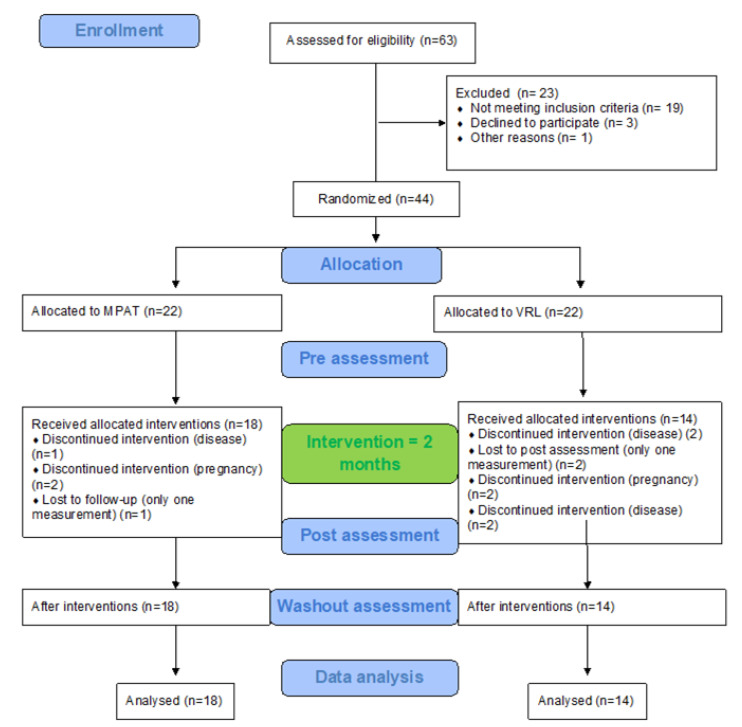
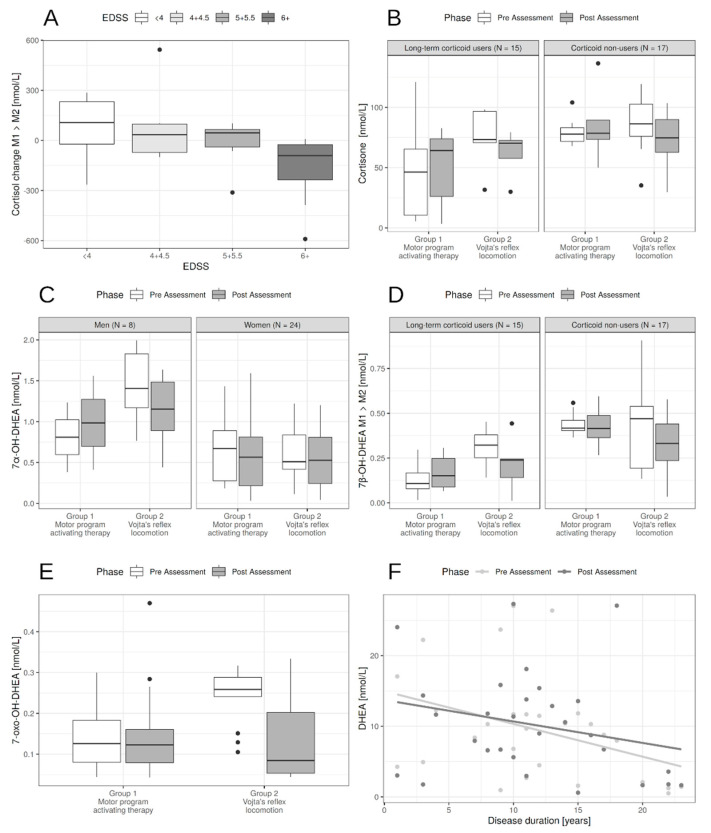
Only few studies have monitored the potential of physical activity training and physical therapy to modulate the reaction of the endocrine system. In this study, the effect of neuroproprioceptive facilitation and inhibition physical therapy on clinical outcomes and neuroactive steroids production in people with multiple sclerosis was evaluated. Moreover, we were interested in the factors that influence the treatment effect. METHODS: In total, 44 patients with multiple sclerosis were randomly divided into two groups. Each group underwent a different kind of two months ambulatory therapy (Motor program activating therapy and Vojta's reflex locomotion). During the following two months, participants were asked to continue the autotherapy. Primary (serum level of cortisol, cortisone, 7α-OH-DHEA, 7β-OH-DHEA, 7-oxo-DHEA, DHEA) and secondary (balance, cognition and patient-reported outcomes) outcomes were examined three times (pre, post, and washout assessments). RESULTS: In both groups, there is a decreasing trend of 7-oxo-DHEA concentration in post-assessment and 7β-OH-DHEA in washout versus pre-assessment. A higher impact on neuroactive steroids is visible after Vojta's reflex locomotion. As for clinical outcomes, the Paced Auditory Serial Addition Test and Multiple Sclerosis Impact Scale significantly improved between post-assessment and washout assessment. The improvement was similar for both treatments. CONCLUSIONS: Neuroproprioceptive facilitation and inhibition improved the clinical outcomes and led to non-significant changes in neuroactive steroids. Trial registration (NCT04379193).
Overview
The claims and statistics of this paper haven’t been checked yet.
Free: it reads the open-access text and checks the first 5 claims that cite a source we can check. Create a free account to check every claim.
Integrity signals
Registry
Cites
Statistics
Figures
Verification
Claims the paper makes
The claims and statistics of this paper haven’t been checked yet.
Free: it reads the open-access text and checks the first 5 claims that cite a source we can check. Create a free account to check every claim.
Claims other papers make about this one
Each is checked against this paper’s own text: does it say what the citing paper says it does?
The source backs part of the claim, not all of it — or backs it for a different population, condition or comparison.
In the citing paper
“they reduce inflammatory processes, modulate cellular immunity, have neuroprotective effects, play a role in myelination and in the priming of synaptic plasticity induction.”
From People with newly diagnosed multiple sclerosis benefit from a complex preventative intervention—a single group prospective study with follow up (2024) · cites this paper as [17]
Experimental — accuracy not yet measuredThe source backs part of the claim, not all of it — or backs it for a different population, condition or comparison.
In the citing paper
“In conjunction with other hormones and transmitters, they affect some aspects of human mood, emotions and behaviour, and as such increase feelings of well-being (17).”
From People with newly diagnosed multiple sclerosis benefit from a complex preventative intervention—a single group prospective study with follow up (2024) · cites this paper as [17]
Experimental — accuracy not yet measured
Self-check
Percentages, sums and reported differences re-computed from the paper’s own numbers.
The self-check needs the paper’s full text.
Citations
Cites
Psychophysical bases of perceived exertion
BORG, G. A. V. (1982) · Medicine & Science in Sports & Exercise · doi:10.1249/00005768-198205000-00012 · Cited by 16,580 · cited 1×
“The physical load during all therapies was fairly light [40], but the demands being induced on the central nervous system were high [41].”
BackgroundRating neurologic impairment in multiple sclerosis: An expanded disability status scale (EDSS)
Kurtzke, J. F. (1983) · Neurology · doi:10.1212/wnl.33.11.1444 · Cited by 15,011 · cited 9×
“There was also a slight effect of age, but both age and MS type effect disappeared with the inclusion of EDSS because of the correlation between these factors (Table 3).”
BackgroundInfluentialThe Timed “Up & Go”: A Test of Basic Functional Mobility for Frail Elderly Persons
Podsiadlo, D., & Richardson, S. (1991) · Journal of the American Geriatrics Society · doi:10.1111/j.1532-5415.1991.tb01616.x · Cited by 14,418
Diagnostic criteria for multiple sclerosis: 2010 revisions to the McDonald criteria
Polman, C. H., Reingold, S. C., Banwell, B., Clanet, M., Cohen, J. A., Filippi, M., Fujihara, K., Havrdova, E., Hutchinson, M., Kappos, L., et al. (2011) · Annals of Neurology · doi:10.1002/ana.22366 · Cited by 9,802 · cited 1×
“Accordingly, participants were both genders, adults, diagnosed with definite multiple sclerosis [37] of moderate to severe disease severity (Expanded Disability Status Scale (EDSS) [38] ranging from 3 to 7.”
BackgroundNew Multiple Sclerosis Phenotypic Classification
Lublin, F. D. (2014) · European Neurology · doi:10.1159/000367614 · Cited by 4,259
The Balance Scale: reliability assessment with elderly residents and patients with an acute stroke
Berg, K., Wood-Dauphinee, S., & Williams, J. (1995) · Journal of Rehabilitation Medicine · doi:10.2340/1650197719952736 · Cited by 1,639 · cited 7×
“Based on the previous study [39] with a similar setting and therapy, we estimated the number of participants to be 20 in Group 1 and 20 in Group 2 to have 90% power to detect a difference in BBS ≥3 points at the 5% level of statistical significance.”
MethodInfluentialMeasuring the Functional Impact of Fatigue: Initial Validation of the Fatigue Impact Scale
Fisk, J. D., Ritvo, P. G., Ross, L., Haase, D. A., Marrie, T. J., & Schlech, W. F. (1994) · Clinical Infectious Diseases · doi:10.1093/clinids/18.supplement_1.s79 · Cited by 1,541 · cited 3×
“The clinical measures were focused on balance (Berg Balance Scale (BBS) [45] and Time Up and Go test (TUG) [46]), cognitive functions (Paced Auditory Serial Addition Test (PASAT 3)—single digits were presented every 3s [47]) and patient-reported outcomes (Multiple Sclerosis Impact Scale (MSIS-29) [48], Modified Fatigu…”
MethodThe Multiple Sclerosis Impact Scale (MSIS-29): A new patient-based outcome measure
Hobart, J. (2001) · Brain · doi:10.1093/brain/124.5.962 · Cited by 1,120 · cited 4×
“Participants significantly improved in cognitive functions measured by PASAT 3 (by mean 2.6 points, p = 0.010), which further improved after the next two months (by mean total change 3.9 points, p 0.001), and in the impact of multiple sclerosis evaluated by MSIS-29 (by 4.6 points, p = 0.044).”
MethodInfluentialFischer, J. S., Rudick, R. A., Cutter, G. R., Reingold, S. C., & National MS Society Clinical Outcomes Assessment Task Force (1999) · Multiple Sclerosis Journal · doi:10.1177/135245859900500409 · Cited by 993
Measuring the impact of MS on walking ability: The 12-Item MS Walking Scale (MSWS-12)
Hobart, J. C., Riazi, A., Lamping, D. L., Fitzpatrick, R., & Thompson, A. J. (2003) · Neurology · doi:10.1212/wnl.60.1.31 · Cited by 821 · cited 3×
“The clinical measures were focused on balance (Berg Balance Scale (BBS) [45] and Time Up and Go test (TUG) [46]), cognitive functions (Paced Auditory Serial Addition Test (PASAT 3)—single digits were presented every 3s [47]) and patient-reported outcomes (Multiple Sclerosis Impact Scale (MSIS-29) [48], Modified Fatigu…”
Method
Cited by
Lactate Threshold Training Program on Patients with Multiple Sclerosis: A Multidisciplinary Approach
Amato, A., Ragonese, P., Ingoglia, S., Schiera, G., Schirò, G., Liegro, C. M. D., Salemi, G., Liegro, I. D., & Proia, P. (2021) · Nutrients · doi:10.3390/nu13124284 · Cited by 28
“It can improve cognitive and autonomic system functions [6,7] by influencing the concentration of circulating epinephrine and norepinephrine [8] and through modulating the expression of some neurotrophic factors (such as the brain-derived neurotrophic factor (BDNF)), even in pathological conditions [9,10].”
BackgroundCritical review of the evidence for Vojta Therapy: a systematic review and meta-analysis
González, J. L. S., Sanz-Esteban, I., Menéndez-Pardiñas, M., Navarro‐López, V., & Sanz-Mengíbar, J. M. (2024) · Frontiers in Neurology · doi:10.3389/fneur.2024.1391448 · Cited by 25
RetractedAbreu-Corrales, A., Velasco, A. L., Cuesta‐Gómez, A., & González, J. L. S. (2023) · Frontiers in Neurology · doi:10.3389/fneur.2023.1209477 · Cited by 3
Hrušková, N., Berchová Bímová, K., Davies Smith, A., Škodová, T., Bičíková, M., Kolátorová, L., Štětkářová, I., Brožek, Ľ., Javůrková, A., Angelová, G., et al. (2024) · Frontiers in Neurology · doi:10.3389/fneur.2024.1373401 · Cited by 2
Miznerova, B., Reissigová, J., Váša, L., Frank, J., Hudec, M., Rodina, L. I., Herynkova, A., Havlík, J., Tintěra, J., Rydlo, J., et al. (2025) · BMJ Open · doi:10.1136/bmjopen-2024-088046 · Cited by 4
Abdelhamed, A. I., Mortada, H., Samy, H., Elfeky, A., Ammar, S., AMR, M. D. M. R. E.-G. Y. M., & Elshennawy, S. (2024) · Manuelle Medizin · doi:10.1007/s00337-024-01066-w
Metadata
- Authors
- Angelova, G., Skodova, T., Prokopiusova, T., Markova, M., Hruskova, N., Prochazkova, M., Pavlikova, M., Spanhelova, S., Stetkarova, I., Bicikova, M., Kolatorova, L., & Rasova, K.
- Affiliations
- Department of Rehabilitation Medicine, Third Faculty of Medicine, Charles University, Ruska 87, 10000 Prague 10, Czech Republic
- Department of Steroids and Proteofactors, Institute of Endocrionology, 11694 Prague, Czech Republic
- Charles University (CZ)
- Department of Rehabilitation and Sport Medicine, Motol University Hospital, V Uvalu 84, 150 06 Prague 5, Czech Republic
- Department of Neurology, Third Faculty of Medicine, Charles University, 10000 Prague, Czech Republic
- Venue
- Life
- Publisher
- MDPI AG
- Published
- 2020-10-31
- Volume
- 10
- Issue
- 11
- Pages
- 267
- ISSN
- 2075-1729 (ISSN-L)
- PMC
- PMC7693100
- OpenAlex
- W3097546509
- Cited by
- 6
- References
- 64
- Citations by year
- 2025: 1 · 2024: 3 · 2023: 1 · 2021: 1
- FWCI
- 0.33
- Type
- journal article
- Language
- en
- Open access
- gold
- doi.org
- Licence
- Locations
- Life (publishedVersion, cc-by)
- PubMed Central (publishedVersion, cc-by)
- PubMed (publishedVersion)
- DOAJ (DOAJ: Directory of Open Access Journals) (submittedVersion, cc-by-sa)
- Topics
- Health Sciences › Medicine › Clinical Neurology › Multiple Sclerosis Research Studies
- Health Sciences › Medicine › Rehabilitation › Stroke Rehabilitation and Recovery
- Health Sciences › Medicine › Clinical Neurology › Spinal Cord Injury Research
- Keywords
- multiple sclerosis, neurosteroids, dehydroepiandrosterone, cortisol, cortisone, balance, cognition, Paced Auditory Serial Addition Test, endocrine system
About these checks
Registry, retraction, Cites and statistics results are computed, not judged, with one exception: a printed reference that no index lists is read once by a model before it counts as a citation error. Claims are extracted by a model and kept only when their quote appears verbatim in the text; each cited source is then checked, with a model’s help, for whether it says what the claim relies on. Those verdicts can be wrong — read the claim’s quote and the cited source before relying on one.
Statistics and arithmetic are recomputed, not judged.
Confidence bands are shown only for fields calibrated on our annotated test set. None is calibrated yet, so no band is shown.
What counts as a claim ›How we measure confidence ›How we check this ›
Are you an author, or do you see a problem with this page? Request a review
Data sources
Bibliographic data: Semantic Scholar, OpenAlex, Crossref.
Contains information from the Semantic Scholar Academic Graph Datasets, made available under the ODC Attribution License (ODC-BY 1.0).
Semantic Scholar’s data is described in: Kinney, R., et al. (2023). The Semantic Scholar Open Data Platform. arXiv:2301.10140.
