

Determination of the Respiratory Compensation Point by Detecting Changes in Intercostal Muscles Oxygenation by Using Near-Infrared Spectroscopy
Open accessThe DOI matches its Crossref record; 67 of the 67 references it cites were found in a registry or an index.
Abstract
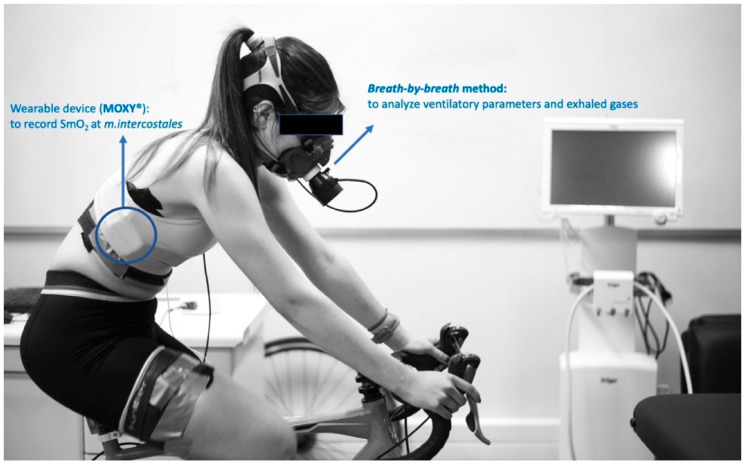
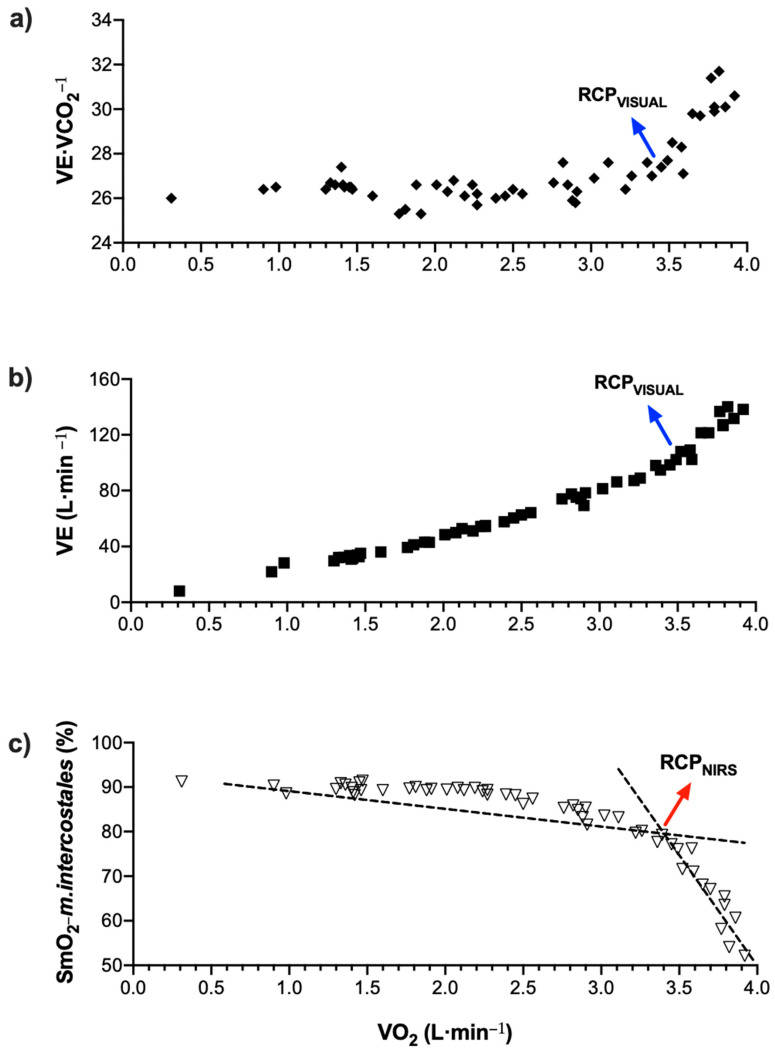
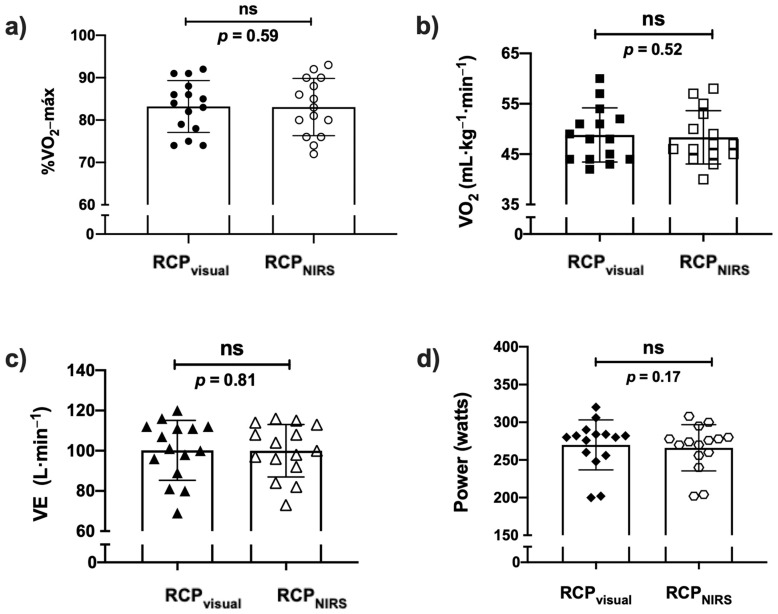
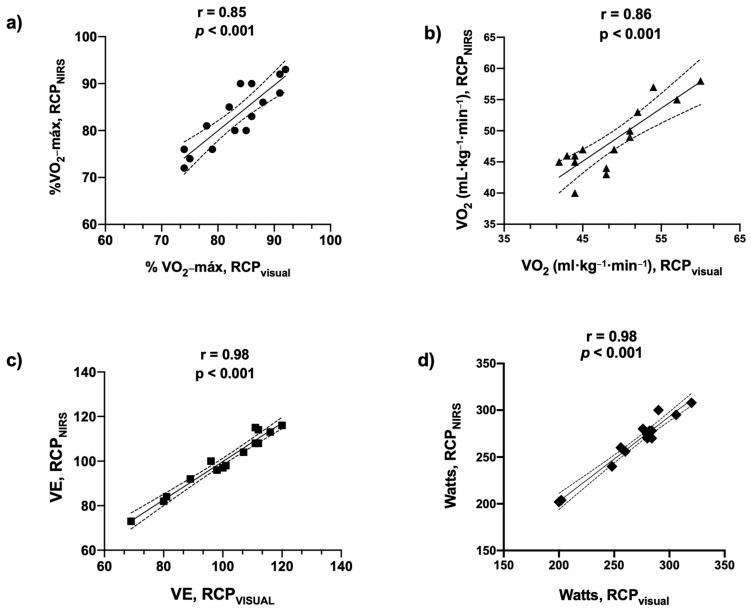
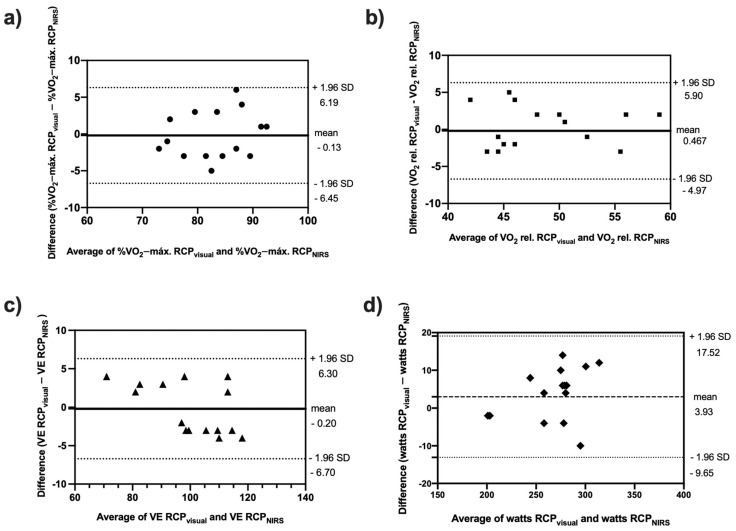
This study aimed to evaluate if the changes in oxygen saturation levels at intercostal muscles (SmO2-m.intercostales) assessed by near-infrared spectroscopy (NIRS) using a wearable device could determine the respiratory compensation point (RCP) during exercise. Fifteen healthy competitive triathletes (eight males; 29 ± 6 years; height 167.6 ± 25.6 cm; weight 69.2 ± 9.4 kg; V˙O2-máx 58.4 ± 8.1 mL·kg−1·min−1) were evaluated in a cycle ergometer during the maximal oxygen-uptake test (V˙O2-máx), while lung ventilation (V˙E), power output (watts, W) and SmO2-m.intercostales were measured. RCP was determined by visual method (RCPvisual: changes at ventilatory equivalents (V˙E·V˙CO2−1, V˙E·V˙O2−1) and end-tidal respiratory pressure (PetO2, PetCO2) and NIRS method (RCPNIRS: breakpoint of fall in SmO2-m.intercostales). During exercise, SmO2-m.intercostales decreased continuously showing a higher decrease when V˙E increased abruptly. A good agreement between methods used to determine RCP was found (visual vs NIRS) at %V˙O2-máx, V˙O2, V˙E, and W (Bland-Altman test). Correlations were found to each parameters analyzed (r = 0.854; r = 0.865; r = 0.981; and r = 0,968; respectively. p < 0.001 in all variables, Pearson test), with no differences (p < 0.001 in all variables, Student’s t-test) between methods used (RCPvisual and RCPNIRS). We concluded that changes at SmO2-m.intercostales measured by NIRS could adequately determine RCP in triathletes.
Overview
The claims and statistics of this paper haven’t been checked yet.
Free: it reads the open-access text and checks the first 5 claims that cite a source we can check. Create a free account to check every claim.
Integrity signals
Registry
Cites
Statistics
Figures
Verification
Claims the paper makes
The claims and statistics of this paper haven’t been checked yet.
Free: it reads the open-access text and checks the first 5 claims that cite a source we can check. Create a free account to check every claim.
Claims other papers make about this one
Each is checked against this paper’s own text: does it say what the citing paper says it does?
The source backs part of the claim, not all of it — or backs it for a different population, condition or comparison.
In the citing paper
“The remaining studies also compared gas exchange with muscle oxygenation in the second threshold in cycling16,39,42,43 and running16,40.”
From Reliability of threshold determination using portable muscle oxygenation monitors during exercise testing: a systematic review and meta-analysis (2023) · cites this paper as [39]
Experimental — accuracy not yet measuredThe source backs part of the claim, not all of it — or backs it for a different population, condition or comparison.
In the citing paper
“The results of the different studies suggest that the relationship between both methods in threshold determination is affected by the region assessed by the NIRS device, as good values (ICC = 0.92–0.97) were observed on assessing the intercostalis during cycling39.”
From Reliability of threshold determination using portable muscle oxygenation monitors during exercise testing: a systematic review and meta-analysis (2023) · cites this paper as [39]
Experimental — accuracy not yet measuredThe source backs part of the claim, not all of it — or backs it for a different population, condition or comparison.
In the citing paper
“Some of the articles included in this review demonstrate mean bias between MOT2 and LT2 or VT2 ranging from 0.01 and 0.4 km·h−125,44,45,49, between 3.9 and 15.4 W39,41, 0.05 W·kg−117 and 10.7% of the power output26.”
From Reliability of threshold determination using portable muscle oxygenation monitors during exercise testing: a systematic review and meta-analysis (2023) · cites this paper as [39]
Experimental — accuracy not yet measuredThe cited source says what the claim attributes to it.
In the citing paper
“The articles included in this systematic review use different methods for determining thresholds: BSX Insight (20%, N = 3)45,47,49, double linear regression (46%, N = 7)16,26,39,41–44, visual method17,25,40, Dmax or modified Dmax46 and applications of devices Humon Beta48.”
From Reliability of threshold determination using portable muscle oxygenation monitors during exercise testing: a systematic review and meta-analysis (2023) · cites this paper as [39]
Self-check
Percentages, sums and reported differences re-computed from the paper’s own numbers.
The self-check needs the paper’s full text.
Citations
Cites
A new method for detecting anaerobic threshold by gas exchange
Beaver, W. L., Wasserman, K., & Whipp, B. J. (1986) · Journal of Applied Physiology · doi:10.1152/jappl.1986.60.6.2020 · Cited by 4,103 · cited 1×
“VO2 [24,44,45], breakpoint at heart-rate variability [46–50], or lactate blood level curves [11,41,51]; however, in order to diminish the variability inter- and intra- evaluator, we chose the method widely used for exercise”
ATS/ERS Statement on Respiratory Muscle Testing
(2002) · American Journal of Respiratory and Critical Care Medicine · doi:10.1164/rccm.166.4.518 · Cited by 2,841
Estimating regression models with unknown break‐points
Muggeo, V. M. R. (2003) · Statistics in Medicine · doi:10.1002/sim.1545 · Cited by 2,371 · cited 11×
“intercostales values recorded by MOXY® [33].”
InfluentialThe maximal expiratory flow-volume curve. Normal standards, variability, and effects of age.
Knudson, R. J., Slatin, R. C., Lebowitz, M. D., & Burrows, B. A. (1976) · PubMed · doi:10.1164/arrd.1976.113.5.587 · Cited by 695 · cited 1×
“…the participants arrived at the laboratory; subsequently, spirometry (Microlab, model ML3500, CareFusion®, San Diego, CA, USA) was performed according to the American Thoracic Society (ATS) and European Respiratory Society (ERS) protocols [26], utilizing the reference values of Knudson et al. [27].”
Validation of near-infrared spectroscopy in humans
Mancini, D. M., Bolinger, L., Li, H., Kendrick, K., Chance, B., & Wilson, J. R. (1994) · Journal of Applied Physiology · doi:10.1152/jappl.1994.77.6.2740 · Cited by 669 · cited 1×
“Regarding, SmO2 has mainly been evaluated in locomotor muscles [12], showing good values for validity [13] and reliability [14,15].”
BackgroundSeiler, K. S., & Kjerland, G. Ø. (2006) · Scandinavian Journal of Medicine & Science in Sports · doi:10.1111/j.1600-0838.2004.00418.x · Cited by 643
What is Best Practice for Training Intensity and Duration Distribution in Endurance Athletes?
Seiler, S. (2010) · International Journal of Sports Physiology and Performance · doi:10.1123/ijspp.5.3.276 · Cited by 625 · cited 1×
“as marathon, road cycling, or triathlon [1–3].”
Understanding near infrared spectroscopy and its application to skeletal muscle research
Barstow, T. J. (2019) · Journal of Applied Physiology · doi:10.1152/japplphysiol.00166.2018 · Cited by 470 · cited 2×
“, (2021) in runners [25] have reported interesting results, those data are difficult to extrapolate to our participants owing to factors such as the method used for RCP determination [11,32], sex-differences associated to ventilatory response to exercise [23], high biological variability of cardioventilatory responses…”
The maximally attainable V̇o2during exercise in humans: the peak vs. maximum issue
Day, J. R., Rossiter, H. B., Coats, E. M., Skasick, A., & Whipp, B. J. (2003) · Journal of Applied Physiology · doi:10.1152/japplphysiol.00024.2003 · Cited by 447 · cited 1×
“The V̇ O 2 -máx. was calculated as the highest value obtained during the last 30 s of the incremental test, despite increasing the exercise intensity (<150 mL·min −1 of exercise) [28].”
An Examination and Critique of Current Methods to Determine Exercise Intensity
Jamnick, N. A., Pettitt, R. W., Granata, C., Pyne, D. B., & Bishop, D. J. (2020) · Sports Medicine · doi:10.1007/s40279-020-01322-8 · Cited by 424
Cited by
Muscle Oximetry in Sports Science: An Updated Systematic Review
Perrey, S., Quaresima, V., & Ferrari, M. (2024) · Sports Medicine · doi:10.1007/s40279-023-01987-x · Cited by 100
Sendra-Pérez, C., Sanchez-Jimenez, J. L., Marzano-Felisatti, J. M., Encarnación-Martínez, A., Salvador-Palmer, R., & Priego-Quesada, J. I. (2023) · Scientific Reports · doi:10.1038/s41598-023-39651-z · Cited by 52
“The articles included in this systematic review use different methods for determining thresholds: BSX Insight (20%, N = 3) 45,47,49 , double linear regression (46%, N = 7) 16,26,39,41–44 , visual method 17,25,40 , Dmax or modified Dmax 46 and applications of devices Humon Beta 48 .”
BackgroundMethodResultInfluentialKowalski, T., Kasiak, P. S., Rębiś, K., Klusiewicz, A., Granda, D., & Wiecha, S. (2023) · Frontiers in Physiology · doi:10.3389/fphys.2023.1264265 · Cited by 29
Sendra-Pérez, C., Encarnacion-Martinez, A., Salvador-Palmer, R., Murias, J. M., & Priego-Quesada, J. I. (2025) · European Journal of Applied Physiology · doi:10.1007/s00421-024-05593-1 · Cited by 16
“…2021), most of the studies examining NIRS break-points have only assessed one muscle, such as the vastus lateralis (Cayot et al. 2021), rectus femoris (Salas-Montoro et al. 2022), deltoideus (Yogev et al. 2022), gastrocnemius (Borges & Driller 2016), or intercostals (Contreras-Briceño et al. 2022).”
Espinosa‐Ramírez, M., Riquelme-Sánchez, S., Araya, F., Rodríguez, G., Figueroa-Martínez, F., Gabrielli, L., Viscor, G., Reid, W. D., & Briceño, F. A. C. (2023) · Biology · doi:10.3390/biology12020219 · Cited by 21
Self-citation
Metadata
- Authors
- Contreras-Briceño, F., Espinosa-Ramirez, M., Keim-Bagnara, V., Carreño-Román, M., Rodríguez-Villagra, R., Villegas-Belmar, F., Viscor, G., Gabrielli, L., Andía, M. E., Araneda, O. F., & Hurtado, D. E.
- Affiliations
- Laboratory of Exercise Physiology, Department of Health Science, Facultad de Medicina, Pontificia Universidad Católica de Chile, Santiago 7820436, Chile
- Pontificia Universidad Católica de Chile (CL)
- Universitat de Barcelona (ES)
- Universidad de Los Andes, Chile (CL)
- ORCID
- Venue
- Life
- Publisher
- MDPI AG
- Published
- 2022-03-17
- Volume
- 12
- Issue
- 3
- Pages
- 444
- ISSN
- 2075-1729 (ISSN-L)
- PMC
- PMC8954259
- OpenAlex
- W4220866167
- Cited by
- 17
- References
- 67
- Citations by year
- 2026: 2 · 2025: 6 · 2024: 5 · 2023: 4
- FWCI
- 3.92
- Type
- journal article
- Language
- en
- Open access
- gold
- doi.org
- Licence
- Locations
- Life (publishedVersion, cc-by)
- PubMed Central (publishedVersion, cc-by)
- PubMed (publishedVersion)
- Dipòsit Digital de la Universitat de Barcelona (Universitat de Barcelona) (submittedVersion, cc-by)
- DOAJ (DOAJ: Directory of Open Access Journals) (submittedVersion, cc-by-sa)
- Funders
- ANID-Millennium Science Initiative Program (ICN2021_004)
- Topics
- Health Sciences › Medicine › Physiology (medical) › Cardiovascular and exercise physiology
- Health Sciences › Medicine › Orthopedics and Sports Medicine › Sports Performance and Training
- Physical Sciences › Engineering › Biomedical Engineering › Non-Invasive Vital Sign Monitoring
- Keywords
- respiratory compensation point, near-infrared spectroscopy, ventilatory equivalents, VO2max, exercise ventilation, triathletes
About these checks
Registry, retraction, Cites and statistics results are computed, not judged, with one exception: a printed reference that no index lists is read once by a model before it counts as a citation error. Claims are extracted by a model and kept only when their quote appears verbatim in the text; each cited source is then checked, with a model’s help, for whether it says what the claim relies on. Those verdicts can be wrong — read the claim’s quote and the cited source before relying on one.
Statistics and arithmetic are recomputed, not judged.
Confidence bands are shown only for fields calibrated on our annotated test set. None is calibrated yet, so no band is shown.
What counts as a claim ›How we measure confidence ›How we check this ›
Are you an author, or do you see a problem with this page? Request a review
How to cite
Cite CoChat for the checks on this page, and the paper for its own findings.
- This page
- CoChat. (2026). Citation check: Determination of the Respiratory Compensation Point by Detecting Changes in Intercostal Muscles Oxygenation by Using Near-Infrared Spectroscopy. https://app.cochat.ai/papers/10.3390/life12030444
- The paper
- Contreras-Briceño, F., Espinosa-Ramirez, M., Keim-Bagnara, V., Carreño-Román, M., Rodríguez-Villagra, R., Villegas-Belmar, F., Viscor, G., Gabrielli, L., Andía, M. E., Araneda, O. F., & Hurtado, D. E. (2022). Determination of the Respiratory Compensation Point by Detecting Changes in Intercostal Muscles Oxygenation by Using Near-Infrared Spectroscopy. Life. https://doi.org/10.3390/life12030444
Data sources
Bibliographic data: Semantic Scholar, OpenAlex, Crossref.
Contains information from the Semantic Scholar Academic Graph Datasets, made available under the ODC Attribution License (ODC-BY 1.0).
Semantic Scholar’s data is described in: Kinney, R., et al. (2023). The Semantic Scholar Open Data Platform. arXiv:2301.10140.
