

The DOI matches its Crossref record; 35 of the 35 references it cites were found in a registry or an index; none of the 16 sources its claims cite is checked for support yet.
Activated Carbon Produced by Pyrolysis of Waste Wood and Straw for Potential Wastewater Adsorption
Open accessAbstract
Pyrolysis of straw pellets and wood strips was performed in a fixed bed reactor. The chars, solid products of thermal degradation, were used as potential materials for activated carbon production. Chemical and physical activation processes were used to compare properties of the products. The chemical activation agent KOH was chosen and the physical activation was conducted with steam and carbon dioxide as oxidising gases. The effect of the activation process on the surface area, pore volume, structure and composition of the biochar was examined. The samples with the highest surface area (1349.6 and 1194.4 m2/g for straw and wood activated carbons, respectively) were obtained when the chemical activation with KOH solution was applied. The sample with the highest surface area was used as an adsorbent for model wastewater contamination removal.
Overview
AI snapshot
Written from the paper’s full text.
TL;DR
Pyrolysis of waste straw pellets and beech wood strips at 800 °C produced biochars that were activated chemically with KOH or physically with steam/CO₂. KOH activation gave the highest surface areas, and the best straw-derived activated carbon removed Rhodamine B from model aqueous solutions.
Key findings
- Chemical activation with KOH produced the highest surface areas: 1349.6 m²/g for straw-derived activated carbon and 1194.4 m²/g for wood-derived activated carbon.
- Physical activation with CO₂ at a 1:1 gas-to-carbon molar ratio gave lower surface areas: 682.1 m²/g and 0.35 cm³/g pore volume for straw, and 385 m²/g and 0.2 cm³/g for wood; lower gas ratios (1:0.5) gave less extended surface area.
- Unactivated biochars had low surface areas: 3.1 m²/g for straw char and 27.3 m²/g for wood char.
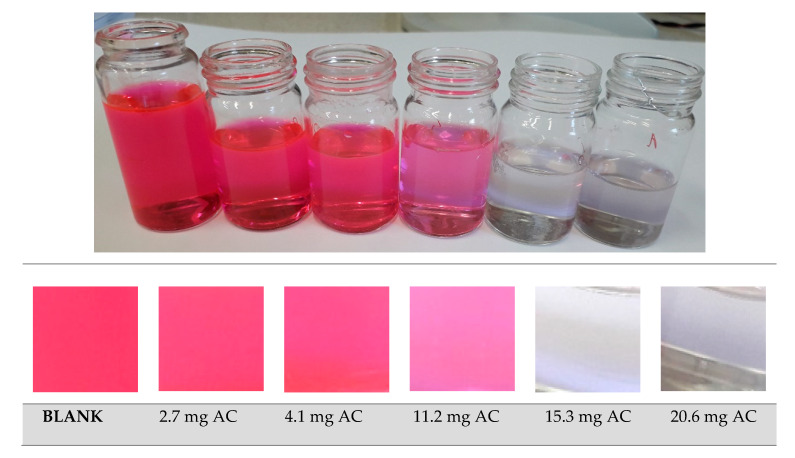
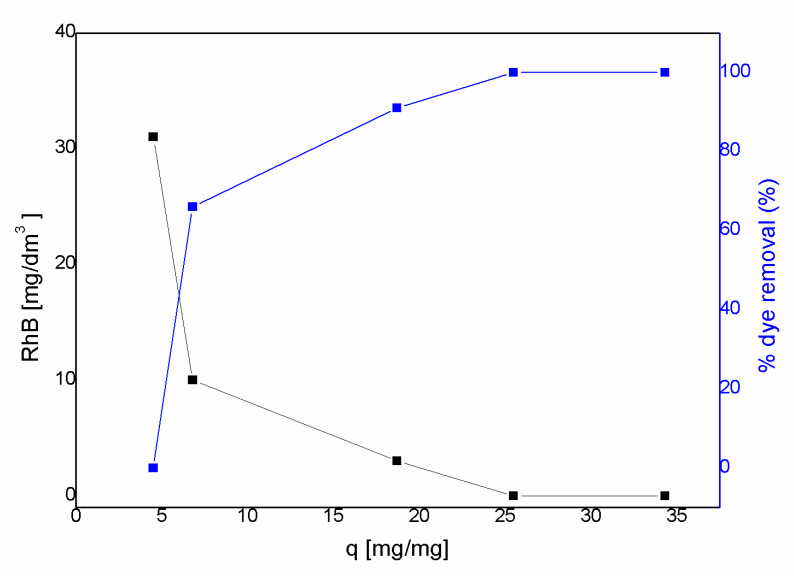
- In Rhodamine B adsorption tests using the 1349.6 m²/g straw-based activated carbon, 4.1 mg of AC decreased RhB concentration by 30%, and total removal of the model solution colour occurred when 15.3 mg AC was added.
Methods
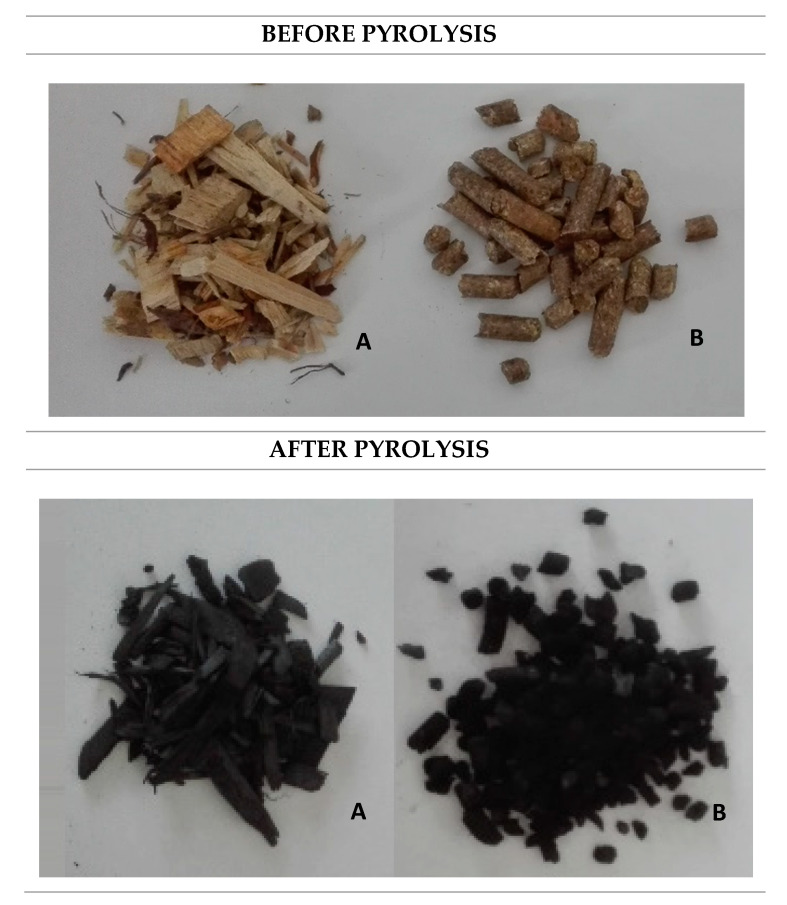
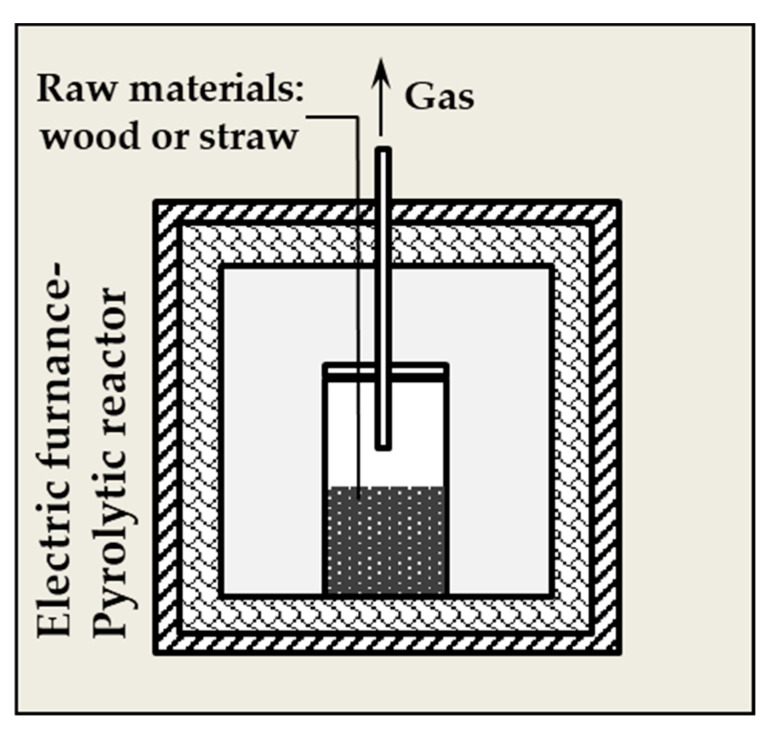
- Fast pyrolysis of about 100 g biomass was performed in a fixed-bed steel reactor at 800 °C for 30 min with a heating rate of 100 °C/min under limited air; char yields used were 23.8 g for straw pellets and 22.5 g for wood chips.
- Activation methods: chemical activation with solid KOH at a 1:2 char:KOH mass ratio, heated at 850 °C for 1 h under N₂ at 50 mL/min; physical activation with steam or CO₂ at 850 °C, gas flow 10 dm³/h for 0.5 or 1 h, using biochar-to-gas molar ratios of 1:0.5 and 1:1.
- Materials were characterised by CHNS-O analysis, thermogravimetry, moisture and calorific value analysis, BET N₂ adsorption–desorption at 77 K, and SEM; RhB adsorption was tested at 25 °C with 20 mL of 30 mg/dm³ dye solution, AC doses from 2.7 to 20.6 mg, 30 min shaking at 120 rpm, and UV-VIS at 553 nm.
Limitations
- The paper states that in the adsorption study the authors used only one, but the most important parameter, to confirm sorption properties of the straw-derived AC; pH, temperature, ionic strength, and other solution parameters were kept constant rather than varied.
- Evident from the text: adsorption was tested only with Rhodamine B as a model contaminant, at a single initial concentration of 30 mg/dm³, and only with the highest-surface-area straw-based KOH-activated carbon.
- Evident from the text: no regeneration, reusability, continuous-flow, or real wastewater tests are reported, and the adsorption analysis does not include kinetic or equilibrium isotherm modelling.
Model-written summary. Check it against the paper before relying on it.
Integrity signals
Registry
Cites
Statistics
Figures
Verification
Claims the paper makes
24 Own result · 11 No full text of the sources · 6 Own interpretation · 3 Not checked yet · 2 Own method · 2 No basis given
A result the paper reports from its own data — it cites no other source for it, so there is none to check. The quote shows it is in the paper.
In the paper
“The results of the surface analysis revealed that the mechanism of chemical activation was more effective in comparison to the use of other activation agents.”
- Also stated in: § 4. Conclusions · plain
“Nevertheless, the chemical activation was more effective than the physical method.”
§ Activated Carbon Produced by Pyrolysis of Waste Wood and Straw for Potential Wastewater Adsorption > 3. Results and Discussion > 3.1. Characterisation of Carbon Materials
plaindirect- Asserted: passes — The authors put it forward as true.
- Checkable: passes — It can be checked against evidence.
- Load-bearing: passes — The paper’s conclusions depend on it.
- Based: passes — The paper gives a reason why it holds.
- Also stated in: § 4. Conclusions · plain
A result the paper reports from its own data — it cites no other source for it, so there is none to check. The quote shows it is in the paper.
In the paper
“Moreover, it was shown that the higher the amount of the activation agent, the greater is the adsorption surface.”
§ Activated Carbon Produced by Pyrolysis of Waste Wood and Straw for Potential Wastewater Adsorption > 4. Conclusions
plaindirect- Asserted: passes — The authors put it forward as true.
- Checkable: passes — It can be checked against evidence.
- Load-bearing: passes — The paper’s conclusions depend on it.
- Based: passes — The paper gives a reason why it holds.
A result the paper reports from its own data — it cites no other source for it, so there is none to check. The quote shows it is in the paper.
In the paper
“A higher surface area was obtained when CO2 was used as an agent in comparison to steam.”
§ Activated Carbon Produced by Pyrolysis of Waste Wood and Straw for Potential Wastewater Adsorption > 4. Conclusions
plaindirect- Asserted: passes — The authors put it forward as true.
- Checkable: passes — It can be checked against evidence.
- Load-bearing: passes — The paper’s conclusions depend on it.
- Based: passes — The paper gives a reason why it holds.
A result the paper reports from its own data — it cites no other source for it, so there is none to check. The quote shows it is in the paper.
In the paper
“As expected, the effectiveness of adsorption increased with increasing amounts of the activated carbon used in the experiment until the complete discoloration of the solution.”
§ Activated Carbon Produced by Pyrolysis of Waste Wood and Straw for Potential Wastewater Adsorption > 3. Results and Discussion > 3.2. Adsorption Analysis with Rhodamine B
plaindirect- Asserted: passes — The authors put it forward as true.
- Checkable: passes — It can be checked against evidence.
- Load-bearing: unclear — It is unclear whether the paper’s conclusions depend on it.
- Based: passes — The paper gives a reason why it holds.
A result the paper reports from its own data — it cites no other source for it, so there is none to check. The quote shows it is in the paper.
In the paper
“In both experiments, a lower gas (CO2 and steam) to carbon molar ratio (1:0.5) provided a less extended surface area of the final material.”
§ Activated Carbon Produced by Pyrolysis of Waste Wood and Straw for Potential Wastewater Adsorption > 3. Results and Discussion > 3.1. Characterisation of Carbon Materials
plaindirect- Asserted: passes — The authors put it forward as true.
- Checkable: passes — It can be checked against evidence.
- Load-bearing: unclear — It is unclear whether the paper’s conclusions depend on it.
- Based: passes — The paper gives a reason why it holds.
A result the paper reports from its own data — it cites no other source for it, so there is none to check. The quote shows it is in the paper.
In the paper
“Total removal of the model solution colour can be observed when 15.3 mg AC was added.”
§ Activated Carbon Produced by Pyrolysis of Waste Wood and Straw for Potential Wastewater Adsorption > 3. Results and Discussion > 3.2. Adsorption Analysis with Rhodamine B
plaindirect- Asserted: passes — The authors put it forward as true.
- Checkable: passes — It can be checked against evidence.
- Load-bearing: passes — The paper’s conclusions depend on it.
- Based: passes — The paper gives a reason why it holds.
A result the paper reports from its own data — it cites no other source for it, so there is none to check. The quote shows it is in the paper.
In the paper
“Analysis of the results presented in Table 2 indicate that the surface area of the activated carbons prepared using the straw pellets is relatively higher.”
- Also stated in: § 4. Conclusions · plain
“A comparison of the results determined for both biomass samples revealed that activated carbon produced from straw pellets had higher surface area regardless of the activation method.”
§ Activated Carbon Produced by Pyrolysis of Waste Wood and Straw for Potential Wastewater Adsorption > 3. Results and Discussion > 3.1. Characterisation of Carbon Materials
plaincorrelational- Asserted: passes — The authors put it forward as true.
- Checkable: passes — It can be checked against evidence.
- Load-bearing: passes — The paper’s conclusions depend on it.
- Based: passes — The paper gives a reason why it holds.
- Also stated in: § 4. Conclusions · plain
A result the paper reports from its own data — it cites no other source for it, so there is none to check. The quote shows it is in the paper.
In the paper
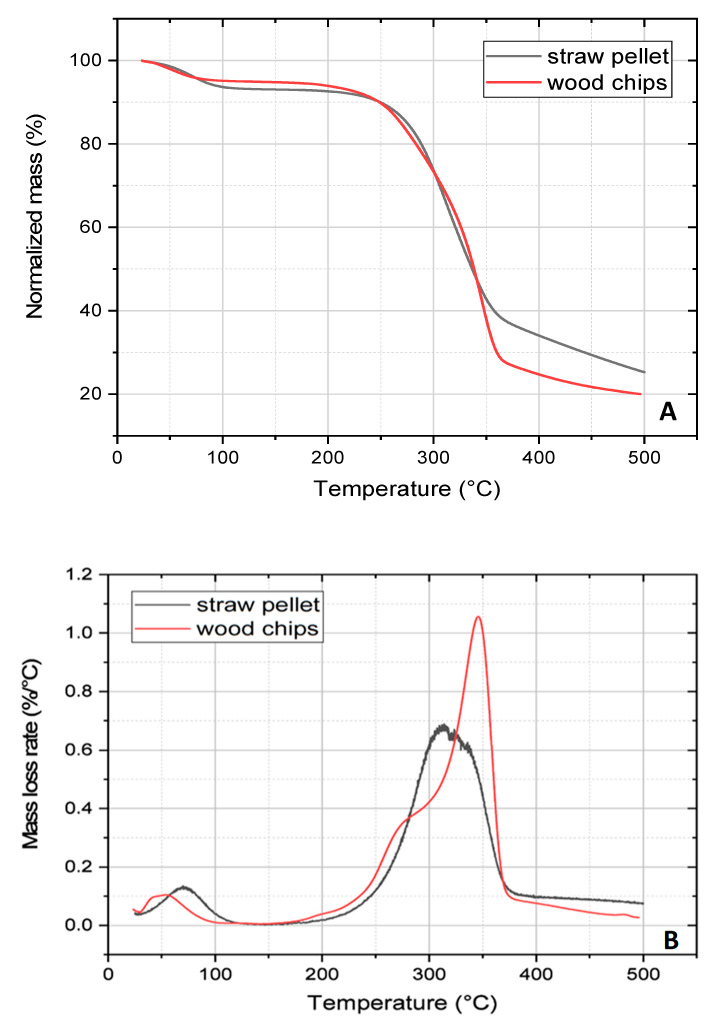
“Comparing the properties of the samples, the decomposition of straw pellets occurs in the temperature range of 220–380 °C, similar to the wood sample.”
§ Activated Carbon Produced by Pyrolysis of Waste Wood and Straw for Potential Wastewater Adsorption > 3. Results and Discussion
plain- Asserted: passes — The authors put it forward as true.
- Checkable: passes — It can be checked against evidence.
- Load-bearing: unclear — It is unclear whether the paper’s conclusions depend on it.
- Based: passes — The paper gives a reason why it holds.
A result the paper reports from its own data — it cites no other source for it, so there is none to check. The quote shows it is in the paper.
In the paper
“Rhodamine, the model waste water contaminant, is adsorbed even by small amounts of AC, with 4.1 mg decreasing the RhB concentration by 30%.”
§ Activated Carbon Produced by Pyrolysis of Waste Wood and Straw for Potential Wastewater Adsorption > 3. Results and Discussion > 3.2. Adsorption Analysis with Rhodamine B
plaindirect- Asserted: passes — The authors put it forward as true.
- Checkable: passes — It can be checked against evidence.
- Load-bearing: passes — The paper’s conclusions depend on it.
- Based: passes — The paper gives a reason why it holds.
A result the paper reports from its own data — it cites no other source for it, so there is none to check. The quote shows it is in the paper.
In the paper
“Elemental analysis revealed that wood is composed of 45.0 wt.% carbon, 6.4 wt.% hydrogen, 1.3 wt.% nitrogen and 47.3 wt.% oxygen.”
§ Activated Carbon Produced by Pyrolysis of Waste Wood and Straw for Potential Wastewater Adsorption > 3. Results and Discussion
plain- Asserted: passes — The authors put it forward as true.
- Checkable: passes — It can be checked against evidence.
- Load-bearing: passes — The paper’s conclusions depend on it.
- Based: passes — The paper gives a reason why it holds.
- It may state two separate claims as one. 16
- Probably not a substantial claim. 16
The paper states this without a source or data behind it here, so there is nothing to check it against. The quote shows it is in the paper.
In the paper
“As a consequence of the substrate thermal decomposition, the relative content of hydrogen decreased (released in the gas phase), whereas nitrogen increased (up to 3.4–3.5 wt.%).”
§ Activated Carbon Produced by Pyrolysis of Waste Wood and Straw for Potential Wastewater Adsorption > 3. Results and Discussion > 3.1. Characterisation of Carbon Materials
plaindirect- Asserted: passes — The authors put it forward as true.
- Checkable: passes — It can be checked against evidence.
- Load-bearing: unclear — It is unclear whether the paper’s conclusions depend on it.
- Based: passes — The paper gives a reason why it holds.
It may state two separate claims as one.
A result the paper reports from its own data — it cites no other source for it, so there is none to check. The quote shows it is in the paper.
In the paper
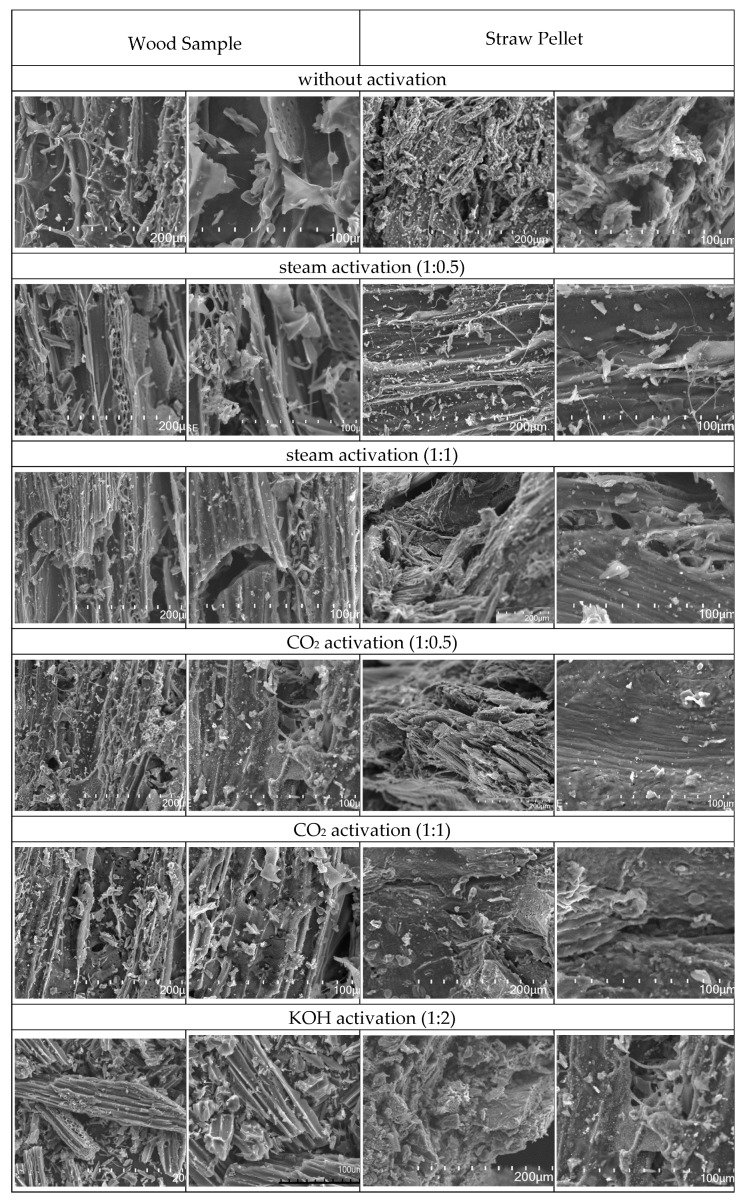
“It was observed that with increasing surface area, the number of single particles decreased and the surface became less frayed.”
§ Activated Carbon Produced by Pyrolysis of Waste Wood and Straw for Potential Wastewater Adsorption > 3. Results and Discussion > 3.1. Characterisation of Carbon Materials
plaincorrelational- Asserted: passes — The authors put it forward as true.
- Checkable: passes — It can be checked against evidence.
- Load-bearing: passes — The paper’s conclusions depend on it.
- Based: passes — The paper gives a reason why it holds.
It may state two separate claims as one.
A result the paper reports from its own data — it cites no other source for it, so there is none to check. The quote shows it is in the paper.
In the paper
“The highest surface area and pore volume of the physically treated samples was obtained for a CO2 to carbon molar ratio of 1:1, with results of 682.1 m2/g: 0.35 cm3/g as determined for straw and 385 m2/g: 0.2 cm3/g for wood.”
§ Activated Carbon Produced by Pyrolysis of Waste Wood and Straw for Potential Wastewater Adsorption > 3. Results and Discussion > 3.1. Characterisation of Carbon Materials
plaincorrelational- Asserted: passes — The authors put it forward as true.
- Checkable: passes — It can be checked against evidence.
- Load-bearing: unclear — It is unclear whether the paper’s conclusions depend on it.
- Based: passes — The paper gives a reason why it holds.
It may state two separate claims as one.
A result the paper reports from its own data — it cites no other source for it, so there is none to check. The quote shows it is in the paper.
In the paper
“For comparison, waste straw contained more volatiles (85.6 wt.%) and more ash 5.9 (wt.%), but less moisture (6.7 wt.%).”
§ Activated Carbon Produced by Pyrolysis of Waste Wood and Straw for Potential Wastewater Adsorption > 3. Results and Discussion
plain- Asserted: passes — The authors put it forward as true.
- Checkable: passes — It can be checked against evidence.
- Load-bearing: unclear — It is unclear whether the paper’s conclusions depend on it.
- Based: passes — The paper gives a reason why it holds.
It may state two separate claims as one.
A result the paper reports from its own data — it cites no other source for it, so there is none to check. The quote shows it is in the paper.
In the paper
“RhB was completely adsorbed on porous material and could not be detected using UV-VIS analysis.”
§ Activated Carbon Produced by Pyrolysis of Waste Wood and Straw for Potential Wastewater Adsorption > 3. Results and Discussion > 3.2. Adsorption Analysis with Rhodamine B
plaindirect- Asserted: passes — The authors put it forward as true.
- Checkable: passes — It can be checked against evidence.
- Load-bearing: passes — The paper’s conclusions depend on it.
- Based: passes — The paper gives a reason why it holds.
It may state two separate claims as one.
A result the paper reports from its own data — it cites no other source for it, so there is none to check. The quote shows it is in the paper.
In the paper
“The surface area of these samples (reference samples shown in Table 2) was relatively low: 3.1 m2/g and 27.3 m2/g for straw and wood char, respectively.”
§ Activated Carbon Produced by Pyrolysis of Waste Wood and Straw for Potential Wastewater Adsorption > 3. Results and Discussion > 3.1. Characterisation of Carbon Materials
plain- Asserted: passes — The authors put it forward as true.
- Checkable: passes — It can be checked against evidence.
- Load-bearing: unclear — It is unclear whether the paper’s conclusions depend on it.
- Based: passes — The paper gives a reason why it holds.
It may state two separate claims as one.
A result the paper reports from its own data — it cites no other source for it, so there is none to check. The quote shows it is in the paper.
In the paper
“According to the elemental analysis the content of carbon, hydrogen, nitrogen and oxygen in the straw was 49.0 wt.%, 6.9 wt.%, 1.7 wt.% and 36.6 wt.%, respectively.”
§ Activated Carbon Produced by Pyrolysis of Waste Wood and Straw for Potential Wastewater Adsorption > 3. Results and Discussion
plain- Asserted: passes — The authors put it forward as true.
- Checkable: passes — It can be checked against evidence.
- Load-bearing: passes — The paper’s conclusions depend on it.
- Based: passes — The paper gives a reason why it holds.
It may state two separate claims as one.
A result the paper reports from its own data — it cites no other source for it, so there is none to check. The quote shows it is in the paper.
In the paper
“The main difference in both characteristics is that the derivative of mass loss (DTG) curve (Figure 3B), representing pyrolysis of the wood, contains a main degradation peak as well as a smaller one appearing on the left side (wood degrades gradually). The straw pellet degradation, in turn, revealed only one main characteristic peak.”
§ Activated Carbon Produced by Pyrolysis of Waste Wood and Straw for Potential Wastewater Adsorption > 3. Results and Discussion
plain- Asserted: passes — The authors put it forward as true.
- Checkable: passes — It can be checked against evidence.
- Load-bearing: unclear — It is unclear whether the paper’s conclusions depend on it.
- Based: passes — The paper gives a reason why it holds.
It may state two separate claims as one.
A result the paper reports from its own data — it cites no other source for it, so there is none to check. The quote shows it is in the paper.
In the paper
“As expected, the elemental analysis confirmed an increase in the carbon content up to 76.2 wt.% (from 49 wt.% before pyrolysis) and 74.0 wt.% (from 45 wt.% before pyrolysis) in the straw and wood chars, respectively.”
§ Activated Carbon Produced by Pyrolysis of Waste Wood and Straw for Potential Wastewater Adsorption > 3. Results and Discussion > 3.1. Characterisation of Carbon Materials
plaindirect- Asserted: passes — The authors put it forward as true.
- Checkable: passes — It can be checked against evidence.
- Load-bearing: unclear — It is unclear whether the paper’s conclusions depend on it.
- Based: passes — The paper gives a reason why it holds.
It may state two separate claims as one.
A result the paper reports from its own data — it cites no other source for it, so there is none to check. The quote shows it is in the paper.
In the paper
“The wood samples contained 67.9 wt.% volatiles, 8.4 wt.% moisture and 2.3 wt.% of ash.”
§ Activated Carbon Produced by Pyrolysis of Waste Wood and Straw for Potential Wastewater Adsorption > 3. Results and Discussion
plain- Asserted: passes — The authors put it forward as true.
- Checkable: passes — It can be checked against evidence.
- Load-bearing: unclear — It is unclear whether the paper’s conclusions depend on it.
- Based: passes — The paper gives a reason why it holds.
It may state two separate claims as one.
A result the paper reports from its own data — it cites no other source for it, so there is none to check. The quote shows it is in the paper.
In the paper
“However, the maximum of the main peak representing the degradation of wood was detected at 350 °C and this peak was higher than that obtained for straw (maximum at 300 °C).”
§ Activated Carbon Produced by Pyrolysis of Waste Wood and Straw for Potential Wastewater Adsorption > 3. Results and Discussion
plain- Asserted: passes — The authors put it forward as true.
- Checkable: passes — It can be checked against evidence.
- Load-bearing: unclear — It is unclear whether the paper’s conclusions depend on it.
- Based: passes — The paper gives a reason why it holds.
It may state two separate claims as one.
In the paper
“Steam or carbon dioxide used as physical activation agents, in turn, penetrate solid structure, remove volatile residues and facilitate their desorption [30].”
§ Activated Carbon Produced by Pyrolysis of Waste Wood and Straw for Potential Wastewater Adsorption > 3. Results and Discussion > 3.1. Characterisation of Carbon Materials
What the sources say
- Not checked — no full text of the sourcecites [30] Cha, 2016, Production and utilization of biochar: A review, J. Ind. Eng. Chem. source
plaindirect- Asserted: passes — The authors put it forward as true.
- Checkable: passes — It can be checked against evidence.
- Load-bearing: fails — The paper’s conclusions may not depend on it.
- Based: passes — The paper gives a reason why it holds.
Probably not a substantial claim. The paper’s conclusions may not depend on it. It may state two separate claims as one.
What the paper did — it cites no source for this, so there is none to check. The quote shows it is in the paper.
In the paper
“In all experiments of the RhB removal, the particle size, temperature, contact time (30 min), initial concentration, pH and concentration of the other ions were kept constant.”
§ Activated Carbon Produced by Pyrolysis of Waste Wood and Straw for Potential Wastewater Adsorption > 3. Results and Discussion > 3.2. Adsorption Analysis with Rhodamine B
plainn = 6- Asserted: passes — The authors put it forward as true.
- Checkable: passes — It can be checked against evidence.
- Load-bearing: fails — The paper’s conclusions may not depend on it.
- Based: passes — The paper gives a reason why it holds.
Probably not a substantial claim. The paper’s conclusions may not depend on it.
In the paper
“The KOH dosage was chosen based on the previous investigation [30], which revealed that an increase in the KOH: char mass ratio provides a higher surface area of the material.”
§ Activated Carbon Produced by Pyrolysis of Waste Wood and Straw for Potential Wastewater Adsorption > 2. Materials and Methods > 2.2. Pyrolysis and Activation Process of Biochar
What the sources say
- Not checked — no full text of the sourcecites [30] Cha, 2016, Production and utilization of biochar: A review, J. Ind. Eng. Chem. source
plaindirect- Asserted: passes — The authors put it forward as true.
- Checkable: passes — It can be checked against evidence.
- Load-bearing: passes — The paper’s conclusions depend on it.
- Based: passes — The paper gives a reason why it holds.
Probably not a substantial claim.
In the paper
“The quality and quantity of each product are highly influenced by the temperature of the process, residence time, heating rate, and size and shape of the biomass particles [6].”
§ Activated Carbon Produced by Pyrolysis of Waste Wood and Straw for Potential Wastewater Adsorption > 1. Introduction
What the sources say
- Not checked — no full text of the sourcecites [6] Tripathi, 2016, Effect of process parameters on production of biochar from biomass waste through pyrolysis: A review, Renew. Sustain. Energy Rev. source
plaindirect- Asserted: passes — The authors put it forward as true.
- Checkable: passes — It can be checked against evidence.
- Load-bearing: fails — The paper’s conclusions may not depend on it.
- Based: passes — The paper gives a reason why it holds.
Probably not a substantial claim. The paper’s conclusions may not depend on it.
In the paper
“However, the value of pH does not significantly affect the efficiency of dye adsorption.”
§ Activated Carbon Produced by Pyrolysis of Waste Wood and Straw for Potential Wastewater Adsorption > 3. Results and Discussion > 3.2. Adsorption Analysis with Rhodamine B
What the sources say
- Not checked — no full text of the sourcecites [34] Hema, 2009, Rhodamine B adsorption by activated carbon: Kinetic and equilibrium studies, Indian J. Chem. Technol.
plain- Asserted: passes — The authors put it forward as true.
- Checkable: passes — It can be checked against evidence.
- Load-bearing: fails — The paper’s conclusions may not depend on it.
- Based: passes — The paper gives a reason why it holds.
Probably not a substantial claim. The paper’s conclusions may not depend on it.
None of the sources cited for this claim have been checked yet.
In the paper
“During pyrolysis, biomass is thermally decomposed in the oxygen-depleted conditions with temperatures between 300 and 1200 °C.”
§ Activated Carbon Produced by Pyrolysis of Waste Wood and Straw for Potential Wastewater Adsorption > 1. Introduction
What the sources say
- Not checked — no full text of the sourcecites [2] Sharma, 2015, Biomass pyrolysis—A review of modelling, process parameters and catalytic studies, Renew. Sustain. Energy Rev. source
- Not checked yetcites [3] Pawel, 2017, Utjecaj temperature na sastav proizvoda pirolize drva, Drv. Ind.
plain- Asserted: passes — The authors put it forward as true.
- Checkable: passes — It can be checked against evidence.
- Load-bearing: fails — The paper’s conclusions may not depend on it.
- Based: passes — The paper gives a reason why it holds.
Probably not a substantial claim. The paper’s conclusions may not depend on it.
In the paper
“Activation processes increase porosity, enhance surface areas and modify chemical properties by introducing a variety of surface sites such as carboxylic, phenolic, hydroxylic and carbonyl groups [22].”
§ Activated Carbon Produced by Pyrolysis of Waste Wood and Straw for Potential Wastewater Adsorption > 1. Introduction
What the sources say
- Not checked — no full text of the sourcecites [22] Figueiredo, 1999, Modification of the surface chemistry of activated carbons, Carbon N.Y. source
plaindirect- Asserted: passes — The authors put it forward as true.
- Checkable: passes — It can be checked against evidence.
- Load-bearing: fails — The paper’s conclusions may not depend on it.
- Based: passes — The paper gives a reason why it holds.
Probably not a substantial claim. The paper’s conclusions may not depend on it. It may state two separate claims as one.
A claim is checked only against the cited paper’s full text, never its abstract, and none is available for its sources.
In the paper
“Nevertheless, pH determines formation of various ionic species in solutions and influences surface charge of the carbon [34,39].”
§ Activated Carbon Produced by Pyrolysis of Waste Wood and Straw for Potential Wastewater Adsorption > 3. Results and Discussion > 3.2. Adsorption Analysis with Rhodamine B
What the sources say
- Not checked — no full text of the sourcecites [34] Hema, 2009, Rhodamine B adsorption by activated carbon: Kinetic and equilibrium studies, Indian J. Chem. Technol.
- Not checked — no full text of the sourcecites [39] Arivoli, 2009, Adsorption of rhodamine B by acid activated carbon-kinetic, thermodynamic and equilibrium studies, Orbital source
plaindirect- Asserted: passes — The authors put it forward as true.
- Checkable: passes — It can be checked against evidence.
- Load-bearing: fails — The paper’s conclusions may not depend on it.
- Based: passes — The paper gives a reason why it holds.
Probably not a substantial claim. The paper’s conclusions may not depend on it. It may state two separate claims as one.
In the paper
“Thermal degradation processes, like pyrolysis or gasification, were designed to convert the organic matter into a variety of products including gases, oils and chars [1].”
§ Activated Carbon Produced by Pyrolysis of Waste Wood and Straw for Potential Wastewater Adsorption > 1. Introduction
What the sources say
- Not checked — no full text of the sourcecites [1] Zhang, 2010, Overview of recent advances in thermo-chemical conversion of biomass, Energy Convers. Manag. source
plaindirect- Asserted: passes — The authors put it forward as true.
- Checkable: passes — It can be checked against evidence.
- Load-bearing: fails — The paper’s conclusions may not depend on it.
- Based: passes — The paper gives a reason why it holds.
Probably not a substantial claim. The paper’s conclusions may not depend on it.
What the paper did — it cites no source for this, so there is none to check. The quote shows it is in the paper.
In the paper
“In this study authors used only one, but the most important parameter, to confirm sorption properties of AC obtained from straw biomass.”
§ Activated Carbon Produced by Pyrolysis of Waste Wood and Straw for Potential Wastewater Adsorption > 3. Results and Discussion > 3.2. Adsorption Analysis with Rhodamine B
plain- Asserted: passes — The authors put it forward as true.
- Checkable: passes — It can be checked against evidence.
- Load-bearing: fails — The paper’s conclusions may not depend on it.
- Based: passes — The paper gives a reason why it holds.
Probably not a substantial claim. The paper’s conclusions may not depend on it.
None of the sources cited for this claim have been checked yet.
In the paper
“According to the literature the chemical activation with KOH above 700 °C results in formation of metallic potassium which may influence the biochar structure contributing in larger specific surface area and higher volume of pores after BET analysis.”
§ Activated Carbon Produced by Pyrolysis of Waste Wood and Straw for Potential Wastewater Adsorption > 3. Results and Discussion > 3.1. Characterisation of Carbon Materials
hedgedconditional- Asserted: passes — The authors put it forward as true.
- Checkable: passes — It can be checked against evidence.
- Load-bearing: fails — The paper’s conclusions may not depend on it.
- Based: passes — The paper gives a reason why it holds.
Probably not a substantial claim. The paper’s conclusions may not depend on it.
In the paper
“The comparison of two typical alkaline activation agents, KOH and NaOH, revealed that in the similar condition of activating the process the biomass samples prepared with NaOH had lower surface area and micropore volumes than those with KOH [27].”
§ Activated Carbon Produced by Pyrolysis of Waste Wood and Straw for Potential Wastewater Adsorption > 1. Introduction
What the sources say
- Not checked — no full text of the sourcecites [27] Ahmadpour, 2013, Comparing the Performance of KOH with NaOH-Activated Anthracites in terms of Methane Storage, Adsorpt. Sci. Technol. source
plaincorrelational- Asserted: passes — The authors put it forward as true.
- Checkable: passes — It can be checked against evidence.
- Load-bearing: fails — The paper’s conclusions may not depend on it.
- Based: passes — The paper gives a reason why it holds.
Probably not a substantial claim. The paper’s conclusions may not depend on it.
In the paper
“Char with low commercial value formed from waste biomaterials can be activated to produce adsorbents for various industrial processes or used directly as a fuel [7].”
§ Activated Carbon Produced by Pyrolysis of Waste Wood and Straw for Potential Wastewater Adsorption > 1. Introduction
What the sources say
- Not checked — no full text of the sourcecites [7] Ellem, 2012, Biomass char as a fuel for internal combustion engines, Asia-Pac. J. Chem. Eng. source
plaindirect- Asserted: passes — The authors put it forward as true.
- Checkable: passes — It can be checked against evidence.
- Load-bearing: passes — The paper’s conclusions depend on it.
- Based: passes — The paper gives a reason why it holds.
Probably not a substantial claim. It may state two separate claims as one.
In the paper
“Chemical activation with alkaline reagents, especially KOH, is widely used, providing materials with very high surface area and defined micropore size distribution [25].”
§ Activated Carbon Produced by Pyrolysis of Waste Wood and Straw for Potential Wastewater Adsorption > 1. Introduction
What the sources say
- Not checked — no full text of the sourcecites [25] Borhan, 2014, Characterization of activated carbon from wood sawdust prepared via chemical activation using potassium hydroxide, Adv. Mater. Res. source
plaindirect- Asserted: passes — The authors put it forward as true.
- Checkable: passes — It can be checked against evidence.
- Load-bearing: fails — The paper’s conclusions may not depend on it.
- Based: passes — The paper gives a reason why it holds.
Probably not a substantial claim. The paper’s conclusions may not depend on it.
A claim is checked only against the cited paper’s full text, never its abstract, and none is available for its sources.
In the paper
“Additionally, increasing temperature and ionic strength of the solution may also improve the dye adsorption due to enlargement of pore size, activation of the adsorbent as well as reduction of the repulsion between carbon and contaminant [34,39].”
§ Activated Carbon Produced by Pyrolysis of Waste Wood and Straw for Potential Wastewater Adsorption > 3. Results and Discussion > 3.2. Adsorption Analysis with Rhodamine B
What the sources say
- Not checked — no full text of the sourcecites [34] Hema, 2009, Rhodamine B adsorption by activated carbon: Kinetic and equilibrium studies, Indian J. Chem. Technol.
- Not checked — no full text of the sourcecites [39] Arivoli, 2009, Adsorption of rhodamine B by acid activated carbon-kinetic, thermodynamic and equilibrium studies, Orbital source
hedgedconditional- Asserted: passes — The authors put it forward as true.
- Checkable: passes — It can be checked against evidence.
- Load-bearing: fails — The paper’s conclusions may not depend on it.
- Based: passes — The paper gives a reason why it holds.
Probably not a substantial claim. The paper’s conclusions may not depend on it.
In the paper
“For example, in Poland, the overproduction of straw in relation to agricultural demand reaches about 10 million tons per year, which is equivalent to around 6 million tons of coal [33].”
§ Activated Carbon Produced by Pyrolysis of Waste Wood and Straw for Potential Wastewater Adsorption > 1. Introduction
What the sources say
- Not checked yetcites [33] Karcz, 2013, The feasibility of straw as a fuel source for power generating boilers, Inżynieria środowiska
plain- Asserted: passes — The authors put it forward as true.
- Checkable: passes — It can be checked against evidence.
- Load-bearing: fails — The paper’s conclusions may not depend on it.
- Based: passes — The paper gives a reason why it holds.
Probably not a substantial claim. The paper’s conclusions may not depend on it. It may state two separate claims as one.
The paper relies on this without support.
Wood is composed of relatively more densely packed cells and is therefore a harder material (hardness above 500 KG/cm2).
“Wood is composed of relatively more densely packed cells, and is therefore a harder material (hardness above 500 KG/cm2).”
The paper relies on this without support.
Rhodamine B is a suitable model contaminant for wastewater adsorption.
“In this experiment, Rhodamine B was used as a model water contaminant to observe the efficiency of the adsorption by the activated carbon.”
The paper relies on this without support.
Straw pellets are a heterogeneous mixture of various waste straw, like wheat and rye, and are commonly used in Polish agriculture and commercially available.
“Typically, the straw pellets are a heterogeneous mixture of various waste straw, like wheat and rye. This pellet is commonly used in Polish agriculture and is commercially available, therefore such biomass was chosen for the experiments.”
The paper relies on this without support.
The final surface properties and functionalities of the char are determined by the nature of pyrolyzed precursors and the type of activation process.
“The final surface properties and functionalities of the char are determined by the nature of pyrolyzed precursors and the type of activation process.”
Self-check
Percentages, sums and reported differences re-computed from the paper’s own numbers.
Each contradiction between two passages listed here was confirmed by an independent check.
Rated major: it would touch a result — a value a result rests on, reported and recomputed p-values on opposite sides of the significance level, two passages that conflict with no sign which is right, or a cited work retracted before this paper was published.
In the paper
§ Activated Carbon Produced by Pyrolysis of Waste Wood and Straw for Potential Wastewater Adsorption > 2. Materials and Methods > 2.2. Pyrolysis and Activation Process of Biochar
“The molar ratio of the biochar to the activating gas of 1:0.5 and 1:1 was applied.”
§ Activated Carbon Produced by Pyrolysis of Waste Wood and Straw for Potential Wastewater Adsorption > 3. Results and Discussion
“Carbon content data (in % wt.), taken from elemental analysis, were than used for calculation of the amount of CO2 and steam used for the physical activation experiments (gas to carbon molar ratio was chosen to be 1:0.5 and 1:1).”
Rated minor: it would not touch a result — a value no result rests on, a p-value that stays on the same side of the significance level, or a conflict that is clerical, resolved elsewhere in the paper, or outside its own findings.
In the paper
§ Activated Carbon Produced by Pyrolysis of Waste Wood and Straw for Potential Wastewater Adsorption > 3. Results and Discussion > 3.1. Characterisation of Carbon Materials
“Ahmadpour et al. [27], in turn, performed the activation of macadamia nut shells using KOH and ZnCl2 with three different preparation methods at various temperatures (600, 700 and 800 °C).”
§ Activated Carbon Produced by Pyrolysis of Waste Wood and Straw for Potential Wastewater Adsorption > References
“27. Ahmadpour A. Rashidi H. Jaber M. Mahboub D. Comparing the Performance of KOH with NaOH-Activated Anthracites in terms of Methane Storage Adsorpt. Sci. Technol. 2013 31 729 745 10.1260/0263-6174.31.8.729”
Rated minor: it would not touch a result — a value no result rests on, a p-value that stays on the same side of the significance level, or a conflict that is clerical, resolved elsewhere in the paper, or outside its own findings.
In the paper
§ Activated Carbon Produced by Pyrolysis of Waste Wood and Straw for Potential Wastewater Adsorption > Abstract
“The samples with the highest surface area (1349.6 and 1194.4 m2/g for straw and wood activated carbons, respectively) were obtained when the chemical activation with KOH solution was applied.”
§ Activated Carbon Produced by Pyrolysis of Waste Wood and Straw for Potential Wastewater Adsorption > 2. Materials and Methods > 2.2. Pyrolysis and Activation Process of Biochar
“The sample (char) was mixed with a solid KOH with a mass ratio of 1:2 and heated at 850 °C.”
Citations
Cites
Modification of the surface chemistry of activated carbons
Figueiredo, J. L., Pereira, M. F. R., Freitas, M. M. A., & Órfão, J. J. M. (1999) · Carbon · doi:10.1016/s0008-6223(98)00333-9 · Cited by 2,935
KOH activation of carbon-based materials for energy storage
Wang, J., & Kaskel, S. (2012) · Journal of Materials Chemistry · doi:10.1039/c2jm34066f · Cited by 2,763
Effect of process parameters on production of biochar from biomass waste through pyrolysis: A review
Tripathi, M., Sahu, J. N., & Ganesan, P. (2016) · Renewable and Sustainable Energy Reviews · doi:10.1016/j.rser.2015.10.122 · Cited by 1,759
Agricultural residues as precursors for activated carbon production—A review
Ioannidou, O., & Zabaniotou, A. A. (2006) · Renewable and Sustainable Energy Reviews · doi:10.1016/j.rser.2006.03.013 · Cited by 1,534
Rajapaksha, A. U., Chen, S. S., Tsang, D. C. W., Zhang, M., Vithanage, M., Mandal, S., Gao, B., Bolan, N. S., & Ok, Y. S. (2016) · Chemosphere · doi:10.1016/j.chemosphere.2016.01.043 · Cited by 1,322
Production and utilization of biochar: A review
Cha, J. S., Park, S. H., Jung, S.-C., Ryu, C., Jeon, J.-K., Shin, M.-C., & Park, Y.-K. (2016) · Journal of Industrial and Engineering Chemistry · doi:10.1016/j.jiec.2016.06.002 · Cited by 1,293
Overview of recent advances in thermo-chemical conversion of biomass
Zhang, L., Xu, C. (., & Champagne, P. (2010) · Energy Conversion and Management · doi:10.1016/j.enconman.2009.11.038 · Cited by 1,217
Thermochemical Biomass Gasification: A Review of the Current Status of the Technology
Kumar, A., V, Jones, D. D., & Hanna, M. A. (2009) · Energies · doi:10.3390/en20300556 · Cited by 925
Ahmed, M. B., Zhou, J. L., Ngo, H. H., Guo, W., & Chen, M. (2016) · Bioresource Technology · doi:10.1016/j.biortech.2016.05.057 · Cited by 843
Tan, X.-F., Liu, S.-B., Liu, Y.-G., Gu, Y.-L., Zeng, G.-M., Hu, X.-J., Wang, X., Liu, S.-H., & Jiang, L.-H. (2017) · Bioresource Technology · doi:10.1016/j.biortech.2016.12.083 · Cited by 711
Reaction mechanisms and multi-scale modelling of lignocellulosic biomass pyrolysis
Anca‐Couce, A. (2015) · Progress in Energy and Combustion Science · doi:10.1016/j.pecs.2015.10.002 · Cited by 691
Biomass pyrolysis-a review of modelling, process parameters and catalytic studies
Sharma, A., Pareek, V., & Zhang, D. (2015) · Renewable and Sustainable Energy Reviews · doi:10.1016/j.rser.2015.04.193 · Cited by 675
Pallarés, J., González-Cencerrado, A., & Arauzo, I. (2018) · Biomass and Bioenergy · doi:10.1016/j.biombioe.2018.04.015 · Cited by 648
Surface Chemical Functional Groups Modification of Porous Carbon
Shen, W., Li, Z., & Liu, Y. (2008) · Recent Patents on Chemical Engineering · doi:10.2174/1874478810801010027 · Cited by 622
Maneerung, T., Liew, J., Dai, Y., Kawi, S., Chong, C., & Wang, C. (2015) · Bioresource Technology · doi:10.1016/j.biortech.2015.10.047 · Cited by 604
The preparation of activated carbon from macadamia nutshell by chemical activation
Ahmadpour, A., & Do, D. D. (1997) · Carbon · doi:10.1016/s0008-6223(97)00127-9 · Cited by 547
Production of activated carbon from coconut shell: Optimization using response surface methodology
Gratuito, M. K. B., Panyathanmaporn, T., Chumnanklang, R., Sirinuntawittaya, N., & Dutta, A. (2007) · Bioresource Technology · doi:10.1016/j.biortech.2007.09.042 · Cited by 447
Cagnon, B., Py, X., Guillot, A., Stoeckli, F., & Chambat, G. (2008) · Bioresource Technology · doi:10.1016/j.biortech.2008.06.009 · Cited by 437
Comparison on pore development of activated carbon produced from palm shell and coconut shell
Daud, W. R. W. (2004) · Bioresource Technology · doi:10.1016/j.biortech.2003.09.015 · Cited by 388
Activated Carbons Derived from High-Temperature Pyrolysis of Lignocellulosic Biomass
Contescu, C. I., Adhikari, S. P., Gallego, N. C., Evans, N. D., & Biss, B. E. (2018) · C – Journal of Carbon Research · doi:10.3390/c4030051 · Cited by 156
Activated carbon briquettes from biomass materials
Amaya, A., Medero, N., Tancredi, N., Silva, H., & Deiana, C. (2006) · Bioresource Technology · doi:10.1016/j.biortech.2006.05.049 · Cited by 144
Boguta, P., SOKOŁOWSKA, Z., Skic, K., & Tomczyk, A. (2019) · Fuel · doi:10.1016/j.fuel.2019.115893 · Cited by 98
An economic analysis of biochar production using residues from Eucalypt plantations
Wrobel-Tobiszewska, A., Boersma, M., Sargison, J., Adams, P., & Jarick, S. (2015) · Biomass and Bioenergy · doi:10.1016/j.biombioe.2015.06.015 · Cited by 69
Cr(III) adsorption by sugarcane pulp residue and biochar
Yang, Z.-H., Xiong, S., Wang, B., Li, Q., & Wu, Y. (2013) · Journal of Central South University · doi:10.1007/s11771-013-1618-4 · Cited by 61
Production and characterization of chars from cherry pulp via pyrolysis
Pehlivan, E., Özbay, N., Yargıç, A. Ş., & Şahin, R. Z. Y. (2017) · Journal of Environmental Management · doi:10.1016/j.jenvman.2017.05.002 · Cited by 57
Granular Activated Carbon from Grape Seeds Hydrothermal Char
Purnomo, C. W., Castello, D., & Fiori, L. (2018) · Applied Sciences · doi:10.3390/app8030331 · Cited by 57
Activated carbon from flash pyrolysis of eucalyptus residue
Grima-Olmedo, C., Ramírez-Gómez, Á., Gómez‐Límón, D., & Clemente-Jul, C. (2016) · Heliyon · doi:10.1016/j.heliyon.2016.e00155 · Cited by 34
Román, S., Ledesma, B., Álvarez-Murillo, A., Abdulla, A. A.-K., & Yusaf, T. F. (2017) · Energies · doi:10.3390/en10040542 · Cited by 25
Comparing the Performance of KOH with NaOH-Activated Anthracites in terms of Methane Storage
Ahmadpour, A., Rashidi, H., Mahboub, M. J. D., & Farmad, M. R. (2013) · Adsorption Science & Technology · doi:10.1260/0263-6174.31.8.729 · Cited by 13
Influence of Temperature on Composition of Wood Pyrolysis Products
Kazimierski, P., & Kardaś, D. (2017) · Drvna industrija · doi:10.5552/drind.2017.1714 · Cited by 12
Self-citationBiomass char as a fuel for internal combustion engines
Ellem, G. K., & Mulligan, C. J. (2012) · Asia-Pacific Journal of Chemical Engineering · doi:10.1002/apj.636 · Cited by 10
Borhan, A., Taha, M. F., & Hamzah, A. A. (2013) · Advanced Materials Research · doi:10.4028/www.scientific.net/amr.832.132 · Cited by 7
Elyounssi, K., Volle, G., Hamidi, A. E., & Blin, J. (2018) · International Journal of Green Energy · doi:10.1080/15435075.2018.1482469 · Cited by 3
(2009) · Indian Journal of Chemical Technology
Research works printed but not linked: 4
- Pawel, 2017, Utjecaj temperature na sastav proizvoda pirolize drva, Drv. Ind., 68, 307
- McMillan, J.D., Adney, W.S., Mielenz, J.R., and Klasson, K.T. (2006). Applied Biochemistry and Biotechnology, Humana Press.
- Karcz, 2013, The feasibility of straw as a fuel source for power generating boilers, Inżynieria środowiska, XI–XII, 8
- Enaime, 2017, Preparation and characterization of activated carbons from olive wastes by physical and chemical activation: Application to Indigo carmine adsorption, J. Mater. Environ. Sci., 8, 4125
Cited by
Sorted by citations
Haleem, A., Shafiq, A., Chen, S., & Nazar, M. (2023) · Molecules · doi:10.3390/molecules28031081 · Cited by 397
Tee, G. T., Gok, X. Y., & Yong, W. F. (2022) · Environmental Research · doi:10.1016/j.envres.2022.113248 · Cited by 360
Preparation of straw activated carbon and its application in wastewater treatment: A review
Wang, H., Xu, J., Liu, X., & Sheng, L. (2020) · Journal of Cleaner Production · doi:10.1016/j.jclepro.2020.124671 · Cited by 214
Adsorption properties of biochars obtained by KOH activation
Jedynak, K., & Charmas, B. (2023) · Adsorption · doi:10.1007/s10450-023-00399-7 · Cited by 146
Iftekhar, S., Heidari, G., Amanat, N., Zare, E. N., Asif, M. B., Hassanpour, M., Lehto, V., & Sillanpää, M. E. T. (2022) · Environmental Chemistry Letters · doi:10.1007/s10311-022-01486-x · Cited by 118
Metadata
- Authors
- Januszewicz, K., Kazimierski, P., Klein, M., Kardaś, D., & Łuczak, J.
- Affiliations
- Gdańsk University of Technology (PL)
- Institute of Fluid Flow-Machinery (PL)
- Nanyang Technological University (SG)
- Corresponding author
- Januszewicz, Katarzyna
- Venue
- Materials
- Publisher
- MDPI AG
- Published
- 2020-04-27
- Volume
- 13
- Issue
- 9
- Pages
- 2047
- ISSN
- 1996-1944 (ISSN-L)
- PMC
- PMC7254296
- OpenAlex
- W3017937534
- Semantic Scholar
- 85a6d7a287800aa7b97019bfda605e2e85db8e47
- Cited by
- 111
- References
- 35
- Citations by year
- 2026: 9 · 2025: 19 · 2024: 17 · 2023: 26 · 2022: 16 · 2021: 16 · 2020: 8
- FWCI
- 5.13
- Type
- journal article
- Language
- en
- Open access
- gold
- dx.doi.org
- Licence
- Locations
- Materials (publishedVersion, cc-by)
- PubMed Central (publishedVersion, cc-by)
- PubMed (publishedVersion)
- DOAJ (DOAJ: Directory of Open Access Journals) (submittedVersion, cc-by-sa)
- DR-NTU (Nanyang Technological University) (submittedVersion, cc-by)
- Topics
- Physical Sciences › Environmental Science › Water Science and Technology › Adsorption and biosorption for pollutant removal
- Physical Sciences › Energy › Fuel Technology › Thermochemical Biomass Conversion Processes
- Physical Sciences › Chemistry › Physical and Theoretical Chemistry › Adsorption, diffusion, and thermodynamic properties of materials
- Keywords
- activated carbon, pyrolysis, wood waste, straw, biochar, chemical activation, KOH activation, physical activation, steam activation, CO2 activation, surface area, pore volume, fixed-bed reactor
About these checks
Registry, retraction, Cites and statistics results are computed, not judged, with one exception: a printed reference that no index lists is read once by a model before it counts as a citation error. Claims are extracted by a model and kept only when their quote appears verbatim in the text; each cited source is then checked, with a model’s help, for whether it says what the claim relies on. Those verdicts can be wrong — read the claim’s quote and the cited source before relying on one.
A language model drew the claims from the paper on 2026-11-08, under version 3 of the claim definition (model deepseek-v4.1-flash, prompt extract-v3).
A second model labelled each claim on 2026-11-08 (model jev-1.13-20260917, definition revision gold-guideline-v0.2).
Statistics and arithmetic are recomputed, not judged.
Confidence bands are shown only for fields calibrated on our annotated test set. None is calibrated yet, so no band is shown.
What counts as a claim ›How we measure confidence ›How we check this ›
Are you an author, or do you see a problem with this page? Request a review
