

The DOI matches its Crossref record; 115 of the 115 references it cites were found in a registry or an index.
Towards Electrochemical Water Desalination Techniques: A Review on Capacitive Deionization, Membrane Capacitive Deionization and Flow Capacitive Deionization
Open accessAbstract
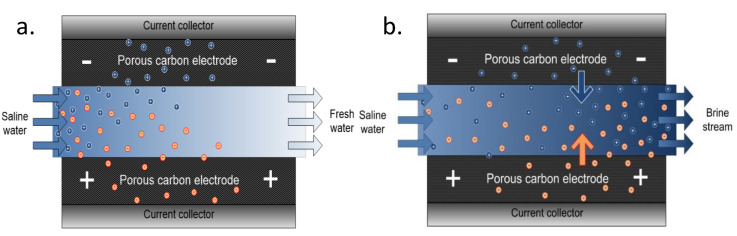
Electrochemical water desalination has been a major research area since the 1960s with the development of capacitive deionization technique. For the latter, its modus operandi lies in temporary salt ion adsorption when a simple potential difference (1.0–1.4 V) of about 1.2 V is supplied to the system to temporarily create an electric field that drives the ions to their different polarized poles and subsequently desorb these solvated ions when potential is switched off. Capacitive deionization targets/extracts the solutes instead of the solvent and thus consumes less energy and is highly effective for brackish water. This paper reviews Capacitive Deionization (mechanism of operation, sustainability, optimization processes, and shortcomings) with extension to its counterparts (Membrane Capacitive Deionization and Flow Capacitive Deionization).
Overview
The claims and statistics of this paper haven’t been checked yet.
Run the check — free, no account needed. It reads the open-access text and checks the sources it cites.
Integrity signals
Registry
Cites
Statistics
Figures
Verification
Claims the paper makes
The claims and statistics of this paper haven’t been checked yet.
Run the check — free, no account needed. It reads the open-access text and checks the sources it cites.
Claims other papers make about this one
Each is checked against this paper’s own text: does it say what the citing paper says it does?
The cited source says what the claim attributes to it.
In the citing paper
“MCDI significantly enhances the efficiency of CDI by improving operating conditions such as charge efficiency and ion adsorption”
From Electrochemical Direct Lithium Extraction: A Review of Electrodialysis and Capacitive Deionization Technologies (2025) · cites this paper as [96]
Self-check
Percentages, sums and reported differences re-computed from the paper’s own numbers.
The self-check needs the paper’s full text.
Citations
Cites
Graphene-Based Ultracapacitors
Stoller, M. D., Park, S., Zhu, Y., An, J., & Ruoff, R. S. (2008) · Nano Letters · doi:10.1021/nl802558y · Cited by 8,448
The Future of Seawater Desalination: Energy, Technology, and the Environment
Elimelech, M., & Phillip, W. A. (2011) · Science · doi:10.1126/science.1200488 · Cited by 6,841
Pseudocapacitive oxide materials for high-rate electrochemical energy storage
Augustyn, V., Simon, P., & Dunn, B. (2014) · Energy & Environmental Science · doi:10.1039/c3ee44164d · Cited by 5,676
Lee, K. P., Arnot, T., & Mattia, D. (2010) · Journal of Membrane Science · doi:10.1016/j.memsci.2010.12.036 · Cited by 2,152
Jeong, H. M., Lee, J. W., Shin, W. H., Choi, Y. J., Shin, H. J., Kang, J. K., & Choi, J. W. (2011) · Nano Letters · doi:10.1021/nl2009058 · Cited by 1,683
Chen, Y., Wang, C., Wu, Z., Xiong, Y., Xü, Q., Yu, S., & Jiang, H. (2015) · Advanced Materials · doi:10.1002/adma.201502315 · Cited by 1,389
Jiang, H., Liu, B., Lan, Y., Kuratani, K., Akita, T., Shioyama, H., Zong, F., & Xü, Q. (2011) · Journal of the American Chemical Society · doi:10.1021/ja203184k · Cited by 1,198
Oren, Y. (2008) · Desalination · doi:10.1016/j.desal.2007.08.005 · Cited by 1,186
Xu, Y., Zhang, C., Zhou, M., Fu, Q., Zhao, C., Wu, M., & Lei, Y. (2018) · Nature Communications · doi:10.1038/s41467-018-04190-z · Cited by 1,147
Electrodialysis desalination for water and wastewater: A review
Al-Amshawee, S., Yunus, M. Y. B. M., Azoddein, A. A. M., Hassell, D. G., Dakhil, I. H., & Hasan, H. A. (2020) · Chemical Engineering Journal · doi:10.1016/j.cej.2019.122231 · Cited by 964
Research works printed but not linked: 5
- Choules, P. (2010, January 30). Update on large scale ocean desal plants. Proceedings of the II Seminario Internacional Desalación, Antofagasta, Chile.
- Lopez, F., Araus, M., Gimenez, R., Munoz, E., Romero, G., and Bastida, J.M. (2015). Energy consumption optimization in a large seawater desalination plant (Aguilas, 210,000 m3/day). International Desalination Association World Congress on Desalination and Water Reuse, International Desalination Association. Conference held in San Diego, CA, USA.
- Helmholtz, 1883, Theory of the double electric layer, J. Frankl. Inst., 110, 217
- Bockris, J.O., Reddy, A.K.N., and Gamboa-Aldeco, M. (2000). Modern Electrochemistry, Kluwer Academic/Springer Publishing Company. [2nd ed.].
- Clare, 2019, Low cost desalination of brackish ground water by Capacitive Deionization (CDI)—Implications for irrigated agriculture, Desalination, 451, 37
Cited by
Sorted by citations
Gurreri, L., Tamburini, A., Cipollina, A., & Micale, G. (2020) · Membranes · doi:10.3390/membranes10070146 · Cited by 492
Recent advances in lithium extraction from salt lake brine using coupled and tandem technologies
Zhang, J., Cheng, Z., Qin, X., Gao, X., Wang, M., & Xiang, X. (2023) · Desalination · doi:10.1016/j.desal.2022.116225 · Cited by 195
Zhang, H., Tian, J., Cui, X., Li, J., & Zhu, Z. (2022) · Carbon · doi:10.1016/j.carbon.2022.10.002 · Cited by 109
Jiang, D., Xu, R., Bai, L., Wu, W., Luo, D., Li, Z., Asahi, T., Mai, Y., Liu, Z., Yamauchi, Y., et al. (2024) · Coordination Chemistry Reviews · doi:10.1016/j.ccr.2024.215923 · Cited by 85
Investigation of fine activated carbon as a viable flow electrode in capacitive deionization
Folaranmi, G., Tauk, M., Bechelany, M., Sistat, P., Cretin, M., & Zaviska, F. (2021) · Desalination · doi:10.1016/j.desal.2021.115500 · Cited by 82
Self-citationDahiya, S., Singh, A., & Mishra, B. K. (2020) · Chemical Engineering Journal · doi:10.1016/j.cej.2020.128129 · Cited by 77
AL-Rajabi, M. M., Abumadi, F. A., Laoui, T., Atieh, M. A., & Khalil, K. A. (2024) · Journal of Water Process Engineering · doi:10.1016/j.jwpe.2024.104816 · Cited by 72
Membrane-based removal of fluoride from groundwater
Rathi, B. S., Kumar, P. S., Rangasamy, G., Badawi, M., & Aminabhavi, T. M. (2024) · Chemical Engineering Journal · doi:10.1016/j.cej.2024.150880 · Cited by 67
Rosentreter, H., Scope, C., Oddoy, T., Lerch, A., & Meier‐Haack, J. (2024) · Desalination · doi:10.1016/j.desal.2024.118412 · Cited by 74
Lissaneddine, A., Pons, M., Aziz, F., Ouazzani, N., Mandi, L., & Mousset, E. (2021) · Environmental Research · doi:10.1016/j.envres.2021.112128 · Cited by 58
Zhang, Z., Zhang, Y., Jiang, C., Li, D., Zhang, Z., Wang, K., Liu, W., Jiang, X. L., Rao, Y., Xu, C., et al. (2022) · Desalination · doi:10.1016/j.desal.2022.115653 · Cited by 56
Wang, J., Shi, Z., Fang, J., Chu, B., Li, N., Shui, L., Wang, G., & Chen, F. (2021) · Separation and Purification Technology · doi:10.1016/j.seppur.2021.119345 · Cited by 52
Folaranmi, G., Bechelany, M., Sistat, P., Cretin, M., & Zaviska, F. (2020) · Materials · doi:10.3390/ma13225185 · Cited by 51
“Capacitive Deionization (CDI) is a water desalination technology that has been engineered for highly efficient functionality when desalting brackish water [2].”
BackgroundSelf-citationSelective fluoride removal on LaHAP/3D-rGO composite electrode by capacitive deionization
Wang, H., Jiang, W., Nie, P., Hu, B., Hu, Y., Huang, M., & Liu, J. (2022) · Electrochimica Acta · doi:10.1016/j.electacta.2022.141029 · Cited by 50
Batteries in desalination: A review of emerging electrochemical desalination technologies
Khodadousti, S., & Κολλιόπουλος, Γ. (2023) · Desalination · doi:10.1016/j.desal.2023.117202 · Cited by 44
Xie, N., Li, Y., Yuan, Y., Gong, J., & Hu, X. (2021) · ACS Applied Energy Materials · doi:10.1021/acsaem.1c02654 · Cited by 43
Electro-desalination: State-of-the-art and prospective
Cao, G., Alam, M. M., Juthi, A. Z., Zhang, Z., Wang, Y., Jiang, C., & Xu, T. (2023) · Advanced Membranes · doi:10.1016/j.advmem.2022.100058 · Cited by 44
Park, J., Lee, J., Shim, I.-T., Kim, E., Nam, S.-H., Koo, J.-W., & Hwang, T.-M. (2025) · Resources · doi:10.3390/resources14020027 · Cited by 44
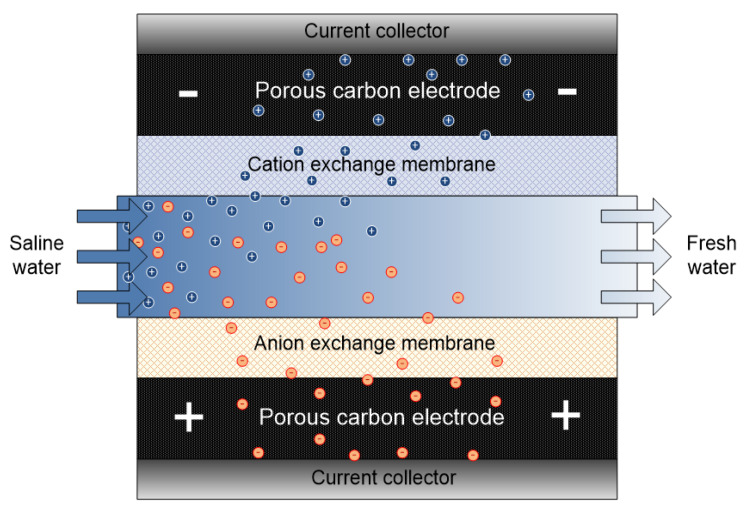
“MCDI significantly enhances the efficiency of CDI by improving operating conditions such as charge efficiency and ion adsorption [96].”
Yu, F., Yang, Z., Zhang, X., Yang, P., Li, L., & Ma, J. (2022) · Journal of Materials Chemistry A · doi:10.1039/d2ta06815j · Cited by 42
Controllable synthesis of nickel–cobalt-doped Prussian blue analogs for capacitive desalination
Liu, R., Wang, Y., Wu, Y., Xiao, Y., & Cai, W. (2023) · Electrochimica Acta · doi:10.1016/j.electacta.2023.141815 · Cited by 45
Review on the polymer materials for capacitive deionization
Kang, D., Huang, C., Ding, M., & Yang, H. Y. (2024) · Desalination · doi:10.1016/j.desal.2024.117884 · Cited by 39
Activated Carbon Blended with Reduced Graphene Oxide Nanoflakes for Capacitive Deionization
Folaranmi, G., Bechelany, M., Sistat, P., Cretin, M., & Zaviska, F. (2021) · Nanomaterials · doi:10.3390/nano11051090 · Cited by 37
“Thus, in order to overcome its challenges, AC surface chemistry is usually modified by various methods, such as oxidation with oxidizing agents [11], or combined with additives to prepare hybrid electrode materials of high performance [5].”
BackgroundSelf-citationNidheesh, P. V., Ganiyu, S. O., Kuppam, C., Mousset, E., Samsudeen, N., Olvera‐Vargas, H., & Kumar, G. (2022) · Journal of Water Process Engineering · doi:10.1016/j.jwpe.2022.103232 · Cited by 37
Tauk, M., Bechelany, M., Lagerge, S., Sistat, P., Habchi, R., Cretin, M., & Zaviska, F. (2022) · Separation and Purification Technology · doi:10.1016/j.seppur.2022.122666 · Cited by 39
Self-citationAutomation of membrane capacitive deionization process using reinforcement learning
Yoon, N., Park, S., Son, M., & Cho, K. H. (2022) · Water Research · doi:10.1016/j.watres.2022.119337 · Cited by 36
Cu@Cu2O/carbon for efficient desalination in capacitive deionization
Yu, F., Yin, H., Bai, X., Pan, J., Zhang, X., & Ma, J. (2023) · Chinese Chemical Letters · doi:10.1016/j.cclet.2023.108362 · Cited by 36
A review of the development in shale oil and gas wastewater desalination
Zhou, S., Huang, L., Wang, G., Wang, W., Zhao, R., Sun, X., & Wang, D. (2023) · The Science of The Total Environment · doi:10.1016/j.scitotenv.2023.162376 · Cited by 39
Exploring flow-electrode capacitive deionization: An overview and new insights
Tauk, M., Sistat, P., Habchi, R., Cretin, M., Zaviska, F., & Bechelany, M. (2024) · Desalination · doi:10.1016/j.desal.2024.118392 · Cited by 36
Self-citationSaif, H. M., Gebregeorgis, T. H., Crespo, J. G., & Pawlowski, S. (2024) · Desalination · doi:10.1016/j.desal.2024.117452 · Cited by 36
Zhu, G., Chen, L., Lu, T., Zhang, L., Hossain, M. S. A., Amin, M. A., Yamauchi, Y., Li, Y., Xu, X., & Pan, L. (2022) · Environmental Research · doi:10.1016/j.envres.2022.112909 · Cited by 33
Jiang, J., Dorji, P., Badeti, U., Sohn, W., Freguia, S., Phuntsho, S., Saliby, I. J. E., & Shon, H. K. (2023) · Desalination · doi:10.1016/j.desal.2023.116924 · Cited by 31
Shi, M., Ji, G., Cui, X., Liu, C., Hong, X., Ding, Z., Qiang, H., Wang, F., & Xia, M. (2022) · Separation and Purification Technology · doi:10.1016/j.seppur.2022.121962 · Cited by 30
Mejía-Marchena, R., Maturana, A., Gómez, D., M., C. G. Q., Arismendy, L., & Cárdenas, C. (2023) · Environmental Technology Reviews · doi:10.1080/21622515.2023.2198147 · Cited by 38
Wang, W., Ma, P., & Li, H. (2023) · Desalination · doi:10.1016/j.desal.2023.116798 · Cited by 28
High speed capacitive deionization system with flow-through electrodes
Guo, L., Ding, M., Yan, D., Pam, M. E., Vafakhah, S., Gu, C., Zhang, W., y Alvarado, P. V., Shi, Y., & Yang, H. Y. (2020) · Desalination · doi:10.1016/j.desal.2020.114750 · Cited by 27
Selectivity adsorption of sulfate by amino-modified activated carbon during capacitive deionization
Chen, X., Deng, W., Miao, L., Gao, M. H., Ao, T., Chen, W., Ueyama, T., & Dai, Q. (2021) · Environmental Technology · doi:10.1080/09593330.2021.2005689 · Cited by 27
Schalenbach, M., Keller, L., Janotta, B., Bauer, A., Tempel, H., Kungl, H., Bonnet, M., & Eichel, R. (2022) · Journal of The Electrochemical Society · doi:10.1149/1945-7111/ac9087 · Cited by 27
Zhou, W. L., Huang, T., Zhao, Y., Kang, D., Huang, C., & Ding, M. (2025) · Chemical Engineering Journal · doi:10.1016/j.cej.2025.161124 · Cited by 26
Khan, S., Rahman, S. U., Shah, A., Akhtar, N., Hussain, Z., Ahmad, N., Kamika, I. A., Azizi, S., & Mâaza, M. (2026) · Desalination · doi:10.1016/j.desal.2026.119860 · Cited by 25
Feng, C., Pan, X., Lin, X., Yang, Y., Fan, F., Jiang, C., & Mei, Y. (2024) · Desalination · doi:10.1016/j.desal.2024.118259 · Cited by 24
Said, I. A., Fuentes, N., & Li, Q. (2022) · Chemical Engineering and Processing - Process Intensification · doi:10.1016/j.cep.2022.109030 · Cited by 23
He, W., Zhou, L., Wang, Y., Yu, L., Hou, Y., Bi, S., Wang, M., & Hou, X. (2023) · EcoMat · doi:10.1002/eom2.12355 · Cited by 23
Rosentreter, H., Walther, M., & Lerch, A. (2021) · Membranes · doi:10.3390/membranes11020126 · Cited by 22
“Therefore, MCDI shows great potential for meeting flexible desalination demands in terms of salt rejection and water recovery [26].”
Miniaturized Salinity Gradient Energy Harvesting Devices
Hsu, W.-S., Preet, A., Lin, T., & Lin, T.-E. L. (2021) · Molecules · doi:10.3390/molecules26185469 · Cited by 21
Xu, L., Peng, S., Wu, K., Tang, L., Wu, M., Zong, Y., Mao, Y., & Wu, D. (2022) · Water Research · doi:10.1016/j.watres.2022.118963 · Cited by 20
Talebi, M., Ahadian, M. M., & Shahrokhian, S. (2021) · Diamond and Related Materials · doi:10.1016/j.diamond.2021.108612 · Cited by 20
Saif, H. M., Crespo, J. G., & Pawlowski, S. (2025) · Desalination · doi:10.1016/j.desal.2025.118769 · Cited by 19
Deng, W., Jing, M., Gao, M., Chen, W., Chen, Y., Chen, F., Tang, Y., & Jin, Y. (2024) · Desalination and Water Treatment · doi:10.1016/j.dwt.2024.100162 · Cited by 18
Advances in efficient desalination technology of capacitive deionization for water recycling
Tong, Y., Zhou, S., Zhou, J., Zhang, G., Li, X., Zhao, C., & Liu, P. (2021) · Journal of Water Reuse and Desalination · doi:10.2166/wrd.2021.101 · Cited by 18
Lei, Y., Yang, W., Yuan, Y., Wei, G., & Guo, L. (2025) · Carbohydrate Polymers · doi:10.1016/j.carbpol.2025.123514 · Cited by 17
Khalil, A. K. A., Teow, Y. H., Yoshizawa‐Fujita, M., Takriff, M. S., Ahmad, A. L., Atieh, M. A., & Khalil, K. A. (2025) · Journal of environmental chemical engineering · doi:10.1016/j.jece.2025.118859 · Cited by 17
Li, B., Xiao, Z., Cao, Y., Yu, Z., Sun, Y., Li, Z., Wang, Y., Gao, Z., & Xu, C. (2023) · Fuel · doi:10.1016/j.fuel.2023.129112 · Cited by 17
The electrode materials in flow‐electrode capacitive deionization desalination: a mini review
Jiang, Y., Zhang, W., Deng, Y., Cao, J., Asare, J. A., Alhassan, S. I., Zhang, F., Wang, P., & Wang, H. (2025) · Rare Metals · doi:10.1007/s12598-024-03215-5 · Cited by 17
Gaikwad, M. S., Suman, S. K., Shukla, K., Sonawane, A. V., & Jain, S. N. (2023) · International Journal of Environmental Science and Technology · doi:10.1007/s13762-023-04778-z · Cited by 17
“In past years, only a few review papers on the MCDI process (Hassanvand et al. 2017; Folaranmi et al. 2020; Kim et al. 2020b; Ali et al. 2021; Pawlowski 2020; Yang et al. 2020) are available (schematically shown in Fig.”
BackgroundTalebi, M., Ahadian, M. M., Shahrokhian, S., & Amini, M. K. (2021) · Separation and Purification Technology · doi:10.1016/j.seppur.2021.119427 · Cited by 16
Jeon, S.-I., Kim, N., Jo, K., Ahn, J., Joo, H., Lee, C., Kim, C., & Yoon, J. (2021) · Chemical Engineering Journal · doi:10.1016/j.cej.2022.135603 · Cited by 16
Khedher, M., Phogat, V., Chow, C. W. K., Palmer, N., Anese, J., Tucker, A., Petrie, P. R., van den Akker, B., & Rameezdeen, R. (2025) · Groundwater for Sustainable Development · doi:10.1016/j.gsd.2025.101449 · Cited by 15
Tunnel-Structured ζ-V2O5 as a Redox-Active Insertion Host for Hybrid Capacitive Deionization
Cool, N. I., James, R. K., Schofield, P., Handy, J. V., Bhatia, M. R., & Banerjee, S. (2022) · ACS Applied Materials & Interfaces · doi:10.1021/acsami.2c17800 · Cited by 14
Jiang, J.-J., Ma, X., Zhou, J., Batol, A., Gou, H., & Zhang, W. (2025) · RSC Sustainability · doi:10.1039/d5su00439j · Cited by 16
Wu, X., Kang, S., Zhu, S., Wang, D., Liu, J., Pan, Y., Jia, H., Shi, M., & Tong, G. (2025) · Separation and Purification Technology · doi:10.1016/j.seppur.2025.136266 · Cited by 12
Su, T., Fu, X., Wang, A., Chai, Y., & Sun, X. (2024) · Journal of environmental chemical engineering · doi:10.1016/j.jece.2024.112287 · Cited by 12
Lv, Y., Zhang, L., & Wang, Y. (2024) · Desalination and Water Treatment · doi:10.1016/j.dwt.2024.100318 · Cited by 12
Reactive transport in membrane separation modeling: A perspective
Nir, O., Oren, Y., Atsbha, M. W., Chandra, A., Geller, Y., Chaudhary, M., Monat, L., Singh, P., & Zevenhoven, R. (2022) · Process Safety and Environmental Protection · doi:10.1016/j.cherd.2022.09.054 · Cited by 11
MnO2-modified soybean root derived porous carbon with excellent capacity deionization
Yin, Q., Xiao, Y., Sha, P., Pang, X., Miao, W., Du, X., Zhang, Q. J., Sui, J., Yu, J., Dong, H., et al. (2023) · Diamond and Related Materials · doi:10.1016/j.diamond.2023.110036 · Cited by 10
Highly Efficient Capacitive Deionization Enabled by NiCo4MnO8.5 Electrodes
Wang, W., Liu, Z., Zhang, Z., & Li, H. (2021) · Global Challenges · doi:10.1002/gch2.202100095 · Cited by 10
Karimirahnama, A., Mozaffarian, M., Dabir, B., & Esmaeilian, N. (2024) · Desalination · doi:10.1016/j.desal.2024.118254 · Cited by 9
Folaranmi, G., Tauk, M., Bechelany, M., Sistat, P., Cretin, M., & Zaviska, F. (2021) · Materials · doi:10.3390/ma14226891 · Cited by 9
“Most desalination technologies, such as multiple effect desalination (MED), reverse osmosis (RO), and others, have high capital costs (when considering plant setup) and energy consumption (when considering pre- and post-treatment of water, as in RO), necessitating the development of a new desalination technique [1].”
BackgroundSelf-citationZhang, Z., Jiang, S., Chen, H., Qi, H., Chen, Y., Chen, Y., Deng, Q., & Wang, S. (2021) · Foods · doi:10.3390/foods10123087 · Cited by 9
Zhang, H., Wu, J., Hu, Z., Wang, H., Gao, S., Gao, M., Yang, Z., Zhang, J., Tong, Y., Zhu, Y., et al. (2026) · Biomass and Bioenergy · doi:10.1016/j.biombioe.2026.109706 · Cited by 8
Cheng, Y., Shi, J., Zhang, Q., Fang, C., Chen, J., & Li, F. (2022) · Polymers · doi:10.3390/polym14152985 · Cited by 8
“However, high resistance, high energy consumption, and limited surface area for ion adsorption restrict the application of MCDI architecture in the field of capacitive deionization [40].”
BackgroundYu, F., Yin, H., Li, J., Chen, T., Sun, L., & Ma, J. (2025) · Desalination · doi:10.1016/j.desal.2025.118747 · Cited by 7
Liu, C., Ho, H., & Iizuka, A. (2025) · Applied Water Science · doi:10.1007/s13201-025-02644-6 · Cited by 9
A Novel Dual-Ion Capacitive Deionization System Design with Ultrahigh Desalination Performance
Jiang, Y., Hou, Z., Yan, L., Gang, H., Wang, H., & Chai, L. (2022) · Polymers · doi:10.3390/polym14214776 · Cited by 7
“On the other hand, capacitive-deionization (CDI), as an emerging energy-efficient desalination technology that employs electrode materials to adsorb salt from saline water, could operate under mild conditions [10,11].”
BackgroundYang, Z.-Q., Zhang, W., Guo, S.-B., Theint, M. M., Yin, Y., Li, J., Yang, J.-L., & Ma, X. (2022) · Langmuir · doi:10.1021/acs.langmuir.2c02628 · Cited by 7
Balaji-Wright, A., Wu, J., Shocron, A. N., Dana, A. G., Suss, M. E., & Mani, A. (2024) · Desalination · doi:10.1016/j.desal.2024.117924 · Cited by 7
Subrahmanya, T. M., Gua, L.-Y., Austria, H. F. M., Huang, T., Abebe, S. H., Hung, W., Wang, C., Hu, C., Lee, K., & Lai, J. (2024) · Desalination · doi:10.1016/j.desal.2024.118513 · Cited by 7
Shajid, S. R., Mourshed, M., Rimon, S. T. A., & Kibria, M. G. (2025) · Journal of Industrial and Engineering Chemistry · doi:10.1016/j.jiec.2025.08.003 · Cited by 6
Review of the current state of technology for capacitive deionization of aqueous salt solutions
Zakharov, A., Tukesheva, A. V., Haque, S. F. B., Ferraris, J. P., Zakhidov, A. A., Tazhibayeva, T., Bazarbayeva, T. A., & Pavlenko, V. V. (2023) · Bulletin of the Karaganda University Physics Series · doi:10.31489/2023ph3/16-33 · Cited by 6
Enhanced Fluoride Removal in Wastewater Using Modified Activated Carbon in FCDI Systems
Xiong, Y., Sun, J., Jiao, Y., Tan, T., Zhang, Y., Diao, H., & Xia, S. (2024) · Water Air & Soil Pollution · doi:10.1007/s11270-024-07352-6 · Cited by 6
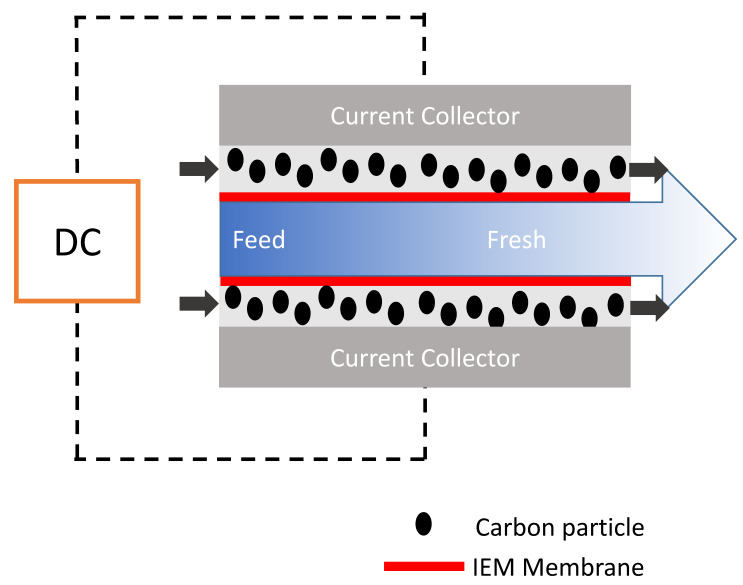
“FCDI not only offers a cost-effective approach with lower energy consumption but also minimizes chemical waste compared to conventional methods (Folaranmi et al., 2020).”
Jiang, H., Yuan, J., Lin, L., Wang, H., Gao, R., Chen, Y., Mu, C., Luo, F., Luo, T., & Wang, X. (2025) · Separation and Purification Technology · doi:10.1016/j.seppur.2025.134055 · Cited by 5
Sun, J., Dong, Y., Sun, L., Fan, D., Zhang, H., Yang, M., Wang, X., Liu, J., Yuan, R., Zhou, B., et al. (2025) · Desalination · doi:10.1016/j.desal.2025.119738 · Cited by 5
Yaacoubi, H., Kaddah, F. C., Elwadood, S. N. A., & Dumée, L. F. (2025) · Water Research · doi:10.1016/j.watres.2025.125286 · Cited by 5
Switchable NaCl cages via a MWCNTs/Ni[Fe(CN) 6 ] 2 nanocomposite for high performance desalination
Yang, Z.-Q., Zhang, W., Kang, Y., Chen, B., Yin, Y., Li, J., Yang, J.-L., Gao, Y., & Ma, X. (2023) · Nanoscale · doi:10.1039/d3nr04410f · Cited by 5
Wu, J., Chen, B., Feng, A., Liu, K., & Yu, Y. (2023) · New Journal of Chemistry · doi:10.1039/d3nj05188a · Cited by 5
Xue, Y., Yang, H., Lv, X., Zhang, X., Jegatheesan, V., Zhou, X., & Zhang, Y. (2024) · Processes · doi:10.3390/pr12061043 · Cited by 5
Mishra, S. K., Sengupta, S., & Das, S. K. (2025) · Environmental Science and Pollution Research · doi:10.1007/s11356-025-36069-0 · Cited by 5
“…technique targets solute from solution by charging the electrodes presented with a higher specific area of surface at a constant voltage or current value rather than solvent (water molecule) from the solution, making them much more suitable without higher energy consumption (Folaranmi et al. 2020).”
Khoiruddin, K., Wardani, A. K., Aryanti, P. T. P., & Wenten, I. G. (2022) · Elsevier eBooks · doi:10.1016/b978-0-323-88514-0.00009-7 · Cited by 5
Activated Carbon-Embedded Reduced Graphene Oxide Electrodes for Capacitive Desalination
Ahmed, T., Sun, J., Park, C.-G., Shon, H. K., Han, D. S., & Park, H. (2023) · Journal of Electrochemical Science and Technology · doi:10.33961/jecst.2023.00066 · Cited by 5
Saleem, M. W., Ali, S., Usman, M., Chaudhary, T. N., Ullah, A., Arslan, M., & Hameed, A. U. (2024) · Environmental Technology · doi:10.1080/09593330.2024.2326798 · Cited by 5
Wu, J., Cui, J., Feng, A., Liu, K., & Yu, Y. (2024) · The Journal of Physical Chemistry C · doi:10.1021/acs.jpcc.4c00621 · Cited by 5
Seawater and Brackish Water Desalination
Usman, M., Sharma, D. D., & Ernst, M. (2024) · Green energy and technology · doi:10.1007/978-3-031-62411-7_8 · Cited by 6
Sherugar, P., Kim, J., Lee, H., Mameda, N., Hou, C., & Choo, K. (2026) · Desalination · doi:10.1016/j.desal.2026.120176 · Cited by 4
Deng, Z., Lu, H., Mo, J., Li, H., Li, Q., Long, J., Zhang, G., Xie, Y., Wang, T., Chen, J., et al. (2026) · Journal of Hazardous Materials · doi:10.1016/j.jhazmat.2026.142487 · Cited by 4
Microfluidic Electrochemical Desalination Systems: A Review
Abuwatfa, W. H., Taleb, H. M. A., AlSawaftah, N., Chahrour, K., Husseini, G. A., & Darwish, N. (2025) · Water · doi:10.3390/w17111601 · Cited by 4
The electrosorption behavior of shuttle-like FeP: performance and mechanism
Peng, G., & Li, H. (2023) · RSC Advances · doi:10.1039/d2ra07857k · Cited by 4
Electrodialysis and membrane capacitive deionization
Ojelade, O. A., & Jolaoso, L. A. (2024) · Elsevier eBooks · doi:10.1016/b978-0-443-14005-1.00006-4 · Cited by 4
Amikam, G., & Gendel, Y. (2021) · Electrochemistry Communications · doi:10.1016/j.elecom.2021.106945 · Cited by 4
Bahrami, H., Gorjian, S., Mokhtarzadeh, H., Ghobadian, B., Kuriqi, A., & Gheisari, J. (2025) · Results in Engineering · doi:10.1016/j.rineng.2025.105552 · Cited by 3
“ASAR and CE were reported to be 15.6 mg/g and 95% in a study by Folaranmi et al. (Folaranmi et al. 2020).”
InfluentialZhang, X. K., Peng, Y., Zhang, N., Gao, J., Shi, M., & Pan, J. (2026) · Separation and Purification Technology · doi:10.1016/j.seppur.2026.137364 · Cited by 3
Lv, M., Wei, W., Du, Z. H., Liu, N., Qiao, Y., Lu, J., & Liu, P. (2026) · Journal of Electroanalytical Chemistry · doi:10.1016/j.jelechem.2026.120112 · Cited by 3
Metadata
- Authors
- Folaranmi, G., Bechelany, M., Sistat, P., Cretin, M., & Zaviska, F.
- Affiliations
- École Nationale Supérieure de Chimie de Montpellier (FR)
- Institut Européen des Membranes, IEM, UMR-5635, University Montpellier, ENSCM, CNRS, Place Eugène Bataillon, CEDEX 05, 34095 Montpellier, France
- Venue
- Membranes
- Publisher
- MDPI AG
- Published
- 2020-05-12
- Volume
- 10
- Issue
- 5
- Pages
- 96
- ISSN
- 2077-0375 (ISSN-L)
- PMC
- PMC7281590
- OpenAlex
- W3025469769
- Cited by
- 149
- References
- 115
- Citations by year
- 2026: 23 · 2025: 29 · 2024: 31 · 2023: 21 · 2022: 21 · 2021: 20 · 2020: 4
- FWCI
- 1.38
- Type
- journal article
- Language
- en
- Open access
- gold
- dx.doi.org
- Licence
- Locations
- Membranes (publishedVersion, cc-by)
- PubMed Central (publishedVersion, cc-by)
- PubMed (publishedVersion)
- HAL (submittedVersion, cc-by)
- DOAJ (DOAJ: Directory of Open Access Journals) (submittedVersion, cc-by-sa)
- Funders
- Australian Government
- Topics
- Physical Sciences › Chemical Engineering › Filtration and Separation › Membrane-based Ion Separation Techniques
- Physical Sciences › Environmental Science › Water Science and Technology › Membrane Separation Technologies
- Physical Sciences › Engineering › Biomedical Engineering › Nanopore and Nanochannel Transport Studies
- Keywords
- capacitive deionization, membrane capacitive deionization, brackish water treatment, energy consumption
About these checks
Registry, retraction, Cites and statistics results are computed, not judged, with one exception: a printed reference that no index lists is read once by a model before it counts as a citation error. Claims are extracted by a model and kept only when their quote appears verbatim in the text; each cited source is then checked, with a model’s help, for whether it says what the claim relies on. Those verdicts can be wrong — read the claim’s quote and the cited source before relying on one.
Statistics and arithmetic are recomputed, not judged.
Confidence bands are shown only for fields calibrated on our annotated test set. None is calibrated yet, so no band is shown.
What counts as a claim ›How we measure confidence ›How we check this ›
Are you an author, or do you see a problem with this page? Request a review
