

Medicinal Plants, Phytochemicals and Regulation of the NLRP3 Inflammasome in Inflammatory Bowel Diseases: A Comprehensive Review
Open accessThe DOI matches its Crossref record; 109 of the 111 references it cites were found in a registry or an index.
Abstract
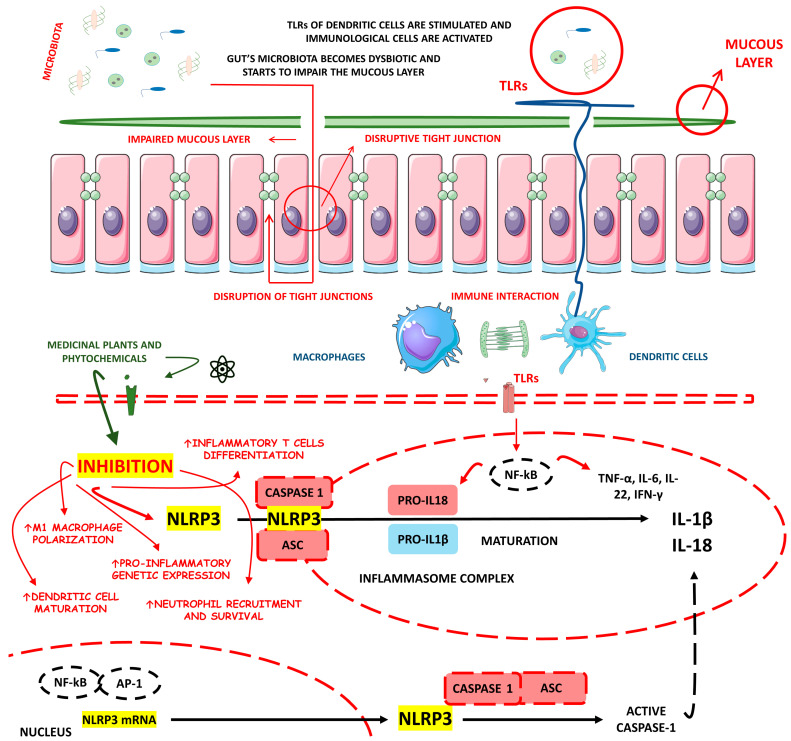
Ongoing research explores the underlying causes of ulcerative colitis and Crohn’s disease. Many experts suggest that dysbiosis in the gut microbiota and genetic, immunological, and environmental factors play significant roles. The term “microbiota” pertains to the collective community of microorganisms, including bacteria, viruses, and fungi, that reside within the gastrointestinal tract, with a particular emphasis on the colon. When there is an imbalance or disruption in the composition of the gut microbiota, it is referred to as dysbiosis. Dysbiosis can trigger inflammation in the intestinal cells and disrupt the innate immune system, leading to oxidative stress, redox signaling, electrophilic stress, and inflammation. The Nod-like Receptor (NLR) Family Pyrin Domain Containing 3 (NLRP3) inflammasome, a key regulator found in immunological and epithelial cells, is crucial in inducing inflammatory diseases, promoting immune responses to the gut microbiota, and regulating the integrity of the intestinal epithelium. Its downstream effectors include caspase-1 and interleukin (IL)-1β. The present study investigated the therapeutic potential of 13 medicinal plants, such as Litsea cubeba, Artemisia anomala, Piper nigrum, Morus macroura, and Agrimonia pilosa, and 29 phytocompounds such as artemisitene, morroniside, protopine, ferulic acid, quercetin, picroside II, and hydroxytyrosol on in vitro and in vivo models of inflammatory bowel diseases (IBD), with a focus on their effects on the NLRP3 inflammasome. The observed effects of these treatments included reductions in IL-1β, tumor necrosis factor-alpha, IL-6, interferon-gamma, and caspase levels, and increased expression of antioxidant enzymes, IL-4, and IL-10, as well as regulation of gut microbiota. These effects could potentially provide substantial advantages in treating IBD with few or no adverse effects as caused by synthetic anti-inflammatory and immunomodulated drugs. However, additional research is necessary to validate these findings clinically and to develop effective treatments that can benefit individuals who suffer from these diseases.
Overview
The claims and statistics of this paper haven’t been checked yet.
Free: it reads the open-access text and checks the first 5 claims that cite a source we can check. Create a free account to check every claim.
Integrity signals
Registry
Cites
Statistics
Figures
Verification
Claims the paper makes
The claims and statistics of this paper haven’t been checked yet.
Free: it reads the open-access text and checks the first 5 claims that cite a source we can check. Create a free account to check every claim.
Claims other papers make about this one
Each is checked against this paper’s own text: does it say what the citing paper says it does?
The cited source says what the claim attributes to it.
In the citing paper
“Direito, R. et al. noted that P-II exhibits potential to inhibit caspase-1 expression [53].”
From Picroside II suppresses chondrocyte pyroptosis through MAPK/NF-κB/NLRP3 signaling pathway alleviates osteoarthritis (2024) · cites this paper as [53]
Self-check
Percentages, sums and reported differences re-computed from the paper’s own numbers.
The self-check needs the paper’s full text.
Citations
Cites
SANRA—a scale for the quality assessment of narrative review articles
Baethge, C., Goldbeck-Wood, S., & Mertens, S. (2019) · Research Integrity and Peer Review · doi:10.1186/s41073-019-0064-8 · Cited by 3,469 · cited 1×
“[14] specifically designed to evaluate the quality of non-systematic reviews.”
BackgroundOrdás, I., Eckmann, L., Talamini, M., Baumgart, D. C., & Sandborn, W. J. (2012) · The Lancet · doi:10.1016/s0140-6736(12)60150-0 · Cited by 2,078
Molecular mechanisms regulating NLRP3 inflammasome activation
Jo, E.-K., Kim, J. K., Shin, D.-M., & Sasakawa, C. (2016) · Cellular & Molecular Immunology · doi:10.1038/cmi.2015.95 · Cited by 1,378 · cited 3×
“Indeed, IL-1β is crucial in mediating pro-inflammatory responses in various tissues among multiple systemic inflammatory diseases and is associated highly with leukocytosis and elevated acute phase proteins [88,90].”
BackgroundGuidelines for the management of inflammatory bowel disease in adults
Carter, M. J., Lobo, A. J., & Travis, S. P. L. (2004) · Gut · doi:10.1136/gut.2004.043372 · Cited by 1,083
Rogler, G., Singh, A., Kavanaugh, A., & Rubin, D. T. (2021) · Gastroenterology · doi:10.1053/j.gastro.2021.07.042 · Cited by 869 · cited 1×
“Common symptoms include diarrhea, rectal bleeding, and abdominal pain [6,7].”
BackgroundNLRP3 inflammasome and its inhibitors: a review
Shao, B.-Z., Xu, Z.-Q., Han, B.-Z., Su, D.-F., & Liu, C. (2015) · Frontiers in Pharmacology · doi:10.3389/fphar.2015.00262 · Cited by 836
NLRP3 Inflammasome and Inflammatory Bowel Disease
Zhen, Y., & Zhang, H. (2019) · Frontiers in Immunology · doi:10.3389/fimmu.2019.00276 · Cited by 649 · cited 2×
“Meanwhile, IL-1β also upregulates IL-2 receptor expression in T cells, which prolongs their survival and enhance their antibody production by direct B cell proliferation [10,102].”
BackgroundEpidemiology and Pathogenesis of Ulcerative Colitis
Du, L., & Ha, C. (2020) · Gastroenterology Clinics of North America · doi:10.1016/j.gtc.2020.07.005 · Cited by 645 · cited 1×
“The aims of a successful treatment consist of maintaining a steroid-free remission, mucosal healing, preventing surgery necessity as well as hospital admission, avoiding disability, and improving the quality of life for all patients [60,68,69].”
BackgroundMetabolic syndrome and cardiovascular diseases: Going beyond traditional risk factors
Silveira Rossi, J. L., Barbalho, S. M., Reverete de Araujo, R., Bechara, M. D., Sloan, K. P., & Sloan, L. A. (2022) · Diabetes/Metabolism Research and Reviews · doi:10.1002/dmrr.3502 · Cited by 604
Self-citationThe NLRP3 inflammasome: Mechanism of action, role in disease and therapies
Wang, L., & Hauenstein, A. V. (2020) · Molecular Aspects of Medicine · doi:10.1016/j.mam.2020.100889 · Cited by 426
Chen, X., Liu, G., Yuan, Y., Wu, G., Wang, S., & Yuan, L. (2019) · Cell Death & Disease · doi:10.1038/s41419-019-2157-1 · Cited by 388
TLR4 Cross-Talk With NLRP3 Inflammasome and Complement Signaling Pathways in Alzheimer's Disease
Yang, J., Wise, L., & Fukuchi, K.-I. (2020) · Frontiers in Immunology · doi:10.3389/fimmu.2020.00724 · Cited by 387
Segal, J. P., LeBlanc, J.-F., & Hart, A. L. (2021) · Clinical Medicine · doi:10.7861/clinmed.2021-0080 · Cited by 351 · cited 2×
“cytokines, including TNF-α, IL-12, IL-23, IL-1β, and IL-6 [64,67,68].”
Pathophysiology of Crohn’s disease inflammation and recurrence
Petagna, L., Antonelli, A., Ganini, C., Bellato, V., Campanelli, M., Divizia, A., Efrati, C., Franceschilli, M., Guida, A. M., Ingallinella, S., et al. (2020) · Biology Direct · doi:10.1186/s13062-020-00280-5 · Cited by 304 · cited 6×
“People with altered interactions with the intestinal lumen commensal bacteria also have an increased risk of developing CD, such as in the case of the Galactoside alpha-(1,2)-fucosyltransferase 2 (FUT2) genetic variances, in which the patients encode a fucosyltransferase enzyme incapable of secreting antigens such as…”
BackgroundInfluentialCrohn's Disease: Diagnosis and Management.
Veauthier, B., Hornecker, J. R., & Heessel, A. (2018) · PubMed · Cited by 278
Inflammatory Bowel Diseases and Gut Microbiota
Haneishi, Y., Furuya, Y., Hasegawa, M., Picarelli, A., Rossi, M., & Miyamoto, J. (2023) · International Journal of Molecular Sciences · doi:10.3390/ijms24043817 · Cited by 242 · cited 1×
“Moreover, oxidative stress, redox signaling, electrophilic stress, and massive inflammation can occur [8,9].”
BackgroundAdams, S., & Bornemann, P. H. (2013) · PubMed · Cited by 215
Gong, Z., Zhao, S., Zhou, J., Yan, J., Wang, L., Du, X., Li, H., Chen, Y., Cai, W., & Wu, J. (2018) · Molecular Immunology · doi:10.1016/j.molimm.2018.09.004 · Cited by 212 · cited 5×
“LPS-primed peritoneal macrophages in vitro and DSS-induced C57BL/6 mice model of colitis in vivo 0, 10, 25, and 50 μM incubated for 24 h in vi ro and 100 mg/kg/day intraperitonially for 7 days in vivo ↑Inflammatio in vitro and ↑DAI, ↓body weight, ↓colon length, ↑inflammatory cells infiltration and ↑tissue damage in vi…”
BackgroundMethodInfluentialShahini, A., & Shahini, A. (2022) · Journal of Cell Communication and Signaling · doi:10.1007/s12079-022-00695-x · Cited by 186
Keshteli, A. H., Madsen, K. L., & Dieleman, L. A. (2019) · Nutrients · doi:10.3390/nu11071498 · Cited by 181 · cited 1×
“Depending on the involved affected segments of the colon, UC can be defined as proctitis, pancolitis, or left-sided colitis [63,64,68,70].”
BackgroundThe epidemiology of inflammatory bowel disease in Asia and Asian immigrants to Western countries
Aniwan, S., Santiago, P., Loftus, E. V., & Park, S. H. (2022) · United European Gastroenterology Journal · doi:10.1002/ueg2.12350 · Cited by 170 · cited 1×
“Additionally, monozygotic twins have concordance rates of 6% to 13% of developing UC [58,59].”
BackgroundLaurindo, L. F., Santos, A. R. D. O. D., Carvalho, A. C. A. D., Bechara, M. D., Guiguer, E. L., Goulart, R. D. A., Vargas Sinatora, R., Araújo, A. C., & Barbalho, S. M. (2023) · Metabolites · doi:10.3390/metabo13010096 · Cited by 166 · cited 2×
“Many medicinal plants and phytochemicals have long been known as IBD regulators [6,13].”
BackgroundSelf-citationSun, Y., Zhao, Y., Yao, J., Zhao, L., Wu, Z., Wang, Y., Pan, D., Miao, H., Guo, Q., & Lu, N. (2015) · Biochemical Pharmacology · doi:10.1016/j.bcp.2015.02.002 · Cited by 158
The Signaling Pathways Regulating NLRP3 Inflammasome Activation
Chen, M.-Y., Ye, X.-J., He, X.-H., & Ouyang, D.-Y. (2021) · Inflammation · doi:10.1007/s10753-021-01439-6 · Cited by 154 · cited 1×
“The most studied inflammatory pathway NLRs activate is NF-kB, but they also conduct mitogen-activated protein kinase (MAPK) signaling, antigen presentation, assembly of cytosolic signals transduction complexes, and embryonic development [88,89].”
BackgroundLiu, X., Zhou, W., Zhang, X., Lü, P., Du, Q., Tao, L., Ding, Y., Wang, Y., & Hu, R. (2016) · Biochemical Pharmacology · doi:10.1016/j.bcp.2016.05.002 · Cited by 151 · cited 3×
“Dimethyl fumarate LPS-stimulated human THP-1 cells in vitro and DSS-induced C57BL/6 mice model of colitis in vivo 20 μM incubated for 12 h in vitro and 30 and 60 mg/kg/day orally for 10 days in vivo ↑Inflammation in vitro and ↓body weight, ↓colon length, ↑blood loss, stool consistency alterations, ↑DAI, ↑inflammatory…”
MethodInfluentialKaenkumchorn, T. K., & Wahbeh, G. T. (2020) · Gastroenterology Clinics of North America · doi:10.1016/j.gtc.2020.07.001 · Cited by 142
Xianglian Pill attenuates ulcerative colitis through TLR4/MyD88/NF-κB signaling pathway
Dai, Y., Lu, Q., Li, P., Zhu, J., Jiang, J., Zhao, T., Hu, Y., Ding, K., & Zhao, M. (2022) · Journal of Ethnopharmacology · doi:10.1016/j.jep.2022.115690 · Cited by 132 · cited 35×
“The results showed that after treatment, the animals presented decreased NLRP3, ASC, caspase1, MPO, iNOS, IL-1β, TNF-α, and IL-6 expression levels and increased claudin 1, occludin, and ZO-1.”
BackgroundInfluentialSheng, K., Zhang, G., Sun, M., He, S., Kong, X., Wang, J., Zhu, F., Zha, X., & Wang, Y. (2020) · Food & Function · doi:10.1039/d0fo01418d · Cited by 131
Preclinical disease and preventive strategies in IBD: perspectives, challenges and opportunities
Torres, J., Burisch, J. M., Riddle, M. S., Dubinsky, M. C., & Colombel, J. (2016) · Gut · doi:10.1136/gutjnl-2016-311785 · Cited by 126 · cited 1×
“Biological medicaments and immunomodulators induce and maintain remissions [75,76,78,84].”
BackgroundConstant, N., & TSHISIKHAWE, M. P. (2018) · Journal of Ethnobiology and Ethnomedicine · doi:10.1186/s13002-018-0255-2 · Cited by 125
Vitamin D Receptor Inhibits NLRP3 Activation by Impeding Its BRCC3-Mediated Deubiquitination
Rao, Z., Chen, X., Wu, J., Xiao, M., Zhang, J., Wang, B., Fang, L., Zhang, H., Wang, X., Yang, S., et al. (2019) · Frontiers in Immunology · doi:10.3389/fimmu.2019.02783 · Cited by 124
Maroyi, A. (2017) · Journal of Ethnobiology and Ethnomedicine · doi:10.1186/s13002-017-0173-8 · Cited by 121
Targeting the NLRP3 inflammasome as new therapeutic avenue for inflammatory bowel disease
Chen, Q.-L., Yin, H., He, Q., & Wang, Y. (2021) · Biomedicine & Pharmacotherapy · doi:10.1016/j.biopha.2021.111442 · Cited by 121 · cited 2×
“Indeed, IL-1β is crucial in mediating pro-inflammatory responses in various tissues among multiple systemic inflammatory diseases and is associated highly with leukocytosis and elevated acute phase proteins [88,90].”
BackgroundTargeting NLRP3 Inflammasome in Inflammatory Bowel Disease: Putting out the Fire of Inflammation
Shao, B., Wang, S., Pan, P., Yao, J., Wu, K., Li, Z., Bai, Y., & Linghu, E. (2019) · Inflammation · doi:10.1007/s10753-019-01008-y · Cited by 110 · cited 1×
“Among mucosal cells, NLRP3 instigates pyroptosis via an activating cleavage of gasdermin D (GSDMD), an executioner for pyroptosis [10,91].”
BackgroundMucosal lesions of the upper gastrointestinal tract in patients with ulcerative colitis: A review
Sun, Y., Zhang, Z., Zheng, C., & Sang, L.-X. (2021) · World Journal of Gastroenterology · doi:10.3748/wjg.v27.i22.2963 · Cited by 103 · cited 1×
“The aims of a successful treatment consist of maintaining a steroid-free remission, mucosal healing, preventing surgery necessity as well as hospital admission, avoiding disability, and improving the quality of life for all patients [60,68,69].”
BackgroundZhao, X., Yang, W., Yu, T., Yu, Y., Cui, X., Zhou, Z., Yang, H., Yu, Y., Bilotta, A. J., Yao, S., et al. (2022) · Gastroenterology · doi:10.1053/j.gastro.2022.09.006 · Cited by 99 · cited 1×
“CD inflammation is typically transmural and, on the pathologists’ examinations, granulomas with a discontinuous distribution along the longitudinal axis are frequently found, leading to irreversible tissue damage due to intestinal stenosis and fistulas, inflammatory masses, or even intra-abdominal abscesses derived fr…”
BackgroundPan, X., Wang, H., Zheng, Z., Huang, X. L., Yang, L., Liu, J., Wang, K., & Zhang, Y. (2021) · Carbohydrate Polymers · doi:10.1016/j.carbpol.2021.118864 · Cited by 92 · cited 4×
“SCLP DSS-induced BALB/c mice model of acute colitis in vivo 250 and 500 mg/kg/day orally for 14 days ↑Body weight loss, ↓daily food intake, ↑colonic shortening, ↓goblet cells, ↑mucosal erosi , ↑cryptdamage and ↑infiltration of neutrophils and ononu le r cells ↓NLRP3, ASC, and Caspase-1 mRNA transcription and protein e…”
BackgroundMethodInfluentialSharma, V., Gautam, D. N. S., Radu, A.-F., Behl, T., BUNGAU, S. G., & Vesa, C. M. (2022) · Antioxidants · doi:10.3390/antiox11071359 · Cited by 90 · cited 1×
“For thousands of years, plants have been known to be a source of direct health effects related to the treatment of common diseases [1,2].”
BackgroundZhang, H., Li, Y.-Y., Liu, Z., & Wang, J. (2022) · Food & Nutrition Research · doi:10.29219/fnr.v66.8948 · Cited by 90 · cited 6×
“The results showed that among treated LPS-induced rat intestinal microvascular endothelial Metabolites 2023, 13, 728 27 of 36 cells (RIMVECs) in vitro, quercetin effectively reduced their expression of TLR4, NLRP3, caspase-1, GSDMD, IL-1β, IL-18, IL-6, and TNF-α.”
BackgroundInfluentialTian, M., Ma, P., Zhang, Y., Mi, Y., & Fan, D. (2020) · International Immunopharmacology · doi:10.1016/j.intimp.2020.106645 · Cited by 88 · cited 4×
“DSS-induced C57BL/6 mice model of colitis in vivo 20, 40, and 60 mg/kg/day orally for 14 days ↓Body weight, ↑DAI, ↓colon length, ↑inflammatory cells infiltration and ↓normal colon structure ↓NLRP3, ↓ASC, ↓caspase1, ↓MPO, ↓iNOS, ↓IL-1β, ↓TNF-α, ↓IL-6, ↑claudin 1, ↑occludin and ↑ZO-1 [52]”
BackgroundInfluentialZeng, J., Zhang, D., Wan, X., Bai, Y., Yuan, C., Wang, T., Yuan, D., Zhang, C., & Liu, C. (2020) · Molecular Nutrition & Food Research · doi:10.1002/mnfr.202000452 · Cited by 87 · cited 3×
“5 μg/mL CGA incubated for 15 h in vitro and 20 and 40 mg/kg/day orally for 7 days in vivo ↑Inflammation in vitro and ↓body weight, ↓colon length, ↑loss of crypts, ↑bloody diarrhea and ↑inflammatory cells infiltration in vivo ↓IL-1β, ↓IL-18, ↓NLRP3, ↓ASC, ↓caspase1 p45, ↓caspase1 p20, ↓NF-κB and ↓MiR-155 in vitro and ↓…”
InfluentialLiu, Q., Zuo, R., Wang, K., Nong, F.-F., Fu, Y.-J., Huang, S.-W., Pan, Z.-F., Zhang, Y., Luo, X., Deng, X.-L., et al. (2020) · Acta Pharmacologica Sinica · doi:10.1038/s41401-019-0335-4 · Cited by 78 · cited 3×
“[54] studied the effects of oroxindin, a flavonoid isolated from the traditional Chinese medicine Huang-Qin, against NLRP3 activation during LPS-stimulated human THP-1 cells in vitro and DSS-induced C57BL/6 mice model of acute colitis in vivo models of IBD.”
BackgroundInfluentialBiological functions of NLRP3 inflammasome: A therapeutic target in inflammatory bowel disease
Song, Y., Zhao, Y., Ma, Y., Wang, Z., Rong, L., Wang, B., & Zhang, N. (2021) · Cytokine & Growth Factor Reviews · doi:10.1016/j.cytogfr.2021.03.003 · Cited by 76 · cited 1×
“Meanwhile, IL-1β also upregulates IL-2 receptor expression in T cells, which prolongs their survival and enhance their antibody production by direct B cell proliferation [10,102].”
BackgroundMarinho, S. M. O. C., Illanes, M., Ávila‐Román, J., Motilva, V., & Talero, E. (2021) · Biomolecules · doi:10.3390/biom11020162 · Cited by 75 · cited 4×
“DSS-induced C57BL/6 mice model of colitis in vivo 5, 10, or 20 mg/kg/day orally for 7 days ↑Body weight loss, ↑colon shortening, ↑mucosal damage, ↑massive inflammatory infiltrate, ↑ulceration of the mucous epithelium, and ↓goblet cells ↓NLRP3 inflammasome activation, ↓NLRP3, ASC and caspase-1 expressions, ↓TNF-α, ↓MPO…”
BackgroundMethodInfluentialLiu, W., Guo, W., Hang, N., Yang, Y., Wu, X., Shen, Y., Cao, J., Sun, Y., & Xu, Q. (2016) · Oncotarget · doi:10.18632/oncotarget.8867 · Cited by 70
Zhou, L., Liu, T., Huang, B., Luo, M., Chen, Z., Zhao, Z., Wang, J., Leung, D., Yang, X., Chan, K. W., et al. (2020) · Journal of Allergy and Clinical Immunology · doi:10.1016/j.jaci.2020.09.003 · Cited by 65
Mogrol, an aglycone of mogrosides, attenuates ulcerative colitis by promoting AMPK activation
Han, L., Cheng, R., Wang, J., Xie, H., Li, R., Shimizu, K., & Zhang, C. (2020) · Phytomedicine · doi:10.1016/j.phymed.2020.153427 · Cited by 65 · cited 5×
“[46] studied the activity of mogrol, an active component of Luo Han Guo, in DSS-induced colitis in C57BL/6 mice, phorbol 12-myristate 13-acetate (PMA)-stimulated”
MethodInfluentialPhytochemicals targeting Toll-like receptors 4 (TLR4) in inflammatory bowel disease
Dai, W., Long, L., Wang, X., Li, S., & Xu, H. (2022) · Chinese Medicine · doi:10.1186/s13020-022-00611-w · Cited by 64 · cited 2×
“For thousands of years, plants have been known to be a source of direct health effects related to the treatment of common diseases [1,2].”
BackgroundLi, X., Wu, X., Wang, Q., Xu, W., Zhao, Q. D., Xu, N., Hu, X., Ye, Z., Yu, S., Liu, J., et al. (2022) · Phytomedicine · doi:10.1016/j.phymed.2022.154321 · Cited by 61 · cited 4×
“0 μM incubated for 1 h in vitro and 5 and 10 mg/kg twice daily orally for 7 days in vivo ↑Inflammation and ↑OS in vitro and ↓body weight, ↑DAI, ↓colon length, ↑spleen size, ↑irregular glands, ↑inflammatory cells infiltration, ↑TNF-α, ↑IFN-γ, ↑ IL-1β, ↑IL-6, ↑IL-13, ↑ IL18, ↓IL-4, ↓IL-10 in vivo ↓NLRP3, ↓caspase-1, ↓IL…”
BackgroundInfluentialRecent advances and emerging therapies in the non-surgical management of ulcerative colitis
Wehkamp, J., & Stange, E. F. (2018) · F1000Research · doi:10.12688/f1000research.15159.1 · Cited by 59 · cited 1×
“Depending on the involved affected segments of the colon, UC can be defined as proctitis, pancolitis, or left-sided colitis [63,64,68,70].”
BackgroundThorn, J., Thornton, T. F., Helfgott, A., & Willis, K. J. (2020) · Journal of Ethnobiology and Ethnomedicine · doi:10.1186/s13002-020-00382-4 · Cited by 59
Cai, J., Liu, J., Fan, P., Dong, X., Zhu, K., Liu, X., Zhang, N., & Cao, Y. (2021) · International Immunopharmacology · doi:10.1016/j.intimp.2021.108015 · Cited by 56 · cited 5×
“DSS-induced Kunming mice model of colitis in vivo 10 or 50 mg/kg/day orally for 7 days ↑Diarrhea, ↑gross bleeding, ↑body weight loss, ↑colon weight, ↑colon shortening, ↑disruption of the crypt epithelium, ↑mucosal damage and ↑inflammatory cells ↓NLRP3 inflammasome activation, ↓NLRP3, ASC and caspase-1 expressions, ↓TN…”
BackgroundMethodInfluentialPu, Z., Liu, Y., Li, C., Xu, M., Xie, H., & Zhao, J. (2020) · The American Journal of Chinese Medicine · doi:10.1142/s0192415x20500846 · Cited by 55 · cited 5×
“7 macrophages in vitro and DSS-induced C57BL/6J mice model of colitis in vivo 20, 50, and 100 μM incubated for 4 h in vitro and 25, 50 and 100 mg/kg/day orally for 7 days in vivo ↑Inflammation in vitro and ↑ulcer, ↓colon length and ↓histo hemical score in vivo ↓ILcaspase-1 in vitro, ↓MPO, ↓IL-1β, ↓IL-17, ↓TNF-α, ↓IFN-…”
BackgroundMethodInfluentialUse of Synbiotics for Ulcerative Colitis Treatment
Roselli, M., & Finamore, A. (2019) · Current Clinical Pharmacology · doi:10.2174/1574884715666191226120322 · Cited by 54 · cited 4×
“Depending on the involved affected segments of the colon, UC can be defined as proctitis, pancolitis, or left-sided colitis [63,64,68,70].”
BackgroundInfluentialQian, B., Wang, C., Zeng, Z., Ren, Y., Li, D., & Song, J. (2020) · Oxidative Medicine and Cellular Longevity · doi:10.1155/2020/8393504 · Cited by 54 · cited 5×
“DSS-induced Kunming mice model of colitis in vivo 10 or 50 mg/kg/day orally for 7 days ↑Diarrhea, ↑gross bleeding, ↑body weight loss, ↑colon weight, ↑colon shortening, ↑disruption of the crypt epithelium, ↑mucosal damage and ↑inflammatory cells ↓NLRP3 inflammasome activation, ↓NLRP3, ASC and caspase-1 expressions, ↓TN…”
BackgroundMethodInfluentialYan, S., Wang, P., Wei, H., Jia, R., Zhen, M., Li, Q., Xue, C., & Li, J. (2022) · Phytomedicine · doi:10.1016/j.phymed.2022.154362 · Cited by 54 · cited 5×
“The results showed that after the treatment, the animals presented decreased levels of NLRP3, Notch-1, NF-κBp65, p-NF-κBp65, NLRP3, IL-18, IL-6, IL-1β, co-expression of Notch-1, IL-18, TNF-α, macrophages infiltration, and interferon regulatory factor 5 (IRF5).”
BackgroundMethodInfluentialChen, L., Liu, D., Mao, M., Liu, W., Wang, Y., Liang, Y., Cao, W., & Zhong, X. (2022) · Molecular Nutrition & Food Research · doi:10.1002/mnfr.202200341 · Cited by 50 · cited 8×
“Compounds/Phytochemicals In Vivo/In Vitro Model Effective Doses/Concentrations Related Clinical Features of IBD Related Molecular Mechanisms in Regulation of NLRP3 in IBD Reference Artemisinin analog SM934 Metabolites 2023, 13, x FOR PEER REVIEW 10 of 37 infiltration and ↑intestinal necrosis in vivo ↓caspase-3 and ↓TX…”
BackgroundMethodInfluentialIBD Genetic Risk Profile in Healthy First-Degree Relatives of Crohn’s Disease Patients
Kevans, D., Silverberg, M. S., Borowski, K., Griffiths, A., Xu, W., Onay, V., Paterson, A. D., Knight, J., Croitoru, K., & on behalf of the GEM Project (2016) · Journal of Crohn's and Colitis · doi:10.1093/ecco-jcc/jjv197 · Cited by 48 · cited 1×
“Additionally, monozygotic twins have concordance rates of 6% to 13% of developing UC [58,59].”
BackgroundOroxylin A inhibits colitis by inactivating NLRP3 inflammasome
Zhou, W., Liu, X., Zhang, X., Tang, J., Li, Z., Wang, Q., & Hu, R. (2017) · Oncotarget · doi:10.18632/oncotarget.19440 · Cited by 48
Ding, W., Ding, Z., Wang, Y., Zhu, Y., Gao, Q., Cao, W., & Du, R. (2020) · Frontiers in Pharmacology · doi:10.3389/fphar.2020.573870 · Cited by 47 · cited 5×
“↓Body weight, ↑tissue damage, ↑inflammatory cells infiltration and ↑mucosal edema ↓NLRP3, ↓Sirt1, ↓IL-1β and ↓TNFα [51] Human THP-1 cells stimulated by LPS in vitro and DSS-induced C57BL/6J mice model of colitis in vivo 10 μM incubated for 1 h in vitro and 20, 40, and 60 mg/kg/day orally for 10 days in ↑Inflammation i…”
BackgroundMethodInfluentialChen, X., Gao, Y., Xie, J., Hua, H., Pan, C., Huang, J., Jing, M., Chen, X., Xu, C., Gao, Y., et al. (2023) · Journal of Translational Medicine · doi:10.1186/s12967-023-04038-1 · Cited by 47
Shao, M., Yan, Y., Zhu, F., Yang, X., Qi, Q., Yang, F., Hao, T., Lin, Z., He, P., Zhou, Y., et al. (2022) · Frontiers in Pharmacology · doi:10.3389/fphar.2022.849014 · Cited by 45 · cited 4×
“[32] innovated using the artemisinin analog SM934, which is water soluble and isolated from Artemisia annua, as an effective treatment against NLRP3 signaling activation in IBD both in vitro and in vivo.”
BackgroundMethodInfluentialMedicinal plant-based drug delivery system for inflammatory bowel disease
Li, N., Wang, M., Lyu, Z., Shan, K., Chen, Z., Chen, B., Chen, Y., Hu, X., Dou, B., Zhang, J., et al. (2023) · Frontiers in Pharmacology · doi:10.3389/fphar.2023.1158945 · Cited by 45 · cited 1×
“These delivery systems attract particular attention due to their small size, low immunogenicity, surface modification diversity, and targeting advantages [103].”
BackgroundLaurindo, L. F., de Maio, M. C., Minniti, G., Corrêa, N. D. G., Barbalho, S. M., Quesada, K. R., Guiguer, É. L., Sloan, K. P., Detregiachi, C. R. P., Araújo, A. C., et al. (2023) · Metabolites · doi:10.3390/metabo13020243 · Cited by 44 · cited 4×
“Common symptoms include diarrhea, rectal bleeding, and abdominal pain [6,7].”
BackgroundInfluentialSelf-citationXue, S., Xue, Y., Dou, D., Wu, H. G., Zhang, P., Gao, Y., Tang, Y., Xia, Z., Yang, S., & Gu, S. (2022) · Disease Markers · doi:10.1155/2022/2782112 · Cited by 42
Bian, Z., Qin, Y., Li, L., Su, L., Fei, C., Yu, H., Hu, M., Chen, X., Zhang, W. K., Mao, C., et al. (2022) · Journal of Ethnopharmacology · doi:10.1016/j.jep.2022.115570 · Cited by 42 · cited 4×
“These effects were observed by the use of the Piper nigrum seed, the fruit extracts obtained from Shisandra chinensis [18], Morus macroura [22], and Lycium ruthenicum Murray [27]; and extracts from the whole plant from Artemisia anomala [17] and Ficus pandurata [24].”
BackgroundMethodInfluentialZhang, Q., Xu, N., Hu, X., & Zheng, Y. (2020) · Journal of Ethnopharmacology · doi:10.1016/j.jep.2020.112956 · Cited by 41 · cited 5×
“0 μM incubated for 4 h in vitro and 10 and 20 g kg/day intraperitonially for 7 days in vivo ↑Inflammation in vitro and ↑DAI, ↓colon length, ↑inflammatory cells infiltr tion an architecture in vivo ↓IL-1β, ↓IL-6 and ↓TNF-α in vitro and ↓NLRP3, ↓ASC, ↓IL-1β, ↓MPO, ↓TNF-α, ↓IL-6, ↓NF-κB activation cascade, ↓STAT3 and ↓β-…”
BackgroundInfluentialYang, F., Ni, B., Liu, Q., He, F., Li, L., Zhong, X., Zheng, X., Lu, J., Chen, X., Lin, H., et al. (2022) · Stem Cell Research & Therapy · doi:10.1186/s13287-022-03118-1 · Cited by 40 · cited 1×
“Matrix metalloproteinases (MMP-1 and MMP-3), produced through the stimulation of leukocyte proteins such as CD44 and CD26, are among the factors that contribute to the inflammatory response [75,77,81].”
BackgroundSardou, H. S., Vosough, P. R., Abbaspour, M., Akhgari, A., Sathyapalan, T., & Sahebkar, A. (2023) · Inflammopharmacology · doi:10.1007/s10787-023-01140-0 · Cited by 40 · cited 1×
“One example is the case of Inflammatory Bowel Diseases (IBDs), which are mainly treated nowadays with surgery and synthetic drugs that may not present effectiveness in many patients and can cause serious adverse effects [5,6].”
BackgroundNgui, I. Q. H., Perera, A. P., & Eri, R. D. (2020) · Molecules · doi:10.3390/molecules25102427 · Cited by 39
Pereira, R. B., Rahali, F. Z., Nehme, R., Falleh, H., Jemaa, M. B., Sellami, I. H., Ksouri, R., Bouhallab, S., Ceciliani, F., Abdennebi‐Najar, L., et al. (2023) · Food Research International · doi:10.1016/j.foodres.2023.112678 · Cited by 39 · cited 1×
“[4] demonstrated that essential oils extracted from Tunisian flora plants such as rosemary (Rosmarinus officinalis), oregano (Origanum vulgare), prickly juniper (Juniperus oxycedrus), sage (Salvia officinalis), wormwood (Artemisia herba-alba), black cumin (Nigella sativa), geranium (Pelargonium graveolens), and corian…”
BackgroundADP/P2Y1 aggravates inflammatory bowel disease through ERK5-mediated NLRP3 inflammasome activation
Zhang, C., Qin, J., Zhang, S., Zhang, N., Tan, B., Siwko, S. K., Zhang, Y., Wang, Q., Chen, J., Qian, M., et al. (2020) · Mucosal Immunology · doi:10.1038/s41385-020-0307-5 · Cited by 37
Hua, L., Liang, S., Zhou, Y., Wu, X., Cai, H., Liu, Z., Ou, Y., Chen, Y., Chen, X., Yan, Y., et al. (2022) · International Immunopharmacology · doi:10.1016/j.intimp.2022.109431 · Cited by 37
Miao, F. (2021) · Nutrition · doi:10.1016/j.nut.2021.111579 · Cited by 35 · cited 4×
“Hydroxytyrosol DSS-induced Kunming mice model of colitis in vivo 40 mg/kg/day orally for 14 days ↑Body weight loss, ↑colon shortening, ↑colonic morphologic damage, ↑desquamative epithelial cells in the lumen, ↑diffuse bleeding, ↓diversity levels of gut microbiota, and inflammatory cells infiltration ↓NLRP3, ASC, and C…”
BackgroundMethodInfluentialWang, J., Wang, X., Ma, X., Xu, B., Chen, L., Chen, C.-L., Liu, W., Liu, Y.-C., & Xiang, Z. (2022) · Journal of Ethnopharmacology · doi:10.1016/j.jep.2022.114989 · Cited by 34 · cited 3×
“[23] conducted an in vivo study with a TNBS-induced Sprague-Dawley rat model of colitis to evaluate the roles of Patrinia villosa against NLRP3 activation in this model of IBD.”
MethodResultSalama, R. M., Darwish, S. F., Elshaffei, I. M., Elmongy, N. F., Fahmy, N. M., Afifi, M. S., & Abdel‐Latif, G. A. (2022) · Food and Chemical Toxicology · doi:10.1016/j.fct.2022.113146 · Cited by 34 · cited 4×
“AA-induced mice model of colitis in vivo Whole fruit extract 100, 200, or 300 mg/kg/day orally given for 7 days before induction ↑DAI, ↑intestinal inflammation, ↓colon length, ↑mucosa injury, and ↓intestinal crypts ↑miRNA-223, ↓TNFα, ↓NFκB-p65, ↓caspase-1, ↓NLRP3, ↑SOD, ↑GSH, ↓MDA, ↓IL-1β, ↓TNF-α, ↓IL-18, ↓ROS, and ↓n…”
BackgroundMethodInfluentialFerulic acid relieved ulcerative colitis by inhibiting the TXNIP/NLRP3 pathway in rats
Sheng, Y., Qian, H., Zhang, D., & Jiang, Z. (2022) · Cell Biology International · doi:10.1002/cbin.11935 · Cited by 34 · cited 4×
“Ferulic acid TNF-α-stimulated HIMECs cells in vitro and TNBS-induced Sprague‒Dawley mice model of colitis in vivo 125, 250, or 500 μM incubated for 2 h in vitro and 10, 20, or 250 mg/kg/day rectally for 14 days in vivo ↓Cell proliferation and ↑cell apoptosis in vitro and ↓colon length, ↑inflammatory cells ↓IL-1β, ↓IL-…”
BackgroundMethodInfluentialSun, H., Cai, H., Fu, Y., Wang, Q., Ji, K., Du, L., Xu, C., Tian, L., He, N., Wang, J., et al. (2020) · Dose-Response · doi:10.1177/1559325820931292 · Cited by 33
Dai, W., Zhan, X., Peng, W., Liu, X., Peng, W., Quanxi, M., & Hu, X. (2021) · Oxidative Medicine and Cellular Longevity · doi:10.1155/2021/2617881 · Cited by 31 · cited 14×
“[24] studied a DSS-induced C57BL/6 mice model of colitis to evaluate the roles of Ficus pandurata Hance against NLRP3 activation in this model of IBD.”
BackgroundMethodInfluentialHong, F., Zhao, M., Xue, L., Ma, X., Liu, L., Cai, X., Zhang, R., Li, N., Wang, L., Ni, H., et al. (2022) · Phytomedicine · doi:10.1016/j.phymed.2022.154163 · Cited by 30 · cited 4×
“Other authors evaluated the effects of the whole plant extracts obtained from Artemisia anomala [17] and Ficus pandurata [24] and found that these extracts can similarly reduce IL-1β, NLRP3, caspase-1, and NF-kB.”
BackgroundMethodInfluentialMa, X., Di, Q., Li, X., Zhao, X., Zhang, R., Xiao, Y., Li, X., Wu, H., Tang, H., Quan, J., et al. (2022) · Frontiers in Immunology · doi:10.3389/fimmu.2022.853194 · Cited by 30
Felice, C., Buono, A. D., Gabbiadini, R., Rattazzi, M., & Armuzzi, A. (2023) · International Journal of Molecular Sciences · doi:10.3390/ijms24043957 · Cited by 30 · cited 1×
“Moreover, oxidative stress, redox signaling, electrophilic stress, and massive inflammation can occur [8,9].”
BackgroundPalenca, I., Seguella, L., Re, A., Franzin, S. B., Corpetti, C., Pesce, M., Rurgo, S., Steardo, L., Sarnelli, G., & Esposito, G. (2022) · Biomolecules · doi:10.3390/biom12081163 · Cited by 29
Chen, J., Pan, M., Wang, J., Zhang, M., Feng, M., Xiaoming, C., Zhang, Q., & Sun, Y. (2023) · Toxicology and Applied Pharmacology · doi:10.1016/j.taap.2023.116494 · Cited by 29
Zong, S., Yang, L., Park, H. J., & Li, J. (2020) · Food & Function · doi:10.1039/d0fo00172d · Cited by 25 · cited 30×
“AA-induced mice model of colitis in vivo Whole fruit extract 100, 200, or 300 mg/kg/day orally given for 7 days before induction ↑DAI, ↑intestinal inflammation, ↓colon length, ↑mucosa injury, and ↓intestinal crypts ↑miRNA-223, ↓TNFα, ↓NFκB-p65, ↓caspase-1, ↓NLRP3, ↑SOD, ↑GSH, ↓MDA, ↓IL-1β, ↓TNF-α, ↓IL-18, ↓ROS, and ↓n…”
BackgroundMethodInfluentialChen, Y., Zheng, Z.-H., Li, C., Pan, Y., Tang, X., & Wang, X. J. (2019) · Oxidative Medicine and Cellular Longevity · doi:10.1155/2019/7180284 · Cited by 22 · cited 4×
“Resveratrol Analog 2-Methoxyl-3,6-Dihydroxyl-IRA Human colon cancer LS174T and Caco2 cells in vitro and DSS-induced C57BL/6 mice model of colitis in vivo 1 μM incubated for 24 h in vitro and 200 mg/kg/day orally for 9 days in vivo ↑Inflammation in vitro and ↓body weight, ↓colon length, ↑bleeding of anus, ↑tissue damag…”
BackgroundMethodInfluentialCheng, J., Ma, X., Zhang, H., Wu, X., Li, M., Ai, G., Zhan, R., Xie, J., Su, Z., & Huang, X. (2022) · Biomedicine & Pharmacotherapy · doi:10.1016/j.biopha.2022.113335 · Cited by 22 · cited 3×
“5, 25, or 50 mg/kg/day of OPAL orally for 14 days ↑Diarrhea, ↓body weight, ↑rectal bleeding, colon shortening, ↑bloody stools, ↑inflammatory cell infiltration, ↑crypt damage, ↑epithelial cell destruction, and mucosal thickening ↓NLRP3, ↓ASC, and ↓Caspase-1 mRNA, ↓TNF-α, IL-1β, IFN-γ, IL17A, IL-6 pro-inflammatory cytok…”
BackgroundInfluentialRelationship of NLRP3 inflammasome with periodontal, endodontic and related systemic diseases
Ünsal, R. B. K., Şehirli, A. Ö., Sayıner, S., & Aksoy, U. (2022) · Molecular Biology Reports · doi:10.1007/s11033-022-07894-0 · Cited by 22
Ning, L., Ye, N., Bai, Y., Miao, Z., Cao, T., Lu, W., Xu, D., Tan, C., Xu, Y., & Yan, J. (2023) · Cell Death Discovery · doi:10.1038/s41420-023-01361-w · Cited by 20
Yao, H., Yan, J., Yin, L., & Chen, W. (2022) · Immunopharmacology and Immunotoxicology · doi:10.1080/08923973.2022.2054425 · Cited by 19 · cited 5×
“Picroside II LPS-stimulated THP-1 treated cells in vitro and DSS-induced C57BL/6 mice model colitis in vivo 1, 5, 15, 30, 60, 100, or 150 μM incubated for 1 h in vitro and 5 or 10 mg/kg/day ↑Inflammation in vitro and ↑body weight loss, ↑tissue damage, ↑mucosal erosion and ulceration, and ↓NLRP3, ASC, and Caspase-1 pro…”
BackgroundMethodInfluentialHealth Maintenance for Adult Patients with Inflammatory Bowel Disease
Hashash, J. G., Picco, M. F., & Farraye, F. A. (2021) · Current Treatment Options in Gastroenterology · doi:10.1007/s11938-021-00364-9 · Cited by 17 · cited 1×
“The treatment of UC involves mesalamine, immunosuppressive drugs, corticosteroids, and monoclonal antibodies against TNF-α [62,64,71].”
Zhang, S., Lai, Q., Liu, L., Yang, Y., & Wang, J. (2022) · Allergologia et Immunopathologia · doi:10.15586/aei.v50i6.674 · Cited by 17 · cited 4×
“LPS-stimulated NCM460 cells in vitro 10, 30, 60, 100, or 200 μmol/L for 24 h in vitro ↑Inflammation and ↑cell injury in vitro ↓Bax, ↑Bcl-2 expression, ↓TNF-α, IL-1β and IL-6 expressions, ↑SOD and T-AOC expressions, ↓MDA and ↓MPO expressions, ↓NLRP3, ↓p-p65–p65 expression and ↓pIκBα–IκBα expression [29]”
BackgroundInfluentialLiang, B., Wu, C., Wang, C., Sun, W., Chen, W., Hu, X., Liu, N., & Xing, D. (2022) · Frontiers in Microbiology · doi:10.3389/fmicb.2022.1065608 · Cited by 17
Rahimi, V. B., Rahmanian‐Devin, P., & Askari, V. R. (2023) · Toxicon · doi:10.1016/j.toxicon.2023.107132 · Cited by 16 · cited 1×
“[3] have shown that Boswellia serrata could be a therapeutic agent against lipopolysaccharide-induced endotoxemia cardiac injury in H9c2 cells via anti-inflammatory and antioxidant effects.”
BackgroundWong, W.-T., Wu, C., Li, L., Hung, D.-Y., Chiu, H., Hsu, H.-T., Ho, C., Chernikov, O. V., Cheng, S., Yang, S., et al. (2022) · Frontiers in Nutrition · doi:10.3389/fnut.2022.871325 · Cited by 15 · cited 3×
“5 h in vitro and 20, 40, and 80 mg/kg/day orally for 7 days in vivo ↑Inflammation in vitro and ↑fecal occult blood, ↑diarrhea, ↓body weight, ↓colon length and splenomegaly in vivo ↓IL-1β, ↓ASC, ↓caspase-1, ↓NLRP3, ↓ROS, ↓pyroptosis, ↓IL-6, and ↓mitochondrial ROS/damage in vitro and ↓IL-1β and ↓IL-6 in vivo [16]”
BackgroundResultNadalian, B., Nadalian, B., Houri, H., Shahrokh, S., Abdehagh, M., Yadegar, A., & Ebrahimipour, G. (2022) · Frontiers in Medicine · doi:10.3389/fmed.2022.985300 · Cited by 15 · cited 2×
“encode a fucosyltransferase enzyme incapable of secreting antigens such as ABO [75,79,80].”
BackgroundThe Role of Gut Microbiota in Inflammatory Bowel Disease-Current State of the Art
Safarpour, A. R., Askari, H., Shojaei‐Zarghani, S., Raeis-Abdollahi, E., Jahromi, H. K., Raise‐Abdullahi, P., Daliri, K., Tajbakhsh, A., & Rahmati, L. (2022) · Mini-Reviews in Medicinal Chemistry · doi:10.2174/1389557522666220914093331 · Cited by 15 · cited 2×
“Toll-like receptors sense these molecular bacterial patterns on immune cells, contributing to the disease’s chronic inflammation [75,83].”
BackgroundTailoring Biologic or Immunomodulator Treatment Withdrawal in Inflammatory Bowel Disease
Louis, E. J. (2020) · Frontiers in Medicine · doi:10.3389/fmed.2019.00302 · Cited by 14
Li, C., Wang, M., Sui, J., Zhou, Y., & Chen, W. (2021) · Acta Biochimica et Biophysica Sinica · doi:10.1093/abbs/gmab116 · Cited by 14 · cited 3×
“Agrimonia pilosa DSS-induced C57BL/6 mice model of colitis in vivo 3 and 6 g/kg/day orally for 8 days ↓Body weight, ↓colon length, ↑neutrophil infiltration, ↑crypt loss, ↓goblet cell, and ↑submucosal edema ↓TNF-α, ↓IL-6, ↓IL-1β, ↓p65, ↓p-p65, ↓NLRP3, ↓ASC, ↓caspase-1, ↓NF-kB, and ↓NLRP3 [25]”
MethodInfluentialNovel technologies to characterize and engineer the microbiome in inflammatory bowel disease
Boix-Amorós, A., Monaco, H., Sambataro, E., & Clemente, J. C. (2022) · Gut Microbes · doi:10.1080/19490976.2022.2107866 · Cited by 14 · cited 1×
“Biological medicaments and immunomodulators induce and maintain remissions [75,76,78,84].”
BackgroundLi, R., Chen, C., Liu, B., Shi, W., Shimizu, K., & Zhang, C. (2021) · Phytomedicine · doi:10.1016/j.phymed.2021.153814 · Cited by 13 · cited 4×
“TNF-α-stimulated NCM460 treated cells in vitro and DSSinduced C57BL/6 mice model of colitis in vivo 10 μM incubated for 48 h in vitro and 10 mg/kg/day orally for 64 days in vivo ↑Inflammation in vitro and ↑body weight loss, ↑colonic shortening, ↑infiltration of inflammatory cells, ↑deformation of the crypt epithelium,…”
BackgroundMethodInfluentialLi, J., Xu, Z.-J., Ouyang, C., Wu, X., Xie, Y., & Xie, J. (2022) · Allergologia et Immunopathologia · doi:10.15586/aei.v50i6.669 · Cited by 13 · cited 4×
“LPS-stimulated NCM460 cells in vitro 0, 5, 10, or 20 μM in vitro ↑Inflammation and ↑apoptosis and in vitro ↓Bax, ↑Bcl-2, ↓TNF-α, ↓IL-1β, ↓IL6, ↑SOD, ↑T-AOC, ↓MDA, ↓MPO, ↓ROS, ↓intracellular Ca2+ concentration, ↑mitochondrial membrane potential, ↓NLRP3, ↓pIκBα/IκBα and ↓p-P65/P65 [30]”
BackgroundInfluentialHealth Maintenance in Ulcerative Colitis
Lee, S. D. (2020) · Gastroenterology Clinics of North America · doi:10.1016/j.gtc.2020.09.002 · Cited by 10
Sudeep, H. V., Venkatakrishna, K., Raj, A., Reethi, B., & Shyamprasad, K. (2022) · Journal of Food Biochemistry · doi:10.1111/jfbc.14306 · Cited by 9
Atanassova, A., & Georgieva, A. (2022) · PubMed · doi:10.26355/eurrev_202209_29655 · Cited by 9 · cited 2×
“encode a fucosyltransferase enzyme incapable of secreting antigens such as ABO [75,79,80].”
BackgroundWang, M., Jiang, F., Zhang, L., Zhang, J., & Xie, H. (2022) · Frontiers in Physiology · doi:10.3389/fphys.2022.953977 · Cited by 6
Ruan, S., & Zha, L. (2022) · Journal of Biochemical and Molecular Toxicology · doi:10.1002/jbt.23188 · Cited by 5 · cited 5×
“Moronic acid LPS/IFN-γ-stimulated intestinal macrophages in vitro and DSSinduced C57BL/6 mice model of colitis in vivo 10 or 20 μM incubated for 6 h in vitro and 5 or 10 mg/kg/day orally in vivo ↑Inflammatory phenotype in vitro and ↑inflammatory cells infiltration in vivo ↓TNF-α, ↓IL-1β, ↓IL-6, ↓ROS, ↓CD11, ↓NF-kB (P5…”
MethodInfluentialStopping Anti-TNF in Crohn’s Disease Remitters: Pros and Cons: The Pros
Louis, E. J. (2021) · Inflammatory Intestinal Diseases · doi:10.1159/000520942 · Cited by 4
Hospitalization of Patients with Ulcerative Colitis: A Systematic Review and Meta-Analysis.
Niv, Y. (2021) · PubMed · Cited by 2
Cited by
Fornari Laurindo, L., Aparecido Dias, J., Cressoni Araújo, A., Torres Pomini, K., Machado Galhardi, C., Rucco Penteado Detregiachi, C., Santos de Argollo Haber, L., Donizeti Roque, D., Dib Bechara, M., Vialogo Marques de Castro, M., et al. (2024) · Frontiers in Immunology · doi:10.3389/fimmu.2023.1305933 · Cited by 144
Self-citationBas, T. G. (2026) · International Journal of Molecular Sciences · doi:10.3390/ijms27031404 · Cited by 107
Tauil, R. B., Golono, P. T., de Lima, E. P., Goulart, R. D. Á., Guiguer, É. L., Bechara, M. D., Nicolau, C. C. T., Yanaguizawa, J. L., Fiorini, A. M. R., Méndez‐Sánchez, N., et al. (2024) · Pharmaceuticals · doi:10.3390/ph17101354 · Cited by 87
Self-citationLiu, J., Guan, Y., Yang, L., Fang, H., Sun, H., Sun, Y., Yan, G., Kong, L. D., & Wang, X. (2025) · Pharmaceuticals · doi:10.3390/ph18060912 · Cited by 72
Li, J.-H., Xu, J., Huang, C., Hu, J.-X., Xu, H., Guo, X., Zhang, Y., Xu, J., Peng, Y., Zhang, Y., et al. (2024) · International Journal of Nanomedicine · doi:10.2147/ijn.s493434 · Cited by 62
Metadata
- Authors
- Direito, R., Barbalho, S. M., Figueira, M. E., Minniti, G., de Carvalho, G. M., de Oliveira Zanuso, B., de Oliveira dos Santos, A. R., de Góes Corrêa, N., Rodrigues, V. D., de Alvares Goulart, R., Guiguer, E. L., Araújo, A. C., Bosso, H., & Fornari Laurindo, L.
- Affiliations
- University of Lisbon (PT)
- São Paulo State Technological College (BR)
- Universidade de Marília (BR)
- Department of Biochemistry and Pharmacology, School of Medicine, University of Marília (UNIMAR), Avenida Hygino Muzzy Filho, 1001, Marília 17525-902, São Paulo, Brazil
- Faculdade de Medicina de Marília (BR)
- Faculdade de Medicina de São José do Rio Preto (BR)
- ORCID
- Venue
- Metabolites
- Publisher
- MDPI AG
- Published
- 2023-06-06
- Volume
- 13
- Issue
- 6
- Pages
- 728
- ISSN
- 2218-1989 (ISSN-L)
- PMC
- PMC10305268
- OpenAlex
- W4379799957
- Cited by
- 32
- References
- 111
- Citations by year
- 2026: 9 · 2025: 10 · 2024: 11 · 2023: 2
- FWCI
- 0.85
- Type
- journal article
- Language
- en
- Open access
- gold
- doi.org
- Licence
- Locations
- Metabolites (publishedVersion, cc-by)
- PubMed Central (publishedVersion, cc-by)
- PubMed (publishedVersion)
- DOAJ (DOAJ: Directory of Open Access Journals) (submittedVersion, cc-by-sa)
- Topics
- Life Sciences › Biochemistry, Genetics and Molecular Biology › Molecular Biology › Inflammasome and immune disorders
- Health Sciences › Medicine › Gastroenterology › Inflammatory Bowel Disease
- Health Sciences › Medicine › Complementary and alternative medicine › Natural Compounds in Disease Treatment
- Keywords
- inflammatory bowel disease, NLRP3 inflammasome, medicinal plants, phytochemicals, Crohn's disease, ulcerative colitis, gut dysbiosis, caspase-1, IL-1β, oxidative stress, antioxidant enzymes, morroniside, protopine, ferulic acid, quercetin, picroside II, hydroxytyrosol, Litsea cubeba, Artemisia anomala, black pepper, Morus macroura, Agrimonia pilosa, anti-inflammatory therapy
About these checks
Registry, retraction, Cites and statistics results are computed, not judged, with one exception: a printed reference that no index lists is read once by a model before it counts as a citation error. Claims are extracted by a model and kept only when their quote appears verbatim in the text; each cited source is then checked, with a model’s help, for whether it says what the claim relies on. Those verdicts can be wrong — read the claim’s quote and the cited source before relying on one.
Statistics and arithmetic are recomputed, not judged.
Confidence bands are shown only for fields calibrated on our annotated test set. None is calibrated yet, so no band is shown.
What counts as a claim ›How we measure confidence ›How we check this ›
Are you an author, or do you see a problem with this page? Request a review
Data sources
Bibliographic data: Semantic Scholar, OpenAlex, Crossref.
Contains information from the Semantic Scholar Academic Graph Datasets, made available under the ODC Attribution License (ODC-BY 1.0).
Semantic Scholar’s data is described in: Kinney, R., et al. (2023). The Semantic Scholar Open Data Platform. arXiv:2301.10140.
