

The DOI matches its Crossref record; 72 of the 77 references it cites were found in a registry or an index.
Pentacyclic Triterpenoids from the Medicinal Herb, Centella asiatica (L.) Urban
Open accessAbstract
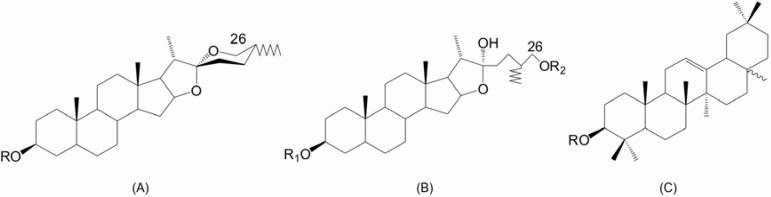
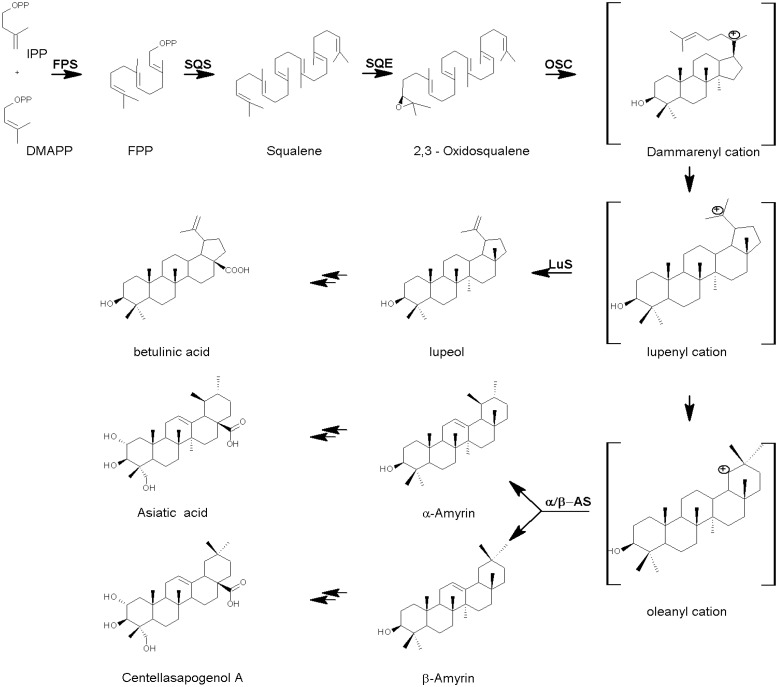
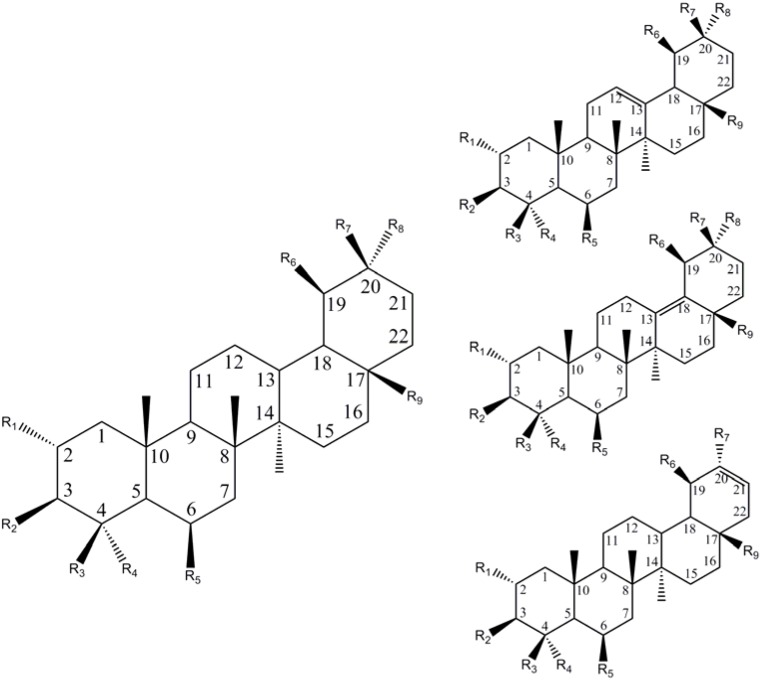
Centella asiatica accumulates large quantities of pentacyclic triterpenoid saponins, collectively known as centelloids. These terpenoids include asiaticoside, centelloside, madecassoside, brahmoside, brahminoside, thankuniside, sceffoleoside, centellose, asiatic-, brahmic-, centellic- and madecassic acids. The triterpene saponins are common secondary plant metabolites and are synthesized via the isoprenoid pathway to produce a hydrophobic triterpenoid structure (aglycone) containing a hydrophilic sugar chain (glycone). The biological activity of saponins has been attributed to these characteristics. In planta, the Centella triterpenoids can be regarded as phytoanticipins due to their antimicrobial activities and protective role against attempted pathogen infections. Preparations of C. asiatica are used in traditional and alternative medicine due to the wide spectrum of pharmacological activities associated with these secondary metabolites. Here, the biosynthesis of the centelloid triterpenoids is reviewed; the range of metabolites found in C. asiatica, together with their known biological activities and the chemotype variation in the production of these metabolites due to growth conditions are summarized. These plant-derived pharmacologically active compounds have complex structures, making chemical synthesis an economically uncompetitive option. Production of secondary metabolites by cultured cells provides a particularly important benefit to manipulate and improve the production of desired compounds; thus biotechnological approaches to increase the concentrations of the metabolites are discussed.
Overview
The claims and statistics of this paper haven’t been checked yet.
Run the check — free, no account needed. It reads the open-access text and checks the sources it cites.
Integrity signals
Registry
Cites
Statistics
Figures
Verification
Claims the paper makes
The claims and statistics of this paper haven’t been checked yet.
Run the check — free, no account needed. It reads the open-access text and checks the sources it cites.
Claims other papers make about this one
Each is checked against this paper’s own text: does it say what the citing paper says it does?
The source backs part of the claim, not all of it — or backs it for a different population, condition or comparison.
In the citing paper
“The Centella triterpenoids can be considered as phytoanticipins against a wide range of bacterial, fungal and parasitic agents due to their antimicrobial activities, selective cytotoxicity and protective function against pathogenic infections.”
From Therapeutic Properties and Pharmacological Activities of Asiaticoside and Madecassoside: A Review (2023) · cites this paper as [3]
Experimental — accuracy not yet measured
Self-check
Percentages, sums and reported differences re-computed from the paper’s own numbers.
The self-check needs the paper’s full text.
Citations
Cites
The function of terpene natural products in the natural world
Gershenzon, J., & Dudareva, N. (2007) · Nature Chemical Biology · doi:10.1038/nchembio.2007.5 · Cited by 2,198
Biological activities and distribution of plant saponins
Sparg, S. G., Light, M. E., & van Staden, J. (2004) · Journal of Ethnopharmacology · doi:10.1016/j.jep.2004.05.016 · Cited by 1,469
Herbal Medicines: A Guide for Healthcare Professionals
Newall, C. A., Anderson, L. A., & Phillipson, J. D. (1996) · Medical Entomology and Zoology · Cited by 845
The isoprene rule and the biogenesis of terpenic compounds
Růžička, L. (1953) · Cellular and Molecular Life Sciences · doi:10.1007/bf02167631 · Cited by 746
Fungal Resistance to Plant Antibiotics as a Mechanism of Pathogenesis
Morrissey, J. P., & Osbourn, A. E. (1999) · Microbiology and Molecular Biology Reviews · doi:10.1128/mmbr.63.3.708-724.1999 · Cited by 635
Giri, A., & Narasu, M. L. (2000) · Biotechnology Advances · doi:10.1016/s0734-9750(99)00016-6 · Cited by 579
Chemical, pharmacological and clinical profile of the East Asian medical plant Centella aslatica
Brinkhaus, B., Lindner, M., Schuppan, D., & Hahn, E. G. (2000) · Phytomedicine · doi:10.1016/s0944-7113(00)80065-3 · Cited by 525
Compromised disease resistance in saponin-deficient plants
Papadopoulou, K. Κ., Melton, R. E., Leggett, M., Daniels, M. J., & Osbourn, A. (1999) · Proceedings of the National Academy of Sciences · doi:10.1073/pnas.96.22.12923 · Cited by 466
(1980) · Springer eBooks · doi:10.1007/978-3-642-67360-3 · Cited by 450
Biosynthesis of Triterpenoid Saponins in Plants
Haralampidis, K., Trojanowska, M., & Osbourn, A. (2002) · Advances in biochemical engineering, biotechnology · doi:10.1007/3-540-44604-4_2 · Cited by 429
Research works printed but not linked: 18
- Devon, T.K., and Scott, A.I. (1972). Handbook of Natural Occurring Compounds, Academic Press.
- Bell, E.A., and Charlwood, B.V. (1980). Encyclopedia of Plant Physiology, Springer Verlag.
- Rastogi, 1963, Chemical examination of Centella asiatica Linn. II. Brahmoside and brahminoside, Indian J. Chem., 1, 267
- Dutta, 1962, Triterpenoids: Part I. Thankuniside and Thankunic acid – a new triterpene glycoside and acid from Centella asiatica Linn. (Urb.), J. Sci. Ind. Res., B12, 239
- Bhattacharyya, 1956, Constituents of Centella asiatica Part II. Structure of the terpene acids, J. Indian Chem. Soc., 33, 630
- Rao, 1970, Variation in the chemical composition of Indian samples of Centella asiatica, Curr. Sci., 38, 77
- Dutta, 1968, Isothankunic acid–A new triterpene acid from Centella asiatica (URB), Bull. Nat. Inst. Sci. India, 37, 178
- Castellani, 1981, The Centella asiatica, Bull. Chim. Farm., 120, 570
- Pinhas, 1967, Sur la constitution chimique de la partie glucidique du madecassoside, Bull. Soc. Chim. Fr., 6, 1888
- 1963, New drugs from higher plants recently introduced into therapeutics, Lebanese Pharm., 8, 15
- Boely, 1975, Indications of titrated extract of Centella asiaticia in phlebology, Gaz. Med. Fr., 82, 741
- Wolfram, 1965, Erfahrungen mit Maddecasol bei der behandling ulzererõserser Hautverãnderungen, Wien. Med. Wschr., 115, 439
- Cristoni, 1998, Management of local adiposity with botanicals, Chimica Oggi/Chemistry Today, 16, 11
- Lucia, 1997, Phamacological and toxicological studies on Centella asiatica, Fitotherapia, LXVIII, 413
- Jatisatienr, C., and Tragoolpua, K. (4,, January June). Effect of the extract from eight species of medicinal plants on growth of selected plant pathogenic molds and dermatophyte. International Symposium on Breeding Research on Medicinal and Aromatic Plants, Quedlingberg, Germany.
- Srivastava, 1997, Antibacterial activity of Centella asiatica, Fitotherapia, 68, 466
- Ullah, 2009, Antimicrobial, cytotoxic and antioxidant activity of Centella asiatica, Eur. J. Sci. Res., 30, 260
- Gaines, 2004, Increasing alkaloid production from Catharanthus roseus suspensions through methyl jasmonate elicitation, Pharm. Eng., 24, 1
Cited by
Sorted by citations
Therapeutic and Medicinal Uses of Terpenes
Cox-Georgian, D., Ramadoss, N., Dona, C., & Basu, C. (2019) · Springer eBooks · doi:10.1007/978-3-030-31269-5_15 · Cited by 466
Centella asiatica: Phytochemistry and mechanisms of neuroprotection and cognitive enhancement
Gray, N. E., Alcazar Magana, A., Lak, P., Wright, K. M., Quinn, J., Stevens, J. F., Maier, C. S., & Soumyanath, A. (2018) · Phytochemistry Reviews · doi:10.1007/s11101-017-9528-y · Cited by 299
Triterpene Composition and Bioactivities of Centella asiatica
Hashim, P., Sidek, H., Helan, M. H. M., Sabery, A., Palanisamy, U. D., & Ilham, M. (2011) · Molecules · doi:10.3390/molecules16021310 · Cited by 266
Triterpenoid-biosynthetic UDP-glycosyltransferases from plants
Rahimi, S., Kim, J., Mijakovic̀, I., Jung, K., Choi, G., Kim, S., & Kim, Y. (2019) · Biotechnology Advances · doi:10.1016/j.biotechadv.2019.04.016 · Cited by 234
Centella asiatica in Dermatology: An Overview
Bylka, W., Znajdek-Awiżeń, P., Studzińska-Sroka, E., Dańczak‐Pazdrowska, A., & Brzezińska, M. (2014) · Phytotherapy Research · doi:10.1002/ptr.5110 · Cited by 231
Metadata
- Authors
- James, J. T., & Dubery, I. A.
- Affiliations
- University of Johannesburg (ZA)
- Corresponding author
- Dubery, Ian A.
- Venue
- Molecules
- Publisher
- MDPI AG
- Published
- 2009-10-09
- Volume
- 14
- Issue
- 10
- Pages
- 3922-3941
- ISSN
- 1420-3049 (ISSN-L)
- PMC
- PMC6255425
- OpenAlex
- W2124211842
- Cited by
- 399
- References
- 77
- Citations by year
- 2026: 24 · 2025: 44 · 2024: 30 · 2023: 34 · 2022: 29 · 2021: 38 · 2020: 25 · 2019: 26 · 2018: 21 · 2017: 26 · 2016: 23 · 2015: 15 · 2014: 19 · 2013: 20 · 2012: 13
- FWCI
- 0.64
- Type
- journal article
- Language
- en
- Open access
- gold
- doi.org
- Licence
- Locations
- Molecules (publishedVersion, cc-by)
- Europe PMC (PubMed Central) (publishedVersion, other-oa)
- PubMed Central (publishedVersion, cc-by)
- PubMed (publishedVersion)
- DOAJ (DOAJ: Directory of Open Access Journals) (submittedVersion)
- Topics
- Physical Sciences › Chemistry › Organic Chemistry › Natural product bioactivities and synthesis
- Health Sciences › Medicine › Complementary and alternative medicine › Medicinal Plants and Neuroprotection
- Physical Sciences › Chemistry › Organic Chemistry › Phytochemical Studies and Bioactivities
- Keywords
- Centella asiatica, pentacyclic triterpenes, triterpenoid saponins, asiaticoside, madecassoside, triterpenoid biosynthesis, isoprenoid pathway, antimicrobial activity, phytoanticipins, secondary metabolites, cell culture production, biotechnological production, traditional medicine
- MeSH terms
- Humans, Plants, Medicinal, Saponins, Triterpenes, Centella
About these checks
Registry, retraction, Cites and statistics results are computed, not judged, with one exception: a printed reference that no index lists is read once by a model before it counts as a citation error. Claims are extracted by a model and kept only when their quote appears verbatim in the text; each cited source is then checked, with a model’s help, for whether it says what the claim relies on. Those verdicts can be wrong — read the claim’s quote and the cited source before relying on one.
Statistics and arithmetic are recomputed, not judged.
Confidence bands are shown only for fields calibrated on our annotated test set. None is calibrated yet, so no band is shown.
What counts as a claim ›How we measure confidence ›How we check this ›
Are you an author, or do you see a problem with this page? Request a review
