

Thymidine analogues for tracking DNA synthesis.
Open accessThe DOI matches its Crossref record; 65 of the 65 references it cites were found in a registry or an index.
Abstract
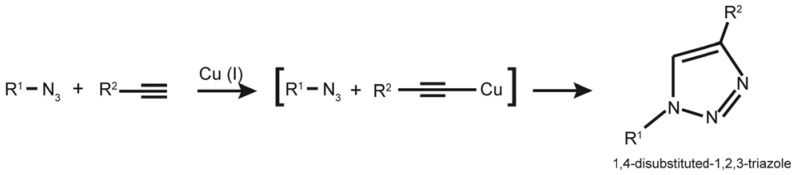
Replicating cells undergo DNA synthesis in the highly regulated, S-phase of the cell cycle. Analogues of the pyrimidine deoxynucleoside thymidine may be inserted into replicating DNA, effectively tagging dividing cells allowing their characterisation. Tritiated thymidine, targeted using autoradiography was technically demanding and superseded by 5-bromo-2-deoxyuridine (BrdU) and related halogenated analogues, detected using antibodies. Their detection required the denaturation of DNA, often constraining the outcome of investigations. Despite these limitations BrdU alone has been used to target newly synthesised DNA in over 20,000 reviewed biomedical studies. A recent breakthrough in “tagging DNA synthesis” is the thymidine analogue 5-ethynyl-2′-deoxyuridine (EdU). The alkyne group in EdU is readily detected using a fluorescent azide probe and copper catalysis using ‘Huisgen’s reaction’ (1,3-dipolar cycloaddition or ‘click chemistry’). This rapid, two-step biolabelling approach allows the tagging and imaging of DNA within cells whilst preserving the structural and molecular integrity of the cells. The bio-orthogonal detection of EdU allows its application in more experimental assays than previously possible with other “unnatural bases”. These include physiological, anatomical and molecular biological experimentation in multiple fields including, stem cell research, cancer biology, and parasitology. The full potential of EdU and related molecules in biomedical research remains to be explored.
Overview
The claims and statistics of this paper haven’t been checked yet.
Free: it reads the open-access text and checks the first 5 claims that cite a source we can check. Create a free account to check every claim.
Integrity signals
Registry
Cites
Statistics
Figures


Verification
Claims the paper makes
The claims and statistics of this paper haven’t been checked yet.
Free: it reads the open-access text and checks the first 5 claims that cite a source we can check. Create a free account to check every claim.
Claims other papers make about this one
Each is checked against this paper’s own text: does it say what the citing paper says it does?
The source backs part of the claim, not all of it — or backs it for a different population, condition or comparison.
In the citing paper
“Growth arrest is a key feature which can be readily demonstrated in vitro using colony-formation assays or by BrdU/EdU-incorporation assays that measure DNA synthesis (Cavanagh et al., 2011; Crane and Bhattacharya, 2013; Mead and Lefebvre, 2014; Adan et al., 2016; Bhaskara, 2016).”
From Mechanisms of Cellular Senescence: Cell Cycle Arrest and Senescence Associated Secretory Phenotype (2021) · cites this paper as Cavanagh et al., 2011
Experimental — accuracy not yet measured
Self-check
Percentages, sums and reported differences re-computed from the paper’s own numbers.
The self-check needs the paper’s full text.
Citations
Cites
Neurogenesis in the adult human hippocampus
Eriksson, P. S., Perfilieva, E., Björk-Eriksson, T., Alborn, A.-M., Nordborg, C., Peterson, D. A., & Gage, F. H. (1998) · Nature Medicine · doi:10.1038/3305 · Cited by 6,369
Subventricular zone astrocytes are neural stem cells in the adult mammalian brain
Doetsch, F., Caillé, I., Lim, D. A., García-Verdugo, J. M., & Alvarez-Buylla, A. (1999) · Cell · doi:10.1016/s0092-8674(00)80783-7 · Cited by 3,898 · cited 1×
“Studies of cell origin and migration at high resolution together with quantitative studies of cell genesis are possible using BrdU [2,20-22].”
BackgroundAutoradiographic and histological evidence of postnatal hippocampal neurogenesis in rats
Altman, J., & Das, G. D. (1965) · Journal of Comparative Neurology · doi:10.1002/cne.901240303 · Cited by 3,592 · cited 6×
“Once inside the tissue the chemical is available to all cells [2,12].”
BackgroundInfluentialAgard, N. J., Prescher, J. A., & Bertozzi, C. R. (2004) · Journal of the American Chemical Society · doi:10.1021/ja044996f · Cited by 3,017
Mechanisms and Functional Implications of Adult Neurogenesis
Zhao, C., Deng, W., & Gage, F. H. (2008) · Cell · doi:10.1016/j.cell.2008.01.033 · Cited by 3,007
Gratzner, H. G. (1982) · Science · doi:10.1126/science.7123245 · Cited by 2,628
Long-Distance Neuronal Migration in the Adult Mammalian Brain
Lois, C., & Alvarez-Buylla, A. (1994) · Science · doi:10.1126/science.8178174 · Cited by 2,331
Doetsch, F., Garcı́a-Verdugo, J. M., & Alvarez-Buylla, A. (1997) · The Journal of Neuroscience · doi:10.1523/jneurosci.17-13-05046.1997 · Cited by 1,902
A chemical method for fast and sensitive detection of DNA synthesis in vivo
Salic, A., & Mitchison, T. J. (2008) · Proceedings of the National Academy of Sciences · doi:10.1073/pnas.0712168105 · Cited by 1,861
Copper-free click chemistry for dynamic in vivo imaging
Baskin, J. M., Prescher, J. A., Laughlin, S. T., Agard, N. J., Chang, P. V., Miller, I. A., Lo, A., Codelli, J. A., & Bertozzi, C. R. (2007) · Proceedings of the National Academy of Sciences · doi:10.1073/pnas.0707090104 · Cited by 1,833
Research works printed but not linked: 4
- Klug, W.S., and Cummings, M.R. (2006). Concepts of Genetics, Pearson Education. [8th].
- Eriksson, 1998, Neurogenesis in the adult human hippocampus, Nat. Med., 4, 1313, 10.1038/3305 · DOI · Paper page
- Huisgen, R. (1961). Centenary lecture-1,3-Dipolar cycloadditions. Proc. Chem. Soc., 357–396.
- Cavanagh, B., Jesuadian, S., Ng, A., Dwyer, P., Nguyen, M., Bellette, B., Karunaratne, A., Poulsen, S.-A., Mackay-Sim, A., and Meedeniya, A. (February, January 31). EdU in Multiple Applications and Cell Types. Proceedings of the Australian Neuroscience Society 31st Annual Meeting, Auckland, New Zealand,.
Cited by
Mechanisms of Cellular Senescence: Cell Cycle Arrest and Senescence Associated Secretory Phenotype
Kumari, R., & Jat, P. (2021) · Frontiers in Cell and Developmental Biology · doi:10.3389/fcell.2021.645593 · Cited by 1,622
Contrast Medium-Induced Acute Kidney Injury
Sadat, U., Usman, A., Boyle, J. R., Hayes, P. D., & Solomon, R. J. (2015) · Cardiorenal Medicine · doi:10.1159/000430770 · Cited by 1,285
Cell Proliferation and Cytotoxicity Assays
Adan, A., Kiraz, Y., & Baran, Y. (2016) · Current Pharmaceutical Biotechnology · doi:10.2174/1389201017666160808160513 · Cited by 584
Assaying Cell Cycle Status Using Flow Cytometry
Kim, K. H., & Sederstrom, J. M. (2015) · Current Protocols in Molecular Biology · doi:10.1002/0471142727.mb2806s111 · Cited by 308
Aging of the cells: Insight into cellular senescence and detection Methods.
Mohamad Kamal, N. S., Safuan, S., Shamsuddin, S., & Foroozandeh, P. (2020) · European Journal of Cell Biology · doi:10.1016/j.ejcb.2020.151108 · Cited by 287
Wang, L., Cao, X., Yang, Y., Kose, C., Kawara, H., Lindsey-Boltz, L. A., Selby, C. P., & Sancar, A. (2022) · Proceedings of the National Academy of Sciences · doi:10.1073/pnas.2210176119 · Cited by 26
Metadata
- Authors
- Cavanagh, B. L., Walker, T., Norazit, A., & Meedeniya, A. C. B.
- Affiliations
- Griffith University (AU)
- Corresponding author
- Meedeniya, Adrian C.B.
- Venue
- Molecules
- Publisher
- MDPI AG
- Published
- 2011-09-15
- Volume
- 16
- Issue
- 9
- Pages
- 7980-7993
- ISSN
- 1420-3049 (ISSN-L)
- PMC
- PMC6264245
- OpenAlex
- W2161049445
- Cited by
- 143
- References
- 65
- Citations by year
- 2026: 8 · 2025: 11 · 2024: 4 · 2023: 6 · 2022: 13 · 2021: 12 · 2020: 10 · 2019: 9 · 2018: 9 · 2017: 11 · 2016: 13 · 2015: 12 · 2014: 8 · 2013: 13 · 2012: 4
- FWCI
- 0.30
- Type
- journal article
- Language
- en
- Open access
- gold
- doi.org
- Licence
- Locations
- Molecules (publishedVersion, cc-by)
- Europe PMC (PubMed Central) (publishedVersion, other-oa)
- PubMed Central (publishedVersion, cc-by)
- PubMed (publishedVersion)
- DOAJ (DOAJ: Directory of Open Access Journals) (submittedVersion, cc-by-sa)
- Griffith Research Online (submittedVersion, cc-by)
- Topics
- Physical Sciences › Chemistry › Organic Chemistry › Click Chemistry and Applications
- Life Sciences › Biochemistry, Genetics and Molecular Biology › Molecular Biology › DNA and Nucleic Acid Chemistry
- Life Sciences › Biochemistry, Genetics and Molecular Biology › Molecular Biology › DNA Repair Mechanisms
- Keywords
- thymidine analogs, 5-ethynyl-2'-deoxyuridine, click chemistry, 1,3-dipolar cycloaddition, bioorthogonal labeling, DNA labeling, S-phase cell cycle, bromodeoxyuridine, tritiated thymidine, cell proliferation imaging
- MeSH terms
- Animals, Bromodeoxyuridine, Cells, Cultured, Deoxyuridine, DNA, Fluorescent Dyes, Humans, Staining and Labeling, Thymidine, Cell Proliferation, Stem Cell Niche, Click Chemistry
About these checks
Registry, retraction, Cites and statistics results are computed, not judged, with one exception: a printed reference that no index lists is read once by a model before it counts as a citation error. Claims are extracted by a model and kept only when their quote appears verbatim in the text; each cited source is then checked, with a model’s help, for whether it says what the claim relies on. Those verdicts can be wrong — read the claim’s quote and the cited source before relying on one.
Statistics and arithmetic are recomputed, not judged.
Confidence bands are shown only for fields calibrated on our annotated test set. None is calibrated yet, so no band is shown.
What counts as a claim ›How we measure confidence ›How we check this ›
Are you an author, or do you see a problem with this page? Request a review
Data sources
Bibliographic data: Semantic Scholar, OpenAlex, Crossref.
Contains information from the Semantic Scholar Academic Graph Datasets, made available under the ODC Attribution License (ODC-BY 1.0).
Semantic Scholar’s data is described in: Kinney, R., et al. (2023). The Semantic Scholar Open Data Platform. arXiv:2301.10140.
