

Computational Study of Heat Transfer inside Different PCMs Enhanced by Al2O3 Nanoparticles in a Copper Heat Sink at High Heat Loads
Open accessThe DOI matches its Crossref record; 41 of the 41 references it cites were found in a registry or an index.
Abstract
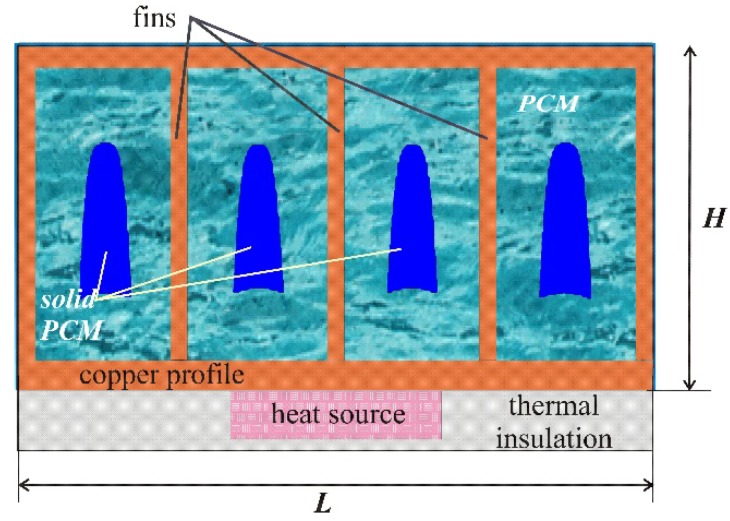
The cooling of electronic elements is one of the most important problems in the development of architecture in electronic technology. One promising developing cooling method is heat sinks based on the phase change materials (PCMs) enhanced by nano-sized solid particles. In this paper, the influence of the PCM’s physical properties and the concentration of nanoparticles on heat and mass transfer inside a closed radiator with fins, in the presence of a source of constant volumetric heat generation, is analyzed. The conjugate problem of nano-enhanced phase change materials (NePCMs) melting is considered, taking into account natural convection in the melt under the impact of the external convective cooling. A two-dimensional problem is formulated in the non-primitive variables, such as stream function and vorticity. A single-phase nano-liquid model is employed to describe the transport within NePCMs.
Overview
The claims and statistics of this paper haven’t been checked yet.
Free: it reads the open-access text and checks the first 5 claims that cite a source we can check. Create a free account to check every claim.
Integrity signals
Registry
Cites
Statistics
Figures
Verification
Claims the paper makes
The claims and statistics of this paper haven’t been checked yet.
Free: it reads the open-access text and checks the first 5 claims that cite a source we can check. Create a free account to check every claim.
Claims other papers make about this one
Each is checked against this paper’s own text: does it say what the citing paper says it does?
The source backs part of the claim, not all of it — or backs it for a different population, condition or comparison.
In the citing paper
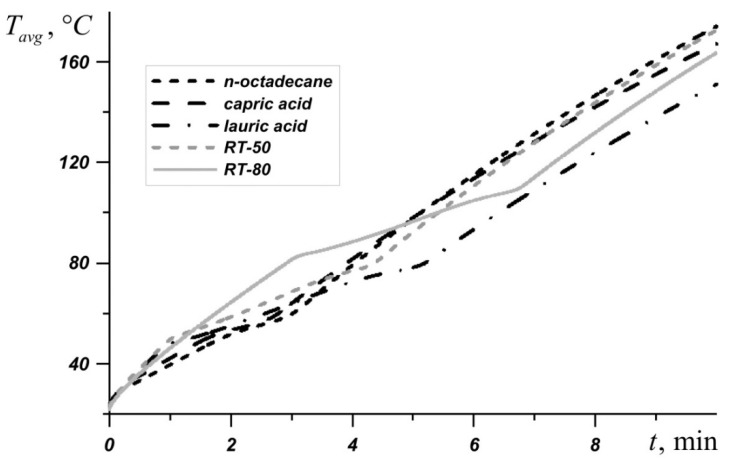
“The lauric acid had the lowest temperature heat sink after four minutes, making it the best choice.”
From Nano-Enhanced Phase Change Materials in Latent Heat Thermal Energy Storage Systems: A Review (2021) · cites this paper as [80]
Experimental — accuracy not yet measuredThe cited source says what the claim attributes to it.
In the citing paper
“NPs reduced latent heat, accelerated the melting process, and reduced the overall heat capacity.”
From Nano-Enhanced Phase Change Materials in Latent Heat Thermal Energy Storage Systems: A Review (2021) · cites this paper as [80]
The cited source says what the claim attributes to it.
In the citing paper
“As a result of this, NPs only enhanced the system up to 2% concentration, which was determined to be the best concentration [80].”
From Nano-Enhanced Phase Change Materials in Latent Heat Thermal Energy Storage Systems: A Review (2021) · cites this paper as [80]
The cited source says what the claim attributes to it.
In the citing paper
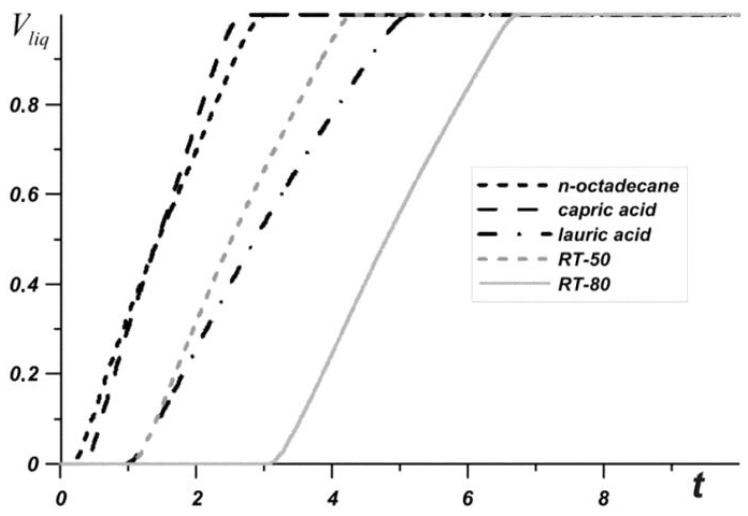
“Since n-octadecane has the lowest melting point, it started melting first; however, since it melted quickly, it only cooled for a short amount of time.”
From Nano-Enhanced Phase Change Materials in Latent Heat Thermal Energy Storage Systems: A Review (2021) · cites this paper as [80]
The cited source says what the claim attributes to it.
In the citing paper
“NPs enhanced up to 2% concentration”
From Nano-Enhanced Phase Change Materials in Latent Heat Thermal Energy Storage Systems: A Review (2021) · cites this paper as [80]
Self-check
Percentages, sums and reported differences re-computed from the paper’s own numbers.
The self-check needs the paper’s full text.
Citations
Cites
PCM thermal storage in buildings: A state of art
Tyagi, V. V., & Buddhi, D. (2007) · Renewable and Sustainable Energy Reviews · doi:10.1016/j.rser.2005.10.002 · Cited by 1,090
A new thermal conductivity model for nanofluids
Koo, J., & Kleinstreuer, C. (2004) · Journal of Nanoparticle Research · doi:10.1007/s11051-004-3170-5 · Cited by 1,052 · cited 1×
“In this study, the thermal conductivity model [39] for nanofluids, which takes into account the influence of particle size, concentration, and base fluid properties, was used.”
MethodVajjha, R. S., & Das, D. K. (2009) · International Journal of Heat and Mass Transfer · doi:10.1016/j.ijheatmasstransfer.2009.06.027 · Cited by 908 · cited 2×
“In [40], the new empirical correlations for β and f(T,Φ) were obtained experimentally considering nanoparticles of Al2O3, ZnO, and CuO.”
MethodMelting and Solidification of a Pure Metal on a Vertical Wall
Gau, C., & Viskanta, R. (1986) · Journal of Heat Transfer · doi:10.1115/1.3246884 · Cited by 655 · cited 2×
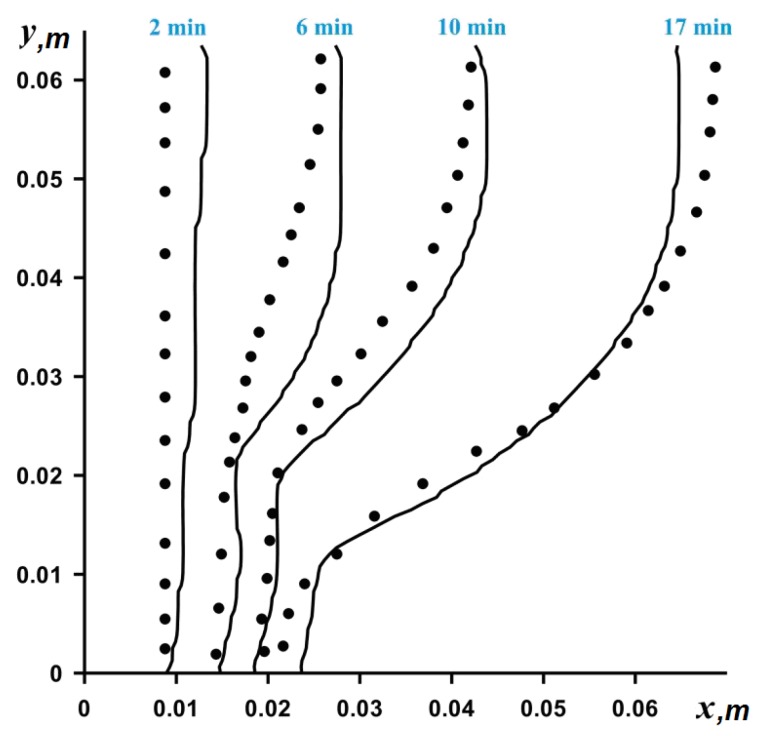
“Comparison of obtained numerical data (solid line) and experimental data (dots) [29].”
BackgroundResultExperimental study of using PCM in brick constructive solutions for passive cooling
Castell, A., Martorell, I., Medrano, M., Pérez, G., & Cabeza, L. F. (2010) · Energy and Buildings · doi:10.1016/j.enbuild.2009.10.022 · Cited by 549
Increasing the efficiency of PV panel with the use of PCM
Stropnik, R., & Stritih, U. (2016) · Renewable Energy · doi:10.1016/j.renene.2016.06.011 · Cited by 467
Vajjha, R. S., Das, D. K., & Namburu, P. K. (2010) · International Journal of Heat and Fluid Flow · doi:10.1016/j.ijheatfluidflow.2010.02.016 · Cited by 432
Leong, K. Y., Abdul Rahman, M. R., & Gurunathan, B. A. (2019) · Journal of Energy Storage · doi:10.1016/j.est.2018.11.008 · Cited by 405
Hosseinizadeh, S. F., Tan, F. L., & Moosania, S. M. (2011) · Applied Thermal Engineering · doi:10.1016/j.applthermaleng.2011.07.031 · Cited by 336 · cited 1×
“Aluminum oxide (nanoparticles) (d = 59 × 10−9 m) [34] 36 765 3600 7.”
Lee, K. O., Medina, M. A., Raith, E., & Sun, X. (2015) · Applied Energy · doi:10.1016/j.apenergy.2014.09.003 · Cited by 318
Cited by
Chu, Y.-M., Yadav, D., Shafee, A., Li, Z., & Bach, Q.-V. (2020) · Journal of Molecular Liquids · doi:10.1016/j.molliq.2020.114121 · Cited by 240
Improving solar cooker performance using phase change materials: A comprehensive review
Omara, A. A. M., Abuelnuor, A. A. A., Mohammed, H. A., Habibi, D., & Younis, O. (2020) · Solar Energy · doi:10.1016/j.solener.2020.07.015 · Cited by 128
Nano-Enhanced Phase Change Materials in Latent Heat Thermal Energy Storage Systems: A Review
Tofani, K., & Tiari, S. (2021) · Energies · doi:10.3390/en14133821 · Cited by 114
“As a result of this, NPs only enhanced the system up to 2% concentration, which was determined to be the best concentration [80].”
BackgroundMethodInfluentialMaleki, H., Ashrafi, M., Ilghani, N. Z., Goodarzi, M., & Muhammad, T. (2021) · Journal of Energy Storage · doi:10.1016/j.est.2021.103310 · Cited by 102
Korti, A. I. N., & Guellil, H. (2020) · Journal of Energy Storage · doi:10.1016/j.est.2020.101726 · Cited by 91
Global prospects and challenges of latent heat thermal energy storage: a review
Saha, S., Ruslan, A. R. M., Morshed, A. K. M. M., & Hasanuzzaman, M. (2020) · Clean Technologies and Environmental Policy · doi:10.1007/s10098-020-01997-7 · Cited by 80
Saeed, A. M., Abderrahmane, A., Qasem, N. A. A., Mourad, A., Alhazmi, M., Ahmed, S. E., & Guedri, K. (2022) · Journal of Energy Storage · doi:10.1016/j.est.2022.105172 · Cited by 70
Saleel, C. A. (2021) · Journal of Thermal Analysis and Calorimetry · doi:10.1007/s10973-021-10839-7 · Cited by 65
Kothari, R. C., Sahu, S. K., & Kundalwal, S. I. (2021) · Chemical Engineering and Processing - Process Intensification · doi:10.1016/j.cep.2021.108328 · Cited by 59
Location impact of a pair of magnetic sources on melting of a magneto-Ferro phase change substance
Izadi, M., Ghalambaz, M., & Mehryan, S. A. M. (2020) · Chinese Journal of Physics · doi:10.1016/j.cjph.2020.03.002 · Cited by 59
Herouz, K., Laidoudi, H., Abderrahmane, A., Mourad, A., Guedri, K., Oreijah, M., & Younis, O. (2023) · Journal of Energy Storage · doi:10.1016/j.est.2023.106736 · Cited by 50
A review of phase change materials and heat enhancement methodologies
Saqib, M., & Andrzejczyk, R. (2022) · Wiley Interdisciplinary Reviews Energy and Environment · doi:10.1002/wene.467 · Cited by 54
Arshad, A., Jabbal, M., Faraji, H., Talebizadehsardari, P., Bashir, M. A., & Yan, Y. (2021) · Heat and Mass Transfer · doi:10.1007/s00231-021-03065-2 · Cited by 46
“This equation is also widely used after its development in different numerical studies in the literature showing the accuracy of this equation [29, 39–41].”
Sheremet, M. А. (2021) · Nanomaterials · doi:10.3390/nano11071716 · Cited by 43
“[6] have numerically investigated an opportunity to enhance the heat removal from the local heat-generating element under the influence of a heat sink filled with a phase change material.”
BackgroundSelf-citationSohail, M., Nazir, U., El-Zahar, E. R., Alrabaiah, H., Kumam, P., Mousa, A. A. A., Sıtthıthakerngkıet, K., & Park, C. (2022) · Scientific Reports · doi:10.1038/s41598-022-13890-y · Cited by 44
“Step-I: Equations (6)–(7) within BCs are called strong form.”
BackgroundMethodInfluentialRoles of nanoparticles on freezing process of water within a tank equipped within fins
Rothan, Y. A. (2021) · Journal of Molecular Liquids · doi:10.1016/j.molliq.2021.116491 · Cited by 34
Rahman, I. U., Nardini, S., Buonomo, B., Manca, O., Khan, H., & Siviero, B. (2025) · Thermal Science and Engineering Progress · doi:10.1016/j.tsep.2025.103673 · Cited by 52
Tony, M. A. (2021) · Energy Storage · doi:10.1002/est2.238 · Cited by 33
Fayyaz, H., Hussain, A., Ali, I., Shahid, H., & Ali, H. M. (2022) · Materials · doi:10.3390/ma15228244 · Cited by 26
“[31] examined how nanofluids have proven themself in one of the best thermal conductive materials in electronic devices.”
BackgroundMehryan, S. A. M., Ayoubloo, K. A., Mahdavi, M., Younis, O., Kazemi, Z., Ghodrat, M., & Ghalambaz, M. (2022) · Journal of Energy Storage · doi:10.1016/j.est.2021.103950 · Cited by 25
Veismoradi, A., Ghalambaz, M., Shirivand, H., Hajjar, A., Mohamad, A. A., Sheremet, M. А., Chamkha, A. J., & Younis, O. (2021) · Applied Thermal Engineering · doi:10.1016/j.applthermaleng.2021.116793 · Cited by 23
Self-citationGhachem, K., Selımefendıgıl, F., Oztop, H. F., Alhadri, M., Kolsi, L., & AlShammari, N. K. (2021) · Alexandria Engineering Journal · doi:10.1016/j.aej.2021.09.034 · Cited by 20
Mehryan, S. A. M., Ghalambaz, M., Vaezi, M., Zadeh, S. M. H., Sedaghatizadeh, N., Younis, O., Chamkha, A. J., & Abulkhair, H. A. (2021) · Applied Mathematical Modelling · doi:10.1016/j.apm.2021.03.029 · Cited by 21
Nanofluids guided energy-efficient solar water heaters: Recent advancements and challenges ahead
Jaiswal, P., Kumar, Y., Das, L., Mishra, V., Pagar, R., Panda, D., & Biswas, K. G. (2023) · Materials Today Communications · doi:10.1016/j.mtcomm.2023.107059 · Cited by 16
Rashidi, N., & Mobadersani, F. (2024) · International Communications in Heat and Mass Transfer · doi:10.1016/j.icheatmasstransfer.2024.107854 · Cited by 16
Cooling electronic components by using nanofluids: a review
Hamad, N. H., Adham, A. M., & Abdullah, R. S. (2024) · Journal of Thermal Analysis and Calorimetry · doi:10.1007/s10973-024-13711-6 · Cited by 16
Shafiq, M. S., & Khan, M. M. (2022) · Journal of Energy Storage · doi:10.1016/j.est.2022.105247 · Cited by 17
Adebayo, P., & Yehya, A. (2022) · Energy Conversion and Management X · doi:10.1016/j.ecmx.2022.100314 · Cited by 14
Bondareva, N. S., Ghalambaz, M., & Sheremet, M. А. (2021) · Energies · doi:10.3390/en14051389 · Cited by 15
“For effective passive cooling, lauric acid [44,45] with a melting temperature of 46 ◦C, which, in addition to high latent heat, also has a high heat capacity, was chosen as PCM.”
Self-citationHassan, E. A., Tony, M. A., & Awad, M. M. (2024) · Nanomaterials · doi:10.3390/nano14070604 · Cited by 16
A review on the selection of phase change materials for photovoltaic thermal management
Sivashankar, M., Selvam, C., & Manikandan, S. (2021) · IOP Conference Series Materials Science and Engineering · doi:10.1088/1757-899x/1130/1/012026 · Cited by 14
Gibanov, N. S., Hussain, M., & Sheremet, M. А. (2023) · International Journal of Thermal Sciences · doi:10.1016/j.ijthermalsci.2023.108402 · Cited by 12
Self-citationReddy, P. S., & Sreedevi, P. (2025) · Journal of Thermal Analysis and Calorimetry · doi:10.1007/s10973-025-14764-x · Cited by 11
“Bondareva et al. [12] perceived remarkable augmentation in both thermal conductivity and viscosity when the volume fraction of nanoparticles is 0.02.”
InfluentialFeng, Z., Yang, W., Liu, X., He, F., Li, Y., Zhou, Y., Fan, J., & Zhang, K. (2020) · Applied Thermal Engineering · doi:10.1016/j.applthermaleng.2020.115633 · Cited by 11
Recent progress on passive cooling strategies for Li-ion battery of electric vehicles
Shruti, G., Salunkhe, P. B., & Shenoy, B. S. (2026) · Journal of Energy Storage · doi:10.1016/j.est.2026.121550 · Cited by 9
Kumar, A., Muthusamy, E., Kumar, R., Goyal, R. K., & Anand, Y. (2026) · Journal of Energy Storage · doi:10.1016/j.est.2026.120747 · Cited by 6
Hassan, E. A., & Tony, M. A. (2023) · Polymers · doi:10.3390/polym15214291 · Cited by 1
“The data illustrated in Figure 8 reveal that the heat transferred by the working fluid ( The data illustrated in Figure 8 reveal that the heat transferred by the working fluid (water) that is calculated for the whole process is attained by Equation (1) [50].”
BackgroundThe Effects of Deep Cryogenic Treatment on Heat transfer of Aluminium Heat Sink
Manickam, R. B. M., & Raja, N. D. (2024) · Materials Science · doi:10.5755/j02.ms.37991 · Cited by 1
Thermal enhancement of parabolic trough collectors using integrated heat transfer techniques
Chakraborty, O., Pathak, K. K., Das, B., Algarni, S. A., Alqahtani, T., & Irshad, K. (2026) · Applied Thermal Engineering · doi:10.1016/j.applthermaleng.2026.132962 · Cited by 1
Mohamed Ibrahim, N. H., Udayakumar, M., Suresh, S., Bhattacharyya, S., & Sharifpur, M. (2020) · International Journal of Numerical Methods for Heat & Fluid Flow · doi:10.1108/hff-07-2020-0458 · Cited by 1
Simulation for converting of two phase of water in complex container with finite element approach
Jiang, M., Musa, A., Abu‐Hamdeh, N. H., & Bantan, R. A. R. (2022) · Journal of Petroleum Science and Engineering · doi:10.1016/j.petrol.2022.110675
Indonesia, U. H. N., Napitupulu, R. A. M., Perangin-angin, S. E., & Siagian, P. (2023) · Jurnal POLIMESIN · doi:10.30811/jpl.v21i5.4266
Napitupulu, R. A. M., Perangin-angin, S. E., Siagian, P., Setyawan, E. Y., & Nababan, W. S. (2025) · Journal of Advanced Research in Numerical Heat Transfer · doi:10.37934/arnht.33.3.114
“From the experiment, it shows that the performance of Solar Cooker (SC) with Al2O3 increases by about 17.6% compared to PCM that does not use Al 2 O 3 [14].”
InfluentialAlkhafaji, M. A., Njim, E. K., & Dawood, W. A. (2025) · AIP conference proceedings · doi:10.1063/5.0286143
Kallouche, A., Kezzar, M., Eid, M. R., Sari, M. R., Sayed, A. A. M., Tabet, I., Mahariq, I., & Elsaid, E. M. (2025) · Proceedings of the Institution of Mechanical Engineers Part N Journal of Nanomaterials Nanoengineering and Nanosystems · doi:10.1177/23977914251345732
Nour, M., Tony, M. A., & Nabwey, H. A. (2026) · ACS Omega · doi:10.1021/acsomega.5c06221 · Cited by 1
Metadata
- Authors
- Bondareva, N. S., Gibanov, N. S., & Sheremet, M. A.
- Affiliations
- National Research Tomsk State University (RU)
- Laboratory on Convective Heat and Mass Transfer, Tomsk State University, Tomsk 634050, Russia
- Venue
- Nanomaterials
- Publisher
- MDPI AG
- Published
- 2020-02-07
- Volume
- 10
- Issue
- 2
- Pages
- 284
- ISSN
- 2079-4991 (ISSN-L)
- PMC
- PMC7075241
- OpenAlex
- W3004691320
- Cited by
- 46
- References
- 41
- Citations by year
- 2026: 4 · 2025: 5 · 2024: 4 · 2023: 5 · 2022: 8 · 2021: 13 · 2020: 7
- FWCI
- 4.06
- Type
- journal article
- Language
- en
- Open access
- gold
- dx.doi.org
- Licence
- Locations
- Nanomaterials (publishedVersion, cc-by)
- Europe PMC (PubMed Central) (publishedVersion, cc-by)
- PubMed Central (publishedVersion, cc-by)
- PubMed (publishedVersion)
- DOAJ (DOAJ: Directory of Open Access Journals) (submittedVersion, cc-by-sa)
- Funders
- the Grants Council (under the President of the Russian Federation (MK-1934.2019.1)
- Topics
- Physical Sciences › Engineering › Mechanical Engineering › Phase Change Materials Research
- Physical Sciences › Chemical Engineering › Fluid Flow and Transfer Processes › Nanofluid Flow and Heat Transfer
- Physical Sciences › Engineering › Mechanical Engineering › Heat Transfer and Optimization
- Keywords
- phase change materials, Al2O3 nanoparticles, copper heat sink, electronics cooling, melting, natural convection, nanoparticle concentration, conjugate heat transfer, stream function-vorticity formulation, high heat load
About these checks
Registry, retraction, Cites and statistics results are computed, not judged, with one exception: a printed reference that no index lists is read once by a model before it counts as a citation error. Claims are extracted by a model and kept only when their quote appears verbatim in the text; each cited source is then checked, with a model’s help, for whether it says what the claim relies on. Those verdicts can be wrong — read the claim’s quote and the cited source before relying on one.
Statistics and arithmetic are recomputed, not judged.
Confidence bands are shown only for fields calibrated on our annotated test set. None is calibrated yet, so no band is shown.
What counts as a claim ›How we measure confidence ›How we check this ›
Are you an author, or do you see a problem with this page? Request a review
Data sources
Bibliographic data: Semantic Scholar, OpenAlex, Crossref.
Contains information from the Semantic Scholar Academic Graph Datasets, made available under the ODC Attribution License (ODC-BY 1.0).
Semantic Scholar’s data is described in: Kinney, R., et al. (2023). The Semantic Scholar Open Data Platform. arXiv:2301.10140.
