

The DOI matches its Crossref record; 15 of the 21 references it cites were found in a registry or an index, and 2 are not checked yet; 6 of the 40 sources its claims cite were checked for support.
Executive Function Profiles in ADHD and Dyslexia: A Mixed-Method Neurocognitive Analysis
Open accessAbstract
Background/Objectives: Executive function (EF) impairments are common in neurodevelopmental disorders but are often examined using group-level approaches that may overlook clinically meaningful cognitive heterogeneity. This study explored EF heterogeneity in children with attention deficit hyperactivity disorder (ADHD), developmental dyslexia, and comorbid presentations using a clinically grounded mixed-method approach. Methods: Standardized neuropsychological data from the NEPSY-II, WISC-IV, and Woodcock–Johnson IV batteries were integrated with a case-based thematic synthesis of 11 clinical evaluations. Semi-inductive analysis was informed by preliminary patterns observed in a larger clinical sample. Results: Three executive function profiles were identified: (1) globally reduced executive functioning, characterized by widespread deficits in inhibition, attention, and working memory; (2) verbal–mnestic executive vulnerability, marked by weaknesses in verbal memory and attention regulation despite relative cognitive strengths; and (3) selective executive control deficit, reflecting impairments in inhibitory control and self-regulation. These profiles revealed clinically meaningful patterns that were not fully captured by categorical diagnostic classifications. Conclusions: The findings support the value of integrated, profile-based approaches for understanding executive function heterogeneity in neurodevelopmental conditions. Such approaches may enhance ecological validity in assessment and contribute to individualized intervention planning. Given the exploratory and case-based nature of the study, the findings should be considered preliminary and hypothesis-generating.
Verified 2026-10-10 · 2 references not checked yet
Overview
CoChat Summary
TL;DR
This mixed-method clinical study examined executive-function heterogeneity in children with ADHD, dyslexia, and comorbid ADHD+dyslexia using NEPSY-II, WISC-IV, and WJ-IV data. It identified three recurring profiles and found that the comorbid group showed the poorest performance on some executive-function measures.
Key findings
- Stage 1 included 30 children in the comparative analysis: ADHD (n = 18), dyslexia (n = 4), and comorbid ADHD+dyslexia (n = 8); 10 additional cases were excluded for unclear or alternative diagnoses.
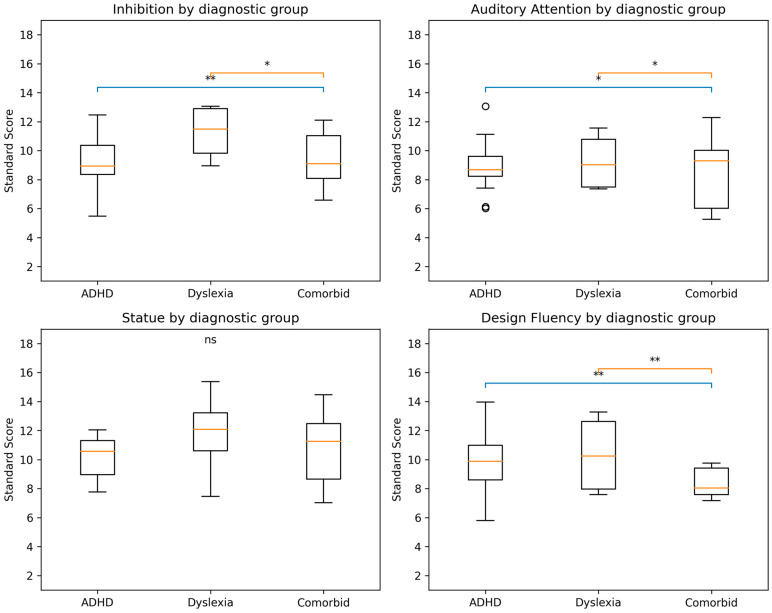
- One-way ANOVAs found significant group differences for Inhibition (*p* = 0.003) and Auditory Attention (*p* = 0.007), with the comorbid group performing more poorly; effect sizes were reported as η² = 0.34 (Inhibition), η² = 0.31 (Auditory Attention), and η² = 0.46 (Design Fluency).
- Stage 2 analyzed 11 clinical cases (ages 9–13) and identified three profiles: globally reduced executive functioning (n = 4), verbal–mnestic executive vulnerability (n = 4), and selective executive control deficit (n = 3).
- The globally reduced profile was most often associated with comorbid ADHD and dyslexia; the verbal–mnestic profile was mostly associated with dyslexia only; the selective executive control deficit profile was associated with ADHD inattentive type without dyslexia.
Methods
- Two-stage mixed-method design: Stage 1 used quantitative group comparison of NEPSY-II executive-function subtests across diagnostic categories; Stage 2 used qualitative thematic synthesis of clinical case reports to derive executive-function typologies.
- Sample/data: Stage 1 drew from 40 clinically evaluated children aged 8–15, with 30 retained for group analyses; Stage 2 purposively selected 11 children aged 9–13 with complete NEPSY-II, WISC-IV, and WJ-IV data.
- Main analysis: Stage 1 computed group means/SDs and ran one-way ANOVAs plus exploratory Games–Howell pairwise comparisons; Stage 2 used iterative cross-case coding, thematic analysis, and matrix-based profile identification.
Limitations
- The paper states that the sample was small, especially Stage 2 (N = 11), and that the uneven group sizes—particularly the dyslexia-only group (n = 4)—limit generalizability and preclude strong statistical inference.
- The data were collected retrospectively from routine clinical assessments, which may have introduced variability in assessment conditions and case selection; this was stated in the paper.
- The analytic framework was constrained by available subtests and norm-referenced instruments, limiting exploration of emotional and motivational dimensions of executive control; this was stated in the paper.
- Evident from the text: the study is cross-sectional and uses purposively selected clinical cases from a private setting, so findings are exploratory and not designed for population-level generalization.
Model-written summary. Check it against the paper before relying on it.
Integrity signals
Registry
Cites
Statistics
Figures

Verification
Claims the paper makes
3 Valid · 2 Not valid · 23 Not checked · 63 Own results and interpretations
The cited sources support only part of this claim — read each source’s verdict below.
In the paper
“In contrast, the hyperactive/impulsive presentation is more strongly linked to deficits in inhibitory control, response regulation, and delay aversion, leading to impulsive behaviors and difficulties in behavioral self-monitoring [4,5].”
§ Executive Function Profiles in ADHD and Dyslexia: A Mixed-Method Neurocognitive Analysis > 1. Introduction
What the sources say
- Partly supportedcites [4] Nigg, 2020, Toward a revised nosology for attention-deficit/hyperactivity disorder heterogeneity, Biol. Psychiatry Cogn. Neurosci. Neuroimaging sourceExperimental — accuracy not yet measured
The Cognitive heterogeneity in ADHD section discusses response inhibition and reward-related mechanisms as possible contributors to ADHD. It does not link inhibitory control, response regulation, or delay aversion more strongly to the hyperactive/impulsive presentation. Instead, it reports that cognitive control was related to inattention symptoms, while stimulus-driven processes were related to hyperactivity over time; the DSM-presentations section does not establish the claimed comparison. (LLM, conf=0.84)
- Not checked — no full text of the sourcecites [5] Barkley, R.A. (2012). Executive Functions: What They Are, How They Work, and Why They Evolved, Guilford Press. source
boostedstates an association- Asserted: passes — The authors put it forward as true.
- Checkable: passes — It can be checked against evidence.
- Load-bearing: unclear — It is unclear whether the paper’s conclusions depend on it.
- Based: passes — The paper gives a reason why it holds.
- Partly supported
The cited sources support only part of this claim — read each source’s verdict below.
In the paper
“Children with the predominantly inattentive presentation typically exhibit difficulties in sustained attention, working memory, and processing speed, often manifesting as disorganization, forgetfulness, and reduced task persistence [3,4].”
§ Executive Function Profiles in ADHD and Dyslexia: A Mixed-Method Neurocognitive Analysis > 1. Introduction
What the sources say
- Not checked — no full text of the sourcecites [3] Willcutt, 2005, Validity of the executive function theory of Attention-Deficit/Hyperactivity Disorder: A meta-analytic review, Biol. Psychiatry source
- Partly supportedcites [4] Nigg, 2020, Toward a revised nosology for attention-deficit/hyperactivity disorder heterogeneity, Biol. Psychiatry Cogn. Neurosci. Neuroimaging sourceExperimental — accuracy not yet measured
The “Cognitive heterogeneity in ADHD” section (page unavailable) links cognitive control to inattention symptoms and discusses working-memory differences in ADHD. It does not establish that children with the predominantly inattentive presentation typically have all three stated difficulties; in particular, the cited passages do not link processing speed to that presentation. (LLM, conf=0.78)
plainstates an association- Asserted: passes — The authors put it forward as true.
- Checkable: passes — It can be checked against evidence.
- Load-bearing: unclear — It is unclear whether the paper’s conclusions depend on it.
- Based: passes — The paper gives a reason why it holds.
A result the paper reports from its own data — it cites no other source for it, so there is none to check. The quote shows it is in the paper.
In the paper
“Although statistically significant differences were observed in selected NEPSY-II subtests (e.g., Inhibition, Auditory Attention), these findings should be interpreted cautiously given the small and uneven group sizes in Stage 1 (N = 30).”
§ Executive Function Profiles in ADHD and Dyslexia: A Mixed-Method Neurocognitive Analysis > 4. Discussions > 4.1. Stage 1
plainstates an associationn = 30- Asserted: passes — The authors put it forward as true.
- Checkable: passes — It can be checked against evidence.
- Load-bearing: unclear — It is unclear whether the paper’s conclusions depend on it.
- Based: passes — The paper gives a reason why it holds.
A result the paper reports from its own data — it cites no other source for it, so there is none to check. The quote shows it is in the paper.
In the paper
“Effect size estimates indicated moderate to large effects for Inhibition (η2 = 0.34), Auditory Attention (η2 = 0.31), and Design Fluency (η2 = 0.46), suggesting meaningful group differences despite the small sample sizes.”
§ Executive Function Profiles in ADHD and Dyslexia: A Mixed-Method Neurocognitive Analysis > 3. Results > 3.1. Stage 1: Descriptive and Comparative Analysis of NEPSY-II Profiles
hedged- Asserted: passes — The authors put it forward as true.
- Checkable: passes — It can be checked against evidence.
- Load-bearing: passes — The paper’s conclusions depend on it.
- Based: passes — The paper gives a reason why it holds.
A result the paper reports from its own data — it cites no other source for it, so there is none to check. The quote shows it is in the paper.
In the paper
“Cross-case comparison supported the consistency of the three cognitive executive profiles across multiple neuropsychological domains.”
§ Executive Function Profiles in ADHD and Dyslexia: A Mixed-Method Neurocognitive Analysis > 3. Results > 3.2. Stage 2: Clinical Typology of Executive Function Profiles (N = 11)
plainstates an association- Asserted: passes — The authors put it forward as true.
- Checkable: passes — It can be checked against evidence.
- Load-bearing: passes — The paper’s conclusions depend on it.
- Based: passes — The paper gives a reason why it holds.
36 more claims
Create a free account to see all 91 claims and every source verdict.
- Probably not a substantial claim. 35
- It may state two separate claims as one. 25
- The quote only partly states this claim. 1
Citations
Cites
Using thematic analysis in psychology
Braun, V., & Clarke, V. (2006) · Qualitative Research in Psychology · doi:10.1191/1478088706qp063oa · Cited by 194,414
Diagnostic and Statistical Manual of Mental Disorders
American Psychiatric Association (2013) · doi:10.1176/appi.books.9780890425596 · Cited by 116,369
Diamond, A. (2013) · Annual Review of Psychology · doi:10.1146/annurev-psych-113011-143750 · Cited by 13,268 · cited 1×
“Executive functions (EFs) refer to a set of higher-order cognitive processes—including inhibition, working memory, and cognitive flexibility—that are essential for behavior regulation, attention control, and goal-directed problem-solving [1].”
Willcutt, E. G., Doyle, A. E., Nigg, J. T., Faraone, S. V., & Pennington, B. F. (2005) · Biological Psychiatry · doi:10.1016/j.biopsych.2005.02.006 · Cited by 3,568 · cited 4×
“The combined presentation reflects a convergence of these difficulties, with impairments across multiple executive domains, including attention regulation, inhibition, and cognitive flexibility [3].”
InfluentialThe nature of phonological processing and its causal role in the acquisition of reading skills
Wagner, R. K., & Torgesen, J. K. (1987) · Psychological Bulletin · doi:10.1037/0033-2909.101.2.192 · Cited by 3,303 · cited 1×
“ADHD is typically associated with impairments in inhibition, working memory, and attentional control [3], while dyslexia is primarily linked to deficits in phonological processing and verbal working memory [7].”
Wechsler Intelligence Scale for Children, Fourth Edition
Wechsler, D. (2012) · PsycTESTS Dataset · doi:10.1037/t15174-000 · Cited by 1,577
Levitt, H. M., Motulsky, S. L., Wertz, F. J., Morrow, S. L., & Ponterotto, J. G. (2017) · Qualitative Psychology · doi:10.1037/qup0000082 · Cited by 851 · cited 2×
“Qualitative synthesis techniques, particularly those based on case-based and semi-inductive approaches, offer promising avenues for capturing heterogeneity in EF across clinical populations [13,14].”
Executive functions: what they are, how they work, and why they evolved
(2012) · Choice Reviews Online · doi:10.5860/choice.50-2366 · Cited by 622
Comorbidity of ADHD and dyslexia
Germanò, E., Gagliano, A., & Curatolo, P. (2010) · Developmental Neuropsychology · doi:10.1080/87565641.2010.494748 · Cited by 331 · cited 2×
“Importantly, comorbidity between ADHD and dyslexia is frequent, with reported overlap ranging from 25% to 40% [8].”
Toward a revised nosology for attention-deficit/hyperactivity disorder heterogeneity
Nigg, J. T., Karalunas, S. L., Feczko, E., & Fair, D. A. (2020) · Biological Psychiatry: Cognitive Neuroscience and Neuroimaging · doi:10.1016/j.bpsc.2020.02.005 · Cited by 132
Metadata
- Authors
- Cucu Ciuhan, G.
- Affiliations
- Department of Psychology, Communication Sciences and Social Work, Faculty of Educational Sciences, University Center Pitesti, National University of Science and Technology POLITEHNICA Bucharest, Targu din Vale Street no. 1, 110040 Pitesti, Romania
- ORCID
- Cucu Ciuhan, Geanina
- Venue
- Neurology International
- Publisher
- MDPI AG
- Published
- 2026-06-03
- Volume
- 18
- Issue
- 6
- Pages
- 110
- ISSN
- 2035-8377 (ISSN-L)
- PMC
- PMC13305708
- OpenAlex
- W7163410040
- Cited by
- 0
- References
- 21
- FWCI
- 0.00
- Type
- journal article
- Language
- en
- Open access
- gold
- doi.org
- Licence
- Locations
- Neurology International (publishedVersion, cc-by)
- PubMed (publishedVersion)
- PubMed Central (publishedVersion, cc-by)
- DOAJ (DOAJ: Directory of Open Access Journals) (submittedVersion)
- Topics
- Health Sciences › Medicine › Psychiatry and Mental health › Attention Deficit Hyperactivity Disorder
- Social Sciences › Psychology › Neuropsychology and Physiological Psychology › Developmental and Educational Neuropsychology
- Life Sciences › Neuroscience › Cognitive Neuroscience › Neural and Behavioral Psychology Studies
- Keywords
- executive function, attention deficit hyperactivity disorder, developmental dyslexia, cognitive heterogeneity, inhibition, working memory, verbal memory, attentional control, self-regulation, inhibitory control, comorbidities, children, neurodevelopmental disorders, personalized interventions
About these checks
Registry, retraction, Cites and statistics results are computed, not judged, with one exception: a printed reference that no index lists is read once by a model before it counts as a citation error. Claims are extracted by a model and kept only when their quote appears verbatim in the text; each cited source is then checked, with a model’s help, for whether it says what the claim relies on. Those verdicts can be wrong — read the claim’s quote and the cited source before relying on one.
The claim verdicts this report counts are experimental: their accuracy is not yet measured.
A language model drew the claims from the paper on 2026-10-10, under version 3 of the claim definition (model deepseek-v4.1-flash, prompt extract-v3).
A second model labelled each claim on 2026-10-10 (model jev-1.13-20260917, definition revision gold-guideline-v0.2).
Cited sources are checked with a language model’s help (gpt-6-sol).
Statistics and arithmetic are recomputed, not judged.
Confidence bands are shown only for fields calibrated on our annotated test set. None is calibrated yet, so no band is shown.
What counts as a claim ›How we measure confidence ›How we check this ›
Are you an author, or do you see a problem with this page? Request a review
How to cite
Cite CoChat for the checks on this page, and the paper for its own findings.
- This page
- CoChat. (2026). Citation check: Executive Function Profiles in ADHD and Dyslexia: A Mixed-Method Neurocognitive Analysis. https://app.cochat.ai/papers/10.3390/neurolint18060110
- The paper
- Cucu Ciuhan, G. (2026). Executive Function Profiles in ADHD and Dyslexia: A Mixed-Method Neurocognitive Analysis. Neurology International. https://doi.org/10.3390/neurolint18060110
Data sources
Bibliographic data: Semantic Scholar, OpenAlex, Crossref.
Contains information from the Semantic Scholar Academic Graph Datasets, made available under the ODC Attribution License (ODC-BY 1.0).
Semantic Scholar’s data is described in: Kinney, R., et al. (2023). The Semantic Scholar Open Data Platform. arXiv:2301.10140.
