

The DOI matches its Crossref record; 53 of the 54 references it cites were found in a registry or an index; none of the 33 sources its claims cite is checked for support yet.
The Association between Iron and Vitamin D Status in Female Elite Athletes
Open accessAbstract
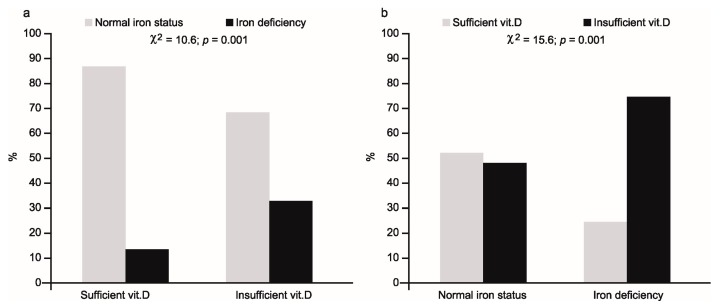
Vitamin D may influence iron metabolism and erythropoiesis, whereas iron is essential for vitamin D synthesis. We examined whether vitamin D deficiencies (VDD) are associated with reduced iron status and whether progressive iron deficiency (ID) is accompanied by inferior vitamin D status. The study included 219 healthy female (14–34 years old) athletes. VDD was defined as a 25(OH)D concentration < 75 nmol/L. ID was classified based on ferritin, soluble transferrin receptor (sTfR), total iron binding capacity (TIBC) and blood morphology indices. The percentage of ID subjects was higher (32%) in the VDD group than in the 25(OH)D sufficient group (11%) (χ2 = 10.6; p = 0.001). The percentage of VDD subjects was higher (75%) in the ID than in the normal iron status group (48%) (χ2 = 15.6; p = 0.001). The odds ratios (ORs) for VDD increased from 1.75 (95% CI 1.02–2.99; p = 0.040) to 4.6 (95% CI 1.81–11.65; p = 0.001) with progressing iron deficiency. ID was dependent on VDD in both VDD groups (25(OH)D < 75 and < 50 nmol/L). The ID group had a lower 25(OH)D concentration (p = 0.000). The VDD group had lower ferritin (p = 0.043) and iron (p = 0.004) concentrations and higher values of TIBC (p = 0.016) and sTfR (p = 0.001). The current results confirm the association between vitamin D and iron status in female athletes, although it is difficult to assess exactly which of these nutrients exerts a stronger influence over the other.
Overview
CoChat Summary
TL;DR
In 219 healthy female elite athletes, vitamin D deficiency and iron deficiency were mutually associated, with iron deficiency more common in vitamin D-deficient athletes and vitamin D deficiency more common in iron-deficient athletes. The authors conclude that iron deficiency may exert a stronger influence on vitamin D status than vice versa, though the cross-sectional design precludes causal inference.
Key findings
- Among 219 female athletes, 54.3% had 25(OH)D <75 nmol/L (1.8% <25 nmol/L); total iron deficiency was 23.3% (low iron stores 7.3%, latent ID 15.1%, iron deficiency anemia 0.9%).
- Iron deficiency was present in 32% of vitamin D-deficient (<75 nmol/L) athletes vs 11% of vitamin D-sufficient athletes (χ² = 10.6; p = 0.001); vitamin D deficiency was present in 75% of iron-deficient vs 48% of normal-iron-status athletes (χ² = 15.6; p = 0.001).
- Odds ratios for vitamin D deficiency increased with progressive iron deficiency, from 1.75 (95% CI 1.02–2.99; p = 0.040) at ferritin <30 µg/L to 4.6 (95% CI 1.81–11.65; p = 0.001) in latent ID/IDA; ORs for iron deficiency were 3.14 (95% CI 1.56–6.31; p = 0.001) for 25(OH)D <75 nmol/L and 3.18 (95% CI 1.09–9.26; p = 0.030) for <50 nmol/L.
- Iron-deficient athletes had lower mean 25(OH)D (p = 0.000); vitamin D-deficient athletes had lower ferritin (p = 0.043) and iron (p = 0.004) and higher TIBC (p = 0.016) and sTfR (p = 0.001).
Methods
- Cross-sectional study: initially 231 female professional athletes from seven sports (volleyball, handball, rowing, canoe sprint, cycling, speed skating, taekwondo); 12 excluded for acute phase reaction markers, leaving 219 healthy females aged 14–34. Blood was drawn once at various training phases/seasons; 51% were examined April–September.
- Blood assays: 25(OH)D by ELISA; ferritin by immunoturbidimetric method; iron and UIBC spectrophotometrically; TIBC calculated; sTfR by immunoenzymatic kits; morphology on ADVIA 120. Iron deficiency stages used ferritin <16 µg/L, sTfR >8.3 mg/L, TIBC >390 µg/dL, and anemia thresholds Hb <120 g/L, HCT <37%, RBC <4.2 × 10¹²/L.
- Statistics: chi-square tests; multivariate logistic regression with stepwise procedure adjusted for iron/vitamin D deficiency, length of day, in-/outdoor discipline, and age; unadjusted logistic regression for ferritin thresholds and 25(OH)D cutoffs; Mann–Whitney U tests; p < 0.05 considered significant.
Limitations
- Stated: cross-sectional design did not allow definite causal conclusions; lack of international unequivocal thresholds for diagnosing both vitamin D and iron deficiency; no hepcidin or interleukin data; no data on time spent outdoors, nutrient intake, or vitamin D/iron supplementation.
- Evident: single blood sample collected at varied training phases and seasons, with no longitudinal follow-up; all participants were Caucasian female athletes, most from national teams, so findings may not generalize to other populations.
Model-written summary. Check it against the paper before relying on it.
Integrity signals
Registry
Cites
Statistics
Figures
Verification
Claims the paper makes
0 Valid · 1 Not valid · 19 Not checked · 47 Own results and interpretations
A result the paper reports from its own data — it cites no other source for it, so there is none to check. The quote shows it is in the paper.
In the paper
“The percentage of ID subjects was higher (32%) in the VDD group than in the 25(OH)D sufficient group (11%) (χ2 = 10.6; p = 0.001).”
- Also stated in: § 3. Results · plain
“In the first case, iron deficiency was present in 32% of 25(OH)D deficient subjects, compared with 11% in the vitamin sufficient group (χ2 = 10.6; p = 0.001).”
§ The Association between Iron and Vitamin D Status in Female Elite Athletes > Abstract
plainstates an association- Asserted: passes — The authors put it forward as true.
- Checkable: passes — It can be checked against evidence.
- Load-bearing: passes — The paper’s conclusions depend on it.
- Based: passes — The paper gives a reason why it holds.
- Also stated in: § 3. Results · plain
A result the paper reports from its own data — it cites no other source for it, so there is none to check. The quote shows it is in the paper.
In the paper
“Logistic regression analysis (Table 3), expressed as the odds ratio (OR), with a 95% confidence interval (95%CI), indicated that in female athletes, vitamin D deficiency was significantly (p = 0.01) affected by two factors: the length of day (OR = 2.29; 95% CI 1.28–4.07; p = 0.005) and iron deficiency (OR = 2.96; 95% CI 1.45–6.02; p = 0.003).”
§ The Association between Iron and Vitamin D Status in Female Elite Athletes > 3. Results
hedgedstates an association- Asserted: passes — The authors put it forward as true.
- Checkable: passes — It can be checked against evidence.
- Load-bearing: passes — The paper’s conclusions depend on it.
- Based: passes — The paper gives a reason why it holds.
A result the paper reports from its own data — it cites no other source for it, so there is none to check. The quote shows it is in the paper.
In the paper
“Additionally, in the group with reduced vitamin D concentration, lower mean values of some hematological indices in reticulocytes (CHr, p = 0.049 and MCVr, p = 0.020) were observed, although the mean value of RBC in this group was higher (p = 0.029).”
§ The Association between Iron and Vitamin D Status in Female Elite Athletes > 3. Results
plainstates an association- Asserted: passes — The authors put it forward as true.
- Checkable: passes — It can be checked against evidence.
- Load-bearing: unclear — It is unclear whether the paper’s conclusions depend on it.
- Based: passes — The paper gives a reason why it holds.
A result the paper reports from its own data — it cites no other source for it, so there is none to check. The quote shows it is in the paper.
In the paper
“The gradual increase in OR, from 1.75 (95% CI 1.02–2.99) at 30 µg/L ferritin to 4.60 (95% CI 1.81–11.65), in athletes with stage II ID and IDA suggests that disorders in vitamin D synthesis can arise along with worsening iron status.”
§ The Association between Iron and Vitamin D Status in Female Elite Athletes > 4. Discussion
hedgedstates a cause- Asserted: passes — The authors put it forward as true.
- Checkable: passes — It can be checked against evidence.
- Load-bearing: passes — The paper’s conclusions depend on it.
- Based: passes — The paper gives a reason why it holds.
35 more claims
Create a free account to see all 67 claims and to verify the 33 references still open.
- It may state two separate claims as one. 17
- Probably not a substantial claim. 12
Self-check
Percentages, sums and reported differences re-computed from the paper’s own numbers.
Each contradiction between two passages listed here was confirmed by an independent check.
Rated minor: it would not touch a result — a value no result rests on, a p-value that stays on the same side of the significance level, or a conflict that is clerical, resolved elsewhere in the paper, or outside its own findings.
In the paper
§ The Association between Iron and Vitamin D Status in Female Elite Athletes > 2. Material and Methods > 2.4. Statistical Analysis
“the risk of iron deficiency in subjects with 25(OH)D concentrations below 25 and 75 nmol/L.”
§ The Association between Iron and Vitamin D Status in Female Elite Athletes > 3. Results
“The ORs for those groups were 3.14 (95% CI 1.56–6.31; p = 0.001) and 3.18 (95% CI 1.09–9.26; p = 0.030), respectively”
Rated minor: it would not touch a result — a value no result rests on, a p-value that stays on the same side of the significance level, or a conflict that is clerical, resolved elsewhere in the paper, or outside its own findings.
In the paper
§ The Association between Iron and Vitamin D Status in Female Elite Athletes > 3. Results
“3.56”
§ The Association between Iron and Vitamin D Status in Female Elite Athletes > 3. Results
“(95% CI 1.6–3.12; p = 0.002)”
Rated minor: it would not touch a result — a value no result rests on, a p-value that stays on the same side of the significance level, or a conflict that is clerical, resolved elsewhere in the paper, or outside its own findings.
In the paper
§ The Association between Iron and Vitamin D Status in Female Elite Athletes > 2. Material and Methods > 2.2. Blood Analysis
“mean cellular hemoglobin content (CHr)”
§ The Association between Iron and Vitamin D Status in Female Elite Athletes > 4. Discussion
“mean corpuscular hemoglobin concentration (CHr)”
Citations
Cites
Durnin, J. V. G. A., & Womersley, J. (1974) · British Journal of Nutrition · doi:10.1079/bjn19740060 · Cited by 6,343
Vitamin D status and ill health: a systematic review
Autier, P., Boniol, M., Pizot, C., & Mullie, P. (2014) · The Lancet Diabetes & Endocrinology · doi:10.1016/s2213-8587(13)70165-7 · Cited by 1,107
Pludowski, P., Holick, M. F., Pilz, S., Wagner, C. L., Hollis, B. W., Grant, W. B., Shoenfeld, Y., Lerchbaum, E., Llewellyn, D. J., Kienreich, K., et al. (2013) · Autoimmunity Reviews · doi:10.1016/j.autrev.2013.02.004 · Cited by 836
Wolf, M., Koch, T. A., & Bregman, D. B. (2013) · Journal of Bone and Mineral Research · doi:10.1002/jbmr.1923 · Cited by 430
Clark, S. F. (2008) · Nutrition in Clinical Practice · doi:10.1177/0884533608314536 · Cited by 374
Suppression of iron-regulatory hepcidin by vitamin D
Bacchetta, J., Zaritsky, J. J., Sea, J. L., Chun, R. F., Lisse, T. S., Zavala, K., Nayak, A., Wesseling-Perry, K., Westerman, M., Hollis, B. W., et al. (2014) · Journal of the American Society of Nephrology · doi:10.1681/asn.2013040355 · Cited by 350
Association of age, sex, and race with body iron stores in adults: Analysis of NHANES III data
Zacharski, L. R., Ornstein, D. L., Woloshin, S., & Schwartz, L. M. (2000) · American Heart Journal · doi:10.1067/mhj.2000.106646 · Cited by 349
Anemia—still a major health problem in many parts of the world!
Milman, N. (2011) · Annals of Hematology · doi:10.1007/s00277-010-1144-5 · Cited by 305
Sun, C. C., Vaja, V., Babitt, J. L., & Lin, H. Y.-F. (2011) · American Journal of Hematology · doi:10.1002/ajh.23110 · Cited by 185
The role of vitamin D in regulating the iron-hepcidin-ferroportin axis in monocytes
Zughaier, S. M., Alvarez, J. A., Sloan, J. H., Konrad, R. J., & Tangpricha, V. (2014) · Journal of Clinical & Translational Endocrinology · doi:10.1016/j.jcte.2014.01.003 · Cited by 174
Larson-Meyer, D. E., & Willis, K. S. (2010) · Current Sports Medicine Reports · doi:10.1249/jsr.0b013e3181e7dd45 · Cited by 169
Sports dietitians Australia position statement: sports nutrition for the adolescent athlete
Desbrow, B., McCormack, J., Burke, L. M., Cox, G. R., Fallon, K., Hislop, M., Logan, R., Marino, N., Sawyer, S. M., Shaw, G., et al. (2014) · International Journal of Sport Nutrition and Exercise Metabolism · doi:10.1123/ijsnem.2014-0031 · Cited by 165
Vitamin D deficiency and anemia: A cross-sectional study
Sim, J. J., Lac, P. T., Liu, I. L. A., Meguerditchian, S. O., Kumar, V. A., Kujubu, D. A., & Rasgon, S. A. (2010) · Annals of Hematology · doi:10.1007/s00277-009-0850-3 · Cited by 165
Chronic iron deficiency as an emerging risk factor for osteoporosis: A hypothesis
Toxqui, L., & Vaquero, M. (2015) · Nutrients · doi:10.3390/nu7042324 · Cited by 154
Prevalence of Iron Deficiency with and without Anemia in Recreationally Active Men and Women
Sinclair, L. M., & Hinton, P. S. (2005) · Journal of the American Dietetic Association · doi:10.1016/j.jada.2005.03.005 · Cited by 144
High prevalence of vitamin D insufficiency in athletes and dancers
Constantini, N. W., Arieli, R., Chodick, G., & Dubnov-Raz, G. (2010) · Clinical Journal of Sport Medicine · doi:10.1097/jsm.0b013e3181f207f2 · Cited by 142
Płudowski, P., Ducki, C., Konstantynowicz, J., & Jaworski, M. (2016) · Polskie Archiwum Medycyny Wewnętrznej · doi:10.20452/pamw.3479 · Cited by 129
Vitamin D and Exercise Performance in Professional Soccer Players
Koundourakis, N. E., Androulakis, N. E. M., Malliaraki, N. E., & Margioris, A. N. (2014) · PLoS ONE · doi:10.1371/journal.pone.0101659 · Cited by 126
Iron deficiency in women: assessment, causes and consequences
Coad, J. E., & Conlon, C. A. (2011) · Current Opinion in Clinical Nutrition & Metabolic Care · doi:10.1097/mco.0b013e32834be6fd · Cited by 104
Smith, E. M., Alvarez, J. A., Kearns, M. D., Hao, L., Sloan, J. H., Konrad, R. J., Ziegler, T. R., Zughaier, S. M., & Tangpricha, V. (2017) · Clinical Nutrition · doi:10.1016/j.clnu.2016.06.015 · Cited by 103
Cytochromes P450: Roles in diseases
Pikuleva, I. A., & Waterman, M. R. (2013) · Journal of Biological Chemistry · doi:10.1074/jbc.r112.431916 · Cited by 101
Hamilton, B., Whiteley, R., Farooq, A., & Chalabi, H. (2014) · Journal of Science and Medicine in Sport · doi:10.1016/j.jsams.2013.03.006 · Cited by 100
Seasonal variation in vitamin D status in professional soccer players of the English Premier League
Morton, J. P., Iqbal, Z., Drust, B., Burgess, D. J., Close, G. L., & Brukner, P. D. (2012) · Applied Physiology Nutrition and Metabolism · doi:10.1139/h2012-037 · Cited by 97
Vitamin D, Race, and Risk for Anemia in Children
Atkinson, M. A., Melamed, M. L., Kumar, J., Roy, C. N., Miller, E. R., Furth, S. L., & Fadrowski, J. J. (2013) · The Journal of Pediatrics · doi:10.1016/j.jpeds.2013.08.060 · Cited by 93
Novel role of 1,25(OH)2D3 in induction of erythroid progenitor cell proliferation
Alon, D. B., Chaimovitz, C., Dvilansky, A., Lugassy, G., Douvdevani, A., Shany, S., & Nathan, I. (2002) · Experimental Hematology · doi:10.1016/s0301-472x(02)00789-0 · Cited by 92
Nutrition Status of Junior Elite Canadian Female Soccer Athletes
Gibson, J. C., Stuart-Hill, L., Martin, S., & Gaul, C. (2011) · International Journal of Sport Nutrition and Exercise Metabolism · doi:10.1123/ijsnem.21.6.507 · Cited by 88
Krzywanski, J., Mikulski, T., Krysztofiak, H., Mlynczak, M., Gaczynska, E., & Ziemba, A. (2016) · PLOS ONE · doi:10.1371/journal.pone.0164395 · Cited by 83
Vitamin D in hematological disorders and malignancies
Larkin, P. M. K., Olson, K. C., Olson, T. L., Feith, D. J., & Loughran, T. P. (2016) · European Journal Of Haematology · doi:10.1111/ejh.12818 · Cited by 82
McClung, J. P., Gaffney‐Stomberg, E., & Lee, J. (2014) · Journal of Trace Elements in Medicine and Biology · doi:10.1016/j.jtemb.2014.06.022 · Cited by 78
Iron status in elite young athletes: gender-dependent influences of diet and exercise
Koehler, K., Braun, H., Achtzehn, S., Hildebrand, U., Predel, H.-G., Mester, J., & Schänzer, W. (2012) · European Journal of Applied Physiology · doi:10.1007/s00421-011-2002-4 · Cited by 78
Low vitamin D levels are associated with both iron deficiency and anemia in children and adolescents
Lee, J. A., Hwang, J. S., Hwang, I. T., Kim, D. H., Seo, J.-H., & Lim, J. S. (2015) · Pediatric Hematology and Oncology · doi:10.3109/08880018.2014.983623 · Cited by 66
Vitamin D Deficiency Among Professional Basketball Players
Fishman, M. P., Lombardo, S. J., & Kharrazi, F. D. (2016) · Orthopaedic Journal of Sports Medicine · doi:10.1177/2325967116655742 · Cited by 59
Screening for haematological and iron-related abnormalities in elite athletes—Analysis of 576 cases
Fallon, K. E. (2007) · Journal of science and medicine in sport · doi:10.1016/j.jsams.2007.02.017 · Cited by 58
Kong, W.-N., Gao, G., & Chang, Y.-Z. (2014) · Cell & Bioscience · doi:10.1186/2045-3701-4-19 · Cited by 54
Effect of iron on serum 25-hydroxyvitamin D and 24,25-dihydroxyvitamin D concentrations
Heldenberg, D., Tenenbaum, G., & Weisman, Y. (1992) · The American Journal of Clinical Nutrition · doi:10.1093/ajcn/56.3.533 · Cited by 50
Vitamin D deficiency and the risk of anemia: A meta-analysis of observational studies
Liu, T., Zhong, S., Liu, L., Liu, S., Li, X., Zhou, T., & Zhang, J. (2015) · Renal Failure · doi:10.3109/0886022x.2015.1052979 · Cited by 49
Factors influencing the post-exercise hepcidin-25 response in elite athletes
Peeling, P., McKay, A. K. A., Pyne, D. B., Guelfi, K. J., McCormick, R. H., Laarakkers, C. M., Swinkels, D. W., Garvican-Lewis, L. A., Ross, M. L. R., Sharma, A. P., et al. (2017) · European Journal of Applied Physiology · doi:10.1007/s00421-017-3611-3 · Cited by 49
Vitamin D and skeletal muscle function in athletes
von Hurst, P. R., & Beck, K. L. (2014) · Current Opinion in Clinical Nutrition & Metabolic Care · doi:10.1097/mco.0000000000000105 · Cited by 47
Blanco-Rojo, R., Pérez-Granados, A. M., Toxqui, L., Zazo, P., de la Piedra, C., & Vaquero, M. P. (2013) · European Journal of Nutrition · doi:10.1007/s00394-012-0375-8 · Cited by 47
Iron as an Ergogenic Aid: Ironclad Evidence?
Rodenberg, R. E., & Gustafson, S. (2007) · Current Sports Medicine Reports · doi:10.1007/s11932-007-0042-7 · Cited by 45
Monlezun, D. J., Camargo, C. A., Mullen, J. T., & Quraishi, S. A. (2015) · Medicine · doi:10.1097/md.0000000000001799 · Cited by 42
Vitamin D deficiency is associated with anaemia among African Americans in a US cohort
Smith, E. M., Alvarez, J. A., Martin, G. S., Zughaier, S. M., Ziegler, T. R., & Tangpricha, V. (2015) · British Journal of Nutrition · doi:10.1017/s0007114515000999 · Cited by 41
Effects of iron on Vitamin D metabolism: A systematic review
Safavi, M., Azizi-Soleiman, F., Vafa, M., & Abiri, B. (2016) · International Journal of Preventive Medicine · doi:10.4103/2008-7802.195212 · Cited by 41
Bone remodelling is reduced by recovery from iron-deficiency anaemia in premenopausal women
Wright, I., Blanco-Rojo, R., Fernández, M. C., Toxqui, L., Moreno, G., Pérez-Granados, A. M., de la Piedra, C., Remacha, Á. F., & Vaquero, M. P. (2013) · Journal of Physiology and Biochemistry · doi:10.1007/s13105-013-0266-3 · Cited by 37
Malczewska‐Lenczowska, J., Sitkowski, D., Orysiak, J., Pokrywka, A., & Szyguła, Z. (2013) · Archives of Medical Science · doi:10.5114/aoms.2013.36926 · Cited by 32
Self-citationBackx, E. M. P., Tieland, M., Maase, K., Kies, A. K., Mensink, M., van Loon, L. J. C., & de Groot, L. C. P. G. M. (2016) · European Journal of Clinical Nutrition · doi:10.1038/ejcn.2016.133 · Cited by 32
Low vitamin D levels increase anemia risk in Korean women
Shin, J. Y., & Shim, J. Y. (2013) · Clinica Chimica Acta · doi:10.1016/j.cca.2013.02.025 · Cited by 31
The role of 25-hydroxy vitamin D deficiency in iron deficient children of North India
Sharma, S., Jain, R., & Dabla, P. K. (2015) · Indian Journal of Clinical Biochemistry · doi:10.1007/s12291-014-0449-x · Cited by 24
Katsumata, S., Katsumata, R., Matsumoto, N., Inoue, H., Takahashi, N., & Uehara, M. (2016) · BMC Nutrition · doi:10.1186/s40795-016-0072-8 · Cited by 21
Malczewska-Lenczowska, J., Orysiak, J., Szczepańska, B., Turowski, D., Burkhard-Jagodzińska, K., & Gajewski, J. (2017) · Biology of Sport · doi:10.5114/biolsport.2017.64584 · Cited by 21
Self-citationErnst, J. B., Zittermann, A., Pilz, S., Kleber, M. E., Scharnagl, H., Brandenburg, V. M., König, W., Grammer, T. B., & März, W. (2016) · European Journal of Nutrition · doi:10.1007/s00394-015-1149-x · Cited by 11
(2014) · PubMed Central
(1996) · PubMed
Cited by
Ghazzawi, H. A., Hussain, M. A., Raziq, K. M., Alsendi, K. K., Alaamer, R. O., Jaradat, M., Alobaidi, S., Al Aqili, R., Trabelsi, K., & Jahrami, H. (2023) · Sports · doi:10.3390/sports11060109 · Cited by 83
Giromini, C., & Givens, D. I. (2022) · Foods · doi:10.3390/foods11142063 · Cited by 105
Iron-Deficiency in Atopic Diseases: Innate Immune Priming by Allergens and Siderophores
Roth‐Walter, F. (2022) · Frontiers in Allergy · doi:10.3389/falgy.2022.859922 · Cited by 63
Vitamin D Deficiency and Its Association with Iron Deficiency in African Children
Mogire, R. M., Muriuki, J. M., Morovat, A., Mentzer, A. J., Webb, E. L., Kimita, W., Ndungu, F. M., Macharia, A., Cutland, C., Sirima, S. B., et al. (2022) · Nutrients · doi:10.3390/nu14071372 · Cited by 53
Ahmed, F., Khosravi‐Boroujeni, H., Khan, M. R., Roy, A. K., & Raqib, R. (2021) · Nutrients · doi:10.3390/nu13020449 · Cited by 52
Metadata
- Authors
- Malczewska-Lenczowska, J., Sitkowski, D., Surała, O., Orysiak, J., Szczepańska, B., & Witek, K.
- Affiliations
- Department of Nutrition Physiology and Dietetics, Institute of Sport, National Research Institute, Trylogii 2/16, 01-982 Warsaw, Poland
- Instytut Sportu (PL)
- ORCID
- Venue
- Nutrients
- Publisher
- MDPI AG
- Published
- 2018-01-31
- Volume
- 10
- Issue
- 2
- Pages
- 167
- ISSN
- 2072-6643 (ISSN-L)
- PMC
- PMC5852743
- OpenAlex
- W2791208338
- Semantic Scholar
- 711c2433c381305b58f1bcf72bfd3c777e9b8af4
- Cited by
- 76
- References
- 54
- Citations by year
- 2026: 4 · 2025: 13 · 2024: 14 · 2023: 12 · 2022: 11 · 2021: 8 · 2020: 7 · 2019: 6
- FWCI
- 3.81
- Type
- journal article
- Language
- en
- Open access
- gold
- doi.org
- Licence
- Locations
- Nutrients (publishedVersion, cc-by)
- PubMed (publishedVersion)
- PubMed Central (publishedVersion, cc-by)
- Funders
- the Ministry of Sport and Tourism of the Republic of Poland ((2016))
- the Ministry of Science and Higher Education of the Republic of Poland ((2015-2017))
- Topics
- Health Sciences › Medicine › Hematology › Iron Metabolism and Disorders
- Health Sciences › Medicine › Endocrinology, Diabetes and Metabolism › Vitamin D Research Studies
- Health Sciences › Medicine › Biochemistry (medical) › Antioxidant Activity and Oxidative Stress
- Keywords
- vitamin D deficiency, iron deficiency, iron status, female athletes, 25-hydroxyvitamin D, ferritin, soluble transferrin receptor, total iron binding capacity, erythropoiesis, iron metabolism, vitamin D synthesis
- MeSH terms
- Iron Deficiencies, Adolescent, Adult, Female, Ferritins, Health Status, Humans, Iron, Physical Fitness, Poland, Receptors, Transferrin, Vitamin D, Vitamin D Deficiency, Biomarkers, Multivariate Analysis, Chi-Square Distribution, Logistic Models, Odds Ratio, Anemia, Iron-Deficiency, Young Adult, Athletes
About these checks
Registry, retraction, Cites and statistics results are computed, not judged, with one exception: a printed reference that no index lists is read once by a model before it counts as a citation error. Claims are extracted by a model and kept only when their quote appears verbatim in the text; each cited source is then checked, with a model’s help, for whether it says what the claim relies on. Those verdicts can be wrong — read the claim’s quote and the cited source before relying on one.
A language model drew the claims from the paper on 2026-11-14, under version 3 of the claim definition (model deepseek-v4.1-flash, prompt extract-v3).
A second model labelled each claim on 2026-11-14 (model jev-1.13-20260917, definition revision gold-guideline-v0.2).
Statistics and arithmetic are recomputed, not judged.
Confidence bands are shown only for fields calibrated on our annotated test set. None is calibrated yet, so no band is shown.
What counts as a claim ›How we measure confidence ›How we check this ›
Are you an author, or do you see a problem with this page? Request a review
Data sources
Bibliographic data: Semantic Scholar, OpenAlex, Crossref.
Contains information from the Semantic Scholar Academic Graph Datasets, made available under the ODC Attribution License (ODC-BY 1.0).
Semantic Scholar’s data is described in: Kinney, R., et al. (2023). The Semantic Scholar Open Data Platform. arXiv:2301.10140.
