

Supplementation with Beef Extract Improves Exercise Performance and Reduces Post-Exercise Fatigue Independent of Gut Microbiota
Open accessThe DOI matches its Crossref record; 35 of the 35 references it cites were found in a registry or an index.
Abstract
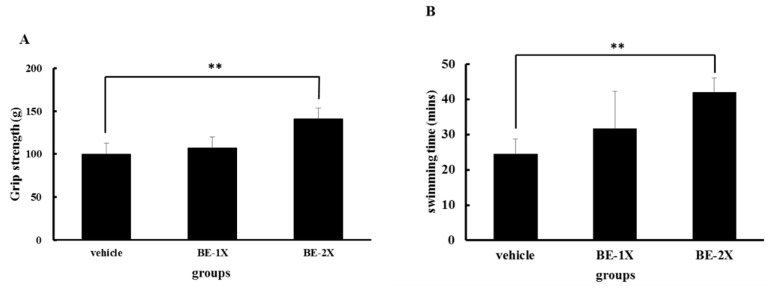
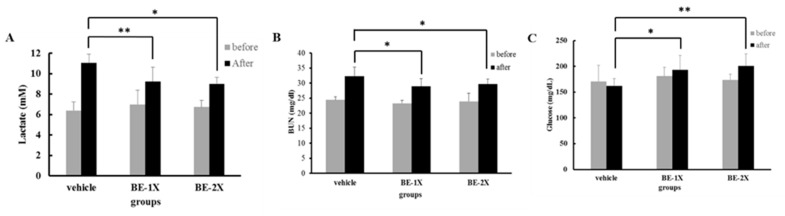
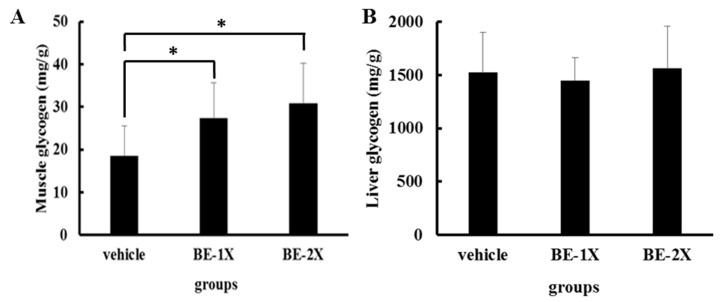
Beef extract (BE) is a nutritional supplement obtained by cooking beef meat. Compared with traditional chicken essence or clam extract, BE is cheaper to produce and may be used for wound healing, as a chemotherapy supplement, or to prevent fatigue. In this study, we evaluated the potential beneficial effects of BE on exercise performance and the related role of the gut microbiota. Pathogen-free male BALB/c mice were divided into three groups to receive vehicle or BE (0, 12.3, or 24.6 mL/kg) by oral gavage for 28 days. Exercise performance was evaluated using forelimb grip strength, swimming time to exhaustion, and physiological levels of fatigue-related biomarkers (serum lactate, blood urea nitrogen, and glucose levels) after physical challenges. BE supplementation elevated endurance and grip strength in a dose-dependent manner; significantly decreased lactate and blood urea nitrogen levels after physical challenge; and significantly increased muscle glycogen content. The germ-free mice supplemented with BE or an equal-calorie portion of albumin did not show significant differences from the other groups in exercise performance and levels of related biomarkers. Therefore, BE supplementation improved endurance and reduced fatigue, which might be related to BE composition, but had no correlation with the gut microbiota.
Overview
The claims and statistics of this paper haven’t been checked yet.
Free: it reads the open-access text and checks the first 5 claims that cite a source we can check. Create a free account to check every claim.
Integrity signals
Registry
Cites
Statistics
Figures
Verification
Claims the paper makes
The claims and statistics of this paper haven’t been checked yet.
Free: it reads the open-access text and checks the first 5 claims that cite a source we can check. Create a free account to check every claim.
Claims other papers make about this one
Each is checked against this paper’s own text: does it say what the citing paper says it does?
In the citing paper
“The administration of a high-protein beef extract improved grip strength in both mice harboring a physiological gut microbiota and germ-free mice, indicating that the effect of dietary proteins on muscle strength is not mediated by gut microbial communities [87].”
From Gut Microbiota, Muscle Mass and Function in Aging: A Focus on Physical Frailty and Sarcopenia (2019) · cites this paper as [87]
Self-check
Percentages, sums and reported differences re-computed from the paper’s own numbers.
The self-check needs the paper’s full text.
Citations
Cites
Ecological and Evolutionary Forces Shaping Microbial Diversity in the Human Intestine
Ley, R. E., Peterson, D. A., & Gordon, J. I. (2006) · Cell · doi:10.1016/j.cell.2006.02.017 · Cited by 3,358 · cited 1×
“The human and animal intestinal tract contains approximately 100 trillion microbes, most of which reside in the colon [19].”
BackgroundH OW H OST-M ICROBIAL I NTERACTIONS S HAPE THE N UTRIENT E NVIRONMENT OF THE M AMMALIAN I NTESTINE
Hooper, L. V., Midtvedt, T., & Gordon, J. I. (2002) · Annual Review of Nutrition · doi:10.1146/annurev.nutr.22.011602.092259 · Cited by 1,621 · cited 1×
“A particularly compelling example of the importance of the gut microbiota in host metabolism is provided by a comparison of the nutritional statuses of germ-free (GF) and conventionally raised laboratory animals [23].”
BackgroundMuscle fatigue: general understanding and treatment
Wan, J.-J., Qin, Z., Wang, P.-Y., Sun, Y., & Liu, X. (2017) · Experimental & Molecular Medicine · doi:10.1038/emm.2017.194 · Cited by 676 · cited 1×
“Currently, the role of inflammation-related metabolites such as creatine kinase, lactate, and ammonia in muscle damage after heavy exertion is well documented [13,14].”
BackgroundLactic Acid and Exercise Performance: Culprit or Friend?
Cairns, S. P. (2006) · Sports Medicine · doi:10.2165/00007256-200636040-00001 · Cited by 446
Wilson, B., & Whelan, K. (2017) · Journal of Gastroenterology and Hepatology · doi:10.1111/jgh.13700 · Cited by 321
Chen, Y.-M., Wei, L., Chiu, Y.-S., Hsu, Y.-J., Tsai, T.-Y., Wang, M.-F., & Huang, C.-C. (2016) · Nutrients · doi:10.3390/nu8040205 · Cited by 297
Self-citationBurd, N. A., Yang, Y., Moore, D. R., Tang, J. E., Tarnopolsky, M. A., & Phillips, S. M. (2012) · British Journal of Nutrition · doi:10.1017/s0007114511006271 · Cited by 276
Effects of massage on delayed-onset muscle soreness, swelling, and recovery of muscle function.
Zainuddin, Z., Newton, M., Sacco, P., & Nosaka, K. (2005) · PubMed · Cited by 246
Biomarkers of muscle and cartilage damage and inflammation during a 200 km run
Kim, H. J., Lee, Y. H., & Kim, C. K. (2007) · European Journal of Applied Physiology · doi:10.1007/s00421-006-0362-y · Cited by 217 · cited 1×
“Long-term endurance exercise may induce muscular injury [16,17], and muscle damage combined with the production of inflammatory mediators from exhaustive exercise may lead to increased pain and performance deficits in muscle function [18].”
BackgroundSelf-citationEffect of Intestinal Microbiota on Exercise Performance in Mice
Hsu, Y. J., Chiu, C. C., Li, Y. P., Huang, W. C., Huang, Y. T., Huang, C. C., & Chuang, H. L. (2015) · Journal of Strength and Conditioning Research · doi:10.1519/jsc.0000000000000644 · Cited by 188 · cited 2×
“This was proposed to occur through the action of the gut microbiota on host antioxidant enzyme systems [24].”
BackgroundResultSelf-citation
Cited by
Gut Microbiota, Muscle Mass and Function in Aging: A Focus on Physical Frailty and Sarcopenia
Ticinesi, A., Nouvenne, A., Cerundolo, N., Catania, P., Prati, B., Tana, C., & Meschi, T. (2019) · Nutrients · doi:10.3390/nu11071633 · Cited by 418
Understanding the gut microbiota and sarcopenia: a systematic review
Liu, C., Cheung, W., Li, J., Chow, S. K., Yu, J., Wong, S. H., Ip, M., Sung, J. J. Y., & Wong, R. M. Y. (2021) · Journal of Cachexia, Sarcopenia and Muscle · doi:10.1002/jcsm.12784 · Cited by 363
“BE also aided GF mice to enhance endurance capacity, and so it had microbiota-independent effect on function.(54) Diets based on soy and whey protein induced muscle loss in rats compared with placebo diet.”
BackgroundMethodInfluentialLiu, S., Meng, F., Zhang, D., Shi, D., Zhou, J., Guo, S., & Chang, X. (2022) · Frontiers in Nutrition · doi:10.3389/fnut.2022.853225 · Cited by 55
“Beef extract (5), ginseng extract (6), and conifer extract (7) reportedly exert beneficial effects on fatigue in animal swimming models.”
BackgroundAnti-Fatigue Activity of Aqueous Extracts of Sonchus arvensis L. in Exercise Trained Mice
Yuan, T., Wu, D., Sun, K., Tan, X., Wang, J., Zhao, T., Ren, B., Zhao, B., Liu, Z., & Liu, X. (2019) · Molecules · doi:10.3390/molecules24061168 · Cited by 40
“The potential anti-fatigue effects might be also related to its effects on gut microbiota and gut barrier function [19].”
BackgroundGhaffar, T., Ubaldi, F., Volpini, V., Valeriani, F., & Spica, V. R. (2024) · Sports · doi:10.3390/sports12080221 · Cited by 38
“Given the vast diversity and number of gut microbiota and their interaction with exercise, the data may not always be current or authentic, making the literature on the role of microbiota seem scarce [25–28].”
Background
Metadata
- Authors
- Hsu, T.-H., Chiu, C.-C., Wang, Y.-C., Chen, T.-H., Chen, Y.-H., Lee, Y.-P., Hung, S.-W., Wu, C.-P., & Chuang, H.-L.
- Affiliations
- National Chiayi University (TW)
- Agricultural Technology Research Institute (TW)
- National Chung Hsing University (TW)
- National Institutes of Applied Research (TW)
- Corresponding author
- Chuang, Hsiao-Li
- ORCID
- Venue
- Nutrients
- Publisher
- MDPI AG
- Published
- 2018-11-12
- Volume
- 10
- Issue
- 11
- Pages
- 1740
- ISSN
- 2072-6643 (ISSN-L)
- PMC
- PMC6266735
- OpenAlex
- W2901769199
- Cited by
- 20
- References
- 34
- Citations by year
- 2026: 2 · 2025: 3 · 2024: 3 · 2023: 2 · 2022: 3 · 2021: 2 · 2020: 3 · 2019: 2
- FWCI
- 0.97
- Type
- journal article
- Language
- en
- Open access
- gold
- doi.org
- Licence
- Locations
- Nutrients (publishedVersion, cc-by)
- Europe PMC (PubMed Central) (publishedVersion, other-oa)
- PubMed Central (publishedVersion, cc-by)
- PubMed (publishedVersion)
- DOAJ (DOAJ: Directory of Open Access Journals) (submittedVersion, cc-by-sa)
- Funders
- the Council of Agriculture, Taiwan. (106AS-19.5.1-CO-a1)
- Topics
- Health Sciences › Nursing › Nutrition and Dietetics › Muscle metabolism and nutrition
- Health Sciences › Medicine › Physiology (medical) › Exercise and Physiological Responses
- Life Sciences › Agricultural and Biological Sciences › Animal Science and Zoology › Animal Nutrition and Physiology
- Keywords
- beef extract, dietary supplementation, exercise performance, post-exercise fatigue, gut microbiota, endurance, grip strength, serum lactate, blood urea nitrogen, muscle glycogen, germ-free mice
- MeSH terms
- Gastrointestinal Microbiome, Red Meat, Animals, Blood Urea Nitrogen, Cattle, Cooking, Fatigue, Glycogen, Male, Mice, Inbred BALB C, Physical Conditioning, Animal, Physical Endurance, Swimming, Muscle, Skeletal, Hand Strength, Lactic Acid, Dietary Supplements, Muscle Strength
About these checks
Registry, retraction, Cites and statistics results are computed, not judged, with one exception: a printed reference that no index lists is read once by a model before it counts as a citation error. Claims are extracted by a model and kept only when their quote appears verbatim in the text; each cited source is then checked, with a model’s help, for whether it says what the claim relies on. Those verdicts can be wrong — read the claim’s quote and the cited source before relying on one.
Statistics and arithmetic are recomputed, not judged.
Confidence bands are shown only for fields calibrated on our annotated test set. None is calibrated yet, so no band is shown.
What counts as a claim ›How we measure confidence ›How we check this ›
Are you an author, or do you see a problem with this page? Request a review
How to cite
Cite CoChat for the checks on this page, and the paper for its own findings.
- This page
- CoChat. (2026). Citation check: Supplementation with Beef Extract Improves Exercise Performance and Reduces Post-Exercise Fatigue Independent of Gut Microbiota. https://app.cochat.ai/papers/10.3390/nu10111740
- The paper
- Hsu, T.-H., Chiu, C.-C., Wang, Y.-C., Chen, T.-H., Chen, Y.-H., Lee, Y.-P., Hung, S.-W., Wu, C.-P., & Chuang, H.-L. (2018). Supplementation with Beef Extract Improves Exercise Performance and Reduces Post-Exercise Fatigue Independent of Gut Microbiota. Nutrients. https://doi.org/10.3390/nu10111740
Data sources
Bibliographic data: Semantic Scholar, OpenAlex, Crossref.
Contains information from the Semantic Scholar Academic Graph Datasets, made available under the ODC Attribution License (ODC-BY 1.0).
Semantic Scholar’s data is described in: Kinney, R., et al. (2023). The Semantic Scholar Open Data Platform. arXiv:2301.10140.
