

The DOI matches its Crossref record; 293 of the 293 references it cites were found in a registry or an index.
Breast Milk, a Source of Beneficial Microbes and Associated Benefits for Infant Health
Open accessAbstract
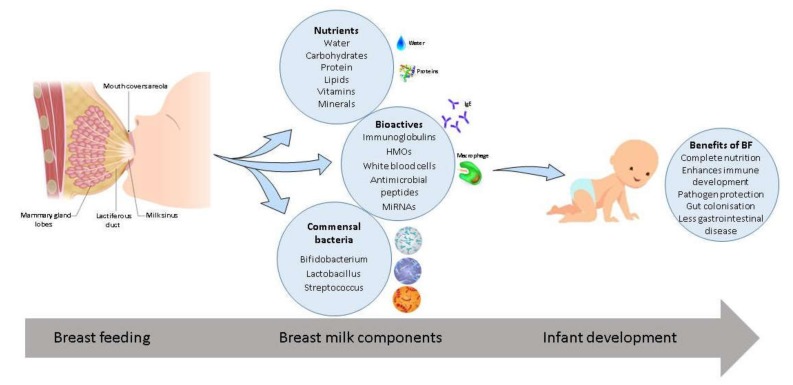
Human breast milk is considered the optimum feeding regime for newborn infants due to its ability to provide complete nutrition and many bioactive health factors. Breast feeding is associated with improved infant health and immune development, less incidences of gastrointestinal disease and lower mortality rates than formula fed infants. As well as providing fundamental nutrients to the growing infant, breast milk is a source of commensal bacteria which further enhance infant health by preventing pathogen adhesion and promoting gut colonisation of beneficial microbes. While breast milk was initially considered a sterile fluid and microbes isolated were considered contaminants, it is now widely accepted that breast milk is home to its own unique microbiome. The origins of bacteria in breast milk have been subject to much debate, however, the possibility of an entero-mammary pathway allowing for transfer of microbes from maternal gut to the mammary gland is one potential pathway. Human milk derived strains can be regarded as potential probiotics; therefore, many studies have focused on isolating strains from milk for subsequent use in infant health and nutrition markets. This review aims to discuss mammary gland development in preparation for lactation as well as explore the microbial composition and origins of the human milk microbiota with a focus on probiotic development.
Overview
The claims and statistics of this paper haven’t been checked yet.
Run the check — free, no account needed. It reads the open-access text and checks the sources it cites.
Integrity signals
Registry
Cites
Statistics
Figures
Verification
Claims the paper makes
The claims and statistics of this paper haven’t been checked yet.
Run the check — free, no account needed. It reads the open-access text and checks the sources it cites.
Claims other papers make about this one
Each is checked against this paper’s own text: does it say what the citing paper says it does?
The cited source says what the claim attributes to it.
In the citing paper
“Although other bioactive compounds present in breast milk, such as immunoglobulins, antibodies, antimicrobial peptides, and lactoferrin, can have microbiota-independent benefits for the infant, mediation of health benefits [such as lower incidence of immune and gastrointestinal diseases, obesity, and type 2 diabetes, as well as improved cognitive function (261, 262)] through the assembly of a”
From Diet and the Microbiota–Gut–Brain Axis: Sowing the Seeds of Good Mental Health (2021) · cites this paper as [263]
Self-check
Percentages, sums and reported differences re-computed from the paper’s own numbers.
The self-check needs the paper’s full text.
Citations
Cites
Hill (2014) · doi:10.1038/nrgastro.2014.66 · Cited by 9,592
Variations in pattern of pubertal changes in girls
Marshall, W. A., & Tanner, J. M. (1969) · Archives of Disease in Childhood · doi:10.1136/adc.44.235.291 · Cited by 5,963
Breastfeeding and the Use of Human Milk
Breastfeeding, S. O. (2005) · PEDIATRICS · doi:10.1542/peds.2004-2491 · Cited by 5,357
Breastfeeding and the use of human milk
BREASTFEEDING, S. O., Eidelman, A. I., Schanler, R. J., Johnston, M., Landers, S., Noble, L., Szucs, K., & Viehmann, L. (2012) · Pediatrics · doi:10.1542/peds.2011-3552 · Cited by 4,357
The Diagnosis of Polycystic Ovary Syndrome during Adolescence
Witchel, S. F., Oberfield, S., Rosenfield, R. L., Codner, E., Bonny, A., Ibáñez, L., Pena, A., Horikawa, R., Gomez-Lobo, V., Joel, D., et al. (2015) · Hormone Research in Paediatrics · doi:10.1159/000375530 · Cited by 3,113
Ballard, O., & Morrow, A. L. (2012) · Pediatric Clinics of North America · doi:10.1016/j.pcl.2012.10.002 · Cited by 2,833
Bushati, N., & Cohen, S. M. (2007) · Annual Review of Cell and Developmental Biology · doi:10.1146/annurev.cellbio.23.090506.123406 · Cited by 2,750
Rescigno, M., Urbano, M., Valzasina, B., Francolini, M., Rotta, G., Bonasio, R., Granucci, F., Kraehenbuhl, J.-P., & Ricciardi‐Castagnoli, P. (2001) · Nature Immunology · doi:10.1038/86373 · Cited by 2,554
The MicroRNA Spectrum in 12 Body Fluids
Weber, J. A., Baxter, D. H., Zhang, S., Huang, D. Y., How Huang, K., Jen Lee, M., Galas, D. J., & Wang, K. (2010) · Clinical Chemistry · doi:10.1373/clinchem.2010.147405 · Cited by 2,477
Optimal duration of exclusive breastfeeding
Kramer, M. S., & Kakuma, R. (2012) · Cochrane Database of Systematic Reviews · doi:10.1002/14651858.cd003517.pub2 · Cited by 1,866
Research works printed but not linked: 4
- Moore, K.L., Persaud, T.V.N., and Torchia, M.G. (2018). The Developing Human-E-Book: Clinically Oriented Embryology, Elsevier.
- Hoover, K., and Wilson-Clay, B. (2002). The Breastfeeding Atlas, LactNews Press.
- Patel, 2016, Human Milk: The Preferred First Food for Premature Infants, J Hum Nutr Food Sci, 4, 1098
- Nantavisai, 2018, In vitro adhesion property and competition against enteropathogens of Lactobacillus strains isolated from Thai infants, Songklanakarin J. Sci. Technol., 40, 69
Cited by
Sorted by citations
Diet and the Microbiota–Gut–Brain Axis: Sowing the Seeds of Good Mental Health
Berding, K., Vlckova, K., Marx, W., Schellekens, H., Stanton, C., Clarke, G., Jacka, F., Dinan, T. G., & Cryan, J. F. (2021) · Advances in Nutrition · doi:10.1093/advances/nmaa181 · Cited by 451
Self-citationda Silva, T. F., Glória, R. D. A., Americo, M. F., Freitas, A. D. S., de Jesus, L. C. L., Barroso, F. A. L., Laguna, J. G., Coelho-Rocha, N. D., Tavares, L. M., le Loir, Y., et al. (2024) · Probiotics and Antimicrobial Proteins · doi:10.1007/s12602-024-10247-x · Cited by 117
Metadata
- Authors
- Lyons, K. E., Ryan, C. A., Dempsey, E. M., Ross, R. P., & Stanton, C.
- Affiliations
- Teagasc - The Irish Agriculture and Food Development Authority (IE)
- University College Cork (IE)
- Corresponding author
- Stanton, Catherine
- Venue
- Nutrients
- Publisher
- MDPI AG
- Published
- 2020-04-09
- Volume
- 12
- Issue
- 4
- Pages
- 1039
- ISSN
- 2072-6643 (ISSN-L)
- PMC
- PMC7231147
- OpenAlex
- W3015536860
- Cited by
- 613
- References
- 293
- Citations by year
- 2026: 66 · 2025: 101 · 2024: 141 · 2023: 116 · 2022: 99 · 2021: 72 · 2020: 16
- FWCI
- 9.36
- Type
- journal article
- Language
- en
- Open access
- gold
- dx.doi.org
- Licence
- Locations
- Nutrients (publishedVersion, cc-by)
- PubMed Central (publishedVersion, cc-by)
- PubMed (publishedVersion)
- Arrow@dit (Dublin Institute of Technology) (acceptedVersion)
- HAL (submittedVersion, cc-by-nc-nd)
- DOAJ (DOAJ: Directory of Open Access Journals) (submittedVersion, cc-by-sa)
- T-Stór (Teagasc) (submittedVersion, cc-by-nc-sa)
- Lenus, The Irish Health Repository (Dr Steevens Hospital Library) (submittedVersion)
- Funders
- Department of Agriculture, Food and the Marine (15F721)
- Topics
- Health Sciences › Nursing › Nutrition and Dietetics › Infant Nutrition and Health
- Life Sciences › Agricultural and Biological Sciences › Food Science › Probiotics and Fermented Foods
- Health Sciences › Medicine › Epidemiology › Breastfeeding Practices and Influences
- Keywords
- human milk microbiota, breast milk, infant health, commensal bacteria, probiotics, mammary gland development, lactation, infant immune development, bottle feeding, pathogen adhesion
- MeSH terms
- Infant Health, Gastrointestinal Microbiome, Breast Feeding, Female, Gastrointestinal Diseases, Humans, Infant, Infant Nutritional Physiological Phenomena, Infant, Newborn, Male, Milk, Human, Probiotics
About these checks
Registry, retraction, Cites and statistics results are computed, not judged, with one exception: a printed reference that no index lists is read once by a model before it counts as a citation error. Claims are extracted by a model and kept only when their quote appears verbatim in the text; each cited source is then checked, with a model’s help, for whether it says what the claim relies on. Those verdicts can be wrong — read the claim’s quote and the cited source before relying on one.
Statistics and arithmetic are recomputed, not judged.
Confidence bands are shown only for fields calibrated on our annotated test set. None is calibrated yet, so no band is shown.
What counts as a claim ›How we measure confidence ›How we check this ›
Are you an author, or do you see a problem with this page? Request a review
