

Analytical Performance Specifications for 25-Hydroxyvitamin D Examinations
Open accessThe DOI matches its Crossref record; 35 of the 36 references it cites were found in a registry or an index.
Abstract
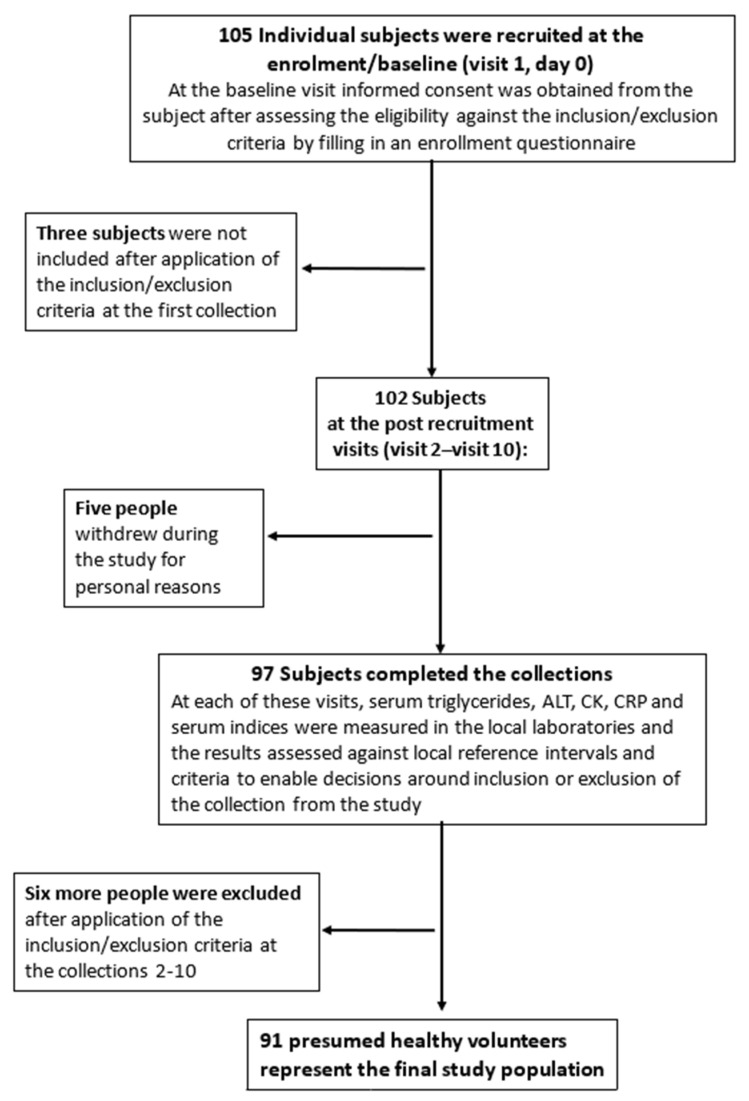
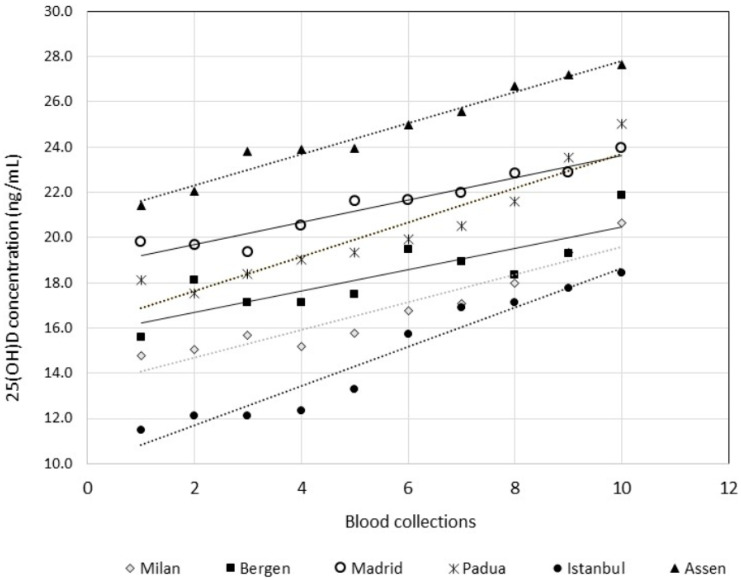
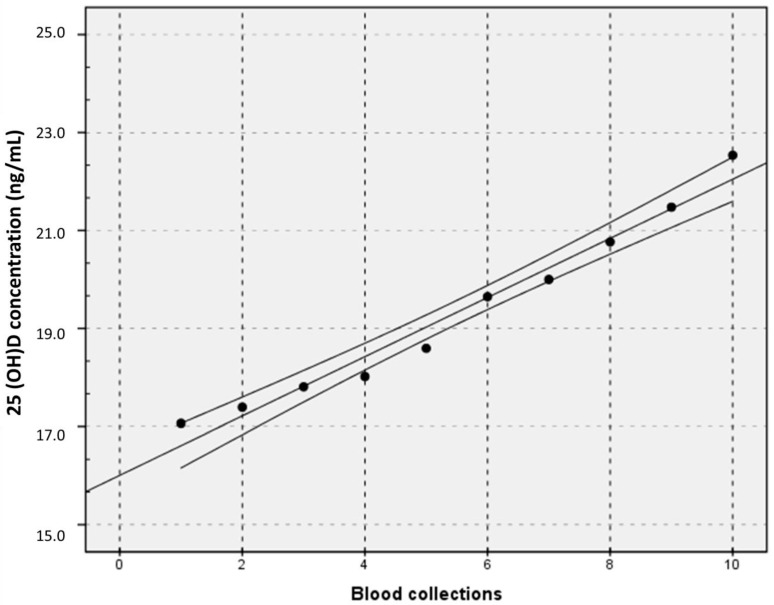
Currently the 25-hydroxy vitamin D (25(OH)D) concentration is thought to be the best estimate of the vitamin D status of an individual. Unfortunately, its measurement remains complex, despite recent technological advances. We evaluated the biological variation (BV) of 25(OH)D in order to set analytical performance specifications (APS) for measurement uncertainty (MU). Six European laboratories recruited 91 healthy participants. The 25(OH)D concentrations in K3-EDTA plasma were examined weekly for up to 10 weeks in duplicate on a Lumipulse G1200 (Fujirebio, Tokyo, Japan). The linear regression of the mean 25(OH)D concentrations at each blood collection showed that participants were not in a steady state. The dissection of the 10-sample collection into two subsets, namely collections 1–5 and 6–10, did not allow for correction of the lack of homogeneity: estimates of the within-subject BV ranged from 5.8% to 7.1% and the between-subject BV ranged from 25.0% to 39.2%. Methods that would differentiate a difference induced by 25(OH)D supplementation at p < 0.05 should have MU < 13.6%, while at p < 0.01, the MU should be <9.6%. The development of APS using BV assumes a steady state of patients. The findings in this study suggest that patients are not in steady state. Therefore, APS that are based on MU appear to be more appropriate.
Overview
The claims and statistics of this paper haven’t been checked yet.
Free: it reads the open-access text and checks the first 5 claims that cite a source we can check. Create a free account to check every claim.
Integrity signals
Registry
Cites
Statistics
Figures
Verification
Claims the paper makes
The claims and statistics of this paper haven’t been checked yet.
Free: it reads the open-access text and checks the first 5 claims that cite a source we can check. Create a free account to check every claim.
Claims other papers make about this one
Each is checked against this paper’s own text: does it say what the citing paper says it does?
The cited source says what the claim attributes to it.
In the citing paper
“The application of the classical model, the validity of which requires random variation of a measurand around homeostatic set point, turned out be inappropriate for the generation of BV estimates for the 25(OH)D [34].”
From The European Biological Variation Study (EuBIVAS): a summary report (2022) · cites this paper as [34]
The cited source says what the claim attributes to it.
In the citing paper
“Accordingly, if following the proposed model, the higher order reference methods should present a MU < 1.2% and ' routine ' assays a MU < 13.6% to detect a difference (increase) at p<0.05 and 9.6% to detect a difference at p<0.01 [34].”
From The European Biological Variation Study (EuBIVAS): a summary report (2022) · cites this paper as [34]
Self-check
Percentages, sums and reported differences re-computed from the paper’s own numbers.
The self-check needs the paper’s full text.
Citations
Cites
Holick, M. F. (2007) · New England Journal of Medicine · doi:10.1056/nejmra070553 · Cited by 13,720
Mittal, M., Kumar, A., Ramji, S., Narula, S., & Thirupuram, S. (1990) · PubMed · Cited by 1,764
Sandberg, S., Fraser, C. G., Horvath, A. R., Jansen, R., Jones, G., Oosterhuis, W., Petersen, P. H., Schimmel, H., Sikaris, K., & Panteghini, M. (2015) · Clinical Chemistry and Laboratory Medicine (CCLM) · doi:10.1515/cclm-2015-0067 · Cited by 563 · cited 1×
“simpler approach advocated by the European Federation of Clinical Chemistry and Laboratory Medicine (EFLM) to set APS using three models, namely: (1)—clinical outcomes, (2)—BV, and (3)—state-of-the-art performance [10].”
MethodSelf-citationSouberbielle, J.-C., Body, J.-J., Lappe, J. M., Plebani, M., Shoenfeld, Y., Wang, T. J., Bischoff-Ferrari, H. A., Cavalier, E., Ebeling, P. R., Fardellone, P., et al. (2010) · Autoimmunity Reviews · doi:10.1016/j.autrev.2010.06.009 · Cited by 540 · cited 1×
“Indeed, the interval between starting vitamin D supplementation and measuring/monitoring the 25(OH)D concentration should at least be three months [27].”
BackgroundSelf-citationTHE DISTRIBUTION OF THE LARGEST OF A SET OF ESTIMATED VARIANCES AS A FRACTION OF THEIR TOTAL
COCHRAN, W. G. (1941) · Annals of Eugenics · doi:10.1111/j.1469-1809.1941.tb02271.x · Cited by 438 · cited 1×
“Hence, this set of data could not be considered homogenous according to the Cochran test [26], a prerequisite for the estimation of CVI and CVG.”
MethodHeijboer, A. C., Blankenstein, M. A., Kema, I. P., & Buijs, M. M. (2012) · Clinical Chemistry · doi:10.1373/clinchem.2011.176545 · Cited by 339
Self-citationSeasonal Changes in Human Plasma Levels of 25-Hydroxyvitamin D
STAMP, T. C. B., & ROUND, J. M. (1974) · Nature · doi:10.1038/247563a0 · Cited by 336 · cited 1×
“This finding may seem obvious, as it has been known for decades that 25(OH)D concentrations observed in summer are higher than those observed in winter [29], but we have demonstrated this for the first time for a cohort of presumably healthy individuals.”
BackgroundTai, S. S.-C., Bedner, M., & Phinney, K. W. (2010) · Analytical Chemistry · doi:10.1021/ac9026862 · Cited by 271 · cited 1×
“The aim of these standardization programs is that 25(OH)D measurements are accurate, as well as comparable over time, location, and laboratory procedure, to the concentrations obtained using Joint Committee for Traceability in Laboratory Medicine (JCTLM) recognized reference measurement procedures (RMPs), such as thos…”
MethodEditorial: The Determination of Circulating 25-Hydroxyvitamin D: No Easy Task
Hollis, B. W. (2004) · The Journal of Clinical Endocrinology & Metabolism · doi:10.1210/jc.2004-0682 · Cited by 239 · cited 1×
“Twenty-five-hydroxy vitamin D (25(OH)D) measurement remains complicated despite recent technological advances [1].”
BackgroundStepman, H. C., Vanderroost, A., Van Uytfanghe, K., & Thienpont, L. M. (2011) · Clinical Chemistry · doi:10.1373/clinchem.2010.152553 · Cited by 203 · cited 1×
“The aim of these standardization programs is that 25(OH)D measurements are accurate, as well as comparable over time, location, and laboratory procedure, to the concentrations obtained using Joint Committee for Traceability in Laboratory Medicine (JCTLM) recognized reference measurement procedures (RMPs), such as thos…”
MethodCeriotti, F., Fernandez-Calle, P., Klee, G. G., Nordin, G., Sandberg, S., Streichert, T., Vives-Corrons, J.-L., & Panteghini, M. (2017) · Clinical Chemistry and Laboratory Medicine (CCLM) · doi:10.1515/cclm-2016-0091 · Cited by 181 · cited 2×
“As a result, the application of Model 2, where the APS is based on BV, is favored [15].”
MethodStöckl, D., Sluss, P. M., & Thienpont, L. M. (2009) · Clinica Chimica Acta · doi:10.1016/j.cca.2009.06.027 · Cited by 135 · cited 6×
“Assays are considered traceable to International System (SI) units when they are calibrated to a JCTLM—recognized RMP, and they are considered standardized when their calibration bias, expressed as mean bias, is <5% to the RMP and the assay imprecision, expressed as mean coefficient of variation, is <10% [7].”
BackgroundMethodInfluentialRøraas, T., Petersen, P. H., & Sandberg, S. (2012) · Clinical Chemistry · doi:10.1373/clinchem.2012.187781 · Cited by 134 · cited 1×
“The number of collections per subject means that the resultant data will be from studies of a high statistical power, delivering high quality estimates of the components of examination and biological variation with tight confidence intervals [19].”
BackgroundWielders, J. P. M., & Wijnberg, F. A. (2009) · Clinical Chemistry · doi:10.1373/clinchem.2008.117366 · Cited by 114 · cited 2×
“Although we have no data on the five—year stability of 25(OH)D at −80 ◦C under our conditions, different pre-examination studies have shown that this measurand is remarkably stable, even under extreme conditions [20,21].”
BackgroundCarobene, A., Strollo, M., Jonker, N., Barla, G., Bartlett, W. A., Sandberg, S., Sylte, M. S., Røraas, T., Sølvik, U. Ø., Fernandez-Calle, P., et al. (2016) · Clinical Chemistry and Laboratory Medicine (CCLM) · doi:10.1515/cclm-2016-0035 · Cited by 110 · cited 5×
“The EuBIVAS has been described in detail elsewhere [17].”
BackgroundMethodInfluentialSelf-citationAarsand, A. K., Díaz-Garzón, J., Fernandez-Calle, P., Guerra, E., Locatelli, M., Bartlett, W. A., Sandberg, S., Røraas, T., Ceriotti, F., Sølvik, U. Ø., et al. (2018) · Clinical Chemistry · doi:10.1373/clinchem.2018.288415 · Cited by 105 · cited 1×
“The participants were generally physically active and approximately 3% were regular smokers (the detailed demographic characteristics are documented in previous publications) [17,25].”
BackgroundSelf-citationMineva, E. M., Schleicher, R. L., Chaudhary-Webb, M., Maw, K. L., Botelho, J. C., Vesper, H. W., & Pfeiffer, C. M. (2015) · Analytical and Bioanalytical Chemistry · doi:10.1007/s00216-015-8733-z · Cited by 103 · cited 9×
“The CDC Vitamin D Standardization-Certification Program (VDSCP) determines the calibration bias and imprecision by evaluating the data obtained from 40 blinded singleunit, fresh-frozen serum samples measured in batches of 10 samples over four consecutive quarters.”
MethodInfluentialSelf-citationLacher, D. A., Hughes, J. P., & Carroll, M. D. (2010) · PubMed · Cited by 71
General Steps to Standardize the Laboratory Measurement of Serum Total 25-Hydroxyvitamin D
Sempos, C. T., Betz, J. M., Camara, J. E., Carter, G. D., Cavalier, E., Clarke, M. W., Dowling, K. G., Durazo-Arvizú, R., Hoofnagle, A. N., Liu, A., et al. (2017) · Journal of AOAC International · doi:10.5740/jaoacint.17-0259 · Cited by 64 · cited 12×
“Supplementary Materials: The following are available online at https://www.mdpi.com/2072-664 3/13/2/431/s1, Figure S1: Passing-Bablok regression of 25(OH)D values (ng/mL) obtained with the Fujirebio Lumipulse and the VDSCP-certified LC-MS/MS of the CHU de Liège.”
BackgroundInfluentialSelf-citationThe 1999 Stockholm Consensus Conference on quality specifications in laboratory medicine
Fraser, C. G. (2015) · Clinical Chemistry and Laboratory Medicine (CCLM) · doi:10.1515/cclm-2014-0914 · Cited by 55 · cited 8×
“Firstly, there is a new simpler approach advocated by the European Federation of Clinical Chemistry and Laboratory Medicine (EFLM) to set APS using three models, namely: (1)—clinical outcomes, (2)—BV, and (3)—state-of-the-art performance [10].”
MethodInfluentialSelf-citationCavalier, E., Rozet, E., Gadisseur, R., Carlisi, A., Monge, M., Chapelle, J.-P., Hubert, P., Souberbielle, J., & Delanaye, P. (2009) · Osteoporosis International · doi:10.1007/s00198-009-1052-5 · Cited by 53 · cited 1×
“This is totally compatible with the proposal of Stepman and Thienpont [33] in a letter on the first paper published on the MU of 25(OH)D [34].”
ResultSelf-citationCarobene, A., Aarsand, A. K., Guerra, E., Bartlett, W. A., Coşkun, A., Díaz-Garzón, J., Fernandez-Calle, P., Jonker, N., Locatelli, M., Sandberg, S., et al. (2019) · Clinical Chemistry · doi:10.1373/clinchem.2019.304618 · Cited by 53 · cited 1×
“The data analysis was performed as previously described [22,23].”
MethodSelf-citationAccuracy of three automated 25-hydroxyvitamin D assays in hemodialysis patients
Depreter, B., Heijboer, A. C., & Langlois, M. R. (2012) · Clinica Chimica Acta · doi:10.1016/j.cca.2012.10.056 · Cited by 49
Self-citationCavalier, E., Lukas, P., Bekaert, A.-C., Peeters, S. D., Goff, C. M. L., Yayo, E. S., Delanaye, P., & Souberbielle, J. (2015) · Clinical Chemistry and Laboratory Medicine (CCLM) · doi:10.1515/cclm-2015-0923 · Cited by 47
Self-citationCarobene, A., Guerra, E., Locatelli, M., Cucchiara, V., Briganti, A., Aarsand, A. K., Coşkun, A., Díaz-Garzón, J., Fernandez-Calle, P., Røraas, T., et al. (2018) · Clinica Chimica Acta · doi:10.1016/j.cca.2018.07.043 · Cited by 47 · cited 1×
“The data analysis was performed as previously described [22,23].”
MethodSelf-citationMoreau, E., Bächer, S., Mery, S., Goff, C. M. L., Piga, N., Vogeser, M., Hausmann, M., & Cavalier, E. (2015) · Clinical Chemistry and Laboratory Medicine (CCLM) · doi:10.1515/cclm-2014-1249 · Cited by 46
Self-citationHarmonization initiatives in the generation, reporting and application of biological variation data
Aarsand, A. K., Røraas, T., Bartlett, W. A., Coşkun, A., Carobene, A., Fernandez-Calle, P., Jonker, N., Díaz-Garzón, J., Braga, F., & Sandberg, S. (2018) · Clinical Chemistry and Laboratory Medicine (CCLM) · doi:10.1515/cclm-2018-0058 · Cited by 46 · cited 1×
“The aim of this study was to evaluate the BV of 25(OH)D in samples obtained in the large European Biological Variation (EuBIVAS) study [17], which recently adopted a recommendation for the generation of BV components [18], and to see if we could significantly update the model proposed by Stöckl et al.”
MethodSelf-citationSerum 25-OH Vitamin D2 and D3 are Stable under Exaggerated Conditions
Lewis, J. G., & Elder, P. A. (2008) · Clinical Chemistry · doi:10.1373/clinchem.2008.111526 · Cited by 43 · cited 2×
“Although we have no data on the five—year stability of 25(OH)D at −80 ◦C under our conditions, different pre-examination studies have shown that this measurand is remarkably stable, even under extreme conditions [20,21].”
BackgroundAnalytical quality goals for 25‐vitamin D based on biological variation
Viljoen, A., Singh, D. K., Farrington, K., & Twomey, P. J. (2011) · Journal of Clinical Laboratory Analysis · doi:10.1002/jcla.20446 · Cited by 39 · cited 1×
“2% [13], with the betweensubject BV (CVG) being greater than 40% [14].”
BackgroundShort-term Variability of Vitamin D–Related Biomarkers
Lutsey, P. L., Parrinello, C. M., Misialek, J. R., Hoofnagle, A. N., Henderson, C. M., Laha, T. J., Michos, E. D., Eckfeldt, J. H., & Selvin, E. (2016) · Clinical Chemistry · doi:10.1373/clinchem.2016.261461 · Cited by 17
Uncertainty in measurement and total error: different roads to the same quality destination?
Farrance, I., Badrick, T. C., & Frenkel, R. B. (2018) · Clinical Chemistry and Laboratory Medicine (CCLM) · doi:10.1515/cclm-2018-0421 · Cited by 14 · cited 1×
“This is also the case for the generation of APS for standard measurement uncertainty (MU) [16].”
BackgroundVitamin D and its metabolites: from now and beyond.
Cavalier, E., & Souberbielle, J. (2018) · PubMed Central · Cited by 11
Self-citationEstimating uncertainty of target values for DEQAS serum materials
Durazo-Arvizú, R., Ahmed, F. S., Berry, J., Cavalier, E., Gunter, E. W., Jones, G., Jones, J. C., Sempos, C. T., Twomey, P. J., Williams, E. L., et al. (2019) · The Journal of Steroid Biochemistry and Molecular Biology · doi:10.1016/j.jsbmb.2018.12.011 · Cited by 9 · cited 1×
“Finally, the Advisory Panel of the Vitamin D External Quality Assessment Scheme (DEQAS, London, UK) recently proposed providing an MU on the target values assigned by the RMP method on each sample sent to participating laboratories [37].”
MethodSelf-citationBrunel, E., Schnitzler, M., Foidart-Dessalle, M., Souberbielle, J., & Cavalier, E. (2013) · International Journal of Endocrinology · doi:10.1155/2013/652648 · Cited by 8 · cited 1×
“6%, which is approximately the same order of magnitude as the increase observed during Spring in this study [32].”
ResultSelf-citationMeasurement uncertainty for the analysis of serum 25-hydroxyvitamin D
Stepman, H. C. M., & Thienpont, L. M. (2009) · Osteoporosis International · doi:10.1007/s00198-009-1099-3 · Cited by 8 · cited 1×
“This is totally compatible with the proposal of Stepman and Thienpont [33] in a letter on the first paper published on the MU of 25(OH)D [34].”
Result
Cited by
Vitamin D Metabolites: Analytical Challenges and Clinical Relevance
Alonso, N., Zelzer, S., Eibinger, G., & Herrmann, M. (2022) · Calcified Tissue International · doi:10.1007/s00223-022-00961-5 · Cited by 169
“A low biological variability [47, 48] in combination with rather high concentrations in the nM range and a long in vitro half-life make 25(OH)D a robust biomarker that can reliably be measured by clinical laboratories [14, 19, 20].”
BackgroundThe European Biological Variation Study (EuBIVAS): a summary report
Carobene, A., Aarsand, A. K., Bartlett, W. A., Coskun, A., Diaz-Garzon, J., Fernandez-Calle, P., Guerra, E., Jonker, N., Locatelli, M., Plebani, M., et al. (2022) · Clinical Chemistry and Laboratory Medicine (CCLM) · doi:10.1515/cclm-2021-0370 · Cited by 84
“[34], that the probability of detection of 25(OH)D variation over a certain period of time could become the new paradigm to evaluate 25(OH)D examination methods.”
BackgroundMethodInfluentialSelf-citationNiet, S. D., Trémège, M., Coffiner, M., Rousseau, A., Calmès, D., Frix, A.-N., Gester, F., Delvaux, M., Dive, A.-F., Guglielmi, E., et al. (2022) · Nutrients · doi:10.3390/nu14153048 · Cited by 81
Self-citationBraga, F., & Panteghini, M. (2021) · Clinical Chemistry and Laboratory Medicine (CCLM) · doi:10.1515/cclm-2021-0170 · Cited by 69
Assessing vitamin D metabolism – four decades of experience
Herrmann, M. (2023) · Clinical Chemistry and Laboratory Medicine (CCLM) · doi:10.1515/cclm-2022-1267 · Cited by 42
Metadata
- Authors
- Cavalier, E., Fraser, C., Bhattoa, H., Heijboer, A., Makris, K., Ulmer, C., Vesper, H., Vasikaran, S., Lukas, P., Delanaye, P., Carobene, A., & on behalf of the IFCC-IOF Committee for Bone Metabolism
- Affiliations
- University of Liège (BE)
- University of Dundee (GB)
- University of Debrecen (HU)
- Amsterdam University Medical Centers (NL)
- KAT General Hospital of Attica (GR)
- Centers for Disease Control and Prevention (US)
- Fiona Stanley Hospital (AU)
- IRCCS Ospedale San Raffaele (IT)
- Corresponding author
- Cavalier, Etienne
- ORCID
- Venue
- Nutrients
- Publisher
- MDPI AG
- Published
- 2021-01-28
- Volume
- 13
- Issue
- 2
- Pages
- 431
- ISSN
- 2072-6643 (ISSN-L)
- PMC
- PMC7911223
- OpenAlex
- W3122649889
- Cited by
- 23
- References
- 36
- Citations by year
- 2026: 3 · 2025: 5 · 2024: 3 · 2023: 5 · 2022: 2 · 2021: 5
- FWCI
- 2.36
- Type
- journal article
- Language
- en
- Open access
- gold
- doi.org
- Licence
- Locations
- Nutrients (publishedVersion, cc-by)
- PubMed Central (publishedVersion, cc-by)
- PubMed (publishedVersion)
- Amsterdam UMC (VU Amsterdam) - Institutional Repository (publishedVersion, other-oa)
- Discovery Research Portal (University of Dundee) (submittedVersion, cc-by)
- Data Archiving and Networked Services (DANS) (submittedVersion, other-oa)
- University of Debrecen Electronic Archive (University of Debrecen) (submittedVersion, other-oa)
- DOAJ (DOAJ: Directory of Open Access Journals) (submittedVersion, cc-by-sa)
- ORBi (University of Liège) (submittedVersion, other-oa)
- Pure Amsterdam UMC (submittedVersion, cc-by)
- Topics
- Health Sciences › Health Professions › Medical Laboratory Technology › Clinical Laboratory Practices and Quality Control
- Health Sciences › Medicine › Endocrinology, Diabetes and Metabolism › Vitamin D Research Studies
- Physical Sciences › Physics and Astronomy › Instrumentation › Scientific Measurement and Uncertainty Evaluation
- Keywords
- 25-hydroxyvitamin D, analytical performance specifications, measurement uncertainty, biological variation, vitamin D status, steady state, vitamin D supplementation
- MeSH terms
- Blood Specimen Collection, Humans, Models, Theoretical, Vitamin D, Linear Models, Uncertainty
About these checks
Registry, retraction, Cites and statistics results are computed, not judged, with one exception: a printed reference that no index lists is read once by a model before it counts as a citation error. Claims are extracted by a model and kept only when their quote appears verbatim in the text; each cited source is then checked, with a model’s help, for whether it says what the claim relies on. Those verdicts can be wrong — read the claim’s quote and the cited source before relying on one.
Statistics and arithmetic are recomputed, not judged.
Confidence bands are shown only for fields calibrated on our annotated test set. None is calibrated yet, so no band is shown.
What counts as a claim ›How we measure confidence ›How we check this ›
Are you an author, or do you see a problem with this page? Request a review
Data sources
Bibliographic data: Semantic Scholar, OpenAlex, Crossref.
Contains information from the Semantic Scholar Academic Graph Datasets, made available under the ODC Attribution License (ODC-BY 1.0).
Semantic Scholar’s data is described in: Kinney, R., et al. (2023). The Semantic Scholar Open Data Platform. arXiv:2301.10140.
