

The DOI matches its Crossref record; 1 of the 1 references it cites were found in a registry or an index.
Living with Food Hypersensitivity as an Adolescent Impairs Health Related Quality of Life Irrespective of Disease Severity: Results from a Population-Based Birth Cohort
Abstract
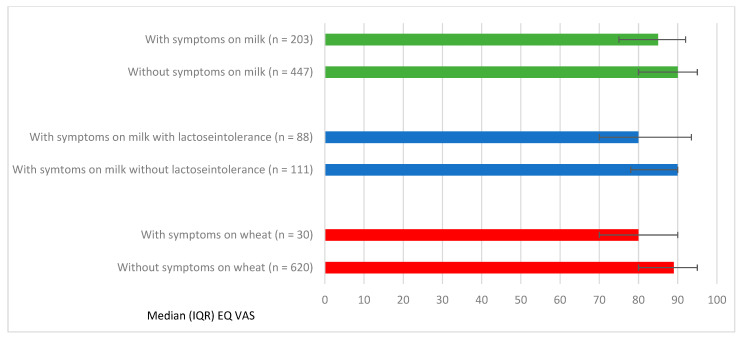
Food hypersensitivity (FHS) refers to food-related symptoms, with or without concurrent Immunoglobulin E (IgE) antibodies related to food(s). It remains unclear how different FHS phenotypes affect health-related quality of life (HRQoL). We examined self-reported HRQoL (with the generic instrument EQ-5D (dimensions and a Visual Analogue Scale (VAS), range 0–100) in association with phenotypes of FHS, and food-specific symptoms among adolescents (n = 2990) from a population-based birth cohort. Overall, 22% of the adolescents had FHS. Compared to adolescents without FHS, those with FHS reported more problems in the dimensions of pain/discomfort (p < 0.001), and anxiety/depression (p = 0.007). Females with FHS reported more problems than males in these dimensions (p < 0.001). Different FHS phenotypes (IgE-sensitization, allergic co-morbidity, and severity of symptoms) were not associated with differences in HRQoL. EQ-VAS scores were lowest for adolescents with symptoms for wheat vs. no wheat, median 80 vs. 89, p = 0.04) and milk vs. no milk (median 85 vs. 90, p = 0.03). Physician-diagnosed lactose intolerance median EQ-VAS was 80 vs. 90, p = 0.03 and also associated with more problems in the dimension of anxious/depression. In conclusion, FHS is associated with lower HRQoL in adolescence, irrespective of phenotypes, but differentially affects females vs. males, and those with vs. without symptoms for milk or wheat.
Overview
The claims and statistics of this paper haven’t been checked yet.
Run the check — free, no account needed. It reads the open-access text and checks the sources it cites.
Integrity signals
Registry
Cites
Statistics
Figures
Verification
Claims the paper makes
The claims and statistics of this paper haven’t been checked yet.
Run the check — free, no account needed. It reads the open-access text and checks the sources it cites.
Claims other papers make about this one
Each is checked against this paper’s own text: does it say what the citing paper says it does?
In the citing paper
“The fear of public symptoms, such as swelling, difficulty breathing, or hives, can discourage individuals from participating in social or professional activities, leading to isolation and a reduced quality of life [102-105].”
From Pollen–Food Allergy Syndrome: Allergens, Clinical Insights, Diagnostic and Therapeutic Challenges (2024) · cites this paper as [102]
Self-check
Percentages, sums and reported differences re-computed from the paper’s own numbers.
The self-check needs the paper’s full text.
Citations
Cites
A systematic review of quality of life research in medicine and health sciences
the LIVSFORSK network, Haraldstad, K., Wahl, A., Andenæs, R., Andersen, J. R., Andersen, M. H., Beisland, E., Borge, C. R., Engebretsen, E., Eisemann, M., et al. (2019) · Quality of Life Research · doi:10.1007/s11136-019-02214-9 · Cited by 1,011
Research works printed but not linked: 52
- Nwaru, 2014, Prevalence of common food allergies in Europe: A systematic review and meta-analysis, Allergy, 69, 992, 10.1111/all.12423 · DOI
- Deschildre, 2017, Food allergy phenotypes: The key to personalized therapy, Clin. Exp. Allergy, 47, 1125, 10.1111/cea.12984 · DOI
- Sicherer, 2018, Food allergy: A review and update on epidemiology, pathogenesis, diagnosis, prevention, and management, J. Allergy Clin. Immunol., 141, 41, 10.1016/j.jaci.2017.11.003 · DOI
- Venter, 2019, EAACI position paper: Influence of dietary fatty acids on asthma, food allergy, and atopic dermatitis, Allergy, 74, 1429, 10.1111/all.13764 · DOI
- Tuck, C.J., Biesiekierski, J.R., Schmid-Grendelmeier, P., and Pohl, D. (2019). Food Intolerances. Nutrients, 11. · DOI
- Ballardini, 2012, Development and comorbidity of eczema, asthma and rhinitis to age 12: Data from the BAMSE birth cohort, Allergy, 67, 537, 10.1111/j.1398-9995.2012.02786.x · DOI
- Pereira, 2005, Prevalence of sensitization to food allergens, reported adverse reaction to foods, food avoidance, and food hypersensitivity among teenagers, J. Allergy Clin. Immunol., 116, 884, 10.1016/j.jaci.2005.05.047 · DOI
- Rona, 2007, The prevalence of food allergy: A meta-analysis, J. Allergy Clin. Immunol., 120, 638, 10.1016/j.jaci.2007.05.026 · DOI
- Savage, 2015, Food allergy: Epidemiology and natural history, Immunol. Allergy Clin. N. Am., 35, 45, 10.1016/j.iac.2014.09.004 · DOI
- Roehr, 2004, Food allergy and non-allergic food hypersensitivity in children and adolescents, Clin. Exp. Allergy, 34, 1534, 10.1111/j.1365-2222.2004.02080.x · DOI
- Protudjer, J.L., Vetander, M., Kull, I., Hedlin, G., van Hage, M., Wickman, M., and Bergstrom, A. (2016). Food-Related Symptoms and Food Allergy in Swedish Children from Early Life to Adolescence. PLoS ONE, 11. · DOI
- Boyce, 2010, NIAD-sponsored expert panel. Guidelines for the diagnoses and management of food allergy in United States: Summary of NIAID-sponsered expert panel report, J. Allergy Clin. Immunol., 126, 1105, 10.1016/j.jaci.2010.10.008 · DOI
- Iweala, 2018, Food Allergy, Curr. Gastroenterol. Rep., 20, 17, 10.1007/s11894-018-0624-y · DOI
- Begen, 2018, Eating out with a food allergy in the UK: Change in the eating out practices of consumers with food allergy following introduction of allergen information legislation, Clin. Exp., 48, 317
- Begen, F.M., Barnett, J., Barber, M., Payne, R., Gowland, M.H., and Lucas, J.S. (2017). Parents’ and caregivers’ experiences and behaviours when eating out with children with a food hypersensitivity. BMC Public Health, 18. · DOI
- Clarke, 2017, Food-induced anaphylaxis to a known food allergen in children often occurs despite adult supervision, Pediatric Allergy Immunol., 28, 715, 10.1111/pai.12770 · DOI
- Miles, 2020, When and how pediatric anaphylaxis cases reach the emergency department: Findings from the Cross-Canada Anaphylaxis Registry, J. Allergy Clin. Immunol. Pract., 8, 1406, 10.1016/j.jaip.2019.10.009 · DOI
- Lagercrantz, 2017, “Healthcare seems to vary a lot”: A focus group study among parents of children with severe allergy, J. Asthma, 54, 1, 10.1080/02770903.2016.1258079 · DOI
- Michaud, 2004, The adolescent with a chronic condition. Part II: Healthcare provision, Arch. Dis. Child., 89, 943, 10.1136/adc.2003.045377 · DOI
- Jonsson, 2017, Experiences of Daily Life Among Adolescents with Asthma—A Struggle with Ambivalence, J. Pediatric Nurs., 35, 23, 10.1016/j.pedn.2017.02.005 · DOI
- Greenhawt, 2014, Food allergy quality of life, Ann. Allergy Asthma Immunol., 113, 506, 10.1016/j.anai.2014.06.027 · DOI
- Haraldstad, K., Kvarme, L.G., Christophersen, K.A., and Helseth, S. (2019). Associations between self-efficacy, bullying and health-related quality of life in a school sample of adolescents: A cross-sectional study. BMC Public Health, 19. · DOI · Paper page
- Jonsson, 2016, Asthma during adolescence impairs health-related quality of life, J. Allergy Clin. Immunol. Pract., 4, 144, 10.1016/j.jaip.2015.07.020 · DOI
- Covaciu, 2013, Childhood allergies affect health-related quality of life, J. Asthma, 50, 522, 10.3109/02770903.2013.789057 · DOI
- Marklund, 2006, Health-related quality of life in food hypersensitive schoolchildren and their families: Parents’ perceptions, Health Qual. Life Outcomes, 4, 48, 10.1186/1477-7525-4-48 · DOI · Paper page
- Avery, 2003, Assessment of quality of life in children with peanut allergy, Pediatric Allergy Immunol., 14, 378, 10.1034/j.1399-3038.2003.00072.x · DOI
- DunnGalvin, 2008, Development and validation of the self-administered Food Allergy Quality of Life Questionnaire for adolescents, J. Allergy Clin. Immunol., 122, 139, 10.1016/j.jaci.2008.05.008 · DOI
- Protudjer, 2016, Impaired health-related quality of life in adolescents with allergy to staple foods, Clin. Transl. Allergy, 6, 37, 10.1186/s13601-016-0128-5 · DOI
- Thornqvist, 2019, Health-related quality of life worsens by school age amongst children with food allergy, Clin. Transl. Allergy, 9, 10, 10.1186/s13601-019-0244-0 · DOI
- Cavkaytar, 2018, Factors Affecting Food Allergy-Related Quality of Life From Parents’ Perception in Turkish Children, Allergy Asthma Immunol. Res., 10, 379, 10.4168/aair.2018.10.4.379 · DOI
- Howe, 2014, What affects quality of life among caregivers of food-allergic children?, Ann. Allergy Asthma Immunol., 113, 69, 10.1016/j.anai.2014.04.016 · DOI
- Strinnholm, 2017, Health Related Quality of Life among schoolchildren aged 12–13 years in relation to food hypersensitivity phenotypes: A population-based study, Clin. Transl. Allergy, 7, 20, 10.1186/s13601-017-0156-9 · DOI
- Wickman, 2002, The BAMSE project: Presentation of a prospective longitudinal birth cohort study, Pediatric Allergy Immunol., 13, 11, 10.1034/j.1399-3038.13.s.15.10.x · DOI
- The EuroQol Group (1990). EuroQol—A new facility for the measurement of health-related quality of life. Health Policy, 16, 199–208. · DOI · Paper page
- Rabin, 2001, EQ-5D: A measure of health status from the EuroQol Group, Ann. Med., 33, 337, 10.3109/07853890109002087 · DOI · Paper page
- Dahlen, 2014, Factors associated with concordance between parental-reported use and dispensed asthma drugs in adolescents: Findings from the BAMSE birth cohort, Pharmacoepidemiol. Drug Saf., 23, 942, 10.1002/pds.3662 · DOI
- Finch, 2018, What is the evidence for the performance of generic preference-based measures? A systematic overview of reviews, Eur. J. Health Econ., 19, 557, 10.1007/s10198-017-0902-x · DOI
- Robles, L., and Priefer, R. (2020). Lactose Intolerance: What Your Breath Can Tell You. Diagnostics, 10. · DOI
- Ferro, 2016, Emotional and behavioral problems in adolescents and young adults with food allergy, Allergy, 71, 532, 10.1111/all.12829 · DOI
- Fong, 2017, Bullying and quality of life in children and adolescents with food allergy, J. Paediatr. Child Health, 53, 630, 10.1111/jpc.13570 · DOI
- DunnGalvin, 2010, Health-related quality of life of food allergic patients measured with generic and disease-specific questionnaires, Allergy, 65, 1031, 10.1111/j.1398-9995.2009.02304.x · DOI
- Verboom, 2014, Longitudinal associations between depressive problems, academic performance, and social functioning in adolescent boys and girls, Dev. Psychol., 50, 247, 10.1037/a0032547 · DOI · Paper page
- Hourihane, 2016, Health-related quality of life in food allergy: Impact, correlates, and predictors, Bundesgesundheitsblatt-Gesundheitsforschung-Gesundheitsschutz, 59, 841, 10.1007/s00103-016-2368-x · DOI
- Stukus, 2016, Leaving home: Helping teens with allergic conditions become independent, Ann. Allergy Asthma Immunol., 116, 388, 10.1016/j.anai.2016.03.026 · DOI
- Stensgaard, 2017, Quality of life in childhood, adolescence and adult food allergy: Patient and parent perspectives, Clin. Exp. Allergy, 47, 530, 10.1111/cea.12849 · DOI
- Venter, 2015, Health-related quality of life in children with perceived and diagnosed food hypersensitivity, Pediatric Allergy Immunol., 26, 126, 10.1111/pai.12337 · DOI
- Wassenberg, 2012, Parent perceived quality of life is age-dependent in children with food allergy, Pediatric Allergy Immunol., 23, 412, 10.1111/j.1399-3038.2012.01310.x · DOI
- Protudjer, 2019, Food allergy-related concerns during the transition to self-management, Allergy Asthma Clin. Immunol., 15, 54, 10.1186/s13223-019-0370-1 · DOI
- Hamshaw, 2019, Perceptions of Food Hypersensitivity Expertise on Social Media: Qualitative Study, Interact. J. Med. Res., 8, e10812, 10.2196/10812 · DOI
- Hart, 2004, The role of the Internet in patient-practitioner relationships: Findings from a qualitative research study, J. Med. Internet Res., 6, e36, 10.2196/jmir.6.3.e36 · DOI · Paper page
- Haahtela, 2017, The Finnish Allergy Programme 2008–2018 works, Eur. Respir. J., 49, 1700470, 10.1183/13993003.00470-2017 · DOI
- Quigley, 2017, Food Allergy in Patients Seeking Mental Health Care: What the Practicing Psychiatrist Should Know, Curr. Psychiatry Rep., 19, 99, 10.1007/s11920-017-0849-8 · DOI
Cited by
Sorted by citations
Pollen–Food Allergy Syndrome: Allergens, Clinical Insights, Diagnostic and Therapeutic Challenges
Haidar, L., Bănărescu, C. F., Uța, C., Moldovan, S. I., Zimbru, E.-L., Zimbru, R.-I., Ciurariu, E., Georgescu, M., & Panaitescu, C. (2024) · Applied Sciences · doi:10.3390/app15010066 · Cited by 21
Metadata
- Authors
- Jonsson, M., Ekström, S., Protudjer, J. L. P., Bergström, A., & Kull, I.
- Venue
- Nutrients
- Publisher
- MDPI AG
- Published
- 2021-07-09
- Volume
- 13
- Issue
- 7
- Pages
- 2357
- ISSN
- 2072-6643
- PMC
- PMC8308910
- Cited by
- 11
- References
- 1
- Language
- en
- Funders
- the Swedish Asthma and Allergy research foundation (F2017-0007)
- the Swedish Research Council for Health, Working Life and Welfare (2010-00451, 2017-00526)
- Swedish Heart-Lung Foundation (20180579)
- the European Research Council (757919)
About these checks
Registry, retraction, Cites and statistics results are computed, not judged, with one exception: a printed reference that no index lists is read once by a model before it counts as a citation error. Claims are extracted by a model and kept only when their quote appears verbatim in the text; each cited source is then checked, with a model’s help, for whether it says what the claim relies on. Those verdicts can be wrong — read the claim’s quote and the cited source before relying on one.
Statistics and arithmetic are recomputed, not judged.
Confidence bands are shown only for fields calibrated on our annotated test set. None is calibrated yet, so no band is shown.
What counts as a claim ›How we measure confidence ›How we check this ›
Are you an author, or do you see a problem with this page? Request a review
How to cite
Cite CoChat for the checks on this page, and the paper for its own findings.
- This page
- CoChat. (2026). Citation check: Living with Food Hypersensitivity as an Adolescent Impairs Health Related Quality of Life Irrespective of Disease Severity: Results from a Population-Based Birth Cohort. https://app.cochat.ai/papers/10.3390/nu13072357
- The paper
- Jonsson, M., Ekström, S., Protudjer, J. L. P., Bergström, A., & Kull, I. (2021). Living with Food Hypersensitivity as an Adolescent Impairs Health Related Quality of Life Irrespective of Disease Severity: Results from a Population-Based Birth Cohort. Nutrients. https://doi.org/10.3390/nu13072357
