

The DOI matches its Crossref record; 52 of the 53 references it cites were found in a registry or an index; none of the 11 sources its claims cite is checked for support yet.
Beneficial Effects on Abdominal Bloating with an Innovative Food-Grade Formulation of Curcuma longa and Boswellia serrata Extracts in Subjects with Irritable Bowel Syndrome and Small Bowel Dysbiosis
Open accessAbstract
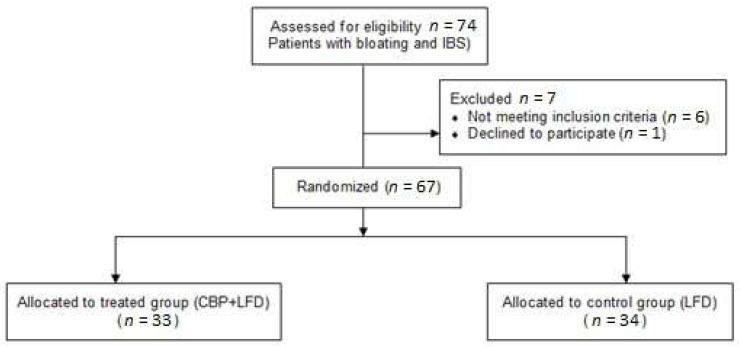
Bloating is a symptom frequently reported by subjects with irritable bowel syndrome (IBS) and small bowel dysbiosis, and Low FODMAP’s diet (LFD) has been used to treat them. Extracts of Curcumalonga and Boswelliaserrata share anti-inflammatory and antimicrobial effects that could be useful in the management of these clinical conditions. The aim of this study was to evaluate the efficacy of curcumin and boswellia extracts (as Curcumin Boswellia Phytosome, CBP) and LFD on the relief of abdominal bloating in IBS subjects with small bowel dysbiosis, in comparison to LFD alone, in a 30-day supplementation, randomized trial. IBS participants were randomized to either the intervention (500 mg bid of CBP and LFD) or control arm (LFD). Small bowel dysbiosis has been defined by an increase of urinary indican with normal urinary skatole. A total of 67 subjects were recruited. The intervention group (33 subjects) showed a significant decrease (p < 0.0001) of bloating, abdominal pain, and indican values at the end of the study, when compared to the control group (34 subjects). Moreover, the subjects of the intervention group showed a significantly better (p < 0.0001) global assessment of efficacy (GAE) as compared to controls. In conclusion, in subjects with IBS and small bowel dysbiosis, abdominal bloating can be successfully reduced with a supplementation with CBP and LFD.
Overview
CoChat Summary
TL;DR
In a 30-day randomized trial of 67 IBS subjects with small bowel dysbiosis, adding Curcumin Boswellia Phytosome (CBP) 500 mg bid to a low-FODMAP diet significantly reduced abdominal bloating, abdominal pain, and urinary indican compared with low-FODMAP diet alone. CBP plus LFD also produced better global efficacy ratings, though the study lacked blinding and placebo control.
Key findings
- Of 67 recruited subjects, 33 received CBP + LFD and 34 received LFD alone; the intervention group showed significant decreases in bloating, abdominal pain, and indican values versus controls (p < 0.0001 for each comparison).
- For bloating, the ordinal model estimated β = −6.11 (OR = 0.002 [95% CI 0.0001; 0.02], p < 0.0001); for abdominal pain, β = −5.23 (OR = 0.005 [95% CI 0.0003; 0.03], p < 0.0001) for being in higher symptom categories after supplementation.
- Indican decreased by 40% in the CBP group compared with controls (linear model β = −0.52, p < 0.0001).
- Global assessment of efficacy was significantly better with CBP: 93.9% of the CBP group were rated grade 3 or 4 versus 14.7% of controls (p < 0.0001); 33 intervention subjects reported no or mild bloating at end of study versus 10 controls.
Methods
- Single-center 30-day randomized trial conducted at the Department of Public Health, University of Pavia, Italy; participants had IBS and small bowel dysbiosis, with bloating as the main symptom, and were randomized to CBP 500 mg bid + LFD or LFD alone.
- A total of 67 subjects were analyzed (51 females, 16 males; mean age 43.09 ± 15.10 years); inclusion required moderate IBS by Rome III criteria and increased urinary indican with normal urinary skatole.
- Outcomes at baseline and day 30 included a 4-point bloating score, 0–10 abdominal pain VAS, urinary indican/skatole, and a 4-point global assessment of efficacy; analysis used t-tests/chi-squared for baseline comparisons, Wilcoxon Mann–Whitney tests for pre–post differences, cumulative link models for ordinal bloating/pain, and a linear model on log-transformed indican in R 3.5.1.
Limitations
- The authors state there was a lack of blinding, the control group received LFD rather than placebo, and adherence with LFD was not checked in either group.
- The authors note that the control group did not receive placebo, which is a weakness given large placebo responses in IBS studies.
- Evident from the text: the trial was short (30 days) and single-center; the authors state results should be confirmed by larger trials with longer supplementation.
Model-written summary. Check it against the paper before relying on it.
Integrity signals
Registry
Cites
Statistics
Figures
Verification
Claims the paper makes
0 Valid · 0 Not valid · 4 Not checked · 20 Own results and interpretations
A result the paper reports from its own data — it cites no other source for it, so there is none to check. The quote shows it is in the paper.
In the paper
“At the end of the study, 33 subjects of the intervention group reported no or a mild degree of bloating, in comparison to only 10 subjects in the control group.”
§ Beneficial Effects on Abdominal Bloating with an Innovative Food-Grade Formulation of Curcuma longa and Boswellia serrata Extracts in Subjects with Irritable Bowel Syndrome and Small Bowel Dysbiosis > 4. Discussion
plainn = 33- Asserted: passes — The authors put it forward as true.
- Checkable: passes — It can be checked against evidence.
- Load-bearing: passes — The paper’s conclusions depend on it.
- Based: passes — The paper gives a reason why it holds.
A result the paper reports from its own data — it cites no other source for it, so there is none to check. The quote shows it is in the paper.
In the paper
“In Table 3, the frequency of GAE measured in T1 is reported; a statistically significant difference (p < 0.0001) was observed between the two groups.”
- Also stated in: § 4. Discussion · plain
“The positive outcome of this botanical management is confirmed by the participants’ global assessment of efficacy (GAE) that showed a significant difference when cases and controls were compared.”
§ Beneficial Effects on Abdominal Bloating with an Innovative Food-Grade Formulation of Curcuma longa and Boswellia serrata Extracts in Subjects with Irritable Bowel Syndrome and Small Bowel Dysbiosis > 3. Results
plainstates an association- Asserted: passes — The authors put it forward as true.
- Checkable: passes — It can be checked against evidence.
- Load-bearing: passes — The paper’s conclusions depend on it.
- Based: passes — The paper gives a reason why it holds.
- Also stated in: § 4. Discussion · plain
A result the paper reports from its own data — it cites no other source for it, so there is none to check. The quote shows it is in the paper.
In the paper
“In our study LFD did not appear to be efficacious for bloating relief in IBS subjects with dysbiosis, while the concomitant supplementation with CBP for 30 days was followed by a significant reduction of bloating.”
§ Beneficial Effects on Abdominal Bloating with an Innovative Food-Grade Formulation of Curcuma longa and Boswellia serrata Extracts in Subjects with Irritable Bowel Syndrome and Small Bowel Dysbiosis > 4. Discussion
hedged- Asserted: passes — The authors put it forward as true.
- Checkable: passes — It can be checked against evidence.
- Load-bearing: passes — The paper’s conclusions depend on it.
- Based: passes — The paper gives a reason why it holds.
A result the paper reports from its own data — it cites no other source for it, so there is none to check. The quote shows it is in the paper.
In the paper
“As for indican, the result of the linear model on the log-transformed variable indicated a statistically significant effect of treatment in the CBP group (𝛽 = −0.52 and p < 0.0001), which corresponded to a decreasing of indican of 40% as compared to control group.”
§ Beneficial Effects on Abdominal Bloating with an Innovative Food-Grade Formulation of Curcuma longa and Boswellia serrata Extracts in Subjects with Irritable Bowel Syndrome and Small Bowel Dysbiosis > 3. Results
plainstates a cause- Asserted: passes — The authors put it forward as true.
- Checkable: passes — It can be checked against evidence.
- Load-bearing: unclear — It is unclear whether the paper’s conclusions depend on it.
- Based: passes — The paper gives a reason why it holds.
A result the paper reports from its own data — it cites no other source for it, so there is none to check. The quote shows it is in the paper.
In the paper
“No statistically significant differences were observed between the two groups at baseline.”
§ Beneficial Effects on Abdominal Bloating with an Innovative Food-Grade Formulation of Curcuma longa and Boswellia serrata Extracts in Subjects with Irritable Bowel Syndrome and Small Bowel Dysbiosis > 3. Results
plainn = 67- Asserted: passes — The authors put it forward as true.
- Checkable: passes — It can be checked against evidence.
- Load-bearing: passes — The paper’s conclusions depend on it.
- Based: passes — The paper gives a reason why it holds.
7 more claims
Create a free account to see all 24 claims and to verify the 11 references still open.
- It may state two separate claims as one. 9
- Probably not a substantial claim. 7
Claims other papers make about this one
Each is checked against this paper’s own text: does it say what the citing paper says it does?
In the citing paper
“Clinical studies in humans have shown that turmeric alone (οne or two tablets of 72 mg once daily for 8 weeks) [49] and in combination with Boswellia serrata (17–23% w/w curcumin in one tablet of 500 mg twice daily for one month) [50] can improve gastrointestinal symptoms in IBS.”
From Plant-Derived Treatments for IBS: Clinical Outcomes, Mechanistic Insights, and Their Position in International Guidelines (2026) · cites this paper as [50]
In the citing paper
“curcumin shows mechanistic and preliminary clinical potential by modulating several IBS-related pathways”
From Plant-Derived Treatments for IBS: Clinical Outcomes, Mechanistic Insights, and Their Position in International Guidelines (2026) · cites this paper as [50]
Self-check
Percentages, sums and reported differences re-computed from the paper’s own numbers.
Each contradiction between two passages listed here was confirmed by an independent check.
Rated minor: it would not touch a result — a value no result rests on, a p-value that stays on the same side of the significance level, or a conflict that is clerical, resolved elsewhere in the paper, or outside its own findings.
In the paper
§ Beneficial Effects on Abdominal Bloating with an Innovative Food-Grade Formulation of Curcuma longa and Boswellia serrata Extracts in Subjects with Irritable Bowel Syndrome and Small Bowel Dysbiosis > 4. Discussion
“A retrospective study published by Gibson et al. [47] and other controlled prospective studies [21,48,49], showed the efficacy of LFD in reducing bloating and other abdominal symptoms such as abdominal pain, flatulence, and diarrhea in Australian and New Zealand IBS patients.”
§ Beneficial Effects on Abdominal Bloating with an Innovative Food-Grade Formulation of Curcuma longa and Boswellia serrata Extracts in Subjects with Irritable Bowel Syndrome and Small Bowel Dysbiosis > References
“47. Gibson P.R. Shepherd S.J. Personal view: Food for thought—Western lifestyle and susceptibility to Crohn’s disease. The FODMAP hypothesis Aliment. Pharmacol. Ther. 2005 21 1399 1409”
Citations
Cites
Agresti, A. (2002) · Wiley Series in Probability and Statistics · doi:10.1002/0471249688 · Cited by 6,746
Longstreth, G. F., Thompson, W. G., Chey, W. D., Houghton, L. A., Mearin, F., & Spiller, R. C. (2006) · Gastroenterology · doi:10.1053/j.gastro.2005.11.061 · Cited by 4,856
Lacy, B. E., Mearin, F., Chang, L., Chey, W. D., Lembo, A. J., Simren, M., & Spiller, R. (2016) · Gastroenterology · doi:10.1053/j.gastro.2016.02.031 · Cited by 2,866
Drossman, D. A., Li, Z., Andruzzi, E., Temple, R. D., Talley, N. J., Grant Thompson, W., Whitehead, W. E., Janssens, J., Funch-Jensen, P., Corazziari, E., et al. (1993) · Digestive Diseases and Sciences · doi:10.1007/bf01303162 · Cited by 2,198
Aggarwal, B. B., & Harikumar, K. B. (2009) · The International Journal of Biochemistry & Cell Biology · doi:10.1016/j.biocel.2008.06.010 · Cited by 1,716
FRANCIS, C. Y., MORRIS, J., & WHORWELL, P. J. (1997) · Alimentary Pharmacology & Therapeutics · doi:10.1046/j.1365-2036.1997.142318000.x · Cited by 1,708
A Diet Low in FODMAPs Reduces Symptoms of Irritable Bowel Syndrome
Halmos, E. P., Power, V. A., Shepherd, S. J., Gibson, P. R., & Muir, J. G. (2014) · Gastroenterology · doi:10.1053/j.gastro.2013.09.046 · Cited by 1,249
Rifaximin Therapy for Patients with Irritable Bowel Syndrome without Constipation
Pimentel, M., Lembo, A., Chey, W. D., Zakko, S., Ringel, Y., Yu, J., Mareya, S. M., Shaw, A. L., Bortey, E., & Forbes, W. P. (2011) · New England Journal of Medicine · doi:10.1056/nejmoa1004409 · Cited by 1,036
Evidence‐based dietary management of functional gastrointestinal symptoms: The FODMAP approach
Gibson, P. R., & Shepherd, S. (2009) · Journal of Gastroenterology and Hepatology · doi:10.1111/j.1440-1746.2009.06149.x · Cited by 690
Shepherd, S. J., Parker, F. C., Muir, J. G., & Gibson, P. R. (2008) · Clinical Gastroenterology and Hepatology · doi:10.1016/j.cgh.2008.02.058 · Cited by 549
Cited by
Kunnumakkara, A. B., Hegde, M., Parama, D., Girisa, S., Kumar, A., Daimary, U. D., Garodia, P., Yenisetti, S. C., Oommen, O. V., & Aggarwal, B. B. (2023) · ACS Pharmacology & Translational Science · doi:10.1021/acsptsci.2c00012 · Cited by 229
Hormetic Nutrition and Redox Regulation in Gut–Brain Axis Disorders
Scuto, M. C., Rampulla, F., Reali, G. M., Spanò, S. M., Salinaro, A. T., & Calabrese, V. (2024) · Antioxidants · doi:10.3390/antiox13040484 · Cited by 104
The Effect of Curcumin on the Gut-Brain Axis: Therapeutic Implications
Enayati, A., Soghi, A., Butler, A. E., Rizzo, M., & Sahebkar, A. (2023) · Journal of Neurogastroenterology and Motility · doi:10.5056/jnm23065 · Cited by 28
Qin, T., Chen, X., Meng, J., Guo, Q., Xu, S., Hou, S., Yuan, Z., & Zhang, W. (2023) · Critical Reviews in Food Science and Nutrition · doi:10.1080/10408398.2023.2204349 · Cited by 21
Mardiana, L., Milanda, T., Hadisaputri, Y. E., & Chaerunisaa, A. Y. (2025) · Drug Design Development and Therapy · doi:10.2147/dddt.s483404 · Cited by 19
Melchior, C., Hammer, H. F., Bor, S., Barba, E., Horvat, I. B., Çelebi, A., Drug, V. L., Dumitrascu, D. L., Kalkan, İ. H., Hauser, G., et al. (2025) · United European Gastroenterology Journal · doi:10.1002/ueg2.70098 · Cited by 15
Tu, X., Ren, H., & Bu, S. (2023) · Frontiers in Microbiology · doi:10.3389/fmicb.2023.1274559 · Cited by 12
Bertuccioli, A., Zonzini, G. B., Cazzaniga, M., Cardinali, M., Pierro, F. D., Gregoretti, A., Zerbinati, N., Guasti, L., Matera, M. R., Cavecchia, I., et al. (2024) · Microorganisms · doi:10.3390/microorganisms12040804 · Cited by 11
Dwivedi, J., Sachan, P., Wal, P., Kosey, S., & Khan, M. M. U. (2023) · Journal of Research in Pharmacy · doi:10.29228/jrp.457 · Cited by 10
Liu, T., Asif, I. M., Bai, C., Huang, Y., Li, B., & Wang, L. (2024) · Nutrition Reviews · doi:10.1093/nutrit/nuae047 · Cited by 10
Pop, D. M., Pop, R. S., & Farcău, D. (2023) · Nutrients · doi:10.3390/nu15204351 · Cited by 9
Moniruzzaman, M., Shah, A., Morrison, M., Koloski, N., Gwee, K. A., Chen, M., Kim, Y., Ayaki, K., Efferth, T., & Holtmann, G. (2025) · Digestive and Liver Disease · doi:10.1016/j.dld.2025.07.010 · Cited by 8
Giacosa, A., Barrile, G. C., Gasparri, C., Perna, S., & Rondanelli, M. (2025) · Nutrients · doi:10.3390/nu17040723 · Cited by 3
Self-citationGiacosa, A., Barrile, G. C., Perna, S., & Rondanelli, M. (2024) · Life · doi:10.3390/life14111410 · Cited by 2
Self-citationPHYSIOLOGICAL EFFECTS OF TURMERIC (Curcuma longa L) IN THE FORM OF NANO AND CRUDE EXTRACT
Simanjuntak, L. J., Rumahorbo, C. G. P., & Situmorang, P. C. (2023) · RASAYAN Journal of Chemistry · doi:10.31788/rjc.2023.1638471 · Cited by 2
Pastras, P., Aggeletopoulou, I., Bali, M., & Triantos, C. (2026) · Nutrients · doi:10.3390/nu18020183 · Cited by 1
A comprehensive review on phytosomes as an emerging technology for delivering herbal medicines
Aneja, P., Guleria, R., Aneja, S., Dahiya, D. P., Goyal, A., Roy, D., Singh, J., & Rangra, N. K. (2025) · Journal of Asian Natural Products Research · doi:10.1080/10286020.2025.2564401 · Cited by 1
Espitia, O. L. P., Barrera-Mojica, M. C., Moya, P. S. C., Zuleta, M. A. G., & Mejía, A. C. (2026) · Revista Colombiana de Gastroenterología · doi:10.22516/25007440.1386 · Cited by 1
O efeito antiinflamatório da cúrcuma nas doenças inflamatórias intestinais
Pereira, F. L., & de Almeida, S. G. (2025) · Research Society and Development · doi:10.33448/rsd-v14i6.48985
Shahrajabian, M. H., & Sun, W. (2025) · Military Medical Science Letters · doi:10.31482/mmsl.2025.007
Jessa Landmann, N. D. (2026) · Wiley eBooks · doi:10.1002/9781394381401.ch15
Komal, A., Ilyas, D., Khan, M. U., Rehman, M. K. U., Hassan, T., Ayub, H., Naqi, N., Ullah, N., & Ilyas, U. (2026) · Molecular Biology Reports · doi:10.1007/s11033-026-11888-7
RADU-MIHAI, B., Ciobica, A. S., & Mavroudis, I. (2026) · Annals of the Academy of Romanian Scientists Series on Biological Sciences · doi:10.56082/annalsarscibio.2026.1.226
Herbal Remedies for Bloating Based on Iranian Traditional Medicine: A Review
Azar, M. R. M. H., & Hashemi, A. (2026) · Plant Biotechnology Persa · doi:10.66224/pbp.8.2.13
Metadata
- Authors
- Giacosa, A., Riva, A., Petrangolini, G., Allegrini, P., Fazia, T., Bernardinelli, L., Peroni, G., & Rondanelli, M.
- Affiliations
- Centro Diagnostico Italiano (IT)
- Indena (Italy) (IT)
- University of Pavia (IT)
- Corresponding author
- Peroni, Gabriella
- ORCID
- Venue
- Nutrients
- Publisher
- MDPI AG
- Published
- 2022-01-18
- Volume
- 14
- Issue
- 3
- Pages
- 416
- ISSN
- 2072-6643 (ISSN-L)
- PMC
- PMC8839120
- OpenAlex
- W4206412636
- Semantic Scholar
- 7b00579f70de9dae6a1797fa12692636a0887b86
- Cited by
- 24
- References
- 53
- Citations by year
- 2026: 6 · 2025: 7 · 2024: 4 · 2023: 7
- FWCI
- 2.95
- Type
- journal article
- Language
- en
- Open access
- gold
- doi.org
- Licence
- Locations
- Nutrients (publishedVersion, cc-by)
- PubMed (publishedVersion)
- PubMed Central (publishedVersion, cc-by)
- Topics
- Health Sciences › Medicine › Gastroenterology › Gastrointestinal motility and disorders
- Life Sciences › Biochemistry, Genetics and Molecular Biology › Molecular Biology › Gut microbiota and health
- Life Sciences › Biochemistry, Genetics and Molecular Biology › Molecular Medicine › Curcumin's Biomedical Applications
- Keywords
- irritable bowel syndrome, bloating, curcumin, Boswellia serrata, phytosomes, low FODMAP diet, dietary supplementation, abdominal pain, gut microbiota
- MeSH terms
- Humans, Plant Extracts, Boswellia, Curcuma, Irritable Bowel Syndrome, Dysbiosis
About these checks
Registry, retraction, Cites and statistics results are computed, not judged, with one exception: a printed reference that no index lists is read once by a model before it counts as a citation error. Claims are extracted by a model and kept only when their quote appears verbatim in the text; each cited source is then checked, with a model’s help, for whether it says what the claim relies on. Those verdicts can be wrong — read the claim’s quote and the cited source before relying on one.
A language model drew the claims from the paper on 2026-11-14, under version 3 of the claim definition (model deepseek-v4.1-flash, prompt extract-v3).
A second model labelled each claim on 2026-11-14 (model jev-1.13-20260917, definition revision gold-guideline-v0.2).
Statistics and arithmetic are recomputed, not judged.
Confidence bands are shown only for fields calibrated on our annotated test set. None is calibrated yet, so no band is shown.
What counts as a claim ›How we measure confidence ›How we check this ›
Are you an author, or do you see a problem with this page? Request a review
Data sources
Bibliographic data: Semantic Scholar, OpenAlex, Crossref.
Contains information from the Semantic Scholar Academic Graph Datasets, made available under the ODC Attribution License (ODC-BY 1.0).
Semantic Scholar’s data is described in: Kinney, R., et al. (2023). The Semantic Scholar Open Data Platform. arXiv:2301.10140.
