

Sclerostin in Excessive Drinkers: Relationships with Liver Function and Body Composition
Open accessThe DOI matches its Crossref record; 58 of the 58 references it cites were found in a registry or an index.
Abstract
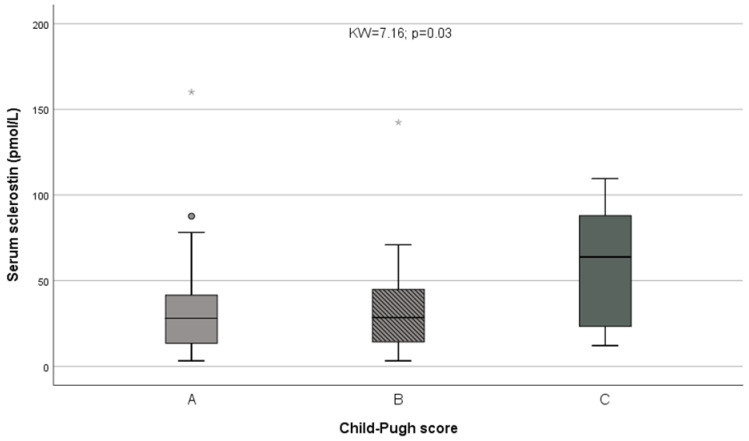
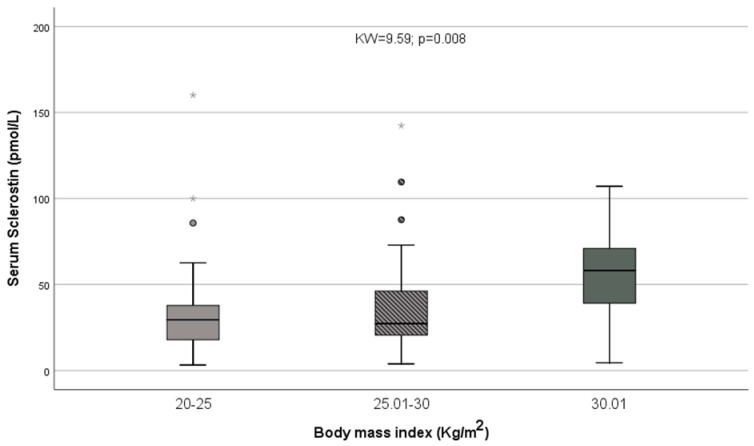
BACKGROUND: Sclerostin was initially described as an inhibitor of the Wnt-β catenin bone-forming pathway, but it also exerts important effects on intermediate metabolism and body composition. Osteosarcopenia and altered body fat distribution are common findings in excessive drinkers. The role of sclerostin in these patients is uncertain. We aim to analyze the behavior of sclerostin in excessive drinkers and its relationships with body composition (fat mass, lean mass, bone mass), handgrip strength, body mass index (BMI), liver function and ethanol intake. METHODS: 107 male active heavy drinkers and 26 age-matched controls were included. Serum sclerostin was determined by ELISA. Body composition analysis was performed by double X-ray absorptiometry. Handgrip strength was recorded using a dynamometer. Liver function was assessed according to Child's classification. RESULTS: Sclerostin was higher among Child's C patients, keeping a relationship with deranged liver function. Obesity, defined according to BMI, and body fat were strongly related to sclerostin, being independent of serum creatinine and of liver function. The relationship of sclerostin with total hip bone mineral density was displaced by BMI. CONCLUSION: Deranged liver function is associated with higher sclerostin levels in alcoholics. Raised sclerostin levels are related to fat deposition and increased BMI.
Overview
The claims and statistics of this paper haven’t been checked yet.
Free: it reads the open-access text and checks the first 5 claims that cite a source we can check. Create a free account to check every claim.
Integrity signals
Registry
Cites
Statistics
Figures
Verification
Claims the paper makes
The claims and statistics of this paper haven’t been checked yet.
Free: it reads the open-access text and checks the first 5 claims that cite a source we can check. Create a free account to check every claim.
Claims other papers make about this one
Each is checked against this paper’s own text: does it say what the citing paper says it does?
In the citing paper
“It was reported that sclerostin levels tended (albeit not significantly) to be higher among individuals with cirrhosis and demonstrated a significant association with liver function impairment, with elevated levels observed among patients classified as Child C [161].”
From Emerging role of liver-bone axis in osteoporosis (2024) · cites this paper as [161]
Self-check
Percentages, sums and reported differences re-computed from the paper’s own numbers.
The self-check needs the paper’s full text.
Citations
Cites
Erdogan, D., Heijnen, B. H. M., Bennink, R. J., Kok, M., Dinant, S., Straatsburg, I. H., Gouma, D. J., & van Gulik, T. M. (2004) · Liver International · doi:10.1111/j.1478-3231.2004.00901.x · Cited by 11,700
Transection of the oesophagus for bleeding oesophageal varices
Pugh, R. N. H., Murray-Lyon, I. M., Dawson, J. L., Pietroni, M. C., & Williams, R. (1973) · Journal of British Surgery · doi:10.1002/bjs.1800600817 · Cited by 7,941 · cited 1×
“To achieve a global assessment of liver function we calculated the Child-Pugh’s score considering prothrombin, albumin, bilirubin, and the presence and intensity of ascites and encephalopathy [38,39].”
MethodWnt/β-Catenin Signaling: Components, Mechanisms, and Diseases
MacDonald, B. T., Tamai, K., & He, X. (2009) · Developmental Cell · doi:10.1016/j.devcel.2009.06.016 · Cited by 5,583 · cited 1×
“Sclerostin is a Wnt-β catenin inhibitor that suppresses bone formation [1].”
BackgroundSurgery and portal hypertension.
Child, C. G., & Turcotte, J. (1964) · PubMed · Cited by 1,933
Appendicular skeletal muscle mass: measurement by dual-photon absorptiometry
Heymsfield, S., Smith, R., Aulet, M., Bensen, B., Lichtman, S., Wang, J., & Pierson, R. (1990) · The American Journal of Clinical Nutrition · doi:10.1093/ajcn/52.2.214 · Cited by 820 · cited 1×
“, the ASM as appendicular lean mass/height, and ASM including only upper limbs and ASM including only lower limbs [40].”
Sclerostin Stimulates Osteocyte Support of Osteoclast Activity by a RANKL-Dependent Pathway
Wijenayaka, A. R., Kogawa, M., Lim, H. P., Bonewald, L. F., Findlay, D. M., & Atkins, G. J. (2011) · PLoS ONE · doi:10.1371/journal.pone.0025900 · Cited by 503 · cited 1×
“Some data support the view that sclerostin may also activate bone resorption [4].”
BackgroundRelation of age, gender, and bone mass to circulating sclerostin levels in women and men
Mödder, U. I., Hoey, K. A., Amin, S., McCready, L. K., Achenbach, S. J., Riggs, B. L., Melton, L. J., & Khosla, S. (2011) · Journal of Bone and Mineral Research · doi:10.1002/jbmr.217 · Cited by 397 · cited 1×
“Paradoxical direct relationships between sclerostin and BMD or BMC have been reported by several authors [7,48], and several explanations have been argued, including an increased osteocyte mass among those with increased BMD [8] (although in that study it was also reported that a low BMD among those with the highest s…”
von Maltzahn, J., Chang, N. C., Bentzinger, C. F., & Rudnicki, M. A. (2012) · Trends in Cell Biology · doi:10.1016/j.tcb.2012.07.008 · Cited by 393
Osteocyte-Related Cytokines Regulate Osteoclast Formation and Bone Resorption
Kitaura, H., Marahleh, A., Ohori, F., Noguchi, T., Shen, W.-R., Qi, J., Nara, Y., Pramusita, A., Kinjo, R., & Mizoguchi, I. (2020) · International Journal of Molecular Sciences · doi:10.3390/ijms21145169 · Cited by 380
Circulating Levels of Sclerostin Are Increased in Patients with Type 2 Diabetes Mellitus
García-Martín, A., Rozas-Moreno, P., Reyes-García, R., Morales-Santana, S., García-Fontana, B., García-Salcedo, J. A., & Muñoz-Torres, M. (2012) · The Journal of Clinical Endocrinology & Metabolism · doi:10.1210/jc.2011-2186 · Cited by 311 · cited 1×
“In this sense, sclerostin levels are related to insulin resistance [12], are higher in diabetics [13] and in patients affected by metabolic syndrome [9], and positively correlate with body fat [14,15], although (as with BMD or BMC) some discrepancy exists regarding this matter.”
Background
Cited by
Novel insights on the effect of sclerostin on bone and other organs
Dreyer, T. J., Keen, J. A. C., Wells, L. M., & Roberts, S. J. (2023) · Journal of Endocrinology · doi:10.1530/joe-22-0209 · Cited by 38
Emerging role of liver-bone axis in osteoporosis
Gao, H., Peng, X., Li, N., Gou, L., Xu, T., Wang, Y., Qin, J., Liang, H., Ma, P., Li, S., et al. (2024) · Journal of Orthopaedic Translation · doi:10.1016/j.jot.2024.07.008 · Cited by 36
The roles of hepatokine and osteokine in liver-bone crosstalk: Advance in basic and clinical aspects
Li, Z., Wen, X., Li, N., Zhong, C., Chen, L., Zhang, F., Zhang, G., Lü, A., & Liu, J. (2023) · Frontiers in Endocrinology · doi:10.3389/fendo.2023.1149233 · Cited by 22
Zhu, J., Lu, Q., Zhan, X., Huang, S., Zhou, C., Wu, S., Chen, T., Yao, Y., Liao, S., Yu, C., et al. (2023) · Scientific Reports · doi:10.1038/s41598-023-36992-7 · Cited by 7
“Another study reported that sclerostin is positively correlated with liver function and BMI in patients with excessive alcohol consumption 26 .”
Tirandi, A., Arboscello, E., Ministrini, S., Liberale, L., Bonaventura, A., Vecchié, A., Bertolotto, M. B., Giacobbe, D. R., Castellani, L., Mirabella, M., et al. (2023) · Internal and Emergency Medicine · doi:10.1007/s11739-023-03223-w · Cited by 6
Metadata
- Authors
- Martín González, C., Fernández Rodríguez, C. M., Abreu González, P., García Rodríguez, A., Alvisa Negrín, J. C., Cabañas Perales, E., González Navarrete, L., Vera Delgado, V. E., Ortega Toledo, P., & González Reimers, E.
- Affiliations
- Departamento de Medicina Interna, Universidad de La Laguna, Servicio de Medicina Interna, Hospital Universitario de Canarias, Tenerife, Canary Islands, 38320 La Laguna, Spain
- Departamento de Ciencias Médicas Básicas, Unidad de Fisiología, Universidad de la Laguna, Tenerife, Canary Islands, 38320 La Laguna, Spain
- Venue
- Nutrients
- Publisher
- MDPI AG
- Published
- 2022-06-22
- Volume
- 14
- Issue
- 13
- Pages
- 2574
- ISSN
- 2072-6643 (ISSN-L)
- PMC
- PMC9268012
- OpenAlex
- W4283313248
- Cited by
- 9
- References
- 58
- Citations by year
- 2026: 2 · 2024: 1 · 2023: 5 · 2022: 1
- FWCI
- 1.19
- Type
- journal article
- Language
- en
- Open access
- gold
- doi.org
- Licence
- Locations
- Nutrients (publishedVersion, cc-by)
- PubMed Central (publishedVersion, cc-by)
- PubMed (publishedVersion)
- DOAJ (DOAJ: Directory of Open Access Journals) (submittedVersion, cc-by-sa)
- Topics
- Health Sciences › Medicine › Pathology and Forensic Medicine › Alcohol Consumption and Health Effects
- Health Sciences › Medicine › Physiology (medical) › Nutrition and Health in Aging
- Health Sciences › Medicine › Orthopedics and Sports Medicine › Bone health and osteoporosis research
- Keywords
- sclerostin, heavy drinkers, alcoholism, liver function, body composition, fat mass, lean body mass, bone mineral density, grip strength, obesity, body mass index, Wnt/β-catenin signaling, osteosarcopenia, body fat distribution
- MeSH terms
- Body Composition, Child, Humans, Liver, Male, Absorptiometry, Photon, Bone Density, Hand Strength, Adaptor Proteins, Signal Transducing
About these checks
Registry, retraction, Cites and statistics results are computed, not judged, with one exception: a printed reference that no index lists is read once by a model before it counts as a citation error. Claims are extracted by a model and kept only when their quote appears verbatim in the text; each cited source is then checked, with a model’s help, for whether it says what the claim relies on. Those verdicts can be wrong — read the claim’s quote and the cited source before relying on one.
Statistics and arithmetic are recomputed, not judged.
Confidence bands are shown only for fields calibrated on our annotated test set. None is calibrated yet, so no band is shown.
What counts as a claim ›How we measure confidence ›How we check this ›
Are you an author, or do you see a problem with this page? Request a review
Data sources
Bibliographic data: Semantic Scholar, OpenAlex, Crossref.
Contains information from the Semantic Scholar Academic Graph Datasets, made available under the ODC Attribution License (ODC-BY 1.0).
Semantic Scholar’s data is described in: Kinney, R., et al. (2023). The Semantic Scholar Open Data Platform. arXiv:2301.10140.
