

Exercise Programs Combined with Diet Supplementation Improve Body Composition and Physical Function in Older Adults with Sarcopenia: A Systematic Review
Open accessThe DOI matches its Crossref record; 47 of the 49 references it cites were found in a registry or an index, and 2 are not checked yet.
Abstract
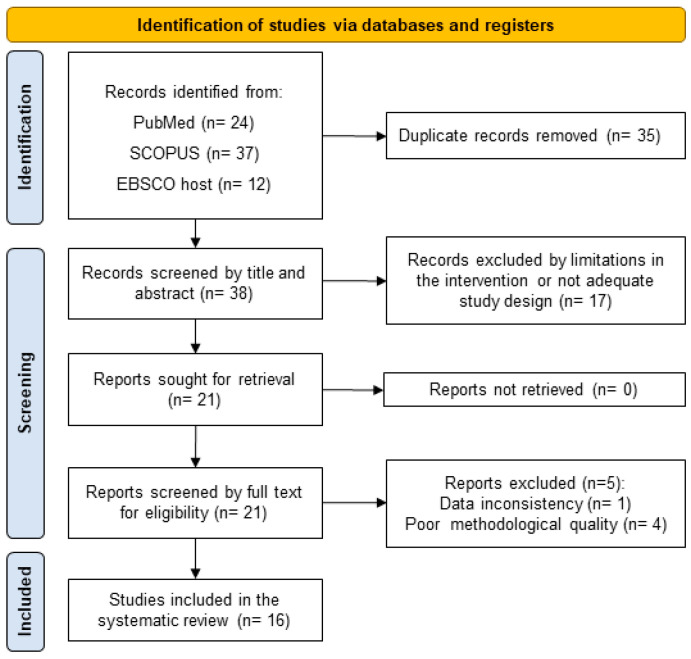
Sarcopenia is a progressive and frequent syndrome among older adults highly related to physical inactivity and malnutrition. Nowadays, it is considered a pathology that triggers multiple health complications associated with the loss of muscle mass, strength, autonomy, and quality of life. The objective of the present systematic review was to evaluate the effect of exercise programs combined with dietary supplementation on body composition as the primary outcome. This systematic review was carried out in accordance with the elements considered for planning a systematic review by the Preferred Reporting Items for Systematic Reviews and Meta-Analyses (PRISMA), and the search was performed in the Scopus, EBSCO, and PubMed databases for the last 10 years. A total of 16 studies met the inclusion criteria and were included in this systematic review. Regular resistance exercise together with daily essential amino acids or whey protein and vitamin D supplementation improve the maintenance or gains in appendiceal/skeletal muscle mass and total lean mass in sarcopenic older adults. The data suggest a synergistic effect not only on the primary outcome, but also on other variables such as strength, speed, stability, and other indicators of quality of life. This systematic review was registered in PROSPERO, ID: CRD42022344284.
Overview
The claims and statistics of this paper haven’t been checked yet.
Free: it reads the open-access text and checks the first 5 claims that cite a source we can check. Create a free account to check every claim.
Integrity signals
Registry
Cites
Statistics
Figures
Verification
Claims the paper makes
The claims and statistics of this paper haven’t been checked yet.
Free: it reads the open-access text and checks the first 5 claims that cite a source we can check. Create a free account to check every claim.
Self-check
Percentages, sums and reported differences re-computed from the paper’s own numbers.
The self-check needs the paper’s full text.
Citations
Cites
The PRISMA 2020 statement: an updated guideline for reporting systematic reviews
Page, M. J., McKenzie, J. E., Bossuyt, P. M., Boutron, I., Hoffmann, T. C., Mulrow, C. D., Shamseer, L., Tetzlaff, J. M., Akl, E. A., Brennan, S. E., et al. (2021) · Systematic Reviews · doi:10.1186/s13643-021-01626-4 · Cited by 13,874
Sarcopenia: revised European consensus on definition and diagnosis
Cruz-Jentoft, A. J., Bahat, G., Bauer, J., Boirie, Y., Bruyère, O., Cederholm, T., Cooper, C., Landi, F., Rolland, Y., Sayer, A. A., et al. (2019) · Age and Ageing · doi:10.1093/ageing/afy169 · Cited by 13,818
Protein content and amino acid composition of commercially available plant-based protein isolates
Gorissen, S. H. M., Crombag, J. J. R., Senden, J. M. G., Waterval, W. A. H., Bierau, J., Verdijk, L. B., & van Loon, L. J. C. (2018) · Amino Acids · doi:10.1007/s00726-018-2640-5 · Cited by 1,169 · cited 1×
“Caseinates and whey proteins have been shown to have a complete aminogram that contributes “essential building blocks for anabolism” [42]; however, they also contain significant amounts of leucine which has been described to be an anabolic stimulus activating pathways such as mTOR and promoting muscle synthesis [43].”
BackgroundClinimetrics: Physiotherapy Evidence Database (PEDro) Scale
Cashin, A. G., & McAuley, J. H. (2020) · Journal of Physiotherapy · doi:10.1016/j.jphys.2019.08.005 · Cited by 975 · cited 1×
“The methodological quality of the selected studies (risk of bias) was assessed by screening the full texts and applying the Physiotherapy Evidence Database (PEDro) scale score [19].”
MethodKim, H. K., Suzuki, T., Saito, K., Yoshida, H., Kobayashi, H., Kato, H., & Katayama, M. (2012) · Journal of the American Geriatrics Society · doi:10.1111/j.1532-5415.2011.03776.x · Cited by 551 · cited 10×
“, 2012 (Japan) [25] 144 Older women, ≥75 years Strengthening exercises and resistance band exercises (twice per week) AA mix, 3 g 12 Walking speed, leg muscle mass, and knee extension strength increase in the exercise–supplementation group”
BackgroundInfluentialRondanelli, M., Klersy, C., Terracol, G., Talluri, J., Maugeri, R., Guido, D., Faliva, M. A., Solerte, B. S., Fioravanti, M., Lukaski, H., et al. (2016) · The American Journal of Clinical Nutrition · doi:10.3945/ajcn.115.113357 · Cited by 412 · cited 10×
“[26] reported that moderate intensity traini g in conjunction with 22 g whey protein and 100 IU vitamin D was eff ctive to obtain a net gain of 1.”
BackgroundInfluentialChen, H., Chung, Y., Chen, Y., Ho, S., & Wu, H. (2017) · Journal of the American Geriatrics Society · doi:10.1111/jgs.14722 · Cited by 317 · cited 1×
“[11] evaluated the effect of different types of exercise programs (resistance, aerobic, and combination training) on elderly population, concluding that all types of exercise programs increased the muscle mass and reduced the body fat percentage, with the most significant effects in the combination training group.”
BackgroundEpidemiology of sarcopenia and insight into possible therapeutic targets
Dennison, E. M., Sayer, A. A., & Cooper, C. (2017) · Nature Reviews Rheumatology · doi:10.1038/nrrheum.2017.60 · Cited by 294
Papadopoulou, S. K., Papadimitriou, K., Voulgaridou, G., Georgaki, E., Tsotidou, E., Zantidou, O., & Papandreou, D. (2021) · Nutrients · doi:10.3390/nu13124499 · Cited by 231 · cited 5×
“loss [5–8], only a few studies have been dedicated to analyzing the possible synergistic effects of these therapies on a regular basis and not only acutely [9,10].”
BackgroundResultInfluentialKim, H., Suzuki, T., Kim, M., Kojima, N., Ota, N., Shimotoyodome, A., Hase, T., Hosoi, E., & Yoshida, H. (2015) · PLOS ONE · doi:10.1371/journal.pone.0116256 · Cited by 210 · cited 7×
“, 2015 (Japan) [27] 123 Older women, ≥75 years Strengthening exercises and resistance band exercises (twice per week) Milk fat globule membrane, 1 g 12 Walking speed and up-and-go time increase in all the groups”
BackgroundInfluential
Research works printed but not linked: 2
- 2021, Nosología en el siglo XXI: Definiendo la sarcopenia, An. Real Acad. Nac. Med., 138, 10
- Vargas, 2019, Sarcopenia: Integrated care approaches for older people, Rev. Med. Sinergia, 4, 24
Cited by
Chang, K. C., Wu, W., Chen, Y., Chen, L.-R., Hsu, W., Lin, Y., & Han, D. (2023) · Aging · doi:10.18632/aging.205254 · Cited by 74
“Furthermore, a systematic review [43] carried out in 2023 emphasized the synergistic benefits of combining exercise and nutrition.”
BackgroundYang, Y. S., Pan, N., Luo, J., Liu, Y., & Ossowski, Z. M. (2025) · Nutrients · doi:10.3390/nu17142342 · Cited by 35
“Meta-analyses have been conducted to explore the overall intervention effects of exercise combined with nutritional interventions in patients with sarcopenia [24–29].”
Non-Pharmacological Strategies for Managing Sarcopenia in Chronic Diseases
Hu, J., Wang, Y., Ji, X., Zhang, Y., Li, K., & Huang, F. (2024) · Clinical Interventions in Aging · doi:10.2147/cia.s455736 · Cited by 33
“118 In the case of female patients with sarcopenia, Fairfield et al found that a combined intervention of 3 g HMB and 2000 IU vitamin D per day for 12 weeks resulted in increased thigh muscle volume and reduced intermuscular adipose tissue volume.”
BackgroundMoradell, A., Casajús, J. A., Moreno, L. A., & Vicente‐Rodríguez, G. (2025) · Nutrients · doi:10.3390/nu17030596 · Cited by 34
“The combined effect of exercise with nutritional supplements has been studied to improve the main outcomes of body composition and physical function [42,43] and, to a lesser extent, quality of life [44].”
Wang, J., Xiang, Y., Wu, L., Zhang, C., Han, B., Cheng, Y., Tong, Y., Yan, D., & Wang, L. (2024) · European Journal of Clinical Nutrition · doi:10.1038/s41430-024-01486-w · Cited by 29
“The choice of confounding factors such as age, socio-economic status, physical activity levels, and dietary habits was based on existing literature indicating their signi fi cant in fl uence on in fl ammation and sarcopenia-related traits [37, 38].”
Metadata
- Authors
- Hernández-Lepe, M. A., Miranda-Gil, M. I., Valbuena-Gregorio, E., & Olivas-Aguirre, F. J.
- Affiliations
- Universidad Autónoma de Baja California (MX)
- Universidad de Sonora (MX)
- Health Sciences Department, University of Sonora, Cajeme 85010, Mexico
- Corresponding author
- Olivas-Aguirre, Francisco Javier
- Venue
- Nutrients
- Publisher
- MDPI AG
- Published
- 2023-04-21
- Volume
- 15
- Issue
- 8
- Pages
- 1998
- ISSN
- 2072-6643 (ISSN-L)
- PMC
- PMC10142564
- OpenAlex
- W4366772261
- Cited by
- 46
- References
- 47
- Citations by year
- 2026: 7 · 2025: 17 · 2024: 17 · 2023: 5
- FWCI
- 1.64
- Type
- journal article
- Language
- en
- Open access
- gold
- doi.org
- Licence
- Locations
- Nutrients (publishedVersion, cc-by)
- PubMed Central (publishedVersion, cc-by)
- PubMed (publishedVersion)
- Funders
- Consejo Nacional de Ciencia y Tecnología (CONACYT) (FORDECYT-PRONACES/347319/2020)
- Topics
- Health Sciences › Medicine › Physiology (medical) › Nutrition and Health in Aging
- Health Sciences › Nursing › Nutrition and Dietetics › Muscle metabolism and nutrition
- Life Sciences › Biochemistry, Genetics and Molecular Biology › Molecular Biology › Muscle Physiology and Disorders
- Keywords
- sarcopenia, older adults, resistance training, dietary supplementation, whey protein, essential amino acids, vitamin D, body composition, lean body mass, muscle mass, physical function, muscle strength, physical activity
- MeSH terms
- Aged, Body Composition, Diet, Humans, Quality of Life, Muscle, Skeletal, Dietary Supplements, Muscle Strength, Resistance Training, Sarcopenia
About these checks
Registry, retraction, Cites and statistics results are computed, not judged, with one exception: a printed reference that no index lists is read once by a model before it counts as a citation error. Claims are extracted by a model and kept only when their quote appears verbatim in the text; each cited source is then checked, with a model’s help, for whether it says what the claim relies on. Those verdicts can be wrong — read the claim’s quote and the cited source before relying on one.
Statistics and arithmetic are recomputed, not judged.
Confidence bands are shown only for fields calibrated on our annotated test set. None is calibrated yet, so no band is shown.
What counts as a claim ›How we measure confidence ›How we check this ›
Are you an author, or do you see a problem with this page? Request a review
Data sources
Bibliographic data: Semantic Scholar, OpenAlex, Crossref.
Contains information from the Semantic Scholar Academic Graph Datasets, made available under the ODC Attribution License (ODC-BY 1.0).
Semantic Scholar’s data is described in: Kinney, R., et al. (2023). The Semantic Scholar Open Data Platform. arXiv:2301.10140.
