

The DOI matches its Crossref record; 44 of the 44 references it cites were found in a registry or an index.
Asiatic Acid Alleviates Hemodynamic and Metabolic Alterations via Restoring eNOS/iNOS Expression, Oxidative Stress, and Inflammation in Diet-Induced Metabolic Syndrome Rats
Open accessAbstract
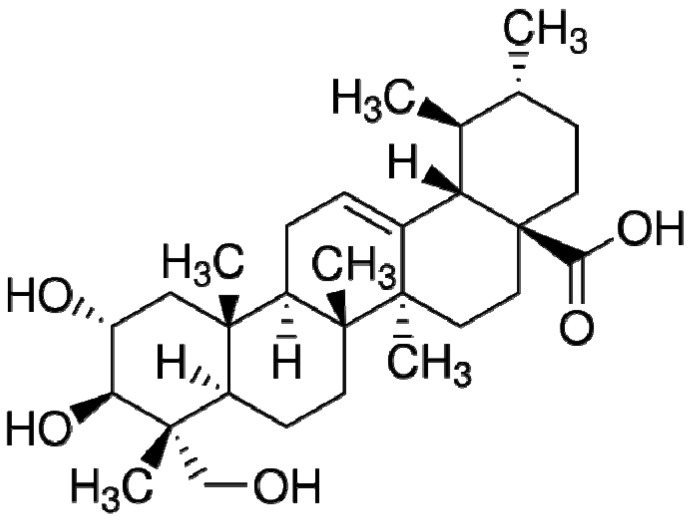
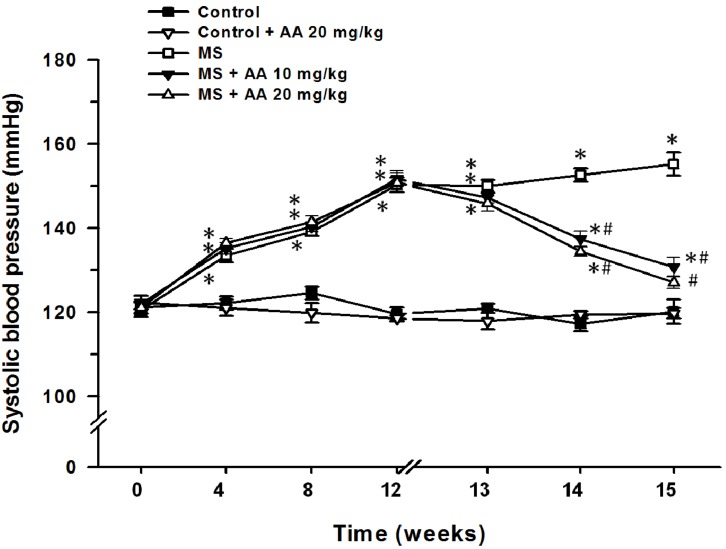
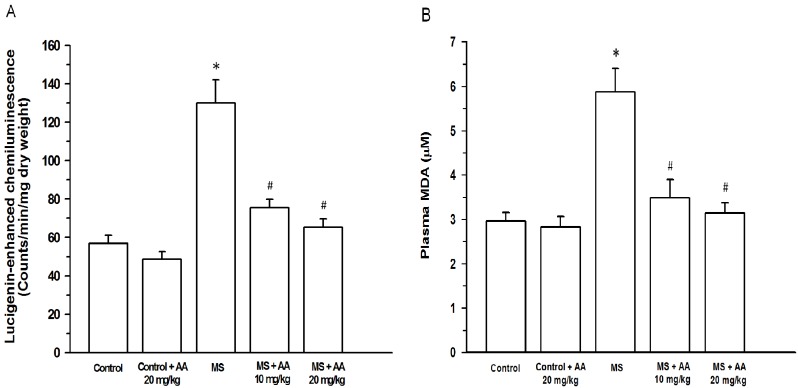
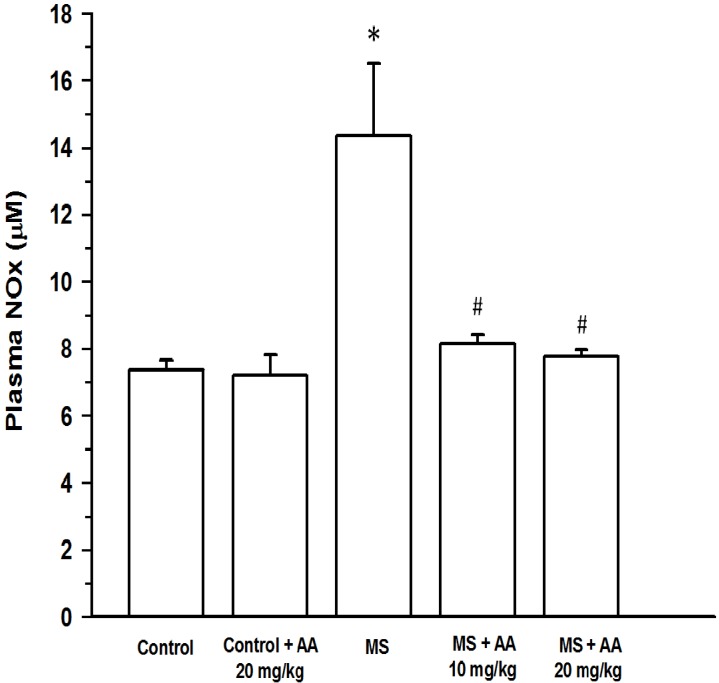
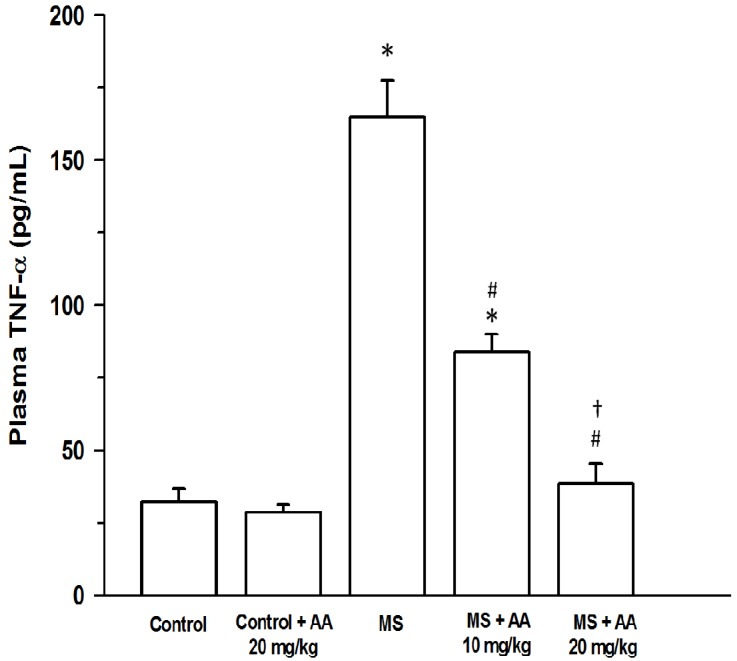
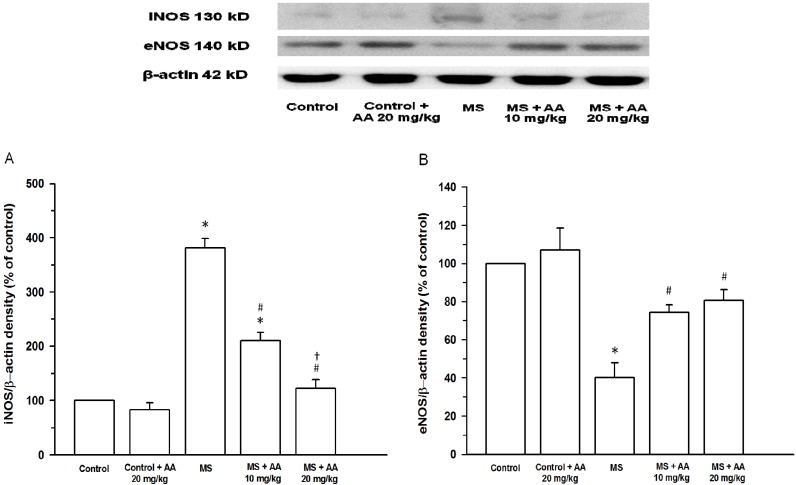
Asiatic acid is a triterpenoid isolated from Centella asiatica. The present study aimed to investigate whether asiatic acid could lessen the metabolic, cardiovascular complications in rats with metabolic syndrome (MS) induced by a high-carbohydrate, high-fat (HCHF) diet. Male Sprague-Dawley rats were fed with HCHF diet with 15% fructose in drinking water for 12 weeks to induce MS. MS rats were treated with asiatic acid (10 or 20 mg/kg/day) or vehicle for a further three weeks. MS rats had an impairment of oral glucose tolerance, increases in fasting blood glucose, serum insulin, total cholesterol, triglycerides, mean arterial blood pressure, heart rate, and hindlimb vascular resistance; these were related to the augmentation of vascular superoxide anion production, plasma malondialdehyde and tumor necrosis factor-alpha (TNF-α) levels (p<0.05). Plasma nitrate and nitrite (NOx) were markedly high with upregulation of inducible nitric oxide synthase (iNOS) expression, but dowregulation of endothelial nitric oxide synthase (eNOS) expression (p<0.05). Asiatic acid significantly improved insulin sensitivity, lipid profiles, hemodynamic parameters, oxidative stress markers, plasma TNF-α, NOx, and recovered abnormality of eNOS/iNOS expressions in MS rats (p<0.05). In conclusion, asiatic acid improved metabolic, hemodynamic abnormalities in MS rats that could be associated with its antioxidant, anti-inflammatory effects and recovering regulation of eNOS/iNOS expression.
Overview
The claims and statistics of this paper haven’t been checked yet.
Run the check — free, no account needed. It reads the open-access text and checks the sources it cites.
Integrity signals
Registry
Cites
Statistics
Figures
Verification
Claims the paper makes
The claims and statistics of this paper haven’t been checked yet.
Run the check — free, no account needed. It reads the open-access text and checks the sources it cites.
Claims other papers make about this one
Each is checked against this paper’s own text: does it say what the citing paper says it does?
The source backs part of the claim, not all of it — or backs it for a different population, condition or comparison.
In the citing paper
“C. asiatica has shown an anti-inflammatory effect observed by the reduction in Interleukin-1β (IL-1β), Interleukin-6 (IL-6) and Tumour Necrosis Factor α (TNFα) [33,36,37], as well as prostaglandin E2 (PGE2) [36,38], and cyclooxygenase-2 (COX-2) [39].”
From A systematic review of the effect of Centella asiatica on wound healing (2022) · cites this paper as [37]
Experimental — accuracy not yet measuredThe source backs part of the claim, not all of it — or backs it for a different population, condition or comparison.
In the citing paper
“This might result from the anti-inflammatory effect caused by C. asiatica due to the reduction in IL-1β, IL-6 and TNFα [33,36,37], as well as prostaglandin E2 (PGE2) [36,38] and cyclooxygenase-2 (COX-2) [39].”
From A systematic review of the effect of Centella asiatica on wound healing (2022) · cites this paper as [37]
Experimental — accuracy not yet measured
Self-check
Percentages, sums and reported differences re-computed from the paper’s own numbers.
The self-check needs the paper’s full text.
Citations
Cites
2 retracted
Antinociceptive Activities and the Mechanisms of Anti‐Inflammation of Asiatic Acid in Mice
Huang, S., Chiu, C., Chen, H., Hou, W., Sheu, M., Lin, Y.-C., Shie, P.-H., & Huang, G. (2011) · Evidence-based Complementary and Alternative Medicine · doi:10.1155/2011/895857 · Cited by 150
RetractedWei, J., Huang, Q., Huang, R., Chen, Y., Lv, S., Wei, L., Liang, C., Liang, S., Zhuo, L., & Lin, X. (2013) · Biological and Pharmaceutical Bulletin · doi:10.1248/bpb.b13-00634 · Cited by 40
RetractedMatthews, D. R., Hosker, J. P., Rudenski, A. S., Naylor, B. A., Treacher, D. F., & Turner, R. C. (1985) · Diabetologia · doi:10.1007/bf00280883 · Cited by 31,502
Xu, H., Barnes, G. T., Yang, Q., Tan, G., Yang, D., Chou, C. J., Sole, J., Nichols, A., Ross, J. S., Tartaglia, L. A., et al. (2003) · Journal of Clinical Investigation · doi:10.1172/jci200319451 · Cited by 6,760
Global and societal implications of the diabetes epidemic
Zimmet, P., Alberti, K. G. M. M., & Shaw, J. (2001) · Nature · doi:10.1038/414782a · Cited by 5,883
Increased oxidative stress in obesity and its impact on metabolic syndrome
Furukawa, S., Fujita, T., Shimabukuro, M., Iwaki, M., Yamada, Y., Nakajima, Y., Nakayama, O., Makishima, M., Matsuda, M., & Shimomura, I. (2004) · Journal of Clinical Investigation · doi:10.1172/jci21625 · Cited by 5,508
Cardiovascular Morbidity and Mortality Associated With the Metabolic Syndrome
Isomaa, B., Almgren, P., Tuomi, T., Forsén, B., Lahti, K., Nissén, M., Taskinen, M.-R., & Groop, L. (2001) · Diabetes Care · doi:10.2337/diacare.24.4.683 · Cited by 4,760
TNF-mediated inflammatory disease
Bradley, Jr. (2008) · The Journal of Pathology · doi:10.1002/path.2287 · Cited by 2,094
Fructose-induced insulin resistance and hypertension in rats.
Hwang, I. S., Ho, H., Hoffman, B. B., & Reaven, G. M. (1987) · Hypertension · doi:10.1161/01.hyp.10.5.512 · Cited by 885
Inducible nitric oxide synthase in human diseases
Kröncke, K.-D., Fehsel, K., & Kolb‐Bachofen, V. (1998) · Clinical & Experimental Immunology · doi:10.1046/j.1365-2249.1998.00648.x · Cited by 585
Cited by
Sorted by citations
Meeran, M. F. N., Goyal, S. N., Suchal, K., Sharma, C., Patil, C. R., & Ojha, S. K. (2018) · Frontiers in Pharmacology · doi:10.3389/fphar.2018.00892 · Cited by 201
Sodium—Glucose cotransporter inhibitors and oxidative stress: An update
Yaribeygi, H., Atkin, S. L., Butler, A. E., & Sahebkar, A. (2019) · Journal of Cellular Physiology · doi:10.1002/jcp.26760 · Cited by 167
Netala, V. R., Teertam, S. K., Li, H., & Zhang, Z. (2024) · Cells · doi:10.3390/cells13171471 · Cited by 181
A systematic review of the effect of Centella asiatica on wound healing
Arribas-López, E., Zand, N., Ojo, O., Snowden, M. J., & Kochhar, T. (2022) · International Journal of Environmental Research and Public Health · doi:10.3390/ijerph19063266 · Cited by 143
“asiatica has shown an anti-inflammatory effect observed by the reduction in Interleukin1β (IL-1β), Interleukin-6 (IL-6) and Tumour Necrosis Factor α (TNFα) [33,36,37], as well as prostaglandin E2 (PGE2) [36,38], and cyclooxygenase-2 (COX-2) [39].”
BackgroundInfluentialPentacyclic triterpenes: New tools to fight metabolic syndrome
Sharma, H., Kumar, P., Deshmukh, R. R., Bishayee, A., & Kumar, S. (2018) · Phytomedicine · doi:10.1016/j.phymed.2018.09.011 · Cited by 118
Metadata
- Authors
- Pakdeechote, P., Bunbupha, S., Kukongviriyapan, U., Prachaney, P., Khrisanapant, W., & Kukongviriyapan, V.
- Affiliations
- Khon Kaen University (TH)
- Corresponding author
- Pakdeechote, Poungrat
- ORCID
- Venue
- Nutrients
- Publisher
- MDPI AG
- Published
- 2014-01-16
- Volume
- 6
- Issue
- 1
- Pages
- 355-370
- ISSN
- 2072-6643 (ISSN-L)
- PMC
- PMC3916866
- OpenAlex
- W2071030426
- Cited by
- 109
- References
- 44
- Citations by year
- 2026: 4 · 2025: 5 · 2024: 7 · 2023: 11 · 2022: 6 · 2021: 15 · 2020: 4 · 2019: 11 · 2018: 16 · 2017: 7 · 2016: 12 · 2015: 6 · 2014: 5
- FWCI
- 8.04
- Type
- journal article
- Language
- en
- Open access
- gold
- doi.org
- Licence
- Locations
- Nutrients (publishedVersion, cc-by)
- Europe PMC (PubMed Central) (publishedVersion, cc-by)
- PubMed Central (publishedVersion, cc-by)
- PubMed (publishedVersion)
- DOAJ (DOAJ: Directory of Open Access Journals) (submittedVersion, cc-by-sa)
- Topics
- Health Sciences › Medicine › Endocrinology, Diabetes and Metabolism › Natural Antidiabetic Agents Studies
- Health Sciences › Medicine › Physiology (medical) › Nitric Oxide and Endothelin Effects
- Health Sciences › Medicine › Complementary and alternative medicine › Medicinal Plants and Neuroprotection
- Keywords
- asiatic acid, Centella asiatica, triterpenoids, metabolic syndrome, high-fat high-carbohydrate diet, fructose-induced obesity, endothelial nitric oxide synthase, inducible nitric oxide synthase, nitric oxide, oxidative stress, inflammation, TNF-α, malondialdehyde, insulin resistance, glucose tolerance, hemodynamics, lipid profile, cardiovascular complications
- MeSH terms
- Animals, Anti-Inflammatory Agents, Antioxidants, Blood Glucose, Diet, Glucose Tolerance Test, Hemodynamics, Inflammation, Insulin, Insulin Resistance, Male, Malondialdehyde, Nitrates, Nitrites, Triglycerides, Tumor Necrosis Factor-alpha, Gene Expression, Rats, Sprague-Dawley, Oxidative Stress, Metabolic Syndrome, Rats, Nitric Oxide Synthase Type II, Nitric Oxide Synthase Type III, Pentacyclic Triterpenes, Diet, High-Fat
About these checks
Registry, retraction, Cites and statistics results are computed, not judged, with one exception: a printed reference that no index lists is read once by a model before it counts as a citation error. Claims are extracted by a model and kept only when their quote appears verbatim in the text; each cited source is then checked, with a model’s help, for whether it says what the claim relies on. Those verdicts can be wrong — read the claim’s quote and the cited source before relying on one.
Statistics and arithmetic are recomputed, not judged.
Confidence bands are shown only for fields calibrated on our annotated test set. None is calibrated yet, so no band is shown.
What counts as a claim ›How we measure confidence ›How we check this ›
Are you an author, or do you see a problem with this page? Request a review
