

The DOI matches its Crossref record; 271 of the 271 references it cites were found in a registry or an index.
Three-Dimensional Spheroids as In Vitro Preclinical Models for Cancer Research
Open accessAbstract
Most cancer biologists still rely on conventional two-dimensional (2D) monolayer culture techniques to test in vitro anti-tumor drugs prior to in vivo testing. However, the vast majority of promising preclinical drugs have no or weak efficacy in real patients with tumors, thereby delaying the discovery of successful therapeutics. This is because 2D culture lacks cell–cell contacts and natural tumor microenvironment, important in tumor signaling and drug response, thereby resulting in a reduced malignant phenotype compared to the real tumor. In this sense, three-dimensional (3D) cultures of cancer cells that better recapitulate in vivo cell environments emerged as scientifically accurate and low cost cancer models for preclinical screening and testing of new drug candidates before moving to expensive and time-consuming animal models. Here, we provide a comprehensive overview of 3D tumor systems and highlight the strategies for spheroid construction and evaluation tools of targeted therapies, focusing on their applicability in cancer research. Examples of the applicability of 3D culture for the evaluation of the therapeutic efficacy of nanomedicines are discussed.
Overview
The claims and statistics of this paper haven’t been checked yet.
Run the check — free, no account needed. It reads the open-access text and checks the sources it cites.
Integrity signals
Registry
Cites
Statistics
Figures
Verification
Claims the paper makes
The claims and statistics of this paper haven’t been checked yet.
Run the check — free, no account needed. It reads the open-access text and checks the sources it cites.
Claims other papers make about this one
Each is checked against this paper’s own text: does it say what the citing paper says it does?
The cited source says what the claim attributes to it.
In the citing paper
“Despite their widespread use, conventional two-dimensional monolayer cultures fail to reproduce these complexities, contributing to the poor translational predictability of many preclinical candidates.”
From Modeling Tumor Microenvironment Complexity In Vitro: Spheroids as Physiologically Relevant Tumor Models and Strategies for Their Analysis (2025) · cites this paper as [6]
Self-check
Percentages, sums and reported differences re-computed from the paper’s own numbers.
The self-check needs the paper’s full text.
Citations
Cites
1 retracted
Jin, H., Gui, R., Sun, J., et al. (2017) · Talanta · doi:10.1016/j.talanta.2017.08.043 · Cited by 24
RetractedHallmarks of Cancer: The Next Generation
Hanahan, D., & Weinberg, R. A. (2011) · Cell · doi:10.1016/j.cell.2011.02.013 · Cited by 66,590
Microenvironmental regulation of tumor progression and metastasis
Quail, D. F., & Joyce, J. A. (2013) · Nature Medicine · doi:10.1038/nm.3394 · Cited by 7,994
A framework for advancing our understanding of cancer-associated fibroblasts
Sahai, E., Astsaturov, I., Cukierman, E., DeNardo, D. G., Egeblad, M., Evans, R. M., Fearon, D., Greten, F. R., Hingorani, S. R., Hunter, T., et al. (2020) · Nature Reviews Cancer · doi:10.1038/s41568-019-0238-1 · Cited by 3,863 · cited 2×
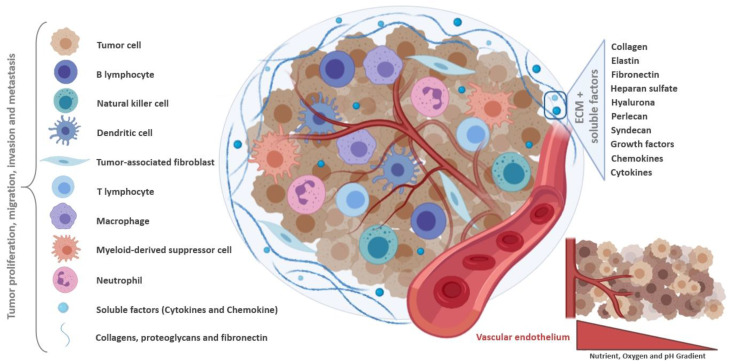
“In this context, CAFs contribute to tumor cell invasion, as well as to changes in tumor growth and immune microenvironment, through ECM remodeling and production of soluble factors [21,22].”
BackgroundThe Tumor Microenvironment Innately Modulates Cancer Progression
Hinshaw, D. C., & Shevde, L. A. (2019) · Cancer Research · doi:10.1158/0008-5472.can-18-3962 · Cited by 3,270
Regulation of transport pathways in tumor vessels: Role of tumor type and microenvironment
Hobbs, S. K., Monsky, W. L., Yuan, F., Roberts, W. G., Griffith, L., Torchilin, V. P., & Jain, R. K. (1998) · Proceedings of the National Academy of Sciences · doi:10.1073/pnas.95.8.4607 · Cited by 2,438
Optical Sectioning Deep Inside Live Embryos by Selective Plane Illumination Microscopy
Huisken, J., Swoger, J., Bene, F. D., Wittbrodt, J., & Stelzer, E. H. K. (2004) · Science · doi:10.1126/science.1100035 · Cited by 2,370
Roles of the immune system in cancer: From tumor initiation to metastatic progression
Gonzalez, H., Hagerling, C., & Werb, Z. (2018) · Genes & Development · doi:10.1101/gad.314617.118 · Cited by 2,111
Role of hypoxia in cancer therapy by regulating the tumor microenvironment
Jing, X., Yang, F., Shao, C., Wei, K., Xie, M., Shen, H., & Shu, Y. (2019) · Molecular Cancer · doi:10.1186/s12943-019-1089-9 · Cited by 2,054
Cancer immunoediting and resistance to T cell-based immunotherapy
O’Donnell, J. S., Teng, M. W. L., & Smyth, M. J. (2018) · Nature Reviews Clinical Oncology · doi:10.1038/s41571-018-0142-8 · Cited by 1,826
Cited by
Sorted by citations
Shah, S., & D’Souza, G. G. M. (2025) · Cells · doi:10.3390/cells14100732 · Cited by 83
“While these models are convenient and scalable, they fail to capture essential characteristics such as spatial cell–cell interactions, oxygen and nutrient gradients, and ECM-mediated diffusion resistance—factors that critically influence drug behavior in solid tumors [6,7].”
Metadata
- Authors
- Pinto, B., Henriques, A. C., Silva, P. M. A., & Bousbaa, H.
- Affiliations
- Cooperativa de Ensino Superior Politécnico e Universitário (PT)
- Universidade do Porto (PT)
- Corresponding author
- Bousbaa, Hassan
- Venue
- Pharmaceutics
- Publisher
- MDPI AG
- Published
- 2020-12-06
- Volume
- 12
- Issue
- 12
- Pages
- 1186
- ISSN
- 1999-4923 (ISSN-L)
- PMC
- PMC7762220
- OpenAlex
- W3111112091
- Cited by
- 440
- References
- 271
- Citations by year
- 2026: 64 · 2025: 97 · 2024: 103 · 2023: 89 · 2022: 56 · 2021: 31
- FWCI
- 4.72
- Type
- journal article
- Language
- en
- Open access
- gold
- doi.org
- Licence
- Locations
- Pharmaceutics (publishedVersion, cc-by)
- PubMed Central (publishedVersion, cc-by)
- PubMed (publishedVersion)
- DOAJ (DOAJ: Directory of Open Access Journals) (submittedVersion, cc-by-sa)
- Funders
- Cooperativa de Ensino Superior Politécnico e Universitário (IMPLDEBRIS-PL-3RL-IINFACTS-2019, BD/CBAS/CESPU/01/2020)
- Fundação para a Ciência e a Tecnologia (SFRH/BD/116167/2016)
- Topics
- Health Sciences › Medicine › Oncology › Cancer Cells and Metastasis
- Physical Sciences › Engineering › Biomedical Engineering › 3D Printing in Biomedical Research
- Physical Sciences › Mathematics › Modeling and Simulation › Mathematical Biology Tumor Growth
- Keywords
- multicellular spheroids, 3D tumor models, tumor cell culture, tumor microenvironment, preclinical drug screening, targeted therapy
About these checks
Registry, retraction, Cites and statistics results are computed, not judged, with one exception: a printed reference that no index lists is read once by a model before it counts as a citation error. Claims are extracted by a model and kept only when their quote appears verbatim in the text; each cited source is then checked, with a model’s help, for whether it says what the claim relies on. Those verdicts can be wrong — read the claim’s quote and the cited source before relying on one.
Statistics and arithmetic are recomputed, not judged.
Confidence bands are shown only for fields calibrated on our annotated test set. None is calibrated yet, so no band is shown.
What counts as a claim ›How we measure confidence ›How we check this ›
Are you an author, or do you see a problem with this page? Request a review
