

The DOI matches its Crossref record; 197 of the 198 references it cites were found in a registry or an index.
Metal and Metalloid Toxicity in Plants: An Overview on Molecular Aspects
Open accessAbstract
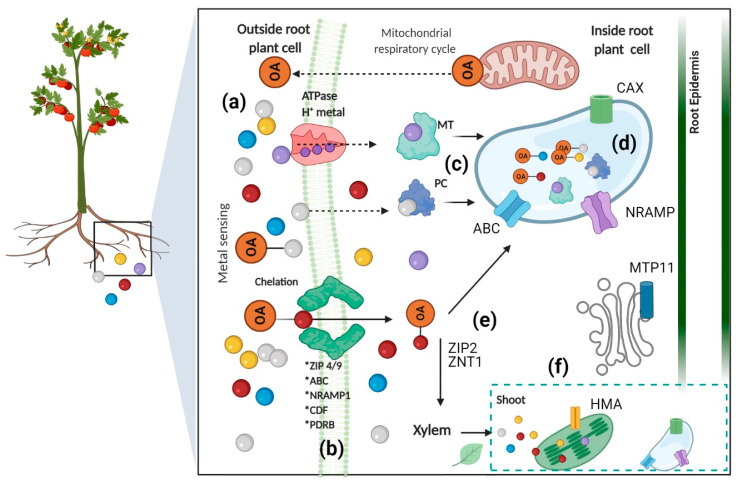
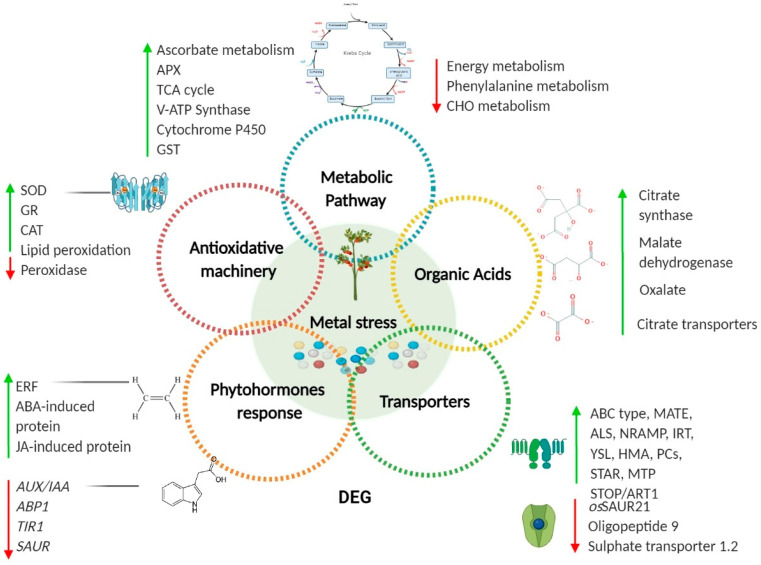
Worldwide, the effects of metal and metalloid toxicity are increasing, mainly due to anthropogenic causes. Soil contamination ranks among the most important factors, since it affects crop yield, and the metals/metalloids can enter the food chain and undergo biomagnification, having concomitant effects on human health and alterations to the environment. Plants have developed complex mechanisms to overcome these biotic and abiotic stresses during evolution. Metals and metalloids exert several effects on plants generated by elements such as Zn, Cu, Al, Pb, Cd, and As, among others. The main strategies involve hyperaccumulation, tolerance, exclusion, and chelation with organic molecules. Recent studies in the omics era have increased knowledge on the plant genome and transcriptome plasticity to defend against these stimuli. The aim of the present review is to summarize relevant findings on the mechanisms by which plants take up, accumulate, transport, tolerate, and respond to this metal/metalloid stress. We also address some of the potential applications of biotechnology to improve plant tolerance or increase accumulation.
Overview
The claims and statistics of this paper haven’t been checked yet.
Run the check — free, no account needed. It reads the open-access text and checks the sources it cites.
Integrity signals
Registry
Cites
Statistics
Figures
Verification
Claims the paper makes
The claims and statistics of this paper haven’t been checked yet.
Run the check — free, no account needed. It reads the open-access text and checks the sources it cites.
Claims other papers make about this one
Each is checked against this paper’s own text: does it say what the citing paper says it does?
The source backs part of the claim, not all of it — or backs it for a different population, condition or comparison.
In the citing paper
“However, when present in concentrations exceeding the threshold level (>10,000 mg/kg), zinc becomes toxic, leading to impaired growth, disrupted physiological functions, and even plant death.”
From Plant hyperaccumulators: a state-of-the-art review on mechanism of heavy metal transport and sequestration (2025) · cites this paper as Angulo-Bejarano et al., 2021
Experimental — accuracy not yet measuredThe cited source says what the claim attributes to it.
In the citing paper
“In addition, these plant species have evolved to possess adaptations for hypertolerance and detoxification of metal and metalloids (Angulo-Bejarano et al., 2021; Peng et al., 2021; Rai et al., 2021).”
From Plant hyperaccumulators: a state-of-the-art review on mechanism of heavy metal transport and sequestration (2025) · cites this paper as Angulo-Bejarano et al., 2021
Self-check
Percentages, sums and reported differences re-computed from the paper’s own numbers.
The self-check needs the paper’s full text.
Citations
Cites
Phytoremediation of heavy metals—concepts and applications
Ali, H., Khan, E., & Sajad, M. A. (2013) · Chemosphere · doi:10.1016/j.chemosphere.2013.01.075 · Cited by 3,961
Heavy metal hyperaccumulating plants: how and why do they do it? And what makes them so interesting
Rascio, N., & Navari-Izzo, F. (2011) · Plant Science · doi:10.1016/j.plantsci.2010.08.016 · Cited by 2,012
Physiological functions of mineral micronutrients (Cu, Zn, Mn, Fe, Ni, Mo, B, Cl)
Hänsch, R., & Mendel, R. R. (2009) · Current Opinion in Plant Biology · doi:10.1016/j.pbi.2009.05.006 · Cited by 1,785
Yadav, S. K. (2009) · South African Journal of Botany · doi:10.1016/j.sajb.2009.10.007 · Cited by 1,611
Rahman, Z., & Singh, V. P. (2019) · Environmental Monitoring and Assessment · doi:10.1007/s10661-019-7528-7 · Cited by 1,535
The next generation of CRISPR–Cas technologies and applications
Pickar-Oliver, A., & Gersbach, C. A. (2019) · Nature Reviews Molecular Cell Biology · doi:10.1038/s41580-019-0131-5 · Cited by 1,459
Global extent, development and economic impact of acid soils
von Uexküll, H. R., & Mutert, E. (1995) · Plant and Soil · doi:10.1007/bf00009558 · Cited by 1,372
Plant abiotic stress response and nutrient use efficiency
Gong, Z., Xiong, L., Shi, H., Yang, S., Herrera‐Estrella, L., Xu, G., Chao, D., Li, J., Wang, P.-Y., Qin, F., et al. (2020) · Science China Life Sciences · doi:10.1007/s11427-020-1683-x · Cited by 1,356
Heavy Metal Tolerance in Plants: Role of Transcriptomics, Proteomics, Metabolomics, and Ionomics
Singh, S., Parihar, P., Singh, R., Singh, V. P., & Prasad, S. M. (2016) · Frontiers in Plant Science · doi:10.3389/fpls.2015.01143 · Cited by 1,354
Palansooriya, K. N., Shaheen, S. M., Chen, S. S., Tsang, D. C. W., Hashimoto, Y., Hou, D., Bolan, N. S., Rinklebe, J., & Ok, Y. S. (2020) · Environment International · doi:10.1016/j.envint.2019.105046 · Cited by 1,272
Research works printed but not linked: 4
- Ensley, B.D. (2000). Metal-Accumulating Plants. Phytoremediation of Toxic Metals: Using Plants to Clean Up the Environment, John Wiley & Son.
- 2018, Zinc Metalloenzymes in Plants, Interciencia, 43, 242
- Marschner, H. (2002). Marschner’s Mineral Nutrition of Higher Plants, Elsevier BV.
- Yadav, 2005, Methylglyoxal Detoxification by Glyoxalase System: A Survival Strategy during Environmental Stresses, Physiol. Mol. Biol. Plants, 11, 1
Cited by
Sorted by citations
Plant stress response and adaptation via anthocyanins: A review
Li, Z., & Ahammed, G. J. (2023) · Plant Stress · doi:10.1016/j.stress.2023.100230 · Cited by 228
Analysis of Heavy Metal Impacts on Cereal Crop Growth and Development in Contaminated Soils
Vasilachi, I. C., Stoleru, V., & Gavrilescu, M. (2023) · Agriculture · doi:10.3390/agriculture13101983 · Cited by 210
Phytochelatins: Sulfur-Containing Metal(loid)-Chelating Ligands in Plants
Seregin, I. V., & Kozhevnikova, A. D. (2023) · International Journal of Molecular Sciences · doi:10.3390/ijms24032430 · Cited by 165
Omics approaches for understanding heavy metal responses and tolerance in plants
Jamla, M., Khare, T., Joshi, S., Patil, S., Penna, S., & Kumar, V. (2021) · Current Plant Biology · doi:10.1016/j.cpb.2021.100213 · Cited by 152
Mechanisms of Heavy Metal Tolerance in Bacteria: A Review
Nnaji, N. D., Anyanwu, C. U., Miri, T., & Onyeaka, H. N. (2024) · Sustainability · doi:10.3390/su162411124 · Cited by 157
Metadata
- Authors
- Angulo-Bejarano, P. I., Puente-Rivera, J., & Cruz-Ortega, R.
- Affiliations
- Laboratorio de Alelopatía, Departamento de Ecología Funcional, Instituto de Ecología, Universidad Nacional Autónoma de México, UNAM, 275, Ciudad Universitaria D.F. Circuito Exterior s/n Anexo al Jardín Botánico Exterior, México City 04510, Mexico
- Instituto de Ecología (MX)
- Venue
- Plants
- Publisher
- MDPI AG
- Published
- 2021-03-27
- Volume
- 10
- Issue
- 4
- Pages
- 635
- ISSN
- 2223-7747 (ISSN-L)
- PMC
- PMC8066251
- OpenAlex
- W3151778362
- Cited by
- 357
- References
- 198
- Citations by year
- 2026: 48 · 2025: 86 · 2024: 102 · 2023: 60 · 2022: 51 · 2021: 10
- FWCI
- 5.45
- Type
- journal article
- Language
- en
- Open access
- gold
- doi.org
- Licence
- Locations
- Plants (publishedVersion, cc-by)
- PubMed Central (publishedVersion, cc-by)
- PubMed (publishedVersion)
- DOAJ (DOAJ: Directory of Open Access Journals) (submittedVersion, cc-by-sa)
- Funders
- Dirección General de Asuntos del Personal Académico, Universidad Nacional Autónoma de México (IN205912)
- Topics
- Life Sciences › Agricultural and Biological Sciences › Plant Science › Plant Stress Responses and Tolerance
- Physical Sciences › Environmental Science › Pollution › Heavy metals in environment
- Life Sciences › Agricultural and Biological Sciences › Plant Science › Plant Micronutrient Interactions and Effects
- Keywords
- metal toxicity, metalloid toxicity, plant stress tolerance, hyperaccumulation, metal exclusion, metal chelation, metal transport, soil contamination, cadmium, lead, arsenic, zinc, copper, aluminum, biomagnification, plant biotechnology
About these checks
Registry, retraction, Cites and statistics results are computed, not judged, with one exception: a printed reference that no index lists is read once by a model before it counts as a citation error. Claims are extracted by a model and kept only when their quote appears verbatim in the text; each cited source is then checked, with a model’s help, for whether it says what the claim relies on. Those verdicts can be wrong — read the claim’s quote and the cited source before relying on one.
Statistics and arithmetic are recomputed, not judged.
Confidence bands are shown only for fields calibrated on our annotated test set. None is calibrated yet, so no band is shown.
What counts as a claim ›How we measure confidence ›How we check this ›
Are you an author, or do you see a problem with this page? Request a review
