

Comparison between the Biological Active Compounds in Plants with Adaptogenic Properties (Rhaponticum carthamoides, Lepidium meyenii, Eleutherococcus senticosus and Panax ginseng)
Open accessThe DOI matches its Crossref record; 245 of the 247 references it cites were found in a registry or an index.
Abstract
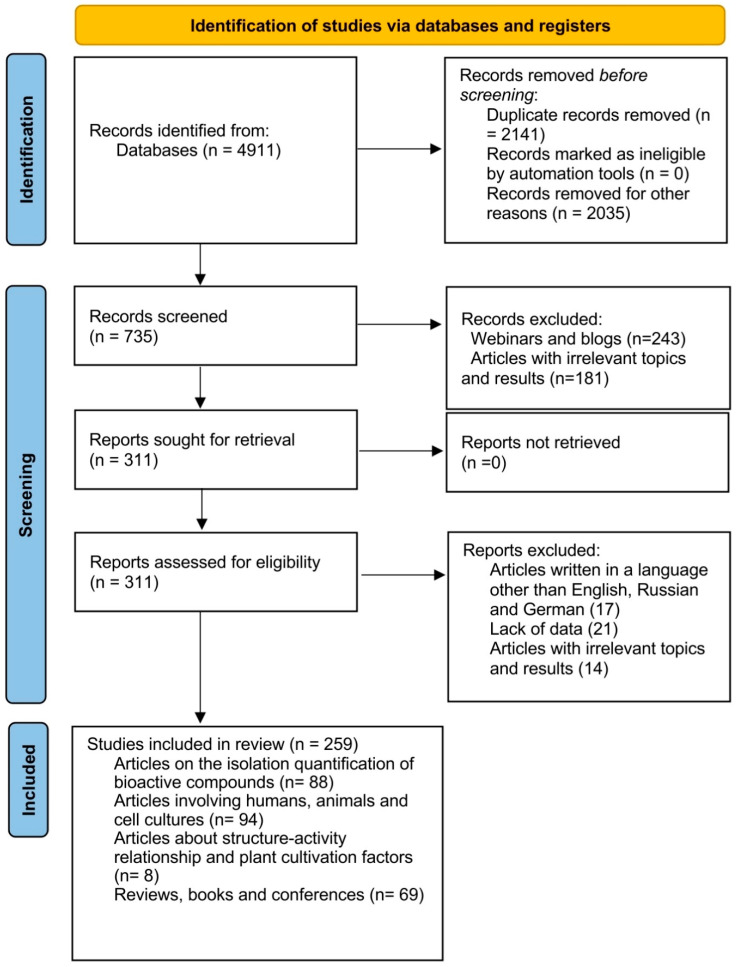
Background: In the 1960s, research into plant adaptogens began. Plants with adaptogenic properties have rich phytochemical compositions and have been used by humanity since ancient times. However, it is not still clear whether the adaptogenic properties are because of specific compounds or because of the whole plant extracts. The aim of this review is to compare the bioactive compounds in the different parts of these plants. Methods: The search strategy was based on studies related to the isolation of bioactive compounds from Rhaponticum carthamoides, Lepidium meyenii, Eleutherococcus senticosus, and Panax ginseng. The Preferred Reporting Items for Systematic Reviews and Meta-Analyses (PRISMA) guidelines were followed. Results: This review includes data from 259 articles. The phytochemicals isolated from Rhaponticum carthamoides, Lepidium meyenii, Eleutherococcus senticosus, and Panax ginseng were described and classified in several categories. Conclusions: Plant species have always played an important role in drug discovery because their effectiveness is based on the hundreds of years of experience with folk medicine in different nations. In our view, there is great potential in the near future for some of the phytochemicals found in these plants species to become pharmaceutical agents.
Overview
The claims and statistics of this paper haven’t been checked yet.
Free: it reads the open-access text and checks the first 5 claims that cite a source we can check. Create a free account to check every claim.
Integrity signals
Registry
Cites
Statistics
Figures
Verification
Claims the paper makes
The claims and statistics of this paper haven’t been checked yet.
Free: it reads the open-access text and checks the first 5 claims that cite a source we can check. Create a free account to check every claim.
Claims other papers make about this one
Each is checked against this paper’s own text: does it say what the citing paper says it does?
The source backs part of the claim, not all of it — or backs it for a different population, condition or comparison.
In the citing paper
“It is primarily derived from herbal sources ( Spinacia oleracea , Cyanotis arachnoidea , Leuzea carthamoides , Rhaponticum carthamoides ) [3,4].”
From Quantitation of Ecdysterone and Targeted Analysis of WADA-Prohibited Anabolic Androgen Steroids, Hormones, and Metabolic Modulators in Ecdysterone-Containing Dietary Supplements (2023) · cites this paper as [4]
Experimental — accuracy not yet measuredThe source backs part of the claim, not all of it — or backs it for a different population, condition or comparison.
In the citing paper
“Previously, a wide range of chemical classes was found in R. carthamoides roots, with steroids, particularly ecdysteroids, flavonoids, lignans, and phenolic compounds (Figure 2) [13,106,107,108,109,110,111,112,113].”
From Ecdysterone and Turkesterone—Compounds with Prominent Potential in Sport and Healthy Nutrition (2024) · cites this paper as [107]
Experimental — accuracy not yet measuredThe source backs part of the claim, not all of it — or backs it for a different population, condition or comparison.
In the citing paper
“The concentration of 20HE (β-ecdysone, ecdysterone, and polypodine A) varies between 0.049% and 1.74% [107,112,119].”
From Ecdysterone and Turkesterone—Compounds with Prominent Potential in Sport and Healthy Nutrition (2024) · cites this paper as [107]
Experimental — accuracy not yet measuredThe cited source says what the claim attributes to it.
In the citing paper
“Moreover, R. carthamoides roots are a source of essential oil, which is characterized by antimicrobial, antioxidant, and anti-inflammatory effects [13,107,114,115,116,117].”
From Ecdysterone and Turkesterone—Compounds with Prominent Potential in Sport and Healthy Nutrition (2024) · cites this paper as [107]
Self-check
Percentages, sums and reported differences re-computed from the paper’s own numbers.
The self-check needs the paper’s full text.
Citations
Cites
1 retracted
Skała, E., Rijo, P., Garcia, C., Sitarek, P., Kalemba, D., Toma, M., Szemraj, J., Pytel, D., Wysokińska, H., & Śliwiński, T. (2016) · Oxidative Medicine and Cellular Longevity · doi:10.1155/2016/8505384 · Cited by 27 · cited 6×
“13-Norcypera-1(5),11(12)-diene Roots [40]”
BackgroundInfluentialRetractedThe PRISMA 2020 statement: An updated guideline for reporting systematic reviews
Page, M. J., McKenzie, J. E., Bossuyt, P. M., Boutron, I., Hoffmann, T. C., Mulrow, C. D., Shamseer, L., Tetzlaff, J. M., Akl, E. A., Brennan, S. E., et al. (2021) · BMJ · doi:10.1136/bmj.n71 · Cited by 108,283
Panche, A. N., Diwan, A. D., & Chandra, S. R. (2016) · Journal of Nutritional Science · doi:10.1017/jns.2016.41 · Cited by 5,298 · cited 1×
“Flavonoids are substances with a phenolic structure, and over 8000 flavonoids are known [80,81].”
BackgroundPietta, P.-G. (2000) · Journal of Natural Products · doi:10.1021/np9904509 · Cited by 4,876 · cited 2×
“Flavonoids are substances with a phenolic structure, and over 8000 flavonoids are known [80,81].”
BackgroundSimple Coumarins and Analogues in Medicinal Chemistry: Occurrence, Synthesis and Biological Activity
Borges, F., Roleira, F., Milhazes, N., Santana, L., & Uriarte, E. (2005) · Current Medicinal Chemistry · doi:10.2174/0929867053507315 · Cited by 994 · cited 1×
“They are secondary metabolites in plants [125].”
Polysaccharides in colon-specific drug delivery
Sinha, V. R., & Kumria, R. (2001) · International Journal of Pharmaceutics · doi:10.1016/s0378-5173(01)00720-7 · Cited by 872 · cited 2×
“They consist of monosaccharides linked with glycoside bonds [113,120,121].”
BackgroundMolecular activities, biosynthesis and evolution of triterpenoid saponins
Augustin, J. M., Kuzina, V., Andersen, S. B., & Bak, S. (2011) · Phytochemistry · doi:10.1016/j.phytochem.2011.01.015 · Cited by 799
P HYTOSTEROLS IN H UMAN N UTRITION
Ostlund, R. E. (2002) · Annual Review of Nutrition · doi:10.1146/annurev.nutr.22.020702.075220 · Cited by 632 · cited 1×
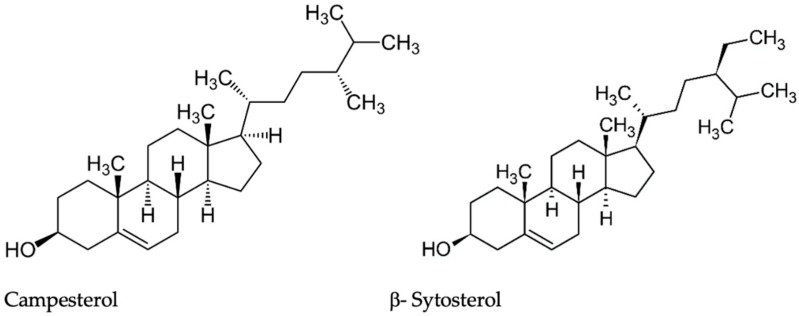
“Phytosterols are cholesterol-like compounds isolated from plants [118].”
BackgroundCHOI, K.-T. (2008) · Acta Pharmacologica Sinica · doi:10.1111/j.1745-7254.2008.00869.x · Cited by 630
New Substances of Plant Origin Which Increase Nonspecific Resistance
Brekhman, I. I., & Dardymov, I. V. (1969) · Annual Review of Pharmacology · doi:10.1146/annurev.pa.09.040169.002223 · Cited by 595 · cited 1×
“from Crassulaceae family and Schisandra chinensis from Schisandraceae family are plants with adaptogenic properties [4].”
Background
Research works printed but not linked: 9
- Gupta G. Rana A.C. Withania Somnifera (Ashwagandha): A Review Pharmacogn. Rev. 2007 1 129 136
- Timofeev N.P. Chukhchin D.G. Accumulation and Composition of Extractive Substances from Above-Ground and Underground Bodies of Levzei safloroid Proceedings of the New Achievements in Chemistry and Chemical Technology of Vegetable Raw Materials: Materials of the IV All-Russian Conference. April 21–23, 2009 Bazarnova N.G. Markin V.I. Altajskogo Gos. Univ. Burnau, Russia 2009 145 147 978-5-7904-0903-5
- Timofeev N.P. Volodin V.V. Frolov Y.M. Distribution of 20-hydroxyecdysone in the structure of the biomass of the aboveground part of Rhaponticum carthamoides (Willd.) Iljin. 7 Russ. Acad. Sci. 1998 34 63 69
- Krasutsky A.G. Cheremisinov V.N. The use of Levzey’s extract to increase the efficiency of the training process in fitness clubs students Proceedings of the Actual Problems of Biochemistry and Bioenergy of Sport of the XXI Century Moscow, Russia 10–26 April 2017 382 388
- Vanyuk A.I. Evaluation of the Effectivnness of Rehabilitation Measures Among Female Volleyball Players 18-22 Years Old in the Competitive Period of the Annual Training Cycle Slobozhanskiy Sci. Sports Visnik. 2012 5 95 98
- Timofeev N.P. Koksharov A.V. Study of Leuzea from Leaves: Results of 15 Years of Trials in Athletics New Unconv. Plants Prospect. Use 2016 12 502 505
- Krasutsky A.G. Cheremisinov V.N. Research of the Influence of Adaptogens on Increasing the Efficacy of the Training Process in Fitness Clubs Proceedings of the Current Problems of Biochemistry and Bioenergy Sport of the XXI Century Moscow, Russia 10–12 April 2018 267 282
- Loyer J. Communicating Superfoods: A Case Study of Maca Packaging In Food and Communication: Proceedings of the Oxford Symposium on Food and Cookery 2015 McWilliams M. Prospect Books London, UK 2016 236 246 978-1-909-248-49-6
- Baczek K. Węglarz Z. Przybył J. Accumulation of Biologically Active Compounds in the Rhizomes and Roots of Eleuthero (Eleutherococcus senticosus/Maxim. Et Rupr./Maxim.) Adv. Environ. Biol. 2011 5 325 328
Cited by
Medicinal Herbs: Promising Immunomodulators for the Treatment of Infectious Diseases
Alanazi, H. H., Elasbali, A. M., Alanazi, M. K., & Azab, E. F. E. (2023) · Molecules · doi:10.3390/molecules28248045 · Cited by 67
Carpio, N. B. U. D., Alvarado-Corella, D., Quiñones-Laveriano, D. M., Araya‐Sibaja, A. M., Vega‐Baudrit, J. R., Monagas, M., Navarro-Hoyos, M., & López, M. V. (2024) · Frontiers in Pharmacology · doi:10.3389/fphar.2024.1360422 · Cited by 55
Stanisz, M., Stanisz, B. J., & Cielecka‐Piontek, J. (2024) · Molecules · doi:10.3390/molecules29194767 · Cited by 58
Network Pharmacology of Adaptogens in the Assessment of Their Pleiotropic Therapeutic Activity
Panossian, A., & Efferth, T. (2022) · Pharmaceuticals · doi:10.3390/ph15091051 · Cited by 57
“Purified compounds can also act as adaptogens [129,130] if there is evidence that they increase adaptability, survival, and resilience in stress and aging by triggering intracellular and extracellular adaptive signaling pathways of cellular and organismal defense systems, e.”
BackgroundEcdysterone and Turkesterone—Compounds with Prominent Potential in Sport and Healthy Nutrition
Todorova, V., Ivanova, S., Chakarov, D., Kraev, K., & Ivanov, K. (2024) · Nutrients · doi:10.3390/nu16091382 · Cited by 31
“Moreover, R. carthamoides roots are a source of essential oil, which is characterized by antimicrobial, antioxidant, and anti-inflammatory effects [13,107,114–117].”
BackgroundInfluentialSelf-citation
Metadata
- Authors
- Todorova, V., Ivanov, K., & Ivanova, S.
- Affiliations
- Medical University Plovdiv (BG)
- Corresponding author
- Todorova, Velislava
- Venue
- Plants
- Publisher
- MDPI AG
- Published
- 2021-12-26
- Volume
- 11
- Issue
- 1
- Pages
- 64
- ISSN
- 2223-7747 (ISSN-L)
- PMC
- PMC8747685
- OpenAlex
- W4200389894
- Cited by
- 56
- References
- 247
- Citations by year
- 2026: 5 · 2025: 19 · 2024: 13 · 2023: 14 · 2022: 5
- FWCI
- 0.84
- Type
- journal article
- Language
- en
- Open access
- gold
- doi.org
- Licence
- Locations
- Plants (publishedVersion, cc-by)
- PubMed Central (publishedVersion, cc-by)
- PubMed (publishedVersion)
- DOAJ (DOAJ: Directory of Open Access Journals) (submittedVersion, cc-by-sa)
- Topics
- Health Sciences › Medicine › Complementary and alternative medicine › Medicinal Plants and Bioactive Compounds
- Health Sciences › Medicine › Complementary and alternative medicine › Phytochemicals and Medicinal Plants
- Life Sciences › Pharmacology, Toxicology and Pharmaceutics › Pharmacology › Ginseng Biological Effects and Applications
- Keywords
- adaptogenic herbs, bioactive compounds, phytochemicals, Rhaponticum carthamoides, Lepidium meyenii, Eleutherococcus senticosus, Panax ginseng, plant extracts, medicinal plants, drug discovery, folk medicine
About these checks
Registry, retraction, Cites and statistics results are computed, not judged, with one exception: a printed reference that no index lists is read once by a model before it counts as a citation error. Claims are extracted by a model and kept only when their quote appears verbatim in the text; each cited source is then checked, with a model’s help, for whether it says what the claim relies on. Those verdicts can be wrong — read the claim’s quote and the cited source before relying on one.
Statistics and arithmetic are recomputed, not judged.
Confidence bands are shown only for fields calibrated on our annotated test set. None is calibrated yet, so no band is shown.
What counts as a claim ›How we measure confidence ›How we check this ›
Are you an author, or do you see a problem with this page? Request a review
Data sources
Bibliographic data: Semantic Scholar, OpenAlex, Crossref.
Contains information from the Semantic Scholar Academic Graph Datasets, made available under the ODC Attribution License (ODC-BY 1.0).
Semantic Scholar’s data is described in: Kinney, R., et al. (2023). The Semantic Scholar Open Data Platform. arXiv:2301.10140.
