

The DOI matches its Crossref record; 95 of the 95 references it cites were found in a registry or an index.
Sensor Technologies for Intelligent Transportation Systems
Open accessAbstract
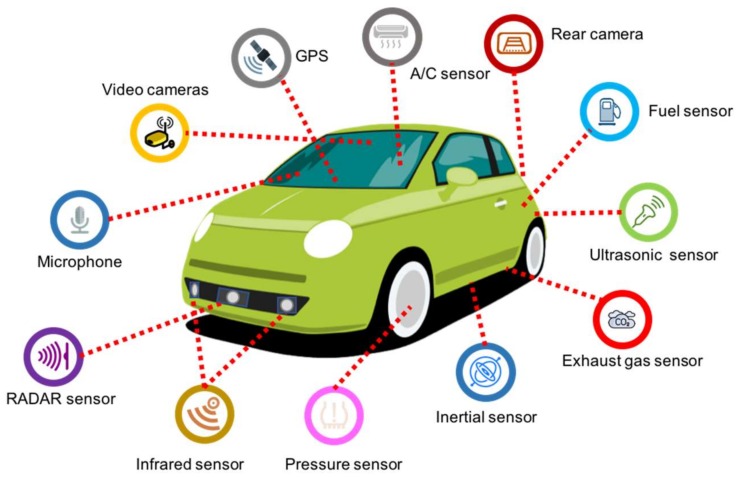
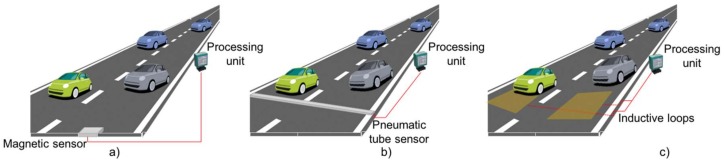
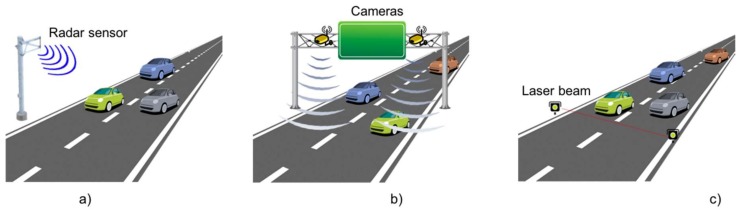
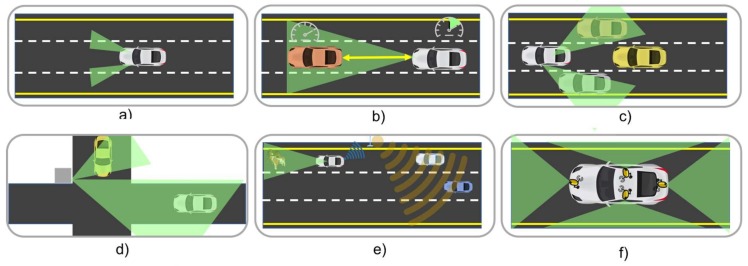
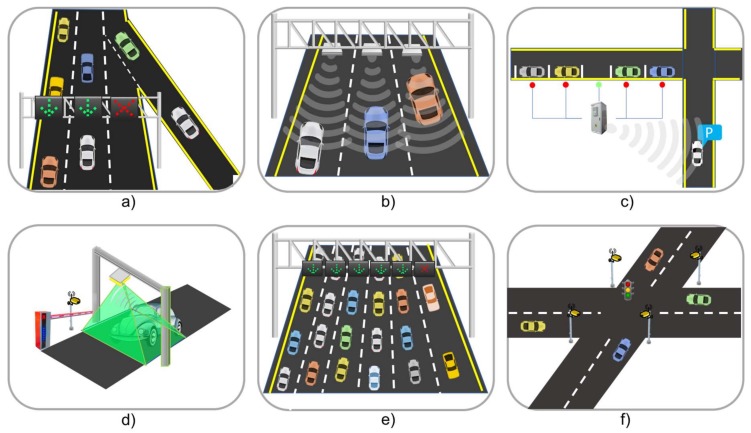
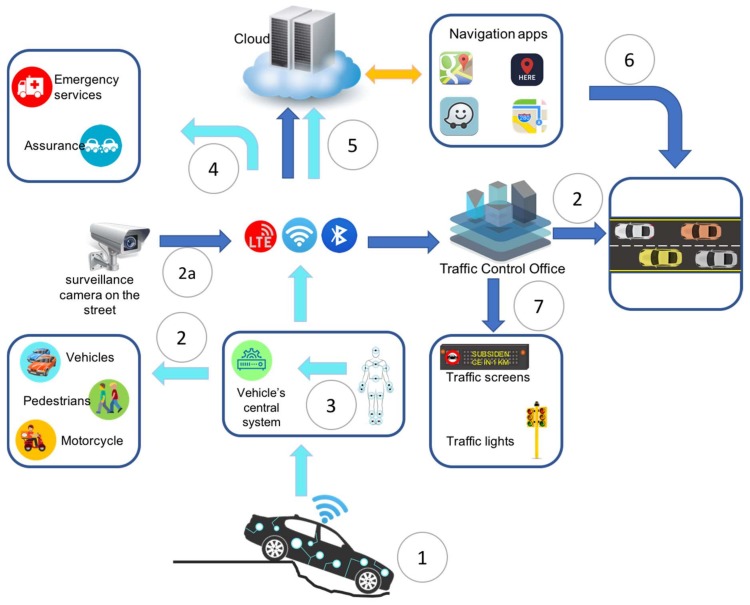
Modern society faces serious problems with transportation systems, including but not limited to traffic congestion, safety, and pollution. Information communication technologies have gained increasing attention and importance in modern transportation systems. Automotive manufacturers are developing in-vehicle sensors and their applications in different areas including safety, traffic management, and infotainment. Government institutions are implementing roadside infrastructures such as cameras and sensors to collect data about environmental and traffic conditions. By seamlessly integrating vehicles and sensing devices, their sensing and communication capabilities can be leveraged to achieve smart and intelligent transportation systems. We discuss how sensor technology can be integrated with the transportation infrastructure to achieve a sustainable Intelligent Transportation System (ITS) and how safety, traffic control and infotainment applications can benefit from multiple sensors deployed in different elements of an ITS. Finally, we discuss some of the challenges that need to be addressed to enable a fully operational and cooperative ITS environment.
Overview
The claims and statistics of this paper haven’t been checked yet.
Free: it reads the open-access text and checks the first 5 claims that cite a source we can check. Create a free account to check every claim.
Integrity signals
Registry
Cites
Statistics
Figures



Verification
Claims the paper makes
The claims and statistics of this paper haven’t been checked yet.
Free: it reads the open-access text and checks the first 5 claims that cite a source we can check. Create a free account to check every claim.
Self-check
Percentages, sums and reported differences re-computed from the paper’s own numbers.
The self-check needs the paper’s full text.
Citations
Cites
Pan, S. J., & Yang, Q. (2010) · IEEE Transactions on Knowledge and Data Engineering · doi:10.1109/tkde.2009.191 · Cited by 23,387
Data-Driven Intelligent Transportation Systems: A Survey
Zhang, J., Wang, F.-Y., Wang, K., Lin, W.-H., Xu, X., & Chen, C. (2011) · IEEE Transactions on Intelligent Transportation Systems · doi:10.1109/tits.2011.2158001 · Cited by 1,817 · cited 1×
“Even though sensors can generate relevant data of transportation systems, the use of additional tools, such as machine learning and data fusion, can generate more data to increase ITS performance, using applications that learn transportation behavior from real-time and historical data [106].”
BackgroundA Review of Data Fusion Techniques
Castanedo, F. (2013) · The Scientific World Journal · doi:10.1155/2013/704504 · Cited by 1,027
Internet of Vehicles: Architecture, Protocols, and Security
Contreras-Castillo, J., Zeadally, S., & Guerrero-Ibanez, J. A. (2018) · IEEE Internet of Things Journal · doi:10.1109/jiot.2017.2690902 · Cited by 744
Self-citationMultisensor fusion and integration: approaches, applications, and future research directions
Luo, R. C., Yih, C.-C., & Su, K. L. (2002) · IEEE Sensors Journal · doi:10.1109/jsen.2002.1000251 · Cited by 620
Guerrero-ibanez, J. A., Zeadally, S., & Contreras-Castillo, J. (2015) · IEEE Wireless Communications · doi:10.1109/mwc.2015.7368833 · Cited by 517
Self-citationSensor fusion potential exploitation-innovative architectures and illustrative applications
Dasarathy, B. V. (1997) · Proceedings of the IEEE · doi:10.1109/5.554206 · Cited by 498
Cooperative Intersection Management: A Survey
Chen, L., & Englund, C. (2016) · IEEE Transactions on Intelligent Transportation Systems · doi:10.1109/tits.2015.2471812 · Cited by 488
VeMAC: A TDMA-Based MAC Protocol for Reliable Broadcast in VANETs
Omar, H. A., Zhuang, W., & Li, L. (2013) · IEEE Transactions on Mobile Computing · doi:10.1109/tmc.2012.142 · Cited by 474
PPCA-Based Missing Data Imputation for Traffic Flow Volume: A Systematical Approach
Qu, L., Hu, J., Li, L., & Zhang, Y. (2009) · IEEE Transactions on Intelligent Transportation Systems · doi:10.1109/tits.2009.2026312 · Cited by 441
Research works printed but not linked: 2
- Durrant-Whyte, H.F., and Stevens, M. (2001, January 7–10). Data fusion in decentralized sensing networks. Proceedings of the 4th International Conference on Information Fusion, Montreal, QC, Canada.
- Manyika, J., and Durrant-Whyte, H. (1995). Data Fusion and Sensor Management: A Decentralized Information-Theoretic Approach, Prentice Hall.
Cited by
Machine learning: Algorithms, real-world applications and research directions
Sarker, I. H. (2021) · SN Computer Science · doi:10.1007/s42979-021-00592-x · Cited by 5,583
IoT in smart cities: A survey of technologies, practices and challenges
Syed, A. S., Sierra-Sosa, D., Kumar, A., & Elmaghraby, A. (2021) · Smart Cities · doi:10.3390/smartcities4020024 · Cited by 527
Automotive LiDAR Technology: A Survey
Roriz, R., Cabral, J., & Gomes, T. (2022) · IEEE Transactions on Intelligent Transportation Systems · doi:10.1109/tits.2021.3086804 · Cited by 442
Energy Harvesting Techniques for Internet of Things (IoT)
Sanislav, T., Mois, G. D., Zeadally, S., & Folea, S. C. (2021) · IEEE Access · doi:10.1109/access.2021.3064066 · Cited by 410
Self-citationDesign architectures for energy harvesting in the Internet of Things
Zeadally, S., Shaikh, F. K., Talpur, A., & Sheng, Q. Z. (2020) · Renewable and Sustainable Energy Reviews · doi:10.1016/j.rser.2020.109901 · Cited by 318
Self-citation
Metadata
- Authors
- Guerrero-Ibáñez, J., Zeadally, S., & Contreras-Castillo, J.
- Affiliations
- Faculty of Telematics, University of Colima, 333 University Avenue, Colima C.P. 28040, Mexico
- University of Kentucky (US)
- Universidad de Colima (MX)
- Corresponding author
- Contreras-Castillo, Juan
- Venue
- Sensors
- Publisher
- MDPI AG
- Published
- 2018-04-16
- Volume
- 18
- Issue
- 4
- Pages
- 1212
- ISSN
- 1424-8220 (ISSN-L)
- PMC
- PMC5948625
- OpenAlex
- W2802574842
- Cited by
- 637
- References
- 95
- Citations by year
- 2026: 33 · 2025: 82 · 2024: 111 · 2023: 107 · 2022: 99 · 2021: 91 · 2020: 76 · 2019: 33 · 2018: 5
- FWCI
- 16.15
- Type
- journal article
- Language
- en
- Open access
- gold
- doi.org
- Licence
- Locations
- Sensors (publishedVersion, cc-by)
- Europe PMC (PubMed Central) (publishedVersion, cc-by)
- PubMed Central (publishedVersion, cc-by)
- PubMed (publishedVersion)
- UKnowledge (University of Kentucky) (submittedVersion, cc-by)
- DOAJ (DOAJ: Directory of Open Access Journals) (submittedVersion, cc-by-sa)
- Funders
- National Highway Traffic Safety Administration
- Topics
- Physical Sciences › Engineering › Civil and Structural Engineering › Road Transport and Highway Systems
- Physical Sciences › Engineering › Automotive Engineering › Autonomous Vehicle Technology and Safety
- Physical Sciences › Engineering › Electrical and Electronic Engineering › Vehicular Ad Hoc Networks (VANETs)
- Keywords
- intelligent transportation systems, in-vehicle sensors, roadside sensors, traffic congestion, road safety, infotainment, traffic management, vehicle-to-infrastructure communication, sensor integration, sustainable transport, cooperative intelligent transport systems
About these checks
Registry, retraction, Cites and statistics results are computed, not judged, with one exception: a printed reference that no index lists is read once by a model before it counts as a citation error. Claims are extracted by a model and kept only when their quote appears verbatim in the text; each cited source is then checked, with a model’s help, for whether it says what the claim relies on. Those verdicts can be wrong — read the claim’s quote and the cited source before relying on one.
Statistics and arithmetic are recomputed, not judged.
Confidence bands are shown only for fields calibrated on our annotated test set. None is calibrated yet, so no band is shown.
What counts as a claim ›How we measure confidence ›How we check this ›
Are you an author, or do you see a problem with this page? Request a review
How to cite
Cite CoChat for the checks on this page, and the paper for its own findings.
- This page
- CoChat. (2026). Citation check: Sensor Technologies for Intelligent Transportation Systems. https://app.cochat.ai/papers/10.3390/s18041212
- The paper
- Guerrero-Ibáñez, J., Zeadally, S., & Contreras-Castillo, J. (2018). Sensor Technologies for Intelligent Transportation Systems. Sensors. https://doi.org/10.3390/s18041212
Data sources
Bibliographic data: Semantic Scholar, OpenAlex, Crossref.
Contains information from the Semantic Scholar Academic Graph Datasets, made available under the ODC Attribution License (ODC-BY 1.0).
Semantic Scholar’s data is described in: Kinney, R., et al. (2023). The Semantic Scholar Open Data Platform. arXiv:2301.10140.
